Why I’m convinced Obama is on course for a second term.

My column predicting an Obama victory from today’s Evening Herald   
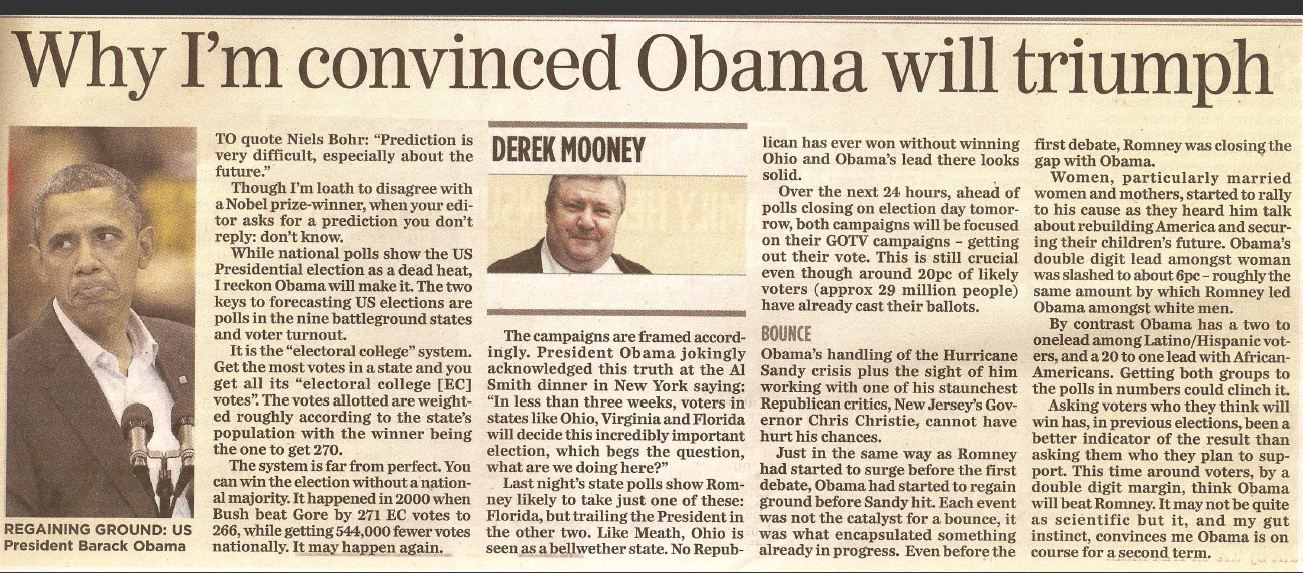
My Herald Column Calling The Election For Obama


To quote Niels Bohr: “Prediction is very difficult, especially about the future.” Though I’m loathe to disagree with a Nobel prize-winner, when your editor asks for a prediction you don’t reply: don’t know.

While national polls show the US Presidential election as a dead heat, I reckon Obama will make it. The two keys to forecasting US elections are polls in the nine battleground states and voter turnout.

It is the “electoral college” system. Get the most votes in a State and you get all its “electoral college [EC] votes”. The votes allotted are weighted roughly according to the States population with the winner being the one to get 270.

The system is far from perfect. You can win the election without a national majority. It happened in 2000 when Bush beat Gore by 271 EC votes to 266, while getting 544,000 fewer votes nationally. It may happen again this time.

The campaigns are framed accordingly. President Obama jokingly acknowledged this truth at the Al Smith dinner in New York saying: “In less than three weeks, voters in states like Ohio, Virginia and Florida will decide this incredibly important election, which begs the question, what are we doing here?”

Last night’s State polls show Romney likely to take just one of these: Florida, but trailing the President in the other two. Like Meath, Ohio is seen as a bellwether state. No Republican has ever won without winning Ohio and Obama’s lead there looks solid.

Over the next 24 hours, ahead of polls closing on election day tomorrow, both campaigns will be focussed on their GOTV campaigns – getting out their vote. This is still crucial even though around 20% of likely voters (approx 29 million people) have already cast their ballots.

Obama’s handling of the Hurricane Sandy crisis plus the sight of him working with one of his staunchest Republican critics: New Jersey’s Gov Chris Christie cannot have hurt his chances.

Just in the same way as Romney had started to surge before the first debate, Obama had started to regain ground before Sandy hit. Each event was not the catalyst for a bounce it was what encapsulated something already in progress.

Even before the first debate Romney was closing the gap with Obama, particularly with women voters. The Obama campaign had spent millions over the Summer on TV ads portraying Romney as an aloof, remote right winger, using his own words from the primaries to indict him. The Republican convention and Romney’s selection of arch fiscal conservative, Paul Ryan, as his running mate did not help dispel the image.

But as soon as he hit the campaign trail proper Romney eased his message. Gone was the tea-party rhetoric that won him the nomination: in its place the more emollient, stern but fair tone that had made him a moderate Governor.

Women, particularly married women and mothers, started to rally to his cause as they heard him talk about rebuilding America and securing their children’s future. Obama’s double digit lead amongst woman was slashed to about 6%. This is roughly the same amount by which Romney led Obama amongst white men.

By contrast Obama has a 2 to 1 lead among Latino/Hispanic voters, an increasingly important constituency, and a 20 to 1 lead with African-Americans. Getting both groups to the polls in numbers could clinch it for him.

I could go on quoting polls of other groups. Under 35s, veterans, middle class etc, but let me close with a slightly more bit quirky one. Asking voters who they think will win has, in previous elections, been seen to be a better indicator of an election result than asking them who they plan to support.

This time around voters, by a double digit margin, think Obama will beat Romney. It may not be quite as scientific but it, and my gut instinct, convinces me Obama is on course for a second term.

ENDS
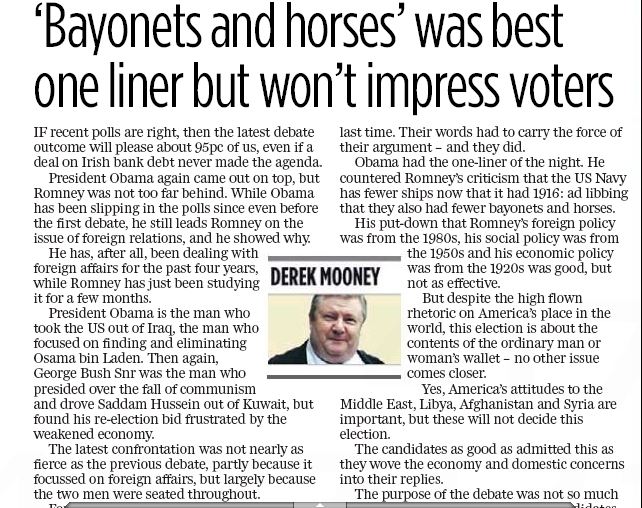
“Bayonets and horses” one-liner wins debate for Obama, but will it impress voters

My take on the third and final presidential debate between President Barack Obama and Gov Mitt Romney, from tonight;s Evening Herald.  The print edition features an abridged version of the full piece below.


If recent polls are right then last night’s presidential debate outcome will please about 95% of us, even if a deal on Irish bank debt never made the agenda!

Derek Mooney column as it appeared in print version

In their third encounter President Obama again came out on top, but Romney was not too far behind. While Obama has been slipping in the polls since even before the first debate, he still leads Romney on the issue of foreign relations and he showed why last night.

He has, after all, been dealing with foreign affairs for the past four years, while Romney has just been studying it for the past few months. President Obama is the man who took the US out of Iraq, the man who focused on finding and eliminating of Bin Ladin. Then again George Bush I was the man who presided over the fall of communism and drove Saddam Hussein out of Kuwait, but found his re-election bid frustrated by the weakened economy.

Last night’s confrontation was not nearly as fierce as the previous debate, partly because it focussed on foreign affairs, but largely because the two men were seated throughout.

For this rsason their individual body language was not as noticeable as it had been last time. Their words had to carry the force of their argument – and they did. Both went on the attack – Obama attacked Romney’s grasp of the issues, while Romney dismissed the President’s foreign policy record as faltering.

Obama had the one-liner of the night. He countered Romney’s criticism that the US Navy has fewer ships now that it had 1916: ad libbing that they also had fewer bayonets and horses. Obama’s prepared put down saying that Romney’s foreign policy was from the 80s, his social policy was from the 50s and his economic policy was from the 20s was good, but not as effective.

The reality that dare not speak its name last night is the fact that foreign relations is not nearly as important as everyone likes to pretend.

Despite the high flown rhetoric from both on America’s place in the world, this election is about the contents of the ordinary man or woman’s wallet – no other issue comes closer.

Yes, America’s attitudes to the Middle East, Libya, Afghanistan and Syria are important, but these will not decide the outcome of this election, jobs and living standards will.

The two candidates as good as admitted this as they wove the economy and domestic concerns into their replies. The purpose of the debate was not so much to debate foreign policy, but to see how both candidates could handle complex issues.

As with the past two debates the role of the moderator was almost as important as the performances of the two contenders. Across the three debates it has had something of a Goldilocks quality to it. In the first Jim Lehrer was judged to have taken a bit of a back seat. Candy Crowley, the moderator of the second debate was accused of taking too big a role in the encounter, framing supplementary questions and, most notably, pulling up Gov Romney on his alleged misquoting of the President.

If Lehrer and Crowley had made the presidential porridge too cold or too hot, last night’s moderator, veteran news man Bob Schieffer, worked to get the balance just right. Schieffer was more forceful than his close friend Lehrer in enforcing the agreed rules, but was less interventionist than Crowley.

Most american commentators agree that these have been the most exciting debates in decades, but they have not done much to reduce the numbers of undecided voters.

As in previos elections the debates have envigorated those whi have already decided who they will support. The battle for undecideds will be won or lost on the ground in a handful of states, particularly Ohio.

The outcome of this election will be tight, the next fortnight will be fraught.

ENDS.

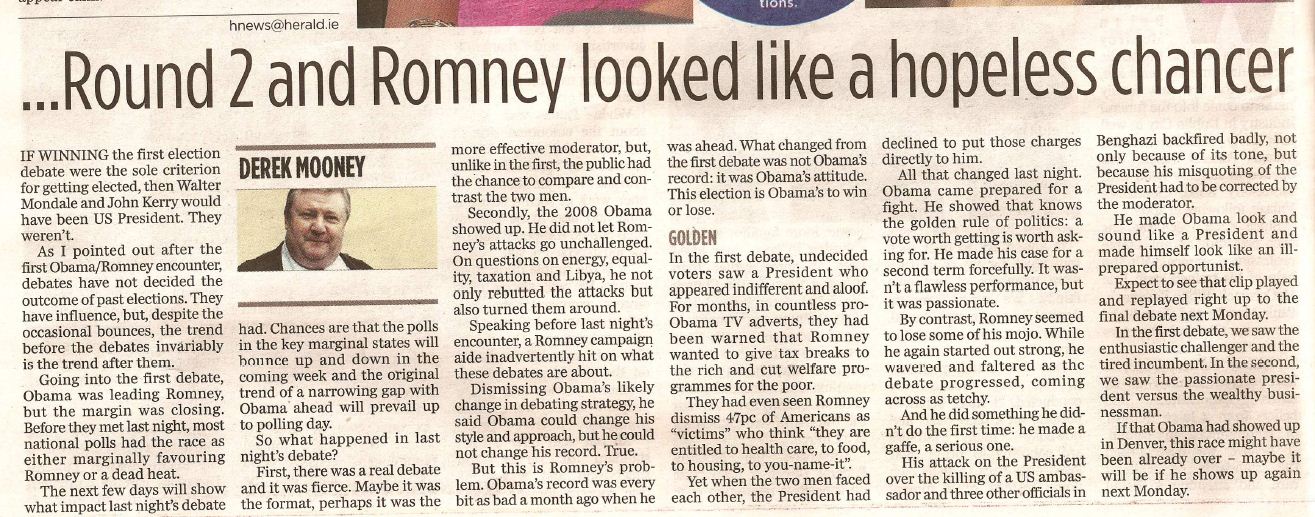
Round 2 and Romney looked like a hopeless chancer

My analysis of the Second Obama Vs Romney debate from tonight’s Evening Herald

——————————————————————————————————————————————————————————-

My Evening Herald Column

If winning the first election debate were the sole criteria for getting elected then Walter Mondale and John Kerry would have been President. They were not.

As I pointed out after the first Obama/ Romney encounter, debates have not decided the outcome of past elections. They are influencers but, despite the occasional bounces, the trend before the debates invariably is the trend after them.

Going into the first debate Obama was leading Romney but the margin was closing. Before they met last night most national polls had the race as either marginally favouring Romney or a dead heat.

The next few days will show what impact last night’s debate had. Chances are that the polls in the key marginal States will bounce up and down in the coming week and the original trend of a narrowing gap with Obama ahead will prevail up to polling day.

So, what happened in last night’s debate?

Firstly, there was a real debate and it was fierce. Maybe it was the format, perhaps it the more effective moderator, but unlike the first the public had the chance to compare and contrast the two men, especially when they clashed directly – and they certainly did that.

Secondly, the 2008 Obama showed up. He did not let Romney’s attacks go unchallenged. On questions on energy, equality, taxation and Libya he not only rebutted the attacks he turned them back on him.

Speaking before last night’s encounter one of Romney’s own campaign aides inadvertently hit on what these debates are about. Pre-emptively dismissing Obama’s likely change in debating strategy, he said Obama could change his style and approach, but he cannot change his record. True.

But this is the Romney campaign’s problem. Obama’s record was every bit as bad a month ago when he was ahead.  What changed at the first debate was not Obama’s record: it was Obama’s attitude. This election is Obama’s to win or lose.

At the previous debate undecided voters saw a President who appeared indifferent and aloof. For months, in countless pro-Obama TV adverts, they had been warned that Romney wanted to give tax breaks to the rich and cut welfare programs for the poor.

They had even seen Romney dismiss 47% of Americans as “victims” who think “they are entitled to health care, to food, to housing, to you-name-it.”

Yet, when the two men faced each other the President had refused to put those charges directly to him. Worse still, Obama came across as being every bit as ineffectual as the pro Romney ads had claimed.

All that changed last night

Obama came prepared for a fight. He showed that knows the golden rule of politics: a vote is worth getting is worth asking for. He made his case for a second forcefully. It was not a flawless performance, but it was passionate.

By contrast, Romney seemed to lose some of his mojo. While he again started out strong, he did waiver and falter as the debate progressed, coming across as tetchy as he argued with the moderator over the rules and time allowed.

But he did something he didn’t do the first time: he made a gaffe, a serious one. His attack on the President over the killing of the American Ambassador and three other officials in Benghazi backfired badly, not only because of its tone but because his misquoting of the President had to be corrected by the moderator.

He made Obama look and sound like a President and made himself look like an ill prepared political opportunist.

Expect to see that clip played and replayed on TV and the internet right up to the final debate on foreign policy next Monday.

In the first debate we saw the enthusiastic challenger and the tired incumbent. In the second we saw the passionate President versus the wealthy businessman.

If that Obama had showed up in Denver, this race might have been over already – maybe it will be if he shows up gain next Monday.


Obama lost first TV battle – but he’s still on course to win the war

My analysis of Wednesday night’s US Presidential Debate from tonight’s Evening Herald (Oct 4th 2012) .

—————————————————————————————————————-

Before last night’s Obama/Romney debate the American political rulebook said that debates do not swing elections. While the debates can give a candidate a short term bounce, the trend after the debates tends to be the same as the trend before them.

Sesame Street
Obama never mentioned Romney’s infamous 47%, though it seems Big Bird and pals are part of it.

Without a doubt Romney had a good night. But nothing happened in Denver to change the political rulebook. While commentators, especially the network TV ones, like to think that TV debates swing elections, the reality is that they haven’t.

Yes, there have been some incidents like President Bush Sr’s constant looking at his watch at the 1992 debate or President Ford’s assertion in the 1976 debate against Jimmy Carter that eastern Europe was not dominated by the USSR, but none of these reversed the course of the elections.

Bush Sr had started to lose ground to Clinton before the debate. Ford was trailing Carter badly by the time they debated. Indeed Ford only agreed to the debate because he was behind. Though we think these TV debates have been the norm in the US since the famous Nixon/Kennedy debates of 1960, the 1976 Carter/ Ford one was the first in 16 years.

Presidential debates by their nature tend to favour the challenger. The format raises the challenger’s status presenting the two candidates as equals. The challenger can put the President on the back foot by going on the attack and picking apart the incumbent’s record.

That is what Romney did last night, and he did it effectively.

While the current race is relatively tight, the polls have favoured Obama since before the summer. As with Carter in 1980 the Democrats should be in trouble. Polling suggests that Americans believe their country is on the wrong track by a margin of almost 20%. Optimism is on the decline. Only 43% of middle class Americans expect that their children’s standard of living will be better than their own. This compares to 51% four years ago.

These numbers should be poison for Obama and the Democrats and make the election a slam dunk for the Republicans, except the same Americans either do not understand or do not believe the alternative vision offered by Romney.

Romney’s people know this. He went into last night’s debate with a mission to change American’s views of him. He did himself some good in that regard. He not only went on the attack on Obama’s record he also scored several points in denying the Democrats portrayal of him as a tax cutter for the rich. The issue for him is that he did this at the expense of discussing the details of his alternative.

Perhaps his position behind Obama convinced him that he had nothing to lose with this approach, but the other risk for Romney is that his lurch to the centre may mean leaving some right wing voters at home?

In contrast, Obama seemed aloof and remote. He was reluctant to attack and take Romney on directly. This may have been a deliberate tactic. His people may have felt that scrapping and politicking with Romney wouldn’t look Presidential – he never mentioned Romney’s 47% remarks even once – however, it also meant that he allowed several very answerable attacks on his record go unchallenged.

While Romney didn’t land a knock out blow, he did win in terms of punches landed. He also did well in terms of appearance and body language, he dominated the debate. These things matter. This is television after all. We get as much information from what we see as what we hear.

Arguably the real impact these debates will have will be down to the clips the TV news shows choose to use in the coming days, though neither man gave a hostage to fortune.  The late night comics will have fun with Romney’s threat to cut public funding for PBS and Big Bird, but I don’t see last night’s rather boring exchanges as switching anyone’s vote.

Romney may have won the debate – but I reckon he will still lose the election

ENDS

Obama lost first TV battle – but he’s still on course to win the war

My analysis of Wednesday night’s US Presidential Debate from tonight’s Evening Herald (Oct 4th 2012) .

—————————————————————————————————————-

Before last night’s Obama/Romney debate the American political rulebook said that debates do not swing elections. While the debates can give a candidate a short term bounce, the trend after the debates tends to be the same as the trend before them.

Sesame Street
Obama never mentioned Romney’s infamous 47%, though it seems Big Bird and pals are part of it.

Without a doubt Romney had a good night. But nothing happened in Denver to change the political rulebook. While commentators, especially the network TV ones, like to think that TV debates swing elections, the reality is that they haven’t.

Yes, there have been some incidents like President Bush Sr’s constant looking at his watch at the 1992 debate or President Ford’s assertion in the 1976 debate against Jimmy Carter that eastern Europe was not dominated by the USSR, but none of these reversed the course of the elections.

Bush Sr had started to lose ground to Clinton before the debate. Ford was trailing Carter badly by the time they debated. Indeed Ford only agreed to the debate because he was behind. Though we think these TV debates have been the norm in the US since the famous Nixon/Kennedy debates of 1960, the 1976 Carter/ Ford one was the first in 16 years.

Presidential debates by their nature tend to favour the challenger. The format raises the challenger’s status presenting the two candidates as equals. The challenger can put the President on the back foot by going on the attack and picking apart the incumbent’s record.

That is what Romney did last night, and he did it effectively.

While the current race is relatively tight, the polls have favoured Obama since before the summer. As with Carter in 1980 the Democrats should be in trouble. Polling suggests that Americans believe their country is on the wrong track by a margin of almost 20%. Optimism is on the decline. Only 43% of middle class Americans expect that their children’s standard of living will be better than their own. This compares to 51% four years ago.

These numbers should be poison for Obama and the Democrats and make the election a slam dunk for the Republicans, except the same Americans either do not understand or do not believe the alternative vision offered by Romney.

Romney’s people know this. He went into last night’s debate with a mission to change American’s views of him. He did himself some good in that regard. He not only went on the attack on Obama’s record he also scored several points in denying the Democrats portrayal of him as a tax cutter for the rich. The issue for him is that he did this at the expense of discussing the details of his alternative.

Perhaps his position behind Obama convinced him that he had nothing to lose with this approach, but the other risk for Romney is that his lurch to the centre may mean leaving some right wing voters at home?

In contrast, Obama seemed aloof and remote. He was reluctant to attack and take Romney on directly. This may have been a deliberate tactic. His people may have felt that scrapping and politicking with Romney wouldn’t look Presidential – he never mentioned Romney’s 47% remarks even once – however, it also meant that he allowed several very answerable attacks on his record go unchallenged.

While Romney didn’t land a knock out blow, he did win in terms of punches landed. He also did well in terms of appearance and body language, he dominated the debate. These things matter. This is television after all. We get as much information from what we see as what we hear.

Arguably the real impact these debates will have will be down to the clips the TV news shows choose to use in the coming days, though neither man gave a hostage to fortune.  The late night comics will have fun with Romney’s threat to cut public funding for PBS and Big Bird, but I don’t see last night’s rather boring exchanges as switching anyone’s vote.

Romney may have won the debate – but I reckon he will still lose the election

ENDS

Coalition Junior Partners Come Off Worse Eventually

My column from Thursday’s Evening Herald (27/Sept/2012)  on Eamon Gilmore’s travails following Dep Roisín Shortall’s resignation.

________________________________________________________________________________________________________________

Who would want to be the leader of the Labour party today? No doubt Éamon Gilmore still does, though perhaps with a little less relish than he exuded last Monday when he was sitting cheerfully behind me on the early morning flight to Brussels.

Former Labour Party Leader
The late Frank Cluskey – took a principled stand on Dublin Gas

While the dip in Labour’s fortunes revealed in the previous day’s RedC poll may not have demonstrably dampened his ardour, last night’s dramatic resignation by Roisín Shortall will.

Eighteen months in office and he is looking like the Mr Worthing character in the “Importance of Being Earnest:”: losing  one Junior Minister, may be regarded as a misfortune; to lose two looks like carelessness.

But isn’t this what happens to the smaller party in Government? When they get into battles with the larger party, don’t they usually come out the worst?

A quick glance at the history of coalitions and it would appear otherwise.

The electoral reality is that going into office costs the smaller party seats at the next election. It takes the bigger risk and, in return, gets a say in policy above its Dáil strength.

That’s the deal. Both partners they know they need the other. It is not for eternity, maybe not even for the full five years of the term, but each knows that without the other neither would in power. unless one sees an alternative, in which case the balance is disturbed.

I served in two Fianna Fáil led coalitions featuring feisty junior partners: the Greens and the Progressive Democrats. While there were the occasional stand-offs, indeed one partly led to my departure, these were the exception to the rule.

Coalition work and last where there is a well negotiated and defined programme for government around which they can agree.

Naturally, where there are two distinct parties with their own hinterlands and approaches, there will be tensions. In my experience these were confined to issues not specifically covered in the Programme for Government or those thrown up by unexpected events.

The other main source of disruptions were the interventions from senior figures, just outside of government, in the smaller party who saw themselves as the conscience of their party, Dan Boyle was particular master of this dark art. While the major partner was usually the main target of these outbursts they were just as often designed to embarrass, irk and provoke their own ministers.

While deeply frustrating, these things came with the territory.  The larger party in a coalition knows it needs the smaller one to stay in office. While it can never allow itself to be seen as a pushover, it also knew that the smaller party could not stay long in office if their members felt there were being used as a mudguard.

This is what makes Roisin Shortall’s resignation so significant. Unlike most ministerial resignations this was about policy. Yes, there are personality and political dimensions too, but essentially this is about adherence to the programme for government.

Her departure is reminiscent of the late Frank Cluskey’s 1983 resignation from Cabinet not only because it too was about policy, but also thanks to the increasing number of comparisons been drawn between both administrations’ handling of the economic problems facing them.

But, as with most parallels, it is not a perfect one. While his departure was a protest against Fine Gael’s stance on Dublin Gas, Shortall’s resignation is just as much about her own parties role in government as it is about Minister Reilly’s capacity to run a department.

When Frank Cluskey quit he made it clear that he did not expect other labour ministers to follow him out and bring down that government. There was no hint that he had lost any confidence in his colleagues. The feeling was mutual. At the meeting following his resignation he reportedly received a lengthy standing ovation from his parliamentary colleagues. Can Deputy Shortall expect to be cheered to the rafters by messers Quinn, Howlin, Gilmore and Rabbitte when they next week? I doubt it.

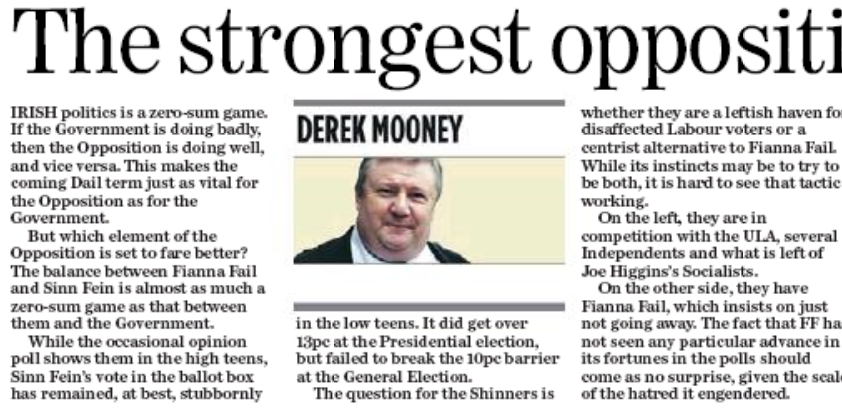
The Strongest Opposition may be within the coalition itself

The text of my column from tonight’s Evening Herald (Mon Sept 17th)

—————————————-

Irish politics is a zero sum game. If the government is doing badly; then the opposition is doing well, and vice versa.

Derek Mooney’s Column in tonight’s Evening Herald

This makes the coming Dáil term just as vital for the opposition as for the government.

But which element of the opposition is set to fare better? The balance between Fianna Fáil and Sinn Féin is almost as much a zero sum game as that between them and the government.

While the occasional opinion poll shows them in the high teens, Sinn Féin’s vote in the ballot box has remained, at best, stubbornly in the low teens. It did get over 13% at the Presidential election, but failed to break the 10% barrier at the General Election.

The question for the Shinners is whether they are a leftish haven for disaffected Labour voters or a centrist alternative to Fianna Fáil. While its instincts may be to try to do both, it is hard to see that tactic working.

On the left they are in competition with the ULA, several Independents and what is left of Joe Higgin’s Socialists.

On the other side they have Fianna Fáil, which insists on just not going away. The fact that FF has not seen any particular advance in its fortunes in the polls should come as no surprise given the scale of the hatred it engendered.

The past 18 months has been about Fianna Fáil stabilising its position. It has put a floor under its decline, which was no small task. The issue now is if it can recover former ground.

While FF may skirmish with SF over ex FF voters who went to Labour, the main battle will be fought elsewhere and with another enemy. Surveys suggest that up to 40% of those who said they voted FF in 2007 switched to FG in 2011.

This sizeable group are still angry and hurt. They have not been ready to listen to Fianna Fáil so far. Will they become disenchanted over the coming months with Enda Kenny and Fine Gael as it struggles to deliver on its election promises?

Will this be sufficient? Will the disenchantment be enough to allow them to listen to anything the party has to say, never mind be convinced by it? These are questions taxing Fianna Fail reps at their think in today and tomorrow.

The opposition parties and independents will also need to consider the competition they face from the emerging, and varied, opposition within government.

It ranges from Brian Hayes and Joan Burton’s fighting over pensioners to FG backbenchers bemoaning its failure to take on the public sector.

The greatest challenge, though, may come from within the Labour Party. There seems to be something about becoming chairman of the smaller party in government that makes the holder think they are the deputy leader of the opposition. I call it “Dan Boyle Syndrome”.

As a first time Deputy; sitting on the government backbenches; the new Labour Chairman may gaze longingly at the other side of the Dáil wishing he were there opposing and criticising the current Government, but he isn’t.

The public gets the difference between government and opposition. They understand the fundamental truth of Mario Cuomo’s famous maxim: “you campaign in poetry but you govern in prose”.

If he thinks doing solo runs will firewall him from the approaching barrage of criticism and unpopularity, then he is in for a nasty surprise. All he needs to do is Google “Dan Boyle” and “election results” to see how these tactics failed.

FG and Lab TDs would do well to heed the words of Mary Harney: “Even the worst day in government is better than the best day in opposition”. This may seem unlikely, but it is the case, especially if you believe politics is about improving things.

If they doubt it, then they only need call the Marine Hotel and ask any Fianna Fáil TD.

ENDS

Dan Boyle Syndrome

What is it about the position of chairman of the smaller party in government that makes them think they are the deputy leader of the opposition?

Labour’s parliamentary party chairman, Colm Keaveney is not a wet day in the job and already he is showing signs of the delusion.

Labour: In government or opposition?

He disowns government actions and policies like a member of the opposition while enjoying the privileges perks and access that being in office bring.

I call it “Dan Boyle Syndrome”. While the avuncular Cork man was not the first to exhibit the symptom, the condition reached such a virulent pitch during his time as the Green party chairman that he came to define the condition.

The most noted previous sufferer of the condition, one Michael McDowell, did occasionally present with chronic symptoms, including a slight political tourettes, but seemed to affect a recovery.

It is like a form of “Stockholm Syndrome”. In that; the subject comes to identify and sympathise with their captor, In “Dan Boyle Syndrome” the person loses any sympathy or attachment to their partners and projects themselves into the role of in-house opposition.

Deputy Keaveney’s angry reaction to the

latest round of health cuts, suggesting that it could precipitate an early election may have uttered with the intention of convincing the public that he was still on their side, but it only served to suggest that he still does not understand how government works.

Rather than convincing his voters that he is still on their side, they want him to convince his senior colleagues in government to start taking measures

The public is not impressed by politicians repeating their own concerns back to them. They want their representatives to reflect their views to those in authority, not reflect them back to those who hold them like a possessed hall of mirrors.

The public get the difference between government and opposition. They understand the fundamental truth of Mario Cuomo’s famous maxim: “you campaign in poetry but you govern in prose”.

Doubtless Deputy Keaveney is getting a lot of hassle and criticism from people he meets on the street. As a first time Deputy; sitting on the government backbenches; he may gaze longingly at the Fianna Fáil benches wishing he were there opposing and criticising the tough and unpopular choices that government brings, but he would do well to remember the words of Mary Harney: “Even the worst day in government was better than the best day in opposition”.

Though it may not seem like it to Deputy Keaveney now, Harney’s counsel is right, but only if you believe politics is about changing things and improving society.

Having worked in government and opposition, I know and understand the strains and pressures of both. I am not totally unsympathetic to Deputy Keaveny’s plight, but being sympathetic is not the same as supportive.

If he seriously believes that he will firewall himself and his party colleagues from the approaching barrage of criticism and unpopularity, then he is in for a bad surprise.

Just google “Dan Boyle” and “election results” and he will see how his tactics failed. While other Greens, like Trevor Sargent and Eamon Ryan saw their vote collapse by between 40% and 50% last year, Boyle’s already low vote (he had lost his Dáil seat in 2007) dropped by almost 70%.

If Deputy Keaveney truly finds it impossible to reconcile the platform he was elected upon with the policies his party is pursuing in office then he can follow the example of his three former colleagues: Willie Penrose, Tommy Broughan and Patrick Nulty and resign the Labour whip in the Dáil.

They were not the only three Oireachtas members elected on a labour ticket missing from the five star Carton House think in. as reported here last Wednesday, three Labour senators also stayed away.

A sign to Deputy Keaveney, perhaps, that if he still around next year he may be chairing an even smaller gathering.

ENDS

Intriguing insight into the worklife of Minister Quinn

My column from today’s Evening Herald on Monday night’s RTE 1 #backtoschool documentary “Inside the Department” – a fly on the wall look at life in Education Minister, Ruairi Quinn’s office. 

——————————————————————————

There are times when you despair at how little choice of TV viewing there appears to be on the domestic channels.

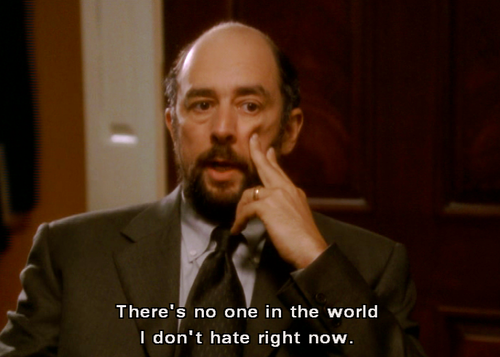
Wesht Wing?
The West Wing’s Toby Ziegler….. not a young Ruairi Quinn TD

Last night was not one of those nights.

You could watch the fly on the wall documentary “Inside the Department” on RTE1 or the latest incarnation of Dallas on TV3.

What a choice. A programme about power, jealousy, feuding, lust, carnality, sumptuous offices, driving ambition, back stabbing, expense accounts and flash cars….. or you could watch JR and Bobby stare it out on Dallas.

As an ex ministerial adviser, I opted for the former and watched “Inside the Department”. Indeed, I not only watched it, I recorded it and watched it a second time.

This was not due to my not believing what I had seen the first time, but rather as a means of catching on the second viewing any gems or nuggets of information I missed on the first viewing.  I needn’t have bothered.

As a PR colleague from the North observed on Twitter last night: like all bad ideas making this documentary probably looked like a good one at the time.

That is not to say it was a bad idea for the producers, far from it. It was interesting programme. The problem is that it did not achieve its goal. It was less a look “inside the department” and more a look at Ruairi Quinn and his kitchen cabinet.

And what a kitchen cabinet it is. I think I counted five of them around a table at one point. When I was a special adviser at the Department of Defence there was just the two of us: me and the Minister’s press adviser. Even so, the then Fine Gael and Labour opposition told us we were over staffed

But even they, notwithstanding their numbers, failed to note that the title of the programme was “Inside the Department” and not “Inside the West Wing”.

They also forgot that they are there as servants of the Minister, not as players. Their role is to aid and assist the minister in implementing government policy. This is work you can best do silently and discreetly.

What possessed them to agree to do interviews to camera and offer what were, in my opinion, smug and ill-considered running commentaries on the events of the day?

Worse still, how did they allow themselves and their Minister to talk so loosely on camera about “summoning” Minister Rabbitte over to the northside and being “wary” of  the planned “off the record” meeting with Rabbitte and a delegation of Labour TDs?

As Minister Quinn said during the programme itself, we all make mistakes, I know that only too well myself, but having such a discussion on camera shows naivety at best.

On the broader front, I got the sense that the neither Minister nor the advisers were ever arguing the public’s side during any discussions: either on the Déis schools or reductions in teacher numbers.

It is called “going native”. It was the accusation that stuck to the last administration after 14 years in office. It is the impression that Ministers and advisers are there to represent and present the policy of the bureaucracy, not the voters.

While it took us the guts of 14 years to that that way, these guys seems to have achieved it in as many weeks.

Listening to them talk and interact with the officials it is almost impossible to believe that they had ever been in opposition. It was if they had no problems with the existing policy and saw it merely as their role to guarantee its seamless and uncritical transmission to the public, with the odd kick at Fianna Fáil thrown in to remind them that this lot is different.

Yes, there were the clips of Ruairi calling the Department “malevolently dysfunction” back in 2010, but where did we see it reflected in his discussion with his officials?

Rather than coming across as our representatives in Government, they came across as the system’s front men to us, more concerned with presentation than substance.

Perhaps the documentary caught the mood of the place accurately, but as someone who believes in the benefits of the adviser system, I sincerely hope it didn’t.

ENDS

It’s petty settling these old scores incognito Chris

My column on the Chris Andrews Twittergate fiasco from today’s (Mon August 13th 2012) Evening Herald

Anonymous Tweets

I am not exactly sure how I feel about Chris Andrews today. I have known him personally for over 25 years. We are near contemporaries. I have campaigned alongside him and, on a couple of occasions, for him. He managed to so something I repeatedly failed to do: to get elected.

In his case that meant serving as a Dublin City Councillor and a TD for the Dublin South East constituency. His defeat in the great Fianna Fáil wipeout of February 2011 was not a reflection on his work as a local representative.

He came closer than many to hanging on in a constituency that has not be traditional FF territory. His work rate meant that the tide which engulfed him was not nearly as severe as that which washed away so many others.

For these reasons I feel sorry to see him exit politics.

But there is another side too. Like many of his friends and supporters I am deeply angered by the report in yesterday’s Sunday Independent of his antics in setting up a fake twitter account to attack Fianna Fáil.

This anger is twofold. It is an anger at his actions and his attempts to glorify them by presenting himself now as some victim, but it is also an anger at his betrayal of the trust of supporters and colleagues, like me.

No matter how much he may seek to convince himself otherwise, Chris is no victim.

He is no principled dissenter or critic being silenced out by an intolerant leadership. His actions were petty and self serving. He hid behind a fake account (@brianfornerFF) and sniped at perceived political rivals in the hope of bringing them down and advancing himself.

I engaged with his fake persona on Twitter a few times, mistakenly believing it what that of a disillusioned young member. After a few exchanges I quickly realised that it was nothing of the sort, though I never suspected it was Chris.

There was nothing noble or admirable in his comments, Most were just bitchy and sneering rants at colleagues. The only “political” thread in his exchanges with me was his expressed disdain for political dynasties, a little ironic now given the source.

The comical point in all of this is that the real Chris Andrews and I were exchanging messages on twitter at the same time as the fake tweets.

I, like others, had become an audiences for Chris’s one man performance of his own “Philadelphia Here I Come”. Unlike Friel’s “Gar Public” and “Gar Private” his were not the inner and outer voices of the same person, one expanding upon and setting the context for the utterances of the other.

Quite the opposite. While “official Chris” publicly expressed support and praise for the party “Continuity Chris” was lashing out at those seeking to reform and rebuild. He did occasionally take pot shots at the leadership and senior figures, but his targets were mainly local.

It was all a game, and a pointless one at that.

There was no great point of principle at stake here. His attacks and indeed his departure was not about the party’s stand on the Fiscal Treaty Referendum, no more than it was about its support of Gay marriage or a reformed Seanad.

This was about high politics or the future, it was about low politics and the past. It was about settling old scores and doing it out of sight, hidden behind a screen.

It was about the worst of the old politics, which makes his parting shot, his suggestion that dissent and criticism is not tolerated in FF, all the more galling.

Because of his age, his location and indeed his background Chris was uniquely placed to play a part in crafting and determining whatever future Fianna Fáil may have. The pity is that he rejected that opportunity – it did not reject him. This is what makes me both sad and angry.