
Last Thursday’s Irish Times/Ipsos poll findings left many people wondering why Fine Gael had suffered such a big drop in support (-4%).
The publication of the second half of the poll’s findings, a day later, offered an answer. It showed that voters would much prefer to see more money spent on improving public services and infrastructure than on tax cuts.
Only 13% of 35 – 49-year-olds (which at 19% is Fine Gael’s strongest voting cohort – though only just) want to see the government surplus used for tax cuts compared to 24% who want to see the surplus used to improve public services such as health and education or 39% who want to see it used to build infrastructure such as public transport, housing, hospitals, and schools. The ratios are very similar across other age groups.
This is a firm rebuke to the recent Fine Gael junior minister wheeze on €1000 tax cuts. The falling Fine Gael support also adds fuel to the pyre being stealthily built under Leo Varadkar’s leadership. Despite stories across three of last weekend’s Sunday newspapers of mounting discontent with Leo’s continued leadership, the pyre is not yet ready to be lit.
That may well change after we see the shape of the new constituencies… but more on that later.
It’s an ill wind that blows no-one any good. The Irish Times report brought the first good polling news for Fianna Fáil-ers in several months.
Fianna Fáil TDs – but especially Councillors – will be relieved to see the party pull ahead of Fine Gael. After months… if not years… of being told that their own party polls were showing that everything is going swimmingly, elected reps will be cheered to see a well-regarded poll echoing those sentiments (no offence meant to B&A/Sunday Times).
At the risk of seeming like a killjoy, it should still be noted that this result is below what the party got at the last general election, and that was the second worst performance by the party.
It is also 6% points below the party’s 2019 local election result (which was 27%). So, even on this figure the party could be facing losing between a fifth and a quarter of its approx. 270 council seats.
Nonetheless, Fianna Fáil TDs and Councillors will be hoping that this signals a permanent return to party support levels in the low 20s. The fact that this increase potentially comes at the expense of both Fine Gael and Sinn Féin will not cause them any distress or bother. They know that the recent Fine Gael tax cut campaign was an attempt to gazump them, and they will be sanguine about it back-firing on Leo and Co.
But while the focus has – unsurprisingly – been on the falling support for both Sinn Féin and Fine Gael, we should pay greater attention to another important finding in the Irish Times poll. A figure that brings equally bad tidings for both and Fianna Fáil and Fine Gael.
I refer to the government’s 34% satisfaction rating – a 4% drop on the 38% secured in the last Irish Times poll. Fine Gael is this government’s greatest burden, though you won’t see any mention of this fact in last Thursday’s Irish Times OpEd which bizarrely hails Fine Gael as “the main government party” … really?!
Back in 2012, one of Fianna Fáil’s top posters told me that government satisfaction/ approval was the key number to look at in Ipsos polls. He was arguing then that the seeds of the Fine Gael/Labour government’s later collapse had already been shown when it’s government satisfaction rating was well below the combined support for the two parties.
Assuming this rule of thumbs still applies, then both Fianna Fáil and Fine Gael must carefully consider their next steps. Will Leo Varadkar heed the lesson of this poll? Will he realise that his offer tax cuts are out of kilter with what wavering Fine Gael voters want? Or will he bet on his political instincts and double down on a policy that has his personal brand all over it?
I suspect – based on the belief that past performance is the best predictor of future action – that he will do the latter. The one thing of which we can be absolutely certain is that neither he nor his entourage will consider the fate or future of anyone outside of their immediate Fine Gael circle.
We now have a Taoiseach who is first and foremost pre-occupied with his own political position and is showing no desire to be either the chairman of chief of the whole of government.
Boundary Reviews:
Earlier I referred to the influence which the new constituency boundaries may have on events in Fine Gael… but also in, and between, other parties. These new boundaries will be unveiled when the new Electoral Commission publishes its report in August.
I would highly recommend a search through the submissions made to the Electoral Commission – all of which are now available to read online. While many are of the “I’d like my county to be a standalone three -seater” variety, there are many well argued, and well researched pieces .
A good starting point is the comprehensive submission from Maynooth University’s Dr Adrian Kavanagh. Adrian is a veteran of these exercises and he had helpfully published his previous submissions online.
But I would also urge you to check out the detailed submission from the Theoretical Physics Student Association in Trinity College Dublin. This submission has been crafted by a crew of top rank data analysts. It is a deep dive into the provisional census figures, that is also informed by previous consistency boundary reports. The result is a thoroughly comprehensive piece of work.
The fact that they have avoided making suggestions for both Dublin and Cork points to their political nous. They have recognised that it is hard to construct a purely statistical argument in urban centres where your knowledge of the geography and historical associations of communities is limited.
The Oireachtas has given the Commission terms of reference that allow it to come up with a recommendation that allows the creation of anywhere between 11 and 21 additional seats.
As you leaf through the countless tables of Theoretical Physics Student Association’s submission you soon begin to realise that the figure which makes most sense is 18 TDs… i.e., a Dáil of 178 seats.
178 is the number where the variation between the TD to population rates is most easily managed and can be kept within a 5% variation across almost all constituencies.
They do not offer 178 as a recommendation, it is just the most logical conclusion one can reach after reading their submission. Indeed, the more you read through a range of the submissions, the more you realise that we will likely see at least 18 new seats in the next Dáil.
But 18 extra seats in the context of a maximum of 5 seats per constituency means some new (i.e., extra) constituencies.
Having nominated my top two recommendations for submissions to read… may I also offer my bottom two recommendations for ones to avoid. Steer clear of the official offerings from the Fine Gael and the Fianna Fáil HQs.
Both are more like commentaries than submissions, though the Fianna Fáil one has the dubious merit of being brief… and I do mean brief… it barely stretches to two pages.
The main recommendation in the Fine Gael offering is that the Commission should look at using wider variances, of up to +/-9%. It says:
“… notwithstanding the +/-5% ‘rule of thumb’, the Commission clearly has discretion with regard to the extent to which population per TD in any given constituency can vary from the national average”
Both submissions urge the Commission to respect county boundaries, with Fianna Fáil advising it to “bear in mind the importance of county boundaries in its deliberations” and to keep any breaches “minimal”.
It’s a fair point, but neither submission offer any advice or guidance where these breaches are unavoidable. There are a few cases where large town have grown to have hinterlands that cross county boundaries. One of the most dramatic examples is Drogheda and its expansion across both Louth and Meath. It is a situation where a breach of county boundaries cannot be minimal, indeed a breach here is an absolute necessity. It from places like this where the new constituencies may emerge.
Such is the growth in the population in both Louth (almost 11%) and the areas adjoining Drogheda (13%) in County Meath (i.e., in Meath East) that you could create a viable and fairly representative five seat Dáil Louth constituency that fully excludes Drogheda, or its hinterland.
Drogheda could then become the intact urban hub of a new three-seater Boyne Valley constituency that includes most of the huge tract of the commuter belt that has been created across North Meath.
Not that creating 18 new TDs will be an easy sell, especially when the range suggested a lower figure of 11.
But it is hard to escape the logic of going for the upper range and settling at least 18 when you consider that the Constitution requires a ratio of 1 TD per 20,000 to 30,000 population.
Note that the Constitution says population… not voters or citizens.
The Electoral Commission, like its recent predecessors will aim for the upper edge of this range – 1 TD per 30,000, but this is hard to achieve when you must also factor-in such other considerations contained in Section 6 of the 1997 Electoral Act which require them to respect “geographic considerations”, keeps constituencies “contiguous”, and even “maintain continuity”.
More significantly the Act also says that Dáil constituencies may only have three, four or five seats. You cannot have 6-seater constituencies under the existing law, though smaller parties have long lobbied for this to be changed.
The prospect of the biggest change in constituency boundaries, since the 1980 constituency revision (the first conducted by an independent commission) increased the number of TDs from 148 to 166, may have several government TDs (though mainly Fine Gael-ers) delaying any decisions on whether they run again or not.
Within Fianna Fáil there seems to be a sense that these new boundaries could mean most of the current crop of TDs holding on to their seats – or facing, at worst, an internal challenge from a party rival.
But – even if Fianna Fáil were to hold on to all 38 seats it won in Feb 2020, it would just be a smaller force in a bigger Dáil. It would need to win at least 5 extra seats at the next election to just keep pace. Things are not looking better for the party at local level.
From what I hear, most of the local election candidate selection conventions it has held so far have been uncontested, with only as many candidates offering as there are places to fill.
This is not a good omen.
It is true that closely contested conventions can lead to disgruntled defeated candidates and some membership discord, but that’s the price you pay for a party with strong local roots.
Fianna Fáil headquarters may hail calm conventions as a sign of a unified and satisfied party, but I see it as a stark warning that the vigour and drive that once characterised its local organisations, is going… if not already gone.
However as bad as things may now look for Martin’s Fianna Fáil, things are looking much worse for Varadkar’s faltering Fine Gael. It has lost 2 TDs so far and has several others announcing that they do not plan to seek re-election. (Eoghan Murphy resigned his seat in April 2021, and Joe McHugh resigned the party whip in July 2022 and announced that he would not run again).
Now, before anyone reminds that Sinn Féin is not noted for its contested selection conventions, and is doing ok at the polls, let me suggest that Sinn Féin may yet face this problem, albeit in reverse.
The highly centralised Sinn Féin model can only survive so long in a growing party. Its membership has been remarkably disciplined in towing the line, but they have done so in the expectation of the party achieving high office. Will that discipline and willingness to allow the party elite to decide everything survive a downturn or bad public reaction to unpopular decisions made by those elite as ministers?
Some concluding thoughts
Let me finish this column with a follow on from the closing paragraphs of my last column. In that I looked at the problems facing Fianna Fáil today and its struggle to get its support levels back into the low to mid 20s.
This is problem that needs to be considered in wider context of the contraction of what was once considered the central ground of Irish politics – Fianna Fáil and Fine Gael. and its declining level of support since
At the outset, let me accept that is a highly oversimplified model. The Irish Labour party has been more centrist than left for most of its recent history, certainly since the 1970s – so it is unfair to exclude it from the model – but I do so to emphasise a point.
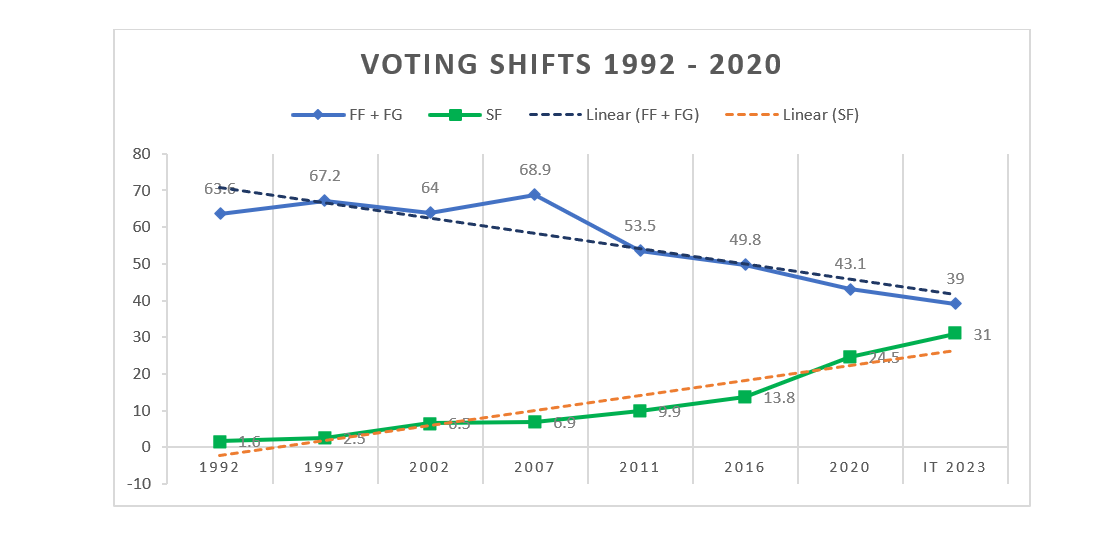
From the 1990s to the mid-2010s the combined Fianna Fáil and Fine Gael level of support was around 65-70%. That fell steeply in 2011 – but Labour was the main beneficiary. Thanks to Labour’s 2011-2016 implosion it fell again to around 50% and has been falling steadily since to 43% at the last election and is now hovering below 40% in most of the latest polls, including the latest Irish Times one.
My point here is that the centre has not gone away, it now identifies as much with Sinn Féin as it does with either Fianna Fáil or Fine Gael and I firmly believe that the approach to Sinn Féin by both parties has been a major factor in that.
My argument is not that either party should embrace Sinn Féin or consider it a coalition partner, but rather that they should – and I am talking more about Fianna Fáil here than Fine Gael – recognise that the attacks on Sinn Féin come across as attacks on its voters. Sinn Féin has sufficient policy contradictions and weaknesses, that there is no excuse for attacking them for being them?
The centre in Ireland has not shrunk or contracted from 60% to 35% of the electorate, it is moving its identity.
The direction of travel is clear… but the destination is not yet reached. Nothing is yet set in stone. The electorate is still volatile.
The question for Fianna Fáil is what does it plan to do about it? What it has been doing up to now, hasn’t worked. Why not change tack?

 derekmooney.ie
One thought on “Next Dáil will have 18 extra TDs… but how many extra will FF or FG win… I doubt it will be many…”