
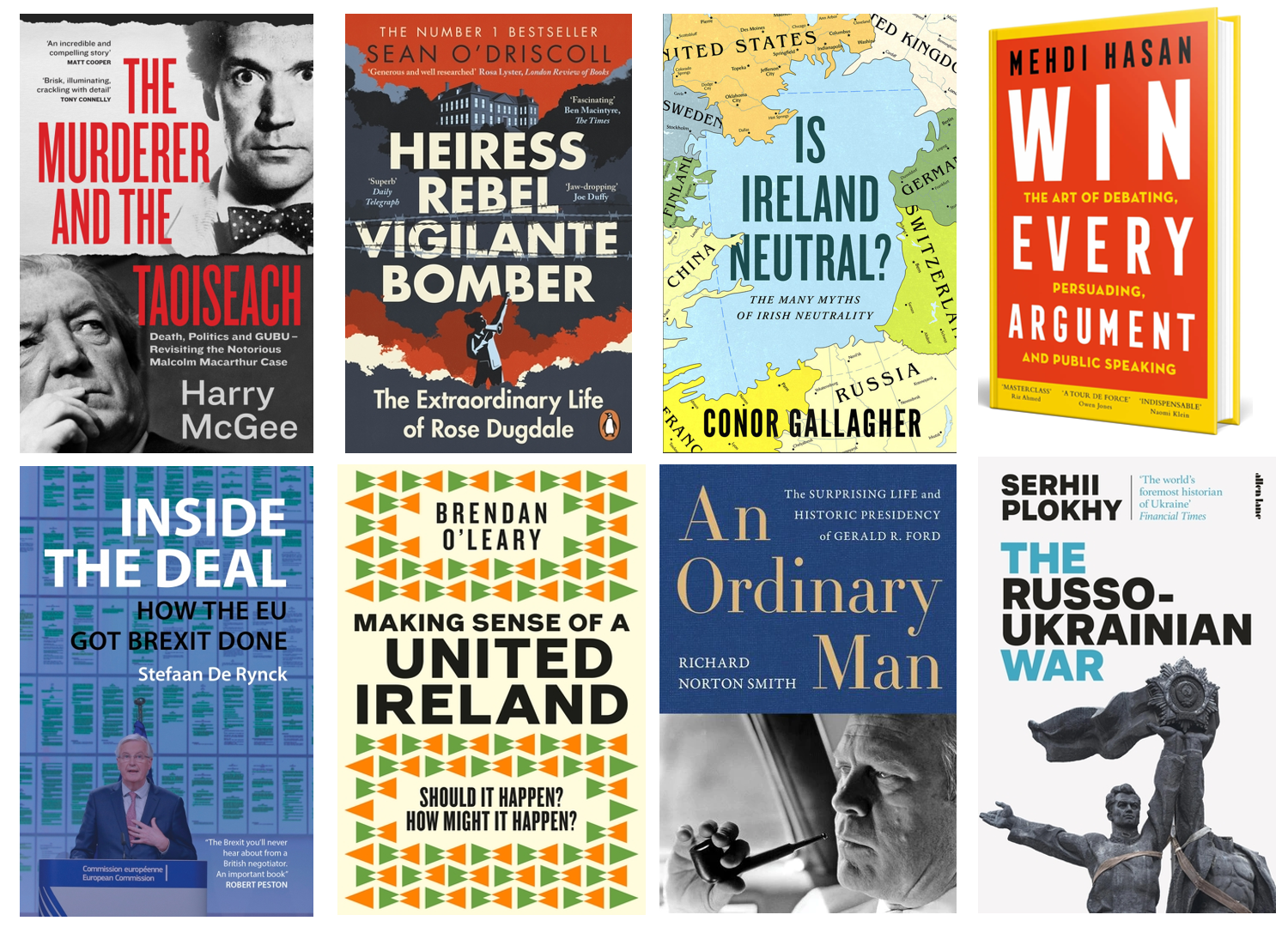

THE MURDERER AND THE TAOISEACH
by Harry McGee
While folks may know that “Gubu” has its origins in the words used by Taoiseach Charles Haughey to describe the capture of the killer of two young people in the home of the Attorney General, Patrick Connolly: grotesque, unbelievable, bizarre and unprecedented, many will not know the full story of the… well… eh… bizarre… events that led to that extraordinary Haughey press conference.
As the book’s blurb states Harry McGee expertly tells the story of the aristocratic Malcolm Macarthur and retraces the events of the hot summer of 1982, from Macarthur’s senseless cold-blooded murder of Bridie Gargan and Dónal Dunne, through the cat-and-mouse Garda manhunt to Macarthur’s eventual capture in the most unlikely of locations.
As a political journalist, McGee naturally focuses on the political implications of the scandal, which contributed to the eventual collapse of Haughey’s government. The book is laced with details, but these never get in the way of McGee’s well-paced retelling of the story.
If you want to learn more about Malcolm Macarthur the man and his fall from wealthy Dublin socialite to wannabe bank robber and cold-hearted killer, I would recommend Mark O’Connell’s A Thread Of Violence. Based largely on the author’s lengthy conversations with Macarthur, the book blurb accurately describes the result as a “haunting and insightful examination of the lies we tell ourselves—and the lengths we’ll go to preserve them.”
HEIRESS, REBEL, VIGILANTE, BOMBER
by Sean O’Driscoll
Sticking with biographies of controversial figures in Ireland, O’Driscoll’s biography of Dr Rose Dugdale is the fascinating and curious story of an English heiress turned provo volunteer.
If you watched the recent documentary series on RTÉ, the Heiress and the Heist, you would know most of the key elements of story: her need to rebel against her upbringing, her class and ultimately her country. Her desire to side with the victim while never grasping – despite her academic brilliance – that her actions created more victims.
Rather than delving into Dugdale’s acts of wanton terrorism, O’Driscoll focuses more on her life before and after prison and attempts to paint a non-judgemental, three-dimension portrait of this most complex person.
Whatever your views on Dugdale, the book is a fair and detailed of an remarkable life, even if you believe, like me, that she is not a particularly extraordinary person.
IS IRELAND NEUTRAL?
by Conor Gallagher
This is very much a personal choice. I don’t choose it because I agree with the author on all points, but rather because the book is a valuable contribution to a much-needed public debate on Irish defence policy and our role in today’s world.
The core tenet of Gallagher’s is that Ireland’s traditional policy of military neutrality is a vague, flimsy and elastic notion that Irish governments have been happy to stretch or, in some cases, abandon. I think this is an unfair characterisation, though I cannot deny there are some elements of truth to it. For too long defence has been seen as the sleeping policy dog which the department would prefer it’s minister not to kick.
The current debate on Irish defence policy is a case in point. Though I favour keeping the Triple-Lock mechanism on oversea deployments, I cannot see the point of having a high-level policy debate on defence policy when our Defence Forces is chronically under strength following a decade of political neglect. Talking about possible NATO membership when our defence capacity is on the floor smacks of hypocrisy.
Where I disagree with Gallagher is the underlying suggestion in his narrative that our policy of military neutrality must lead to us sitting back and doing nothing in the face of aggression. I believe Prof Roger McGinty offers an effective counter argument to this view by highlighting the important role for non-militarily-aligned countries who can be peace entrepreneurs.
That said, Gallagher’s book is still a welcome and timely contribution. It is both accessible and very readable and reminds us that the traditional idea of warfare is changing. It has now expanded to include cyberattacks, environmental concerns, election interference and disinformation and it is only right that we re-examine our response, both in terms of policy and the allocation of resources.
WIN EVERY ARGUMENT
by Mehdi Hasan
This is an essential read for any aspiring politician or political pundit. Written by Mehdi Hasan, a political commentator and pundit with a reputation for loving a good argument, this is a superb guide to debate, persuasion and public speaking.
Too often we see and hear our political leaders try to avoid arguments, fearful perhaps that being seen as argumentative is a negative, but Hasan makes the counter case. A good political argument, made in good faith, where there are two distinct and opposing viewpoints has intrinsic value. Arguing helps us solve problems by uncovering new ideas we might not have considered. It can also be fun where those involved have wit and where the moderator has the intelligence and cop-on to keep their interventions to a minimum.
Though Hasan offers practical advice and tried and tested tips on how to communicate with confidence, his book is a modern re-application of the ancient Greek art of Rhetoric which Aristotle defined as “the faculty of observing in any given case the available means of persuasion”.
Inside the Deal: How the EU Got Brexit Done
by Stefaan De Rynck
Just as any aspiring politician must understand the art of arguing, they must also master the related art of negotiation. Inside the Deal is a Stefaan De Rynck’ superbly written insider account of how the EU dealt with Brexit. As a close aide and adviser Michel Barnier, the EU’s chief Brexit negotiator, De Rynck was in the front row of the negotiations. He explains how possessing clear and defined objectives along with advanced planning and careful attention to detail helped the EU achieve its strategic objectives in its discussion with the British. It is a master class in how to conduct a negotiation and the importance of understanding the interests, concerns, and needs of the other party, especially when they struggle to fully understand it themselves.
MAKING SENSE OF A UNITED IRELAND
by Brendan O’Leary
I cannot put it better than Andy Pollak writing for the Dublin Review of Books: [O’Leary’s book] ‘Should be required reading for everyone – including unionists – who are interested in and concerned about the fate of this island’
O’Leary sets out his position in the opening chapters stating that the book “does not demand Irish reunification, but it does expect it, with a high degree of probability” before adding the important caveat that ‘Demography is not destiny’.
O’Leary then proceeds to consider what may happen over the next critical decade under 8 headings including: How reunification may happen; Lessons from elsewhere; the economics of reunification and how a reunified Ireland should accommodate diversity.
This is deeply serious piece of work – one that some of us believe should have been undertaken by the Irish government – but O’Leary’s near conversational prose style makes the book extremely readable. If there was just one ‘must read’ on this list… this is it.
An Ordinary Man
By Richard Norton Smith
If we think of Gerry Ford nowadays, it is often as the butt of LBJ’s infamous joke that Ford was “so dumb that he can’t fart and chew gum at the same time.” (A cruel jibe as Ford was one of the few Republican congressmen to back Lyndon Johnson’s civil rights legislation). LBJ also claimed that one of John F. Kennedy’s aides was so inept that he “wouldn’t know how to pour piss out of a boot if the instructions were printed on the heel.”
Smith has produced a detailed and favourable biography of America’s only unelected President – Ford succeeded Nixon following Watergate but had only become Vice President a few months earlier when Nixon’s elected running mate, Spiro Agnew resigned following charges of corruption and tax fraud. Smith portrays Ford as an underrated leader whose willingness to make tough decisions and personal decency look better with the passage of time.
At almost 850 pages, this is no light read. But it is vastly entertaining one as Smith chronicles many key moments in the brief Ford presidency from his handling of the post-Watergate crisis in American politics, to America’s final withdrawal from Vietnam to Ford’s embrace of economic deregulation and his support for the far sighted Helsinki Accords.
The Russo-Ukrainian War
by Serhii Plokhy
I finish off this year’s summer political reading list with what is probably the definitive book on one of the biggest crises currently facing Europe and the World, Putin’s invasion of Ukraine.
Written by the noted Ukrainian-American Harvard historian, Serhii Plokhy, this book is his considered, yet deeply personal, attempt to understand and explain the invasion to those unfamiliar with the history of Ukraine and the region. This is contemporary history written in real time by one of the foremost experts on Ukraine’s history. It offers valuable insights into the origins of the conflict and its international ramifications. At its core this book explodes the myth that Putin’s invasion is due to western provocations and portrays it as an act of old-fashioned Russian imperialism.
Not (quite) on my list, but also worth reading:
Frank and Al: FDR, Al Smith, and the Unlikely Alliance That Created the Modern Democratic Party by Terry Golway
But What Can I Do? Why Politics Has Gone So Wrong, and How You Can Help Fix It by Alastair Campbell
The Conservative Party After Brexit: Turmoil and Transformation Hardcover by Prof Tim Bale
Syria betrayed: atrocities, war, and the failure of international diplomacy by Alex J. Bellamy
The Big Con: How the Consulting Industry Weakens our Businesses, Infantilizes our Governments and Warps our Economies By Mariana Mazzucato + Rosie Collington

 derekmooney.ie