
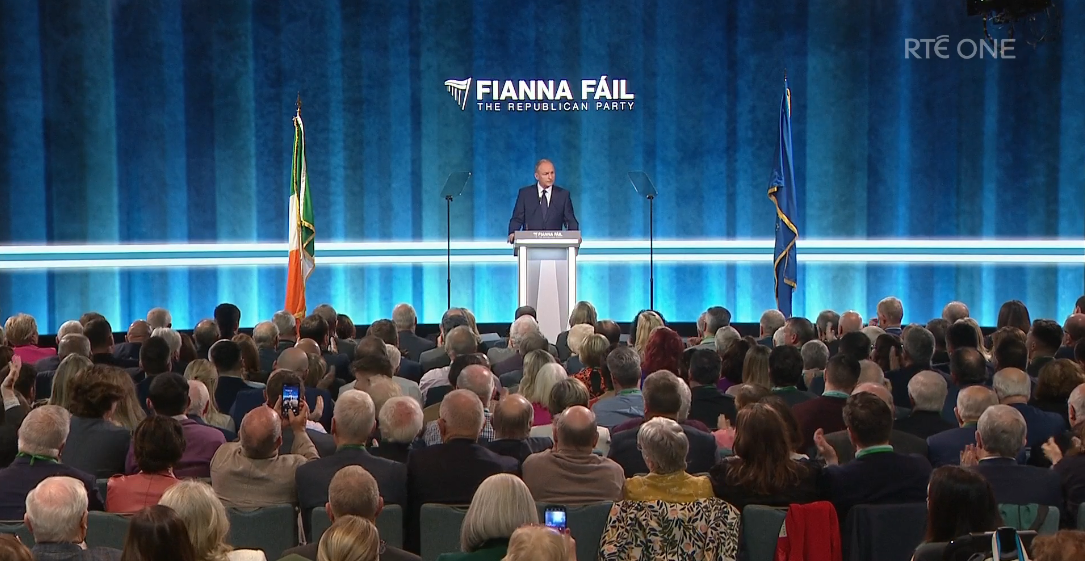
By my calculations last Saturday night’s Árd Fheis speech was Micheál Martin’s ninth as party leader. His first being at the 73ú Árd Fheis in 2012. This week’s micro-gathering was the the 81st.
Martin enters his fourteenth year* as party leader in three months. He has been unfortunate in missing out on several opportunities to address the party faithful, particularly during his time as Taoiseach.
Árd Fheis speeches matter. Though leaders now have other online platforms where they can directly address the public, they greatly cherish the half hour TV slot, once every 12 – 18 months.
Not as much as the RTÉ executives, it seems. Over the past decade they have moved to reduce this slot from one hour to just 30 minutes and moved it from primetime to early evening. Two decisions with which I would very much disagree. I am told the time shift was to cut overtime costs… and we know senior management in RTÉ have always been vigilant in keeping the wage bill down.
Most parties put considerable thought and effort into crafting the party leader’s speech. Party pollsters are consulted and some occasionally do focus groups to test their messaging.
The purpose of this polling and analysis is not to find out what your target voters want to hear and tell them that. Rather it is to test those messages to ensure that voters receive and understand them in the way you planned.
One of the big tasks in mass political communications is ensuring that what you say is what the voters hear. Testing and polling is used to eliminate the possibility of confusion or misunderstanding. What I say is not always the same thing as what you hear.
So, let me attempt to analyze this year’s speech, using some of the metrics I applied to his last one. Though I will not do a compare and contrast, as I did in October 2022.
First, let me look at Martin’s speech from the viewpoint of a speechwriter.
First the good news. This year’s script this year was an improvement on 2022’s. Though it was still overlong, his speech writing team had the wit to include some more full stops.
The bad news is that they needed more. The Hemingway App judged 40 of the 195 sentences (20.5%) in last year’s script as very difficult to understand. The score this year is a tad poorer, (20.9%) with 47 of the 225 sentences rated as very difficult to understand.
Once again Martin’s team tried to cram too much into too short a space. While RTÉ allows just under 27 minutes live TV time, when you allow for the warm-up, walk-on and final shot of a big ovation, the leader has a maximum of 24 minutes and 40 seconds speaking time.
But that assumes that the audience listens in silence. No leader wants that. So the writers must also allow 6 – 8 seconds for each burst of applause – and craft a script that includes an applause every 2 minutes, at a minimum.
Last Saturday Micheál Martin got 25 rounds of applause during his speech (this does not include the audience applause at the end, or before he started). That’s 150 seconds out of your 24m 40s allotted time – leaving the leader with just a little over 22 minutes to deliver his 3390-word script.
That is a staggering delivery rate of 150 words per minute.
It is far too much.
The delivery rate for the script as delivered, without interruptions for applause, would have been a daunting 137 words per minute. That does not allow for the audience at home, or in the hall, to grasp and fully absorb what you have just said. Particularly when many of the lines are over long.
As I pointed out last year, Nicola Sturgeon’s speaking rate in her final conference speech was a much calmer 100 words per minute. In his 2023 conference speech, the Conservative leader, and UK Prime Minister, Rishi Sunak delivered his hour-long address at a rate of 117 words per minute.
The UK Labour leader, Keir Starmer, scored a more impressive 108 words per minute for his 55-minute-long speech… even allowing for the stage invasion by that eejit with the glitter.
A lower word per minute rate allows you to adopt a more conversational style and tone. Preparing a script with this in mind allows your leader to engage in a conversation, rather than a lecture. It allows the speaker to sound more like a leader, than a múinteor.
Martin’s speech writers do him a disservice by trying to throw in everything and the kitchen sink. Cramming in too much – and I fully accept that Martin is probably the biggest culprit when it comes to not cutting back the text – makes the delivery hurried and even a bit shouty.
By trying to include too much you deny yourself the scope to let the audience respond and react to whatever key messages you have included.
As a consequence, Martin once again found himself trying to cut short the applause short. Indeed, it was interesting to see how often the Fianna Fáil membership in the hall saw some of the lines as being far more important and consequential than the leader. This was particularly evident in the sections on Republicanism, Peacekeeping and Gaza.
The loyal supporters in the room were telling him that these were the lines they most wanted to hear. But, rather than allowing these points to sink in, Martin insisting on ploughing ahead and talking across the points that were connecting best. That was a major mistake, for which Martin must accept most of the blame.
These points were – we can see from the latest Sunday Independent/Ireland Thinks poll – in tune with the majority of Irish voters.
The main image and soundbite emerging from Saturday’s Árd Fheis should have been of Martin calmly, but directly, telling a difficult truth to the Israeli government, with that country’s ambassador in the audience, along with the rest of the diplomatic corps.
When you look at the script, you can see that this was the intention. Sadly, Martin’s need to get through the script within the allotted time reduced the impact of the moment.
He needed to trust his loyal members to respond appropriately. They did. You can hear the cheers and see that some stood up expecting a sustained ovation, but most sensed Martin’s need to push on with his speech and so the moment was muted. An example of just how off kilter Martin’s political instincts can be.
This is the script, as delivered:
…Israel has a fundamental obligation to respond within the boundaries of international humanitarian law…
[Applause]
…Civilians must be protected.
The unfolding tragedy and the rising toll of lost lives and especially of children has to stop.
[Applause]
We urgently need a humanitarian ceasefire. We need all hostages to be released. And we need a significant scaling up of vital supplies for civilians and especially medical supplies.
Listen to that section. I start with one of the biggest cheers of the night, for Ireland’s Peacekeepers.
The words are spoken as written, but at such a pace as to undermine their meaning. Martin’s speechwriters got the tone and balance right. It was the speaker who got it wrong.
But the inherent difficulty in examining Martin’s script and delivery as a piece of performance is that you miss the wider perspective. Drilling down into the details of sentence structure and flow risks omitting the bigger issue of message.
What was last Saturday’s speech about?
The political editors were unsure. The Sunday Independent thought the core message was ‘Ireland must stand with Europe’ Their counterparts in the Irish Mail on Sunday thought it was that the coalition disagrees with Sinn Féin on housing. The Business Post broadly agreed with the Mail, saying the key message was that the coalition will have built 100,000 by next year.
The problem with having a shopping list style speech with a section on housing, a section on health, one on education, climate change, Northern Ireland and the Defence Forces (actually, that was not a section, but half a line and a patronising one) is that you have no core message, apart from the fact that you are still the party leader and are still in government.
On Northern Ireland, it is concerning that Martin, despite the shopping list speech, opted not address the long running impasse at Stormont. Nor to offer Ireland’s views on what might happen if the Assembly and Executive are not re-established, and if the London government attempts to impose Direct Rule.
There are times where the shopping list speech works. Party leaders, particularly when in government, need to set out their record of achievements. They are right to remind voters that they have delivered on their pre-election pledges and are worthy of retaining the voters support, but that strategy works best when you are addressing a receptive audience.
If you are doing well in the polls, then you are right to adopt a steady as she goes approach. It is a fair strategy to reassure voters that their faith and confidence in you is well deserved.
But is this the best strategy when your party is languishing anywhere between 3 and 6 percentage points below where you were when you entered government?
Is this the correct approach when voters are unsure as to what makes you different and what makes you better than the alternatives – be they in opposition or serving alongside you in office?
I think not. I am disappointed – though not entirely surprised – that Martin’s strategists went with this approach.
He does not get many opportunities to address voters uninterrupted and explain why his party is the right choice.
As I have said here, many, many times, I think the problem for Fianna Fáil is that Martin and his team do not approach things from the perspective of the leader of a major political party, but rather from that of a popular individual, a leader without a party… a parliamentary president.
As the Independent.ie’s Philip Ryan pointed out in a perceptive analysis piece on Sunday:
…the public has taken to Martin after his time as Taoiseach, with a widely held view that the older man carried himself in a more statesmanlike way than his government partner Varadkar.
But the real issue for Fianna Fáil is that Micheál Martin’s popularity has not filtered down to the rest of the party.
The last line is critical: Martin’s popularity has not filtered down to the rest of the party.
It hasn’t. Nor will it. The incessant spinning by Fianna Fáil apparatchiks, not to mention craven ministers and back benchers to the effect that Martin is Fianna Fáil’s biggest asset may result in a few nice quotes and headlines, but it cannot alter the fact that his personal likeability and popularity does not translate into votes, anywhere.
Whether you believe Fianna Fáil is currently polling at 15% (Business Post) 18% (Sunday Independent) or 20% (Irish Times), the simple fact is that Fianna Fáil support is lower today than it was at the last General Election… and its performance then its second worst ever. Take a look at the Polling Indicator .com to see how far back into third place the party has slipped… under the huge popularity of its current leader.
While Martin likes to talk about the three main parties (FF, FG and SF) being grouped together, each in the low 20’s, as he suggested to Mark Carruthers in his rather brittle BBC The View interview, almost two years of polling says otherwise.
I do not expect Martin or Varadkar to put any of this in their speeches, but I do not think it is too much to expect that political reality play some part when in crafting your message.
By the way, as I have set out here before, I do agree with Micheál Martin that the result of the next election is very far from being a foregone conclusion.
I do not think today’s polls are a predictor of the election outcome – which I increasingly believe will come sooner rather than later. I also think there is some significant scope for major shifts between the three parties.
Sinn Féin is not on some inexorable path to government. Its increase in support is no illusion and is truly impressive, but it is as much due to the failings and political missteps by the two other main parties, by Labour and others.
The relative positions of the three main parties can still change… but only if the leaderships in the two main government parties change their approach and reconnect with their supporters… and their potential voters.
This is not merely about the face on the posters but thinking that this change in fortunes will not require dramatic and radical personnel changes is naïve.
Right now, the choice facing the electorate is as depressing as it is stark.
- On one side you have Varadkar’s Fine Gael representing continuity.
- On the other you have McDonald’s Sinn Féin representing change.
This A or B, continuity or change choice suits these two parties and these two leaders, equally.
But where does Fianna Fáil sit on this scale? Is it a bit of both? A changed continuity?
I don’t see how that works, but the positive for Fianna Fáil is that our PR-STV voting system allows for other options… what sort of change… the challenge for Fianna Fáil is how it frames that. And to do this Fianna Fáil must be more associated with change.
Is Martin capable of representing change after well over a decade at the helm?
The pity is that Martin and his team squandered last Saturday’s opportunity to even begin framing that third way… and neither they, nor any of the other Fianna Fáil folks sitting around the cabinet table: McGrath, O’Brien, Foley, Donnelly or the other one… ehh… McConalogue show any signs of being able to do any better.
—-
* In the first draft I erroneously stated that he would be entering his fifteenth year. My error.

 MooneyComms