
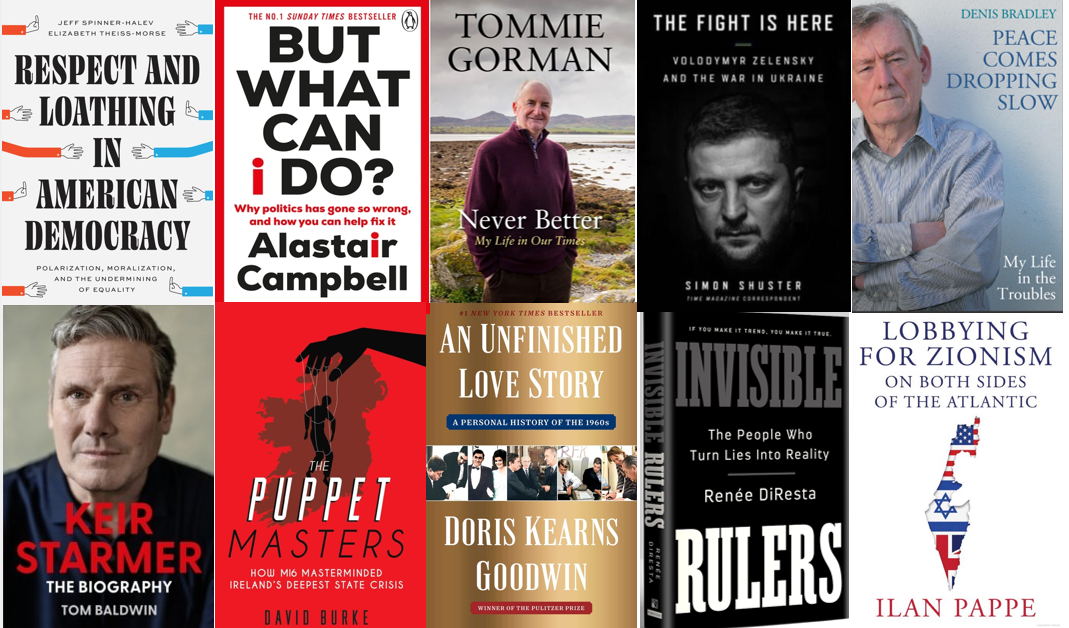
This is my 7th annual Summer political reading list. As with the ones that have gone before, the list is extremely personal. Most of the books on this year’s list have been published within the past 12-18 months. All cover broadly political topics and should (IMHO) interest to those who follow politics, be it Irish, European, American or global. The choices are mine. I have read some, not all, but these appeal to me. Some reflect my own political viewpoints, others challenge them. Feel free to add your own suggestions in the comments below. There is a Podcast to accompany this list
But What Can I Do?: Why Politics Has Gone So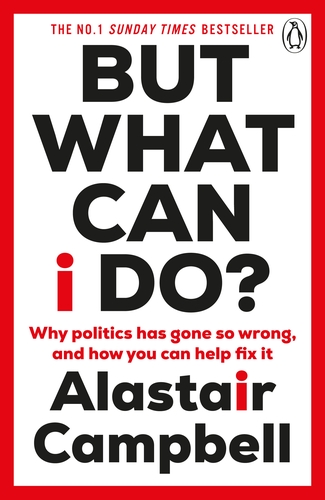 Wrong, and How You Can Help Fix It
by Alastair Campbell
As the late great Seamus Mallon often remarked, decisions are made by the people who show up. This dictum could well have served as an alternative title for Campbell’s latest book. He describes the book as part call to arms, part practical handbook… and it is.
Rather than simply bemoaning the fact that politics today is a mess… and while this book is premised on British politics being an unholy mess, it does have some resonance here in Ireland… Campell’s argument is that people can change that, but only if they engage with politics rather than turning away from it.
The seemingly cynical Campbell makes a very uncynical argument. And delivers it in three distinct sections. The first is more analytical, looking at the roots of the problem. He explores the three big issues in today’s politics; populism, polarisation and post-truth politics and sets out why political disengagement risks undermining our democracy.
Sections two and three form the practical handbook, offering guidance on how one person can make a difference in their community and the wider polity. He explains the power of the pivot, showing how, with some strategic thinking, apparent setbacks can be turned into opportunities. He also offers a route map to developing a campaign mindset and getting your message across.
If you like The Rest is Politics podcasts (though other political podcasts are available) then you will thoroughly enjoy But What Can I Do… especially if you put some of its lessons into practise and become one of the folks who shows up.
Keir Starmer: The Biography
by Tom Baldwin
There are many reasons to read this biography of the new British Prime Minister, not least of which is Andrew Rawnsley’s glowing review (from Feb 2024) which hails Tom Baldwin’s book as the “most complete portrait we have yet been offered of the upwardly mobile, working-class boy from Surrey who has gone where no member of his family had gone before – university, the bar, parliament and, almost certainly next, Downing Street.”
Rawnsley’s admiration for the book is shared by many others, with Robert Peston, Emily Maitlis and Alasdair Campbell hailing it as compelling and required reading. The author, Tom Baldwin is not totally impartial, he was after all the Labour Party’s communications director under Ed Miliband, but neither is the book a hagiography.
It can be fairly described as authoritative – but not authorised. While the (then) Labour leader gave the author consider access, he did not hand over boxes of private papers or seek control over the book’s contents. The result is highly readable and engaging account of a man whose life story and upbringing has made him a more rounded and complex person that we may have previously thought. In his review, The FT’s Robert Shrimsley said that Baldwin had “peeled back more layers than anyone else.” He has. But it is clear that there are some more layers to go before we find the defining characteristic of Starmerism… will it actually be as radical as his back story suggests?
 Peace Comes Dropping Slow: My Life in the Troubles
By Denis Bradley
While this engrossing personal memoir finally details Bradley’s pivotal role in the origins and development of the Northern Ireland peace process, it does a lot more. It reminds us that Denis Bradley is one of this island’s most unvalued and under recognised political thinkers.
Just thirty minutes in his company is a masterclass in Irish politics. So this 250+ page memoir is the equivalent of a master’s degree course in understanding how Northern Ireland moved slowly, but steadily, from a society in a violent conflict to one learning to cope with post conflict realities.
Denis, a Donegal born Derry man, recalls with great humour and self-deprecating candour how that work was done quietly via back-channel conversations and engagements.
Prof Marianne Elliott, a member of the 1992 Opsahl Commission, reviewing the book for the Irish Times in may called it a “masterly and deeply moving… no-frills account”, adding that: “Bradley’s memoir will show how there were good people throughout, who tried and often succeeded in making a difference.” A reminder that it’s the people who show up who make a difference and we are lucky that Denis Bradley did both. Highly recommend.
 Respect and Loathing in American Democracy: Polarization, Moralization, and the Undermining of Equality
By Jeff Spinner-Halev & Elizabeth Theiss-Morse
In a week that started with the shooting of Donald Trump and then moved to the naming of J D Vance as Trump’s VP candidate it seems this is a crucial time to examine why US politics has become so tribalist and polarised.
Respect and loathing is no light read. It is weighty and academic in its approach, but it is this empirical approach that makes its finding so worthwhile. The authors, University of Nebraska–Lincoln political scientist Elizabeth Theiss-Morse and her University of North Carolina colleague, Jeff Spinner-Halev, consider why partisan Democrats and Republicans moralize core beliefs to a point where it makes it impossible to respect the other side.
The book is the outcome of several years of research and some 27 focus groups of liberal and conservative voters, stretching from shortly after the 2016 US presidential election to just after the 2020 one which saw Biden beat Trump,
The authors explain how Americans hold respect as a necessary virtue, but that many voters cannot extend that respect to those who did not vote for their candidate claiming that the most uttered phrase in their focus groups was: “I can’t respect anyone who voted for…”
But while having diverse and competing ideas is a core precept of a functioning democracy, that same democracy is undermined when this comes with the price of a lack of respect for thinking differently.
As they dive deeper into these divides, they conclude that both sides equally underestimate the capacity of their opponents to share a concern for their core values – or worldviews, as they term it. For Democrats, the key worldview is social justice. But they underestimate Republicans support for it, while Republicans, in turn, underestimate Democrats real support for national solidarity, a core Republican worldview.
But worse still is how opposing partisans immediately assume that the other side is at the extreme end of the political spectrum. There is no common ground, perhaps in the same way that silo-ed and partisan news sources means there are very few commonly accepted facts? The authors conclude that rebuilding and re-enforcing civic respect is central to rebuilding American democracy.
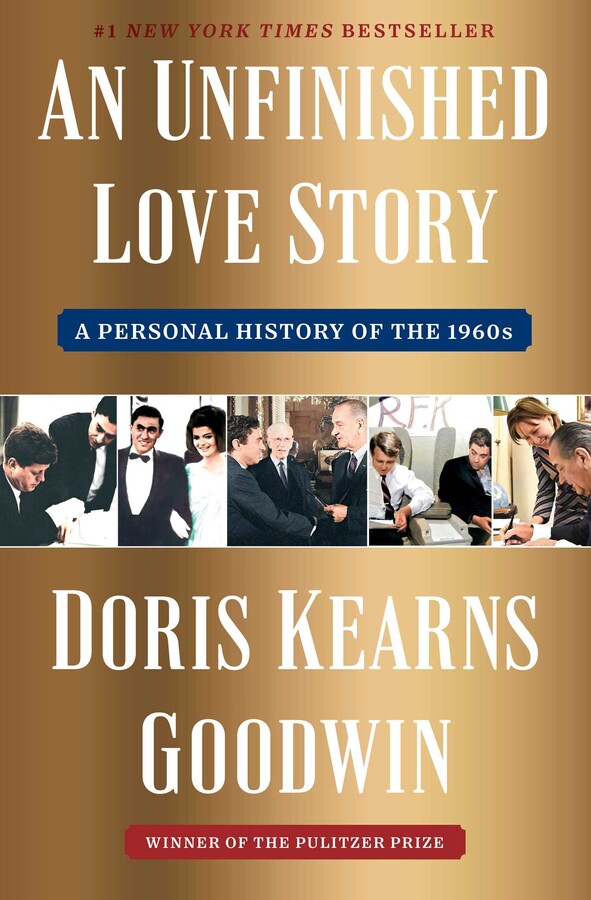 ‘An Unfinished Love Story: A Personal History of the 1960s’
By Doris Kearns Goodwin
This book is on the list as a personal indulgence, on two fronts. I am a fan of Doris Kearns Goodwin and believe she can do no wrong. Her previous works have appeared on this list. I am also a fan of President Lyndon B Johnson and see him as a flawed, but still much underrated reformer.
In this book, she looks back over the time she and her husband, Dick Goodwin, spent working closely with some of the key U.S. political figures in the 1960s and 1970s, including Lyndon Johnson, John F. Kennedy, Jacqueline Kennedy, Martin Luther King Jr., Robert Kennedy, and Eugene McCarthy. Dick Goodwin, drafted many of both JFK and LBJ’s landmark speeches, including LBJ’s famous 1964 Great Society speech. A speech offering a radical vision for social reform that would make both Trump and Vance, wince.
The book itself, was started shortly before Dick’s death in 2018, and born out of their exploration of Dick’s three hundred box archive of letters, diaries, documents, and memorabilia. The result is a fascinating insight into the Goodwin’s passionate and competing loyalties to JFK or LBJ and their exploration of which President deserved more credit for the landmark legislative accomplishments of the ’60s.
 Invisible Rulers: The People Who Turn Lies Into Reality
by Renée DiResta
Renée, describes herself a student and chronicler of online adversarial abuse, describing this as the “ways that people attempt to manipulate, harass, or target others within the constantly evolving landscape of digital platforms.” It is a career that started with her involvement in a 2014 California campaign to pass a State law to raise classroom vaccination rates, following a major measles outbreak and has led to her becoming the technical research manager at the Stanford Internet Observatory.
Invisible Rulers – the title comes from a line in Edward Bernay’s 1928 book Propaganda – explains how the internet ecosystem of interconnected challenges is seeing new technologies transform old problems. Across her research she has analysed geopolitical campaigns from Russia, China, and Iran; the voting‑related rumours that fuelled the January 6 insurrection; and health misinformation and conspiracy theories pushed by domestic influencers. She is also a noted expert on online child safety issues – including, increasingly, their intersection with generative AI.
Not only does she explain and chart how malign online propagandists (including State actors) have been able to deliberately undermine belief in the fundamental legitimacy of institutions that make society work, she sets out a pathway for what can be done about it. She explains how content moderation currently works , and how it can be improved to maximize free expression while minimizing abuse. Though the subject matter is sombre, the writing style is easy and very readable. Highly recommend checking this out in print, as an eBook or an audiobook.
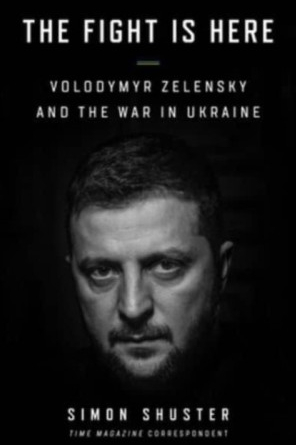 The Showman: Inside the Invasion That Shook the World and Made a Leader of Volodymyr Zelensky
by Simon Shuster
The big selling point for this biography has been the four years of seemingly open access the author, Time correspondent Simon Shuster, was given not just to Volodymyr Zelensky himself but to his inner circle of political allies and friends.
The blurb rightly hails Shuster as telling the intimate and revealing story of the president’s evolution from a slapstick actor to a symbol of resilience. This is true. The book offers readers a solid and frank understanding of Zelensky as a wartime leader and as a committed Ukrainian.
While it is probably true that the definitive Zelensky biography has yet to be written, until it is, Shuster’s considerable work serves a fair and well documented assessment of one of the most significant global figures of this decade.
Shuster explains Zelensky’s own Russian connections, not just a Russian-speaker from the central Ukrainian city of Kryvyi Rih, but his immense fame success in Ukraine and Russia during his entertainment career, with nearly 85% of the profits from Zelensky’s media empire coming from the Russian market pre-2014.
Shuster quotes Zelensky say that he “…saw the hollowness of (Russia’s) excuse for violence, because he knew there were no threats to his rights as a Russian speaker in Ukraine, certainly none that might require any intervention from the Kremlin.”
Similarly, Zelensky’s 2019 presidential election win “exposed the hollowness of Putin’s lies about Ukraine” with Zelensky winning nearly 90% of the vote in the eastern parts of Ukraine that Putin says are part of the ‘Russian world’. “It took the victory of a Russian-speaking Jew from Kryvyi Rih to show that Putin’s theories about Ukraine were not only false but ridiculous.”
 Lobbying for Zionism on Both Sides of the Atlantic
by Ilan Pappe
I was hoping to find a book that would help me better understand what is happening in Gaza and in Israel. I looked at some Netanyahu biographies, but most focus on his scandal plagued career, offering no great insight into the beleaguered and tarnished Israeli leader.
I was tempted to include Guy Ziv’s Jan 2024 book Netanyahu vs The Generals: The Battle for Israel’s Future, which offers a detailed analysis of the on-going tension between Netanyahu and the heads of Israel’s security services, the Defence Forces, the Mossad, and the Shin Bet, but was dissuaded by a colleague more familiar with the region.
He suggested Ilan Pappe’s meticulously researched and forcefully argued work on how lobby groups funded by the Israeli state pushed for unprecedented military aid, recognition of unlawfully occupied territories and the erasure of Palestinian rights. Pappe, an Israeli historian, and professor of history at the University of Exeter asks why a militarily strong and technologically advanced state, as Israel undoubtedly is, still perceives itself as not being wholly legitimate, while Western governments – and very many of its neighbours – now embrace it?
To use Pappe’s own words from the preface: “why do Israel’s elites still think its legitimacy is up for debate in Britain and the United States,” and the book sets about offering one assumption and three hypotheses in answer to this question.
Lobbying for Zionism shows us how a dangerous consensus was built – and how it might be dismantled.
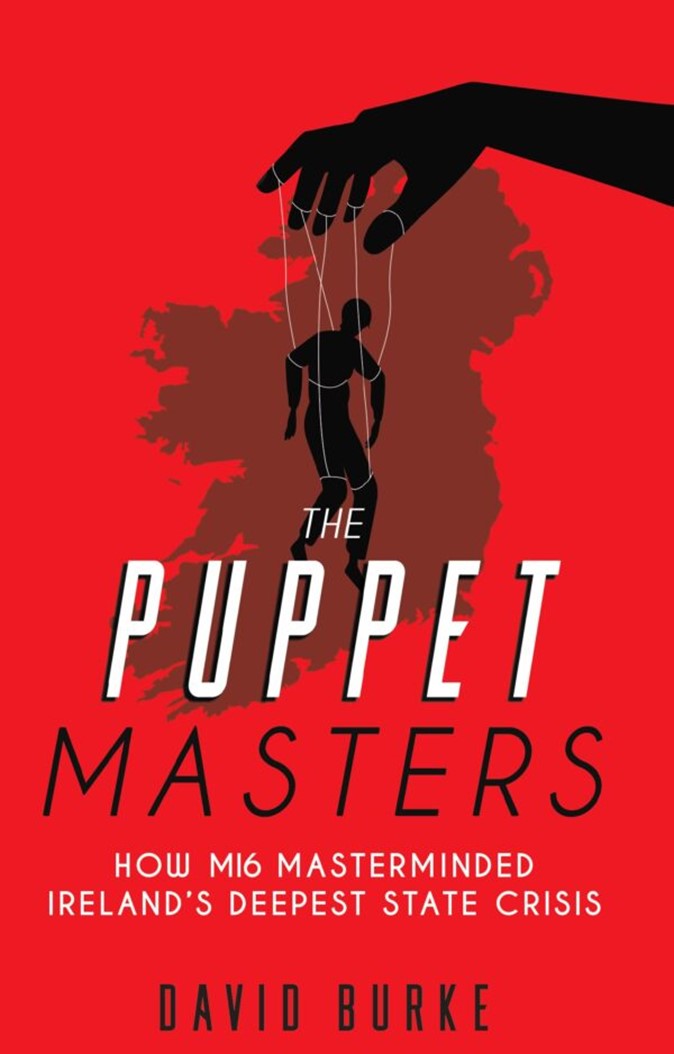 The Puppet Masters
by David Burke,
In this page turner, David Burke uncovers the clandestine activities of Patrick Crinnion, a Garda intelligence officer who secretly served MI6 during the early years of the Troubles. As the Garda Síochána launched a manhunt for the Chief-of-Staff of the IRA, Crinnion found himself playing a crucial role in the effort to track him down.
Before his disappearance, Crinnion’s actions exposed a web of secrets including those of another British spy in the Irish police, damaging intelligence leaks, gunrunning by Irish politicians, and a cover-up related to the murder of a Garda. Burke reveals MI6’s shady dealings, from attempts to smear Irish politicians to plans for using criminals as assassins and the secret surveillance of a key IRA member. Crinnion fled into exile. The Puppet Masters not only reveals what became of him but also provides an insightful look into a turbulent period marked by covert operations, betrayal, and the power struggle that shaped modern Irish history.
 Never Better: My Life in Our Times
By Tommie Gorman
Though I usually include books published over the past 12-18 months, this is a worthy exception. The title “never better” comes from his characteristically optimistic response to queries after his health following his 1994 cancer diagnosis. At its heart it is the story of a life lived to the full, where difficulty and hardship was rarely far away, but never allowed to get in the way.
Tommie writes with passion and sincerity. He revels in being a journalist, so his book is more a compulsive retelling of a journalist’s stories, than the gripping story of a journalist. This is not biography, though it contains plenty of personal and biographical details. He offers vivid insights into his childhood upbringing and how he lived with neuroendocrinal tumours for almost 30-years.
But Tommie is mainly the narrator, not the story. The result is pacey 350-page account of his time covering key events in Belfast, Brussels, London, and Dublin that is highly informative, but rarely judgemental. He offers insights into what has happening behind the scenes that tells you a lot about the politics of the time and place. But he avoids the pitfalls (maybe to the reader’s disappointment) of revealing the gossip that likely came his way. He also avoids questioning or challenging the motives of the political figures who path he crossed, from Arlene Foster to Gerry Adams and from Boris Johnson to Padraig Flynn.
Also worth considering:
- Chip War: The Fight for the World’s Most Critical Technology by Chris Miller
- Why Politics Fails: The Five Traps of the Modern World & How to Escape Them by
- Ben Ansell
and finally…
- Ten Years To Save The West: Lessons from the only conservative in the room by Liz Truss
Liz Truss… seriously? Eh no… the only reason I included this one is to reference the great Groucho Marx quote: this is not a book to be lightly tossed aside… it should be hurled with great force.
Enjoy the summer

 derekmooney.ie