
This article is an accompaniment to my recent Podcast episode entitled: “Shouting match or democracy? Dáil speaking time furore”. In this article I expand on some of my comments in the podcast, focusing on Sinn Féin’s tactics. I suggest that the aggressive approach to this issue from the Shinners stems from its comfort in being in situations of crisis and chaos and further add that this all stems from Sinn Féin struggling to reclaim some pre-eminence in Irish politics after its false dawn at the last general election
One of the soundest political lessons I even heard came from the late, great Ben Briscoe. It was back in the late 1990s now, not long before my disastrous 1999 local election run.
It happened in Leinster House. I was there to meet up with Ben before attending a public meeting with him in Crumlin, at 8.00pm. We met in Ben’s office on the 4th floor of the five Storey block, and after a short chat we headed down to his car, which was parked at the back of Leinster lawn.
As we turned to exit Leinster House, Ben looked up to the live Dail Chamber monitor to a colleague from another party speaking in a debate. Ben nudged me and jokingly said, “ah, there he is, talking his way out of this place again.
This is just a story. An anecdote. It’s not a deep piece of political philosophy. But it still makes a point. The amount of time one speaks in the Dáil, doesn’t equate to getting things done.
If anything, it’s the opposite.
If the amount of time speaking about housing was in direct proportion to what is achieved, then the housing crisis would have been solved 6-7 years ago.
Dáil speaking time is the wrong metric for examining political effectiveness. Particularly when it relates to holding the government to account.
That’s been one of the great myths at the heart of the entire discussion of Dail speaking time over the last couple of weeks. How much time a TD speaks is not in proportion to the amount of action that’s taken.
I’ve been around politics long enough to understand the attractiveness for a TD, particularly a new TD, to be able to tell either a public meeting or an interest group: when I get to Dublin, I’m going to raise your issue directly with the Taoiseach on the floor of the Dáil.
But action doesn’t come just from putting words on the record. That’s fine forgetting a couple of mentions in the local newspaper. Actual power and influence comes from the ability to persuade ministers, (though we are often probably talking about their officials) to take action.
But if you insist on using time spoken in the Dáil as your metric, then the opposition has absolutely nothing to complain about. There is no basis for the opposition bleating on about not have sufficient opportunities to speak.
There’s a very good piece by Minister James Lawless in The Sunday Times about this about two Sundays ago.
He laid out the data clearly, in one of the best expositions of the government’s argument in this whole discussion, so far. (As an aside, I think the government has been exceptionally poor in setting out its case).
As Lawless says, during the average 2-hour private Members debate government TDs are allocated 20 minutes. 10 minutes at the start of the debate and 10 minutes at the end. The other 100 minutes of that 120 minutes are given exclusively to opposition TDs.
One of the reasons that’s happened is that the opposition time has expanded as our party system has become more fractured and split. Just as the number of smaller parties, groups and technical groups have expanded, so has opposition time. But government time, meanwhile, has remained static.
But it’s not just in the area of debates. If you look at how questions are allocated, Sinn Féin enjoys 47 out of the 92 available priority questions.
Now 47 out of 92 is 52% of the allocation. Sinn Féin has 22% of the dull seats. How is that not disproportionate?
Successive governments and oppositions have allowed this to just develop. It hasn’t hurt the way our democracy matters. But neither has it improved it.
So, unpicking some of this imbalance is hardly the end of the democracy.
I think it was the Social Democrats, Cian O’Callaghan, who asked, and I’m sure he said it rhetorically, in what other Parliament is time set aside for government backbenchers to ask ministers questions? Indeed what other parliaments give 100% of a particular time slot exclusively to Government backbenchers.
In fact, a lot of parliaments do it.
You only have to watch UK Prime Minister’s Question Time and any given Wednesday to see that the House of Commons speaker moves from one side of the chamber to the other when picking members other than from the opposition front bench to speak.
Let’s look at March 5 last. Over a 30 minute period approximately 28/29 questions were asked. How were those questions allocated?
- 10 came from the Tory party.
- 4 came from the Liberal Democrat Party.
- 2 questions came from the SNP
- While Plaid Cmyru and an independent MP got one each.
When you add that up, you come to 18 questions. 18 out of 29 came from the opposition. The other eleven came from Labour backbench MP’s.
29 questions, eighteen from the opposition benches and 11 from the government benches.
The 18 from the opposition included the allocation allowed to the leaders of the main opposition parties. (Six allocated to the leader of the opposition, Kemi Badenoch, and two questions are reserved for the leader of the Liberal Democrats and one rotated between other party leaders each week).
Thus, the opposition party leaders get about 30% of the questions that are asked in any Prime Minister’s Questions. The remaining 70% of the questions (that’s usually 20 questions) are divided 50/50 between opposition and government backbenchers. With the Speaker moving from one side to the other.
Let me frame this slightly differently.
One out of every three questions asked in Prime Minister’s Questions every Wednesday comes from a government backbencher.
So, UK government backbenchers have time allocated to ask questions and they get 100% of the 35% of the total time.
Nobody here is proposing anything anywhere near that level of opportunity here. The bottom line is that the government is proposing an extra 8 minutes every Tuesday and Wednesday where government TDs get 100% of the extra 8-minute slot.
I really don’t think the opposition has anything to complain about.
It is also worth reminding ourselves that some of the most difficult and tricky questions that have been posed to British Prime Ministers over the past few years have come from their own backbenchers.
If I were in the government whips office at the moment, I would be hoping that Government TDs don’t win the opportunity to pose questions. Maybe I’m just a little bit more old school.
As I mentioned in a recent podcast, one of the problems I’ve had with the framing of this whole debate is the notion that it is the role of the opposition alone to hold the government to account.
That’s a flawed idea. One I hear Ivana Bacik propagate again today. The executive, the government of the day is accountable to the Dáil as a whole.
The government is answerable to all TDs and there is nothing anti – democratic or undermining of the opposition if government backbench TDs have some facility for asking questions on the floor twice a week.
The opposition has been using the issue of speaking time as a stick to beat the government. That’s politics. You cannot fault them for that.
This is a matter of dull Dáil procedure. It is not a question about our democracy. The hyperbole today and yesterday was off the scale. There, there are many things we are now, but we are not Hungary.
And Micheál Martin is no Viktor Orban.
Now, as I also said in the podcast a couple of weeks ago, I think the government has handled this issue badly from the start. I believe it should have taken the approach of being seen to exhaust all possible opportunities and taking as much time as was needed to try and fix this.
The 20 hours cited by Taoiseach Micheál Martin today hardly counts as exhaustive.
The government approach should have been to say to the opposition that we are going to keep at this until we’re ready to go back into the Dáil chamber with a proposal upon which we are all agreed.
That was clearly a tough ask because it certainly looks like the opposition was going to disagree with any model that the government came up with, but then let things go that way. Let people get bored with the opposition game playing.
The other tactical and political error from government managers was to allow the opposition to unify. This is a point I made in an earlier podcast, so I won’t rehash it here.
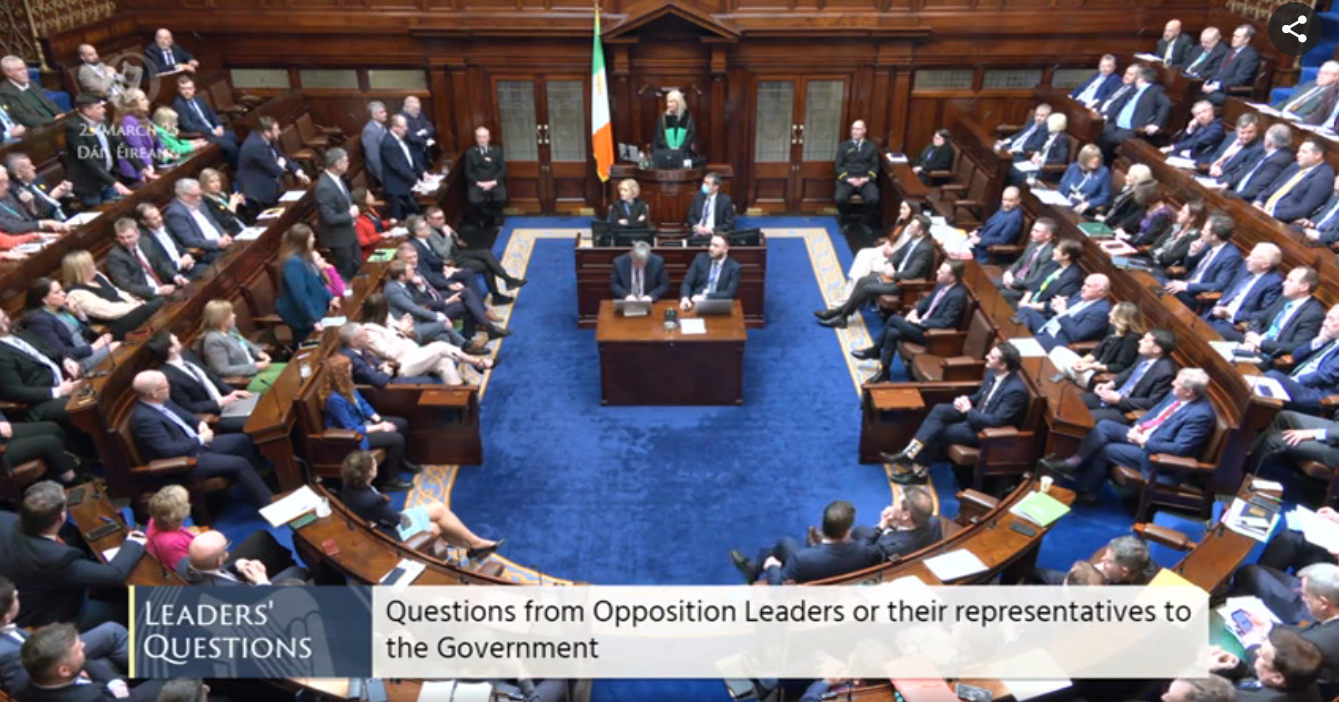
Nonetheless the bawling, screaming and hectoring of the Ceann Comhairle by opposition TDs yesterday was not a good look.
And despite how many times the government fumbled this issue over recent weeks, the opposition managed to snatch defeat from the jaws of victory.
The opposition looked completely unreasonable. It looked like a rabble.
Not exclusively as we now seen that video of Michael Lowry giving a stupid two fingers. It’s an image that makes him look fundamentally like the unserious and dishonourable person, he is.
The opposition says that it was arguing for greater democracy, greater openness and greater transparency in the Dáil proceedings.
But is the way to achieve this by barracking and shouting down the Ceann Comhairle, particularly when the Ceann Comhairle is on their feet trying to restore calm?
There has been a long-standing practise that when the Ceann Comhairle stands up, that whoever speaking stops talking and sits down. They probably don’t stop that very second, but they stop. They desist. They get some control on themselves.
That didn’t happen yesterday. Indeed, the exact opposite happened.
A lot of people seem to have taken that as a signal to shout louder.
Verona Murphy as Ceann Comhairle had a very difficult task. She exercised restraint and some patience, but it was horrendous to watch.
There was not one ounce of respect shown to the office of the Ceann Comhairle, and that was a massive own goal by the opposition and it’s an own goal in which Labour and the Social Democrats must look to their own role within it – though I did not see their TDs involved in the shouting and gross disorder.
Notwithstanding that, I just think Labour and the sock Dems have to sit back and think strategically. Is this the way they should go?
How did the histrionics or the theatrics be shown yesterday progress their case?
Because when I looked at the tactics yesterday, I see some echoes of Sinn Féin believing that it can stop things from progressing when it chooses. It believes it has a veto. It is not one based on a mandate, but rather on its presence and its capacity to make that presence forceful.
But anyone who studied Sinn Féin over the years, particularly during the times leading up to the peace process, knows that Sinn Féin goes to a place of comfort when things get tough around them.
And Sinn Féin’s place of comfort is crisis and chaos.
Sinn Féin, because of its short history and genesis is far more comfortable dealing with chaos and crisis than other parties. When things get tough for Sinn Féin, it likes to get into that zone and to drag everyone there with them, because that’s where it feels in control.
We saw that in the initial stages of the Good Friday Agreement negotiations where Sinn Féin would occasionally throw a spanner into the works, to knock others off balance. It is Sinn Féin brinksmanship. It sees this as giving it a strategic advantage.
I think that’s what Sinn Féin is doing. Not because it has some big strategy, but because it actually doesn’t have a strategy. Sinn Féin is still reeling after the last general election.
Sinn Féin hasn’t yet learned the lessons of the general election or, more importantly, hasn’t learned the lessons of what happened in the 18 months before that, when it watched its support slowly ebbing away.
I made this point in the immediate aftermath of the general election online and on air. The last election should have been their big breakthrough, but it didn’t happen.
Sinn Féin has yet to process that set back and what we see in the Dáil is Sinn Féin struggling to reclaim some pre-eminence, as it struggles to find its role in today’s Irish politics. The sad reality for Sinn Féin is that the voters rejected its alternative government.
What it is engaged in now is the voluble overplaying of some baseline tactics from a very outdated Shinner playbook.
Why Labour and the Social Democrats are going along with this… well that’s an issue with which they must individually or collectively grapple.
At this point the accompanying podcast went on to deal with the recent Garron Noone saga… I don’t plan to include that on this text.
But, I do want to say a few words about the real weakness in the government’s approach to the speaking time discussion, and that is the Independent TD for Tipperary North, Michael Lowry.
By focusing on the Ceann Comhairle and attempting to disrupt Dáil business over how this or that speaking slot is assigned, the opposition is undermining the strongest criticism it has of the one of the key pillars underpinning this government, it’s dependence on Lowry.
Were the Fianna Fáil and Fine Gael leaders so worried and fearful of the prospects of not getting back into office that they could not even contemplate telling the regional independents that they should nominate a negotiator other than their nominal leader, Lowry?
Indeed, the two leaders should have gone further and insisted, as a starting point, to the Regional Independent Group that Deputy Lowry’s support could not be a component of the group’s support mandate?
Did the two party leaders not even google search their own Lowry quotes… though when you do you soon realise that Harris has been far less directly critical of Lowry in his public statements than has Martin.
Did neither leader consider the future impact on government cohesion that might stem from a Garda forwarding a file, following CAB interviews in 2024, to the Office of the Director of Public Prosecutions relating to investigations around the findings of the Moriarty Tribunal?
The regional independents are not a coherent political party. It’s a group. It has only existed in effect since early December 2024, so this was not the equivalent of having your party leadership dictated by another party… Dick Mulcahy in 1948 anyone (I do get that this parallel is flawed… but Mulcahy stood aside knowing his nomination as Taoiseach was unacceptable to Sean MacBride and William Norton)
But none of that has happened and the die in relation to Lowry and the drag factor he adds to this government is now cast.

 derekmooney.ie