Independent Study Shows Ireland had 5th Highest Attendance at EU Council Meetings 2000 – 2010

The attached research paper Report on EU Attendance was conducted by Markus Johansson and Daniel Naurin of the Dept of Political Science at the University of Gothenburg and presented at the SNES spring conference in Uppsala 22-23 March 2011.

SNES (Swedish Network for European Studies in political science) is Sweden’s leading research network dealing with questions of European politics and governance.

The study examined 808 EU Council meetings between 2000 and 2010 and found that Ireland had one of the highest average Ministerial attendances at Council of Minister’s meetings, 5th out of the 27 member states.

The authors of the study argue that attendance is an integral part of EU engagement and reflects the priorities of the governments involved. Ireland’s position as 5th highest out of the 27 member states from 2000-2010 is a testament to Fianna Fáil’s committeeman to Europe and strong engagement

This exposes the hollowness of claims repeatedly made by Government Ministers and the Taoiseach that Fianna Fáil failed to attend EU meetings.

Rebel Ó Cuiv is risking a life in political exile

My column from today’s Evening Herald on Éamon Ó Cuiv’s Craggy Island Act

Craggy Island


If you think Fine Gael or Labour party backbenchers have it tough; spare a thought for Fianna Fáil’s sole backbencher: Éamon Ó Cuiv. He has been rarely out of the headliners since quitting as his party’s deputy leader and communications spokesperson.

Though he served as a Minister for the duration of the 1997 – 2010 Fianna Fáil led governments, it took a few disloyal acts as a back bencher to bring him to some form of public fame.

His newly found rebellious streak comes as a bit of a shock to those who remember his ministerial days, particularly his almost eight year stint as Minister for Community, Rural and Gaeltacht Affairs.

That department’s acronym (D/CRGA), coupled with his peculiarly laconic style, earned it the title Craggy Island during his tenure – though whether this was a reference to Fr Jack, Fr Ted Crilly or Fr Dougal was never fully established.

His reinvention as a latter day rebel is not his first metamorphosis. Despite his Man of Aran manner and demeanour he actually hails from the leafy and affluent, Dublin 4. His success at portraying himself as the archetypal westerner possibly owes as much to his lineage as it does to his conscious efforts.

His excellent track record as a public representation in West Galway, has gained him much respect in the party: almost as much as his position as Dev’s grandson.

This is the Catch 22 he seemed to have missed. While the reduction in the size of the parliamentary party has made him a bigger player, the cachet his political heritage confers is also somewhat diminished. The events of the past few years have reduced the currency value of dynasties in the new leaner Fianna Fáil. Isn’t the concept of dynasty incompatible with a truly republican party?

His outspoken comments on Europe, urging the party to a more Tory-esque euro sceptic position have not been the rallying cry he may have hoped for. Many share his view that Europe has not been working together in partnership or solidarity. They see that Europe’s “failure to act decisively and cohesively damaged its reputation and standing amongst its own citizens”.  But they do not see voting No as the logical or sane answer to that problem.

I put that last line in quotes as, significantly, it does comes not from an Ó Cuiv speech, but rather from Michael Martin’s February 9th address to Institute for International and European Affairs, Dublin.

Ó Cuiv’s belief that he is the lone voice criticising the EU does not stand up. Despite his contentions, voting Yes does not require one to draw a veil over the glaring flaws in what the EU have done in addressing the European banking and economic crisis.

While many in the party may be prepared to allow him the occasional euro-sceptic outburst, they draw a definite line at his idea that Fianna Fáil should be cosying up to Sinn Féin. That is simply not on the table for the vast majority of the party’s public representatives at national and local level.

While some see Ó Cuiv’s grá for such an arrangement as a product of the shinner’s relative weakness in his bailiwick, others suggest it exposes his ill-founded, romantic notions of reuniting republicanism.

The Shinner’s provo-ism is the antithesis of Fianna Fáil’s republicanism. The two strands are simply incompatible and have been for generations. For Ó Cuiv to imagine that they are reconcilable does a disservice to those who adhered to the constitutional republican path and underestimates the ambitions of those who espoused the provo alternative

The irony is that Ó Cuiv’s truculence runs counter to the approach his grandfather adopted. Dev believed that being an elected representative of a political party brought responsibility and required discipline. The party decided its policies behind closed doors and everyone stuck to the party line, whether they personally agreed with it or not.

While there is no desire to grant Ó Cuiv the martyrdom that some think he seeks, he may yet force their hand and find himself banished to a Craggy Island of his own making.

May 4th 2012

BAI Report Does Not Close the File on that Bogus Tweet

Áras12 Candidates McGuinness and Gallagher

Besides our Fianna Fáil backgrounds, Sean Gallagher and I have something else in common: an errant tweet has contributed to us both losing out on a job.

In my case it partly caused me to lose a job I already held. I was Willie O’Dea’s adviser and programme manager when Dan Boyle sent his infamous tweet.

Its claim that there would: “Probably be a few chapters in this story yet” proved baseless, nonetheless 24 hours later the Minister had resigned and yours truly was clearing out his desk. C’est la vie. The tweet only brought the inevitable forward by twelve months.

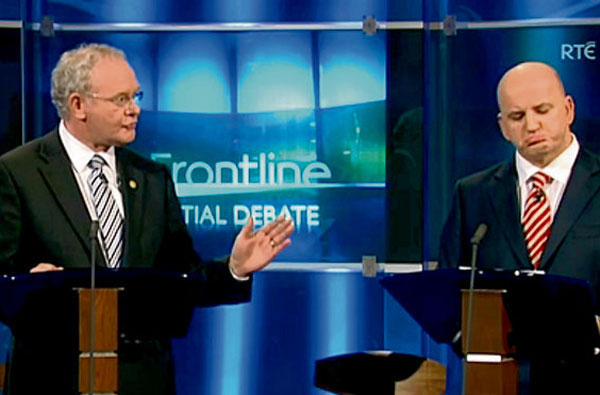
In Sean’s case the broadcast of a bogus tweet during the Frontline Presidential Debate played a major play in derailing his campaign and denying him the job he wanted.

Yesterday the Broadcasting Authority of Ireland gave its verdict on his complaint against RTE, The Frontline and The Pat Kenny Show.

It was a fairly damning judgement. The BAI found that Sean Gallagher had been treated “unfairly” on three counts.

One: by the broadcast of the initial bogus tweet from an account that purported to be from the official Martin McGuinness for President campaign.

Two: by the failure of the Frontline to tell the audience of the subsequent tweet from the official McGuinness campaign denying that it had issued the bogus one.

Three: by the continuing failure of the Today with Pat Kenny radio show the next morning to properly clarify the status and background of the two tweets.

Given that it found that a programme that was intended as a Presidential Debate was unfair to one particular candidate, it was amazing to see the BAI go on to say that no further investigation or inquiry is required as the complaint “was not of such a serious nature as to warrant an investigation or public hearings”.

It is not as if this might have affected the outcome of an election or anything….. oh, hang on a minute…. Yes, it might.

No one can definitively state whether the tweetgate affair altered the outcome, but we do know that Sean Gallagher was the poll leader before the debate and he wasn’t a few days later. We also know that tallies of the postal votes – ie those votes cast and returned to the presiding officers before the Frontline debate – showed Gallagher topping the poll.

On the other hand, it is entirely possible that viewers watching the Frontline debate might have switched from Gallagher to Michael D Higgins even if the tweet had never been mentioned.

All this is in the realms of speculation. What is not speculation however it that someone sent that tweet to undermine the front runner and affect the race.

So, yes, this matter does require further investigation.

The BAI has determined that Mr Gallagher was treated unfairly in how the tweet was handled. RTE’s Director General made a sincere and genuine apology and the RTE Authority is to examine the BAI’s finding.

This is all right and proper. But RTE’s actions are only part of the case.

Like others watching the campaign on the internet I was not aware of the difference between the real and fake McGuinness for President twitter accounts until the controversy broke that night.

The confusion was easy as, according to some Social Media watchers, both twitter accounts were created on the same day. Indeed, as part of its own defence, RTE argued that many other journalists were similarly confused and had taken the first bogus tweet as genuine. (A defence rejected by the BAI)

The question remains: who was responsible for sending out the tweet? Are we going to tolerate a situation where an election outcome can potentially be so easily influenced by one person or group of people acting in the shadows?

We have seen thousands of people protest on the streets of Moscow regarding accusations that Putin rigged their Presidential election, are we not to try and look a bit deeper into this case?

Isn’t the integrity of our democratic process worth a bit more effort?

A tough year for Martin – and it will get tougher

My column in Saturday’s Evening Herald (Jan 28 2012) on Micheal Martin’s first year a leader of Fianna Fáil

—————

A year ago this week {or “today” if published on February 26} Michael Martin sought and won the toughest and possibly most thankless job in Irish politics today: leader of Fianna Fáil.

Looking back over the past year there must have been moments when he felt he hadn’t so much won the prize, as been landed with it. Yet he did win it.

The manner in which he took a stand and challenged for the leadership helped him throw off his previous reputation as an ultra cautious politician who preferred to kick problems to committees rather than taking tough decisions.

On becoming leader [this day one year ago] he found himself at the helm of a demoralised and dissolute party facing into an election for which it was woefully unprepared.

The once great election winning machine that had been Fianna Fáil limped and staggered its way over the line with its new leader’s energetic and impassioned debate performances as rare high points in an otherwise horrendous campaign.

The result was best described by a northern colleague of mine as the greatest political punishment beating ever. The public was not just disillusioned and angry with Fianna Fáil and its Ministers: it had no interest in its views or opinions.

While his first full year in the job has been tough, it could actually have been worse. At the outset many pundits thought the very best he could hope for was stemming the tide of Fianna Fáil’s decline.

Recent opinion polls and the unexpected second place showing in the Dublin West by-election point to the party not just halting the decline, but even reversing it a bit. But there will be no one around Martin popping the champagne corks for a long while yet.

While the party’s prospects may look a tad better now than a year ago: its future is still by no means assured. The party has a long way to go before the public will be ready to listen to what it has to say.

One of Martin’s successes, if this is the right word, has been to get the party’s membership to grasp the new political reality that Fianna Fáil can no longer take its continued existence or relevance as inevitable.

This was no easy lesson for the party to accept. In some ways it is still a work in progress. While there is much talk of reforming both how the party is run and how it develops policy, these have yet to be implemented.

Hopefully, the reconnection Martin has making between the leadership and the members through his constituency visits and personal engagement should enable him to drive through a meaningful reform package.

But it is not as if everything has gone his way. While the right decision was eventually made; the very public “will they/won’t they” row on running a candidate for theArastook its toll. Likewise, Martin’s sometimes over wordy and earnest contributions at Leader’s Questions in the Dáil have not helped convey the idea of a strong leader.

This latter criticism is often attributed to his need to attack on two fronts at once.  Martin is not just targeting the government; he is also targeting the other opposition alternative in Sinn Féin.

Another explanation is that Sinn Féin now has a much bigger back office and research resource than Fianna Fáil. Addams and Co may be reading from scripts, but they are well crafted and written ones

It is not as if his task will get any easier either.

In the coming weeks Martin faces the prospect of dealing with the fallout of the Mahon Tribunal’s report. While there is no confirmed date for its publication, there is much speculation that it may be released just before Fianna Fail’s Árd Fheis at the beginning of March.

Talk about bad timing.

Whatever happens, Martin’s own position is secure. He has from now until the Locals and Europeans in 2014, at least, to show that he can lead the party to recover some of the public trust and confidence it lost.

After one full year, the toughest job in Irish politics is going to get even tougher.

ENDS

FF’s Sean Fleming quickly adds up the damage

My review of Minister Brendan Howlin’s day 1 budget speech. http://www.herald.ie/news/ffs-fleming-quickly-adds-up-the-damage-2954736.html

This is the first budget since Ruairi Quinn’s 1996 one where Fianna Fail have been in the position of having to respond as an opposition.

Only a handful of the remaining Fianna Fail TDs have any experience of replying to a budget statement on the hoof, like this.

Back then they had both the numbers in the chamber and in their research office to be able to respond robustly. Back then, they were also not hampered by seeng their economic strategy being implemented by the government.

In these circumstances, the party’s spokesperson, Sean Fleming, did reasonably well. His accountancy background enabled him to focus in on some of the finer and more damaging points that appeared in the tables, but somehow managed not to make it into the Minister’s script.

Sinn Fein’s Mary Lou McDonald gave one of her best Dail performances to date. Whereas Fleming stuck with the detail, she concentrated on the politics, excoriating and needling Fine Gael and Labour backbenchers for reneging on their election promises.

Over recent years we have been moving from the traditional westminster model of budgets where the finance minister goes into a self imposed silence or purdah in advance of the statement, to a european one where large elements emerge into the public arena in advance.

While recent budgets have seen their share of advance kite flying, this one brought the craft to new and dizzying heights. 

It is all about the management of expectations. It’s an old trick. Get your people spinning that medical cards might be hit, and then hope the public will break out the champagne, or possibly the Babycham given our straightened times, when they are not.
So the theory goes. In this case the audience was not so much the people at home, but the massed ranks of backbench government TDs who would like to be two term Deputies not one termers.
This may account for the very muted applause after Minister Howlin resumed his seat. Though this may just as much been due to how inappropriate and ill judged the loud cheers and fulsome applause the Fianna Fail deputies gave to their recent budgets seems now.

Barrack Closures a Mistake on All Fronts

This article appeared in the Irish Examiner on Thursday November 17th 2011

Resigning as a Minister is not something to be done lightly. You must weigh up the influence and input you are surrendering from having a seat at the table against the public acclamation you will receive. The applause and cheers will soon die down and you will be left standing on the outside while decisions get made without you.

Though he is not a household name, Willie Penrose is a smart man. While he may have the bearing and manner of a classic rural parish pump TD, he is a smart guy. An experienced and successful Barrister, Penrose knows what he is doing.

Gilmore knew that that the future of Columb Barracks in Mullingar was a red line issue for Penrose when he nominated him as a Super Junior – so why did he proceed with the appointment?

This government was only a few days in office when speculation started that they may close some more barracks. Further barrack closures have been a fixation with some senior civil servants and military figures in Defence.

Shortly after I entered the Department of Defence in October 2004 a senior official popped into my office to discuss the issue of “barrack consolidation”. This I came to learn was the euphemism for barrack closures.

There is a school of thought, among some in the Defence organisation, that we should have a much smaller number of super barracks – say three or four – located in the major cities, rather than the existing network of smaller posts across the State.

While this would potentially be a little more economic and efficient, this has to be weighed with the popular support and positive PR generated from having more locally organised and based units. It is a demonstrable fact that recruitment is strongest in those areas where there is a military post.

Even at the height of the Celtic Tiger for every general service recruit post advertised there were at least 5 applicants, while the Cadet competitions often saw 25 or 30 well qualified applicants for each vacancy.

Local barracks and locally based army units form strong bonds with local communities. Use of barracks facilities, especially sports grounds, is usually offered to local community groups, particularly youth groups. The local army unit is always on hand to help out in the classic “aid to the civil power” type exercises – flooding, ice clearance, bad weather etc.

While they are hard to measure on a civil servants excel spreadsheet, these strong local bonds are vitally important and should not be thrown away lightly.

The previous Minister, Michael Smith has closed six barracks back in 1998, though some of these properties had still not been disposed of almost six years later. Indeed it would take a further five or so years to deal with these.

The estimated year on year savings from these 1998 closures was estimated to be in the region of €3.5 – 4.5m. These were “economies of scale” saving from reduced security, heating, lighting and other savings.

If the current row over closing three or four barracks was just about that, I might be tempted to agree with it. But this is a mistake on all fronts.

Alan Shatter says that given the choice between saving buildings and retaining personnel, he opts for the latter. A noble intention: if only that was the choice before him.

It is not.

If the planned closures go ahead the Defence Forces can kiss good bye to seeing their numbers ever rise back above 10,500 again.

There are a number of reasons not to close these barracks.

Their closure will hurt the local economies in Mullingar, Clonmel and Cavan just as much as any factory closure. There is no point the Taoiseach giving out to Talk-Talk management for the inconsiderate handling of that closure while his own Minister is planning to do the same thing.

Where does the Minister propose to transfer the troops stationed in Mullingar, Clonmel and Cavan? Where is the spare capacity in the remaining barracks?

We are already aware from the last round of barrack closures that the remaining barracks were full and operating close to capacity.

To close these other barracks and to permanently move around 500 – 600 troops would require a considerable capital investment in additional facilities in Athlone, Finner andLimerick. This is not something that will appear overnight. Where does the Minister propose to get the cash to provide this additional capacity?

Colm McCarthy’s famous Bord Snip Nua report found that the Defence Forces were the only sector of the Public Service to reduce numbers during the height of the Celtic Tiger. His report suggested a number of further small reforms, including a reduction in the size of the force by a further 500 to 10,000. He recommended this be implemented over a two year period. It was achieved within a year, well ahead of the target date.

So what kind of signal do these further cuts – cuts that go beyond An Bord Snip Nua – send to others in the Public Service? This was a point that Brian Lenihan and Brian Cowen instinctively understood.

Here is a part of the public service that has downsized, modernised and reformed itself beyond expectations and yet it gets singled out again for cuts that neither make sense nor add up. These barrack closures appear, on the face of it, to be gratuitous.

The Defence Forces now do more with less. When it comes to real public sector reform the Defence Forces are a model of how it can be done right. These closures put that model at risk.

The investment in the Defence Forces made between 1997 and 2007 was a text book example of how to invest wisely and productively. Surplus property was sold and the proceeds invested in better training and equipment.

While the numbers working in the Public Service increased by 17% over the decade of the Celtic Tiger, the numbers working in the defence organisation actually fell by 8%.

This applied across all levels. The number of troops fell and so did the number of civil servants. Indeed Defence has a remarkably small civil service

The fact that the Minister does not get this point is compounded by the fact that he did not address the annual PDFORRA conference. That was a bad decision. It was his first opportunity to address the soldier’s representative organisation and he opted to send his Junior Minister while he and his Secretary General heading off to an international conference instead.

Willie Penrose’s resignation is about a lot more than just Mullingar Barracks; it is about a part time Defence Minister who fails to appreciate what he is doing, or is simply not bothered.

It is way too early to call the Aras11 race

My latest article on the aras11 race from the Evening Herald 13th August 2011


In about 75 days we will vote for our next President. It is a long way away and there will be plenty of polls to mull over between now and then.

The latest RedC Paddy Power poll does throw up some unexpected numbers, so I suspect with the next two or three polls. I would not expect them to settle down and reflect actual voter intentions until much closer to October 27th.

Uncle Gaybo tells us that he will make up his mind on whether to run or not. He has some big things to mull over, including his high level of potential support. They are impressive by any standards, almost Norrisian when compared to polls taken in recent weeks.

But what do these big numbers mean or matter when the beneficiary is not in or out of the race yet? Plus, he should consider that early leads come with a major health warning from Irish presidential election history.

The first major poll of the 1997 Aras race was conducted by IMS and published in the Sunday Independent about 40 days before polling (on September 21st)

It showed the Labour party’s candidate, Adi Roche in a commanding lead with 38% – ten points ahead of Uncle Gaybo’s figure today. On polling day, on October 30th she ended up on 7%.

If things changed that much for her in 40 days, consider how much more they might change over the course of 76 days. The words “sprint” and “marathon” come to mind. Come to think of it, so do the words “obstacle course”

As with Uncle Gaybo, Adi’s name had come into the fray as a bit of a surprise announcement just days before an opinion poll. The Irish Times poll; published ten days later, had Roche on 22%, behind McAleese (who polled 35% in both polls).

I know the dangers of comparing polls from different polling companies with different samples. I also know that Adi’s declining poll numbers followed a tough and difficult campaign.

The point I am making here is that any poll taken so far out from the actual polling day, particularly with some candidates yet to declare, is no indicator of how anyone might fair out on the big day. This applies to those at the top or the bottom of the poll. We may as well poll as to who will win the 2012 Eurovision inAzerbaijan(Though it’s a fair bet they’ll be East European)

To put it in its crudest terms, this poll seems to me to simply reflect how well the public recognises the candidates’ names, so far.

I say this as the truth is that the Presidential campaign not started yet. Yes, there has been a lot of coverage over the past few weeks, but this has focussed on particular individuals rather than the full slate.

Apart from a few short one to one interviews on the Pat Kenny radio show and his rather terrible Frontline debate where most of the potential candidates stayed away, there has been no opportunity to calmly judge the candidates suitability to be President.

The campaign proper in October will matter. By then we will know who is definitely in the race or who is not. We will start to hear clear messages from each of them why they are the right person to succeed President McAleese. We will hear about their values and their thoughts on what the next seven years should bring.

We, the public will be able to assess and review the candidates individually and collectively over that three to four weeks of intensive campaigning.

The last thing anyone wants or needs is an 11 week campaign. No one’s sanity, patience or tolerance could withstand 75 days of that.

So let us stay calm, wait to see who is in or out and all take a few deep breaths from now until late September when the race can begin in earnest.