
And they say that negative campaigns don’t work…..

The presidential campaign is barely a week old and already we have candidates producing P60s showing how much they have earned over the years. This was in response to dark propaganda about earnings and directorships.

And they say that negative campaigns don’t work. If we are at this stage just one week into the race then it cannot be long until the demands come that this candidate or that one produces their birth, baptismal or parents’ marriage certs.

We should not really be that surprised. Academic/college politics is said to be so much more vicious than real politics because the stakes are so low. It could just as easily be said about Irish Presidential elections.

It is not that the office is unimportant; it is that the powers are limited and the office appears to fade into the background once the campaign is over.

The fact that Mary McAleese has been an excellent President somehow adds to the notion that it doesn’t matter an awful lot as to who succeeds her.

As none of the candidates have so far convinced us that they are cut from the same cloth as her, the debate is slowly turning to which of them will be the least worst.

The office of President is so tightly defined and closely managed that almost no occupant could manage to go truly rogue. So, while many people, myself included, have severe misgivings about the possibility of McGuinness occupying the office, the truth is that his being President would not change anything. Martin McGuinness being President will not make a significant difference to anyone’s daily life – apart from his own.

The reality of the past decade is that Sinn Féin has been moving steadily to the centre in the North. No sooner do they move into office but they very quickly adopt the policies and strategies of those who were there before them. Sinn Féin in Government in the North is not a thorn in anyone’s side, least of all the DUP’s. They may head up anti hospital closure committees in the 26 counties, but in the North they merrily implement the cuts imposed byLondon.

So, while his election may not herald the end of civilisation as we know it, it could send out a very embarrassing signal at this crucial time.

Almost any of the other candidates: Michael D Higgins, Mary Davis, Sean Gallagher or Gay Mitchell could each fulfil the role in their own individual ways without causing us any embarrassment or sparking an international crisis.

This least-worst approach appeared to be the underlying theme to last night’s TV3 debate.  Unlike past encounters, there was some spark to it. The cross talk between the candidates did not yield much and at times became insufferably twee. The competition to be the most concerned by the trauma of suicide bordered on distasteful.

It was the questioning and serial grilling by the moderator that managed to reveal something more about each of the candidates. As someone said on Twitter last night, it was not that any one candidate emerged as the winner: it was more that some managed to emerge less damaged and scarred.

David Norris and Dana were not among them. Though a veteran of past campaigns, Dana seemed the least prepared and most unfocused. While Norris’s continuing obfuscation in the face of very specific questions from Browne on who it was inIsraelwho had advised him not to publish the remaining letters was telling.

David’s protestations that the public will decide this issue ring particularly hollow when he refuses to give them access to the full facts by releasing the outstanding letters. This issue is not going away and the longer it continues the worse he will get for him.

His media adviser is a big admirer of Tony Blair’s spin doctor, Alastair Campbell, He should remind his client of Campbell’s famous rule that if you allowed a bad news story to dominate the headlines for more than four days, you are in trouble.

David has had more than four days of such headlines and the only end in sight is his own. And, to think, we still have three weeks more of this to go.
‘Hero to zero’ Gilmore has got only himself to blame


My take on Tanaiste Eamon Gilmore’s dilemma from The Evening Herald Thurs Sept 8th – see online here


THE much-missed RTE journalist Gerald Barry gave his name to possibly the one basic rule of Irish politics.

It states that “every leader of the Opposition is the worst ever leader of the Opposition”. Not only does it still apply, but our “new” politics seems to dictate that it be expanded to apply to Tanaistes.

As Eamon Gilmore is learning, being the deputy can be a thankless job. President Franklin Roosevelt’s vice president, John Nance Garner, described the job as “not worth a bucket of warm spit”. Though being a rough Texan, it is likely he put it a bit stronger

President Reagan’s VP, George Bush Snr, put it a bit more delicately, saying the job involved a lot of quiet diplomacy, possibly a reference to the number of state funerals he attended during his time.

Gilmore’s current stint in the doldrums is almost inevitable. He came into Government promising most, and with the highest public approval ratings. Remember the Gilmore For Taoiseach posters? If only I had held on to one! He could never deliver on these high expectations, given his lack of experience in office.

In Opposition, Gilmore outshone and outclassed Kenny. He was the one who seemed more capable and focused. He was better able to capture the public mood. His pithy and apparently off-the-cuff contributions contrasted with Enda’s heavy long-winded scripted ones. Those days are now long gone. The Taoiseach now outpolls the Tanaiste, as ex-FF voters see him more in tune with their concerns.

The cracks in the Gilmore edifice first began to appear in the leaders’ debate between Eamon and Micheal Martin. Contrary to expectations, the new Fianna Fail leader faired well, while Eamon seemed over- prepared, even defensive.

Looking back, it may have been a foretaste of Eamon’s difficulty: changing from Opposition mode into governance mode.

His weakening situation was compounded by taking the job in Government often seen as the most remote from everyday life at home — foreign affairs — and by his choice of ministers.

He appointed a team with both experience and youth, yet he has uniquely managed to rub many of his backbenchers up the wrong way –particularly those who served on the front benches before the election only to find themselves passed over in favour of relative newcomers for junior ministries.

This leaves him caught in a bind. On one side he is being daily eclipsed by his more experienced colleagues, Quinn, Howlin and Rabbitte — while on the other he is being sniped at by disgruntled backbenchers.

A situation not made any easier by the fact that he is not a “gene pool” Labour Party man, just a “stickie” blow-in.

Small wonder his polling numbers have fallen amid stories of his less-than-impressive contributions to Cabinet.

I was hearing these during my recent trips to Brussels as local officials spoke of how pedestrian his performances had been at EU meetings.

His dilemma is now threefold, at least.

First, his platform in Opposition was that we needed to tax more and cut less. That is not the view of the majority voters now.

Second, if he had taken a more central big-spending department he risked exposing his inexperience, so he chose to play safe.

Third, if he was more aggressive and assertive, we would be lambasting him for damaging the cohesiveness of the Coalition and putting party politics above national interest.

In these circumstances it is possible to almost feel sympathy for his plight … but only almost. He alone is the architect of his current misfortunes.

They may ease a little if his candidate fares well in the presidential election, though October 27 is a distance away and a Labour victory is by no means assured.

That would at best prove a temporary respite as already unhappy backbenchers grapple with the consequences of cuts in social welfare and services.

Gilmore’s place is secure for the moment, but all bets (and gloves) will be off come the mid- point of this Government’s term if his role and input into Government has not improved significantly.

Ireland and Norway are very alike. So, could it happen here?

This article can also be viewed on the Herald.ie site here


Monday July 25 2011

Not only has Norwegian PM Jens Stoltenberg shown great leadership in his measured response to the atrocity which had befallen the Norwegian people, he has also given a new measured response to such attacks with the words: “The answer to violence is more democracy, more humanity, but not more naivety.”

The appalling atrocities in central Oslo and the island of Utoya have rightly shocked us all, not just for their ferocity and callousness but for the fact that they have been perpetrated in the city and a country one associates most with peace building and peace making.

Oslo is not just the home of the Nobel Peace Centre and the location for the awarding of the Nobel Peace Prize, it has also given its name to the 1993 foundation on which peace negotiations between Israel and the Palestinians were based: the Oslo Accords.

Briefly, during the first hours after the car bomb exploded in Oslo many minds turned to the possibility that the attack was the work of Islamist terrorists. The attempted car bombing in Stockholm just before Christmas was as hard to understand, but that attack was linked to Islamist terrorism: the first such attack in the Nordic nations.

It took some time for the full scale of the slaying to emerge for experts and analysts to realise that this was not an attack from extremist Islamists.

It was the polar opposite. It was from a local home-grown ultra-nationalist who feared and hated Islam.

This attack, on his own people, was perpetrated by a man whose own warped world view sees Islam as a threat to the Western way of life and whose online writings denounced Norwegian politicians as failing to defend Norway from Islamic influence.

As we look at the horror, should we consider if such a thing could happen here?

Up to last Friday afternoon the Norwegians did not think such a thing was likely.

They, like us, considered this to be something one only read about in other larger cities and countries. Yet, it happened.

In many ways Norway and Ireland are alike. We are both small, quiet, friendly, liberal democracies most noted in the international context for our contributions to peace support and international diplomacy.

During those brief few hours when speculation focused on an external terrorist cause some suggested Norway’s having troops in Afghanistan as a possible reason why it could be a target.

We too have troops serving in Afghanistan since 2002, so it could also potentially make us one, though Norway’s membership of Nato and participation in the Libyan campaign were also cited as possible causes.

But, as we now know, the reason was not external – it was internal. In Norway’s case this domestic threat was aided by their gun laws: Norway’s large hunting and sports shooting traditions does allow regulated access to a range of firearms.

Back in 2008 the Justice Minister, Dermot Ahern, moved to clamp down on gun controls, especially on the numbers of legally held handguns. Yet there are still many thousands of legally and illegally held guns on this island.

The one thing we cannot legislate for, though, is what goes on in someone’s head. A society cannot protect itself 24/7 from the actions of a lone crazed attacker.

To tackle that we need to turn to the last part of Stoltenberg’s advice: we cannot be naive. While the likelihood of such a thing happening here may be small: it is not zero. We must not be naive, we do need to be vigilant.

Aras11: and then there was five, or four…..

With each passing day the Aras11 race increasingly resembles a remake of the 1945 Agatha Christie movie: And Then There Were None.

For those of you who haven’t seen the Barry Fitzgerald classic, or its later remakes, the plot revolves around a group of people brought together on a remote and isolated location by Mr U. N. Owen (say it out loud and you will get it).

One by one the guests depart. Each in increasingly tragic circumstances, until there is just one is left. Or, is there? Have each of them really gone to meet their maker? Could there be a last minute twist in the tale?

Ok, I have done this metaphor to death, but you can see where I am going with it.

Labour’s early selection of Michael D Higgins heralded early exits by Fergus Finlay and Kathleen O’Meara. Niall O’Dowd’s withdrawal last week and Avril Doyle’s exit this week has brought the total number of viable candidates down by four. I say “viable” as there are two also-rans seeking Council nominations.

Today’s Fine Gael selection convention will reduce the field by a further two – though you will find it hard to get a firm consensus on which two.

So what does this all mean? Well, by the close of business tonight the original field will have been halved. Three of these will definitely be on the Aras11 ballot paper: the FG and Lab nominees, plus Sean Gallagher. Two more: Mary Davis and Senator David Norris will be hoping to make it before the final deadline.

So it now looks like there will be a field of five candidates when the election comes around in October. Or will there? Will there be one or two more – will there be one less?  October is still a long way away.

With 33 Oireachtas members, Fianna Fáil has more than the 20 signatures needed and could still choose to support a candidate not already in the race and not necessarily from the Fianna Fáil family.

With a total of 31, the Independent TDs and Senators, including United Left Alliance, could also nominate, if they can find one on whom twenty of them can agree Though Norris supporters suggest he has 8 or 9 of them already signed up.

While Sinn Féin, with 17 Oireachtas members, would need to get three Independents on side to give a nomination to a person of their choice.

Back on the Council trail: the longest declared candidate, Senator David Norris, must be feeling pretty miffed to be overtaken in the Council stakes by Sean Gallagher on 5 and Mary Davis on 2.

Gallagher’s relative ease in securing motions of intent would suggest that he and his team were working on this campaign long before he officially entered the race. I know some of his core campaign team. They are very skilled professionals who have run it like a classic Seanad campaign.

It is this skill and ability; however, that makes Mary Davis’s victory in Gallagher’s Louth and Monaghan backyards all the more impressive.  Her comfortable margins suggests that my mate, and keen political blogger, Jonny Fallon, was right when he tweeted a few weeks back that the other Independents would have to wait until Gallagher got his four councils.

It also suggests that a coalition of non Fine Gael councillors across the remaining councils is preparing to swing in behind the Special Olympics boss Davis, as their next favoured independent. She now looks certain be also be on the Aras11

Less certain is Norris. He has been waiting for almost two months to follow up on his one success in Fingal Council. It will be interesting to see if Fine Gael is still set on stymieing his campaign. This would be in contrast to the Fine Gael abstentions elsewhere which allowed Gallagher to get through.

Maybe Fine Gael fear Norris more than Gallagher, or maybe they just want someone in the race who they can label and attack as a Fianna Fáiler?

Who knows, only time will tell – and time, as Agatha Christie observed, is the best killer.

ENDS 

From Evening Herald July 9th 2011

My Herald Column: Man overboard as ‘Capt Birdseye’ Reilly caught in storm of his own making

See online here:

Man overboard. Just four months in office and the Government has lost its first back bencher. In fairness, they have a lot of them, so one could hardly matter that much.

The 2011 intake of new Fine Gael and Labour TDs are still so unfamiliar to us that, in all likelihood, it could take a while to notice that two or three of them had gone missing.

At this rate — losing one backbencher every four months — the Coalition could hold on to its 58-seat majority for another 10 years. That is if there wasn’t a general election due in just under five years’ time.

And that’s why this first defection might have slightly largely ramifications than originally thought.

Pressure

Denis Naughten defied the party whip by voting for a Dail motion calling for accident and emergency facilities in Roscommon Hospital to remain open.

In doing so, he has significantly raised the pressure on his former colleagues. The Roscommon Hospital Committee has got a scalp. Other hospital committees and pressure groups committees will be taking notes.

Minister of State John Perry, who promised before the election to return breast cancer services at Sligo General Hospital, will find the heat being turned on him. He won’t be alone in the simmering pot. Government backbenchers in Portlaoise and across the country will find more targeted and co-ordinated campaigns being whipped up over the summer.

Never mind a winter of discontent, this government faces an autumn of anguish. Correction: the Fine Gael TDs face an autumn of anguish on the hospitals issue thanks to the Health Ministers upping the ante just before the election. (He’s the one who looks like a cross between Brian Blessed and Captain Birdseye)

If only he had played it calmer and cooler. Everyone could see Fine Gael and Labour were coasting to victory, but that was not enough for Fine Gael’s health spokesperson and deputy leader. Captain Blessed Birdseye wrote an open letter to the voters of Roscommon saying: “Fine Gael undertakes to retain the emergency surgical, medical and other health services at Roscommon Hospital.”

Last week the Taoiseach sought to defend the good Captain with the argument that Dr Reilly said this when he ” … was contesting the general election (and) he was not in possession of the information about the difficulties surrounding the recruitment of non-consultant hospital doctors”.

This did not, however, explain Deputy Naughten’s announcement at the end of March that Fine Gael had firmly “put a halt to any plans by the HSE to withdraw services from smaller hospitals”, and that it would not only protect, but would also enhance and develop these services.

One presumes that his words had Captain Blessed Birdseye’s blessings. If not, the Roscommon Deputy has made a rod for his own back. If he had, then there is still some considerable mileage left in this story.

This is also about management of expectations. The last government reduced expectations enormously, though as often by accident as by design. This Government came in building up expectations beyond anything that was deliverable.

Enda may come to regret leaving ministers in the portfolios they held in opposition. Yes, they are familiar with the minutiae of the issues, but they are also left to face those promises they made. Fine Gael could well end up reaping a whirlwind it started by itself and for itself. To quote the Book of Proverbs: “He that troubleth his own house shall inherit the wind.” Put that in your sails, Captain.

Derek Mooney was political and policy adviser to a Cabinet Minister 2004-2010 and has worked as a public policy consultant since the mid-1990s

– Derek Mooney

Germany lectures us on debt — forgetting the lessons of its own history

Here is my column on Germany forgetting the lessons of its own history from the Herald (Tuesday June 28 2011)

—————————————————————

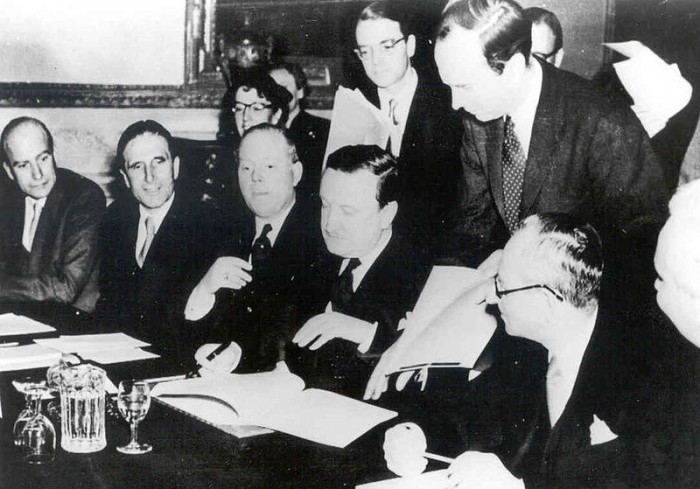
Signing the London Agreement on 27 Feb 1953 (Pic via: http://www.tlaxcala-int.org/article.asp?reference=8440)
Signing the London Agreement on 27 Feb 1953
(Pic via: http://www.tlaxcala-int.org/article.asp?reference=8440)

The media has been full of hourly reports of how the Greek debt crisis has the capacity to send the global economy back into the doldrums.

The Greeks, and by extension, the Portuguese, Irish and Spanish have had to endure tough lectures from France and Germany about the need for austerity.

The German government has been particularly forceful in delivering these lectures. Its leaders tell us their taxpayers do not want to subsidise bloated public sectors or unproductive workers across Europe.

And who could blame them? It is understandable that German workers do not want to pay extra taxes to send money across Europe, even if it is in the form of a loan with generous interest payments attached.

Understandable … but only if you have a short memory and disregard the history of the past century.

An economic historian at the LSE, Prof Albrecht Ritschl, has pointed out that the worst debtor nation of the past century is not Greece, it is Germany — and by a wide margin too. Worse still, Germany is denying to Greece, Portugal and Ireland the precise remedies it needed to rebuild itself. Twice in the last century, after WWI and WWII, Germany has ran up levels of debt that would make the Greek crisis look like a bad night at a mythical Tipperary Casino.

The cost of Germany’s 1930s debt default was as significant as the 2008 financial crisis. A default they were forced into as they could not repay the debts and war reparations set out in the Versailles Treaty following WWI.

This was the result of the rest of the world doing to Germany what Germany and others in the EU are now doing to us. Tons of new debt (in Germany’s case it was war reparations) were heaped on top of existing debt thereby draining the German economy of the ability to rebuild itself.

By the end of WWII, the rest of the world had learned a lesson. It recognised that lumbering a devastated and demoralised Germany with more debt was not a workable solution.

In the 1953 London Agreement on German External Debts, the Allied powers did the exact opposite of what the German and French governments are doing today. They wrote off half of Germany’s total mountain of debt and gave it additional time to repay the monies it owed.

It was thanks to the foresight and generosity of former enemies that West Germany was able to deliver the Wirtschaftswunder (economic miracle) of the 1950s.

This was a deal negotiated between leaders who had learned from the mistakes of the past and could see beyond the political demands of the next election, particularly Germany’s own Konrad Adenauer.

Remember, also, that one of the occupied countries owed money by Germany was Greece. Those protesting in Athens remember that their parents and grandparents had to forego the compensation owed to them.

How galling must it be for them to take lectures from the current German Chancellor on the virtues of paying your debts?

And, in case anyone thinks this is all reaching too far into the past, think again. According to Prof Ritschl, Germany defaulted on one of the conditions of the 1953 London Agreement as recently as 1990.

TOOLS

It is a sad indictment of the current German leadership that it cannot see that denying others the tools that it required to rebuild itself is only storing up trouble for the future.

It does not take a Konrad Adenauer or a Willy Brandt, however, to recognise that Germany’s economic fortunes are so closely intertwined with the other eurozone countries that if part of the eurozone falls, Germany could flounder.

So, even if heeding the lessons of history cannot bring Germany to realise the current policy is not working, self interest just might.

– Derek Mooney