Labour Leader Gilmore Ranked Second Worst in Poll of Ministers’ Performance

Over the past few days (Tues Apil 11 – 13) I ran a simple poll on my website www.derekmooney.ie . In it I asked people to select the three government ministers they believed were performing best in office.

 182 people voted in the online poll.

The results are as follows: You can download the results in pdf format Rate the Ministers

1

Finance Minister Michael Noonan

2

Welfare Minister Joan Burton

3

Agriculture Minister Simon Coveney

4

Pub Exp Minister Brendan Howlin

5

Transport Minister Leo Varadkar

6

Education Minister Ruairi Quinn

7

Enterprise Minister Richard Bruton

8

Children’s Minister Frances Fitzgerald

9

Communications Minister Pat Rabbitte

10

Arts Minister Jimmy Deenihan

11

Justice Minister Alan Shatter

12

Foreign Minister Eamon Gilmore

12

Health Minister James Reilly

13

Environment Minister Phil Hogan*

If they squabble this much over small stuff… what happens when the big probs arrive?

About a week ago I wrote a piece for the Herald defending the government giving politicians a three week break for the Easter.

Scousers
Calm down lads, calm down

This was, I argued, a welcome opportunity for Ministers, TDs and their advisers to do some of the other boring, but important, work and also to take some time to reflect and think about the issues of the day.
Talk about getting it wrong. No sooner has the ink hit the pages than almost everyone in Government was out in public tearing strips off each other.
The whole cast of characters were involved: Environment Minister: Big Phil Hogan, Health Minister: James “Capt Birsdeye O’Reilly, Finance Minister: Michael Noonan, Arts Minister: Jimmy Deenihan, Welfare Minister: Joan Burton, Communications Minister: Pat Rabbitte, Justice Minister Alan Shatter, FG Party Chair Charlie Flanagan plus a few Government backbenchers including Labour’s Colm Keaveney and Fine Gael’s Regina Doherty.

The week before had seen some on the Labour side saying that Big Phil could have handled the whole household charge thing a lot better. Just as it appeared that that particular row had run its course, news broke that Big Phil was meeting with Moriarty Tribunal favourite and Tipp North TD, Michael Lowry only a few days after the publication of that Tribunal’s final report.

Within hours other Ministers, namely Birdseye O’Reilly and Noonan, were confirming that they too had meetings with Lowry. This was all too much for Joan who questioned the wisdom of this. So too did Jimmy, but more subtly.

Joan’s words riled Charlie who went on Twitter to ask if Joan had a Government death wish. Regina subsequently went on Radio to say Charlie was right and that Joan was wrong. Others thought Joan was right, including Colm, who also went on to Twitter to call the judgment of senior figures in Fine Gael into question.

Meanwhile Pat spoke to the Sunday Independent to say that he was frustrated by the “interminable delay” in bringing prosecutions following Mahon and Moriarty. Within hours of the paper hitting the breakfast table Alan had issued a broadside that had Pat in mind when it stressed the importance of not making public comments that might prejudice proceedings.

By lunchtime the Taoiseach was doing a bad Harry Enfield scouser impression telling everyone to “calm done”. All that was missing was him donning a Kevin Keegan wig and finishing off the interview saying: “Dey do do dat dough don’t dey dough”

Not only did all of this happen in just one week, it happened in very quiet week at that. If this is how the members of the Government deal with minor matters, Lord help us when the big problems come. And come they will.

The Government has had a fairly charmed existence since coming to office. While things are clearly not improving, they have not had to face any genuine crises or policy dramas.

Both parties have endured some setbacks early into their term. but none that really tested them. For Fine Gael it was the losses in the presidential election and referendum, plus the Roscommon hospital fiasco. For Labour it was the loss of three TDS, including a Junior Minister and a by-election winner, though these were offset by their man winning the presidency.

The handling of the household charge suggests they lack a certain deftness of touch, yet it pales into significance against the problems they may yet face in the years ahead.

How will a government that descends into public squabbling and faction fighting at the mere mention of the names of Moriarty Lowry or O’Brien cope if Merkel Draghi or Barroso decide to turn the thumbscrews on Corporation tax or whatever?

Have they all forgotten that they will be asking the people to take their collective advice at the end of May and vote yes to the Fiscal Compact Treaty? Might it not help their case to give the appearance of knowing what they are doing and all pulling in one direction?

As to the internecine squabbling, there are several systems in place to stop such petty rows escalating and getting into the public arena. One is called common sense. Another is the special adviser/programme manger system. Isn’t it time to get working on both?

ENDS

BAI Report Does Not Close the File on that Bogus Tweet

Áras12 Candidates McGuinness and Gallagher

Besides our Fianna Fáil backgrounds, Sean Gallagher and I have something else in common: an errant tweet has contributed to us both losing out on a job.

In my case it partly caused me to lose a job I already held. I was Willie O’Dea’s adviser and programme manager when Dan Boyle sent his infamous tweet.

Its claim that there would: “Probably be a few chapters in this story yet” proved baseless, nonetheless 24 hours later the Minister had resigned and yours truly was clearing out his desk. C’est la vie. The tweet only brought the inevitable forward by twelve months.

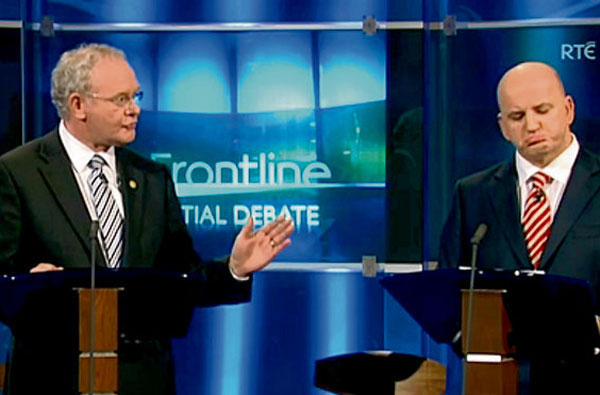
In Sean’s case the broadcast of a bogus tweet during the Frontline Presidential Debate played a major play in derailing his campaign and denying him the job he wanted.

Yesterday the Broadcasting Authority of Ireland gave its verdict on his complaint against RTE, The Frontline and The Pat Kenny Show.

It was a fairly damning judgement. The BAI found that Sean Gallagher had been treated “unfairly” on three counts.

One: by the broadcast of the initial bogus tweet from an account that purported to be from the official Martin McGuinness for President campaign.

Two: by the failure of the Frontline to tell the audience of the subsequent tweet from the official McGuinness campaign denying that it had issued the bogus one.

Three: by the continuing failure of the Today with Pat Kenny radio show the next morning to properly clarify the status and background of the two tweets.

Given that it found that a programme that was intended as a Presidential Debate was unfair to one particular candidate, it was amazing to see the BAI go on to say that no further investigation or inquiry is required as the complaint “was not of such a serious nature as to warrant an investigation or public hearings”.

It is not as if this might have affected the outcome of an election or anything….. oh, hang on a minute…. Yes, it might.

No one can definitively state whether the tweetgate affair altered the outcome, but we do know that Sean Gallagher was the poll leader before the debate and he wasn’t a few days later. We also know that tallies of the postal votes – ie those votes cast and returned to the presiding officers before the Frontline debate – showed Gallagher topping the poll.

On the other hand, it is entirely possible that viewers watching the Frontline debate might have switched from Gallagher to Michael D Higgins even if the tweet had never been mentioned.

All this is in the realms of speculation. What is not speculation however it that someone sent that tweet to undermine the front runner and affect the race.

So, yes, this matter does require further investigation.

The BAI has determined that Mr Gallagher was treated unfairly in how the tweet was handled. RTE’s Director General made a sincere and genuine apology and the RTE Authority is to examine the BAI’s finding.

This is all right and proper. But RTE’s actions are only part of the case.

Like others watching the campaign on the internet I was not aware of the difference between the real and fake McGuinness for President twitter accounts until the controversy broke that night.

The confusion was easy as, according to some Social Media watchers, both twitter accounts were created on the same day. Indeed, as part of its own defence, RTE argued that many other journalists were similarly confused and had taken the first bogus tweet as genuine. (A defence rejected by the BAI)

The question remains: who was responsible for sending out the tweet? Are we going to tolerate a situation where an election outcome can potentially be so easily influenced by one person or group of people acting in the shadows?

We have seen thousands of people protest on the streets of Moscow regarding accusations that Putin rigged their Presidential election, are we not to try and look a bit deeper into this case?

Isn’t the integrity of our democratic process worth a bit more effort?

Labour Party is the real victim of Sinn Fein’s ST poll surge

my take on the recent Sunday Times poll as seen from a different perspective, both in terms of distance and time. I never cease to be intrigued how distance can change your perspective. It is true whether that distance is in time or in space. Indeed not only does it change it, it usually improves it.

This blindingly obvious conclusion struck me late on Saturday night as I sat in my Hotel room on the Costa Blanca coast watching my twitter feed to find the results of the latest Sunday Times opinion poll.

As the old joke goes: it was like deja vu all over again. Exactly one year earlier I was sitting in another room at the same Hotel trying to follow the results of the General Election online.

Though I managed to log in every few hours to catch the resulting coming in online, I still failed to fully grasp the full impact of Fianna Fail’s defeat at the time. My mind was elsewhere. My Dad had died suddenly at my parents’ home in Spain on the eve of polling day. I had, along with other family members, rushed over for the funeral in the days that followed.

It therefore took a week or so for the full enormity of what had happened at the polls to sink in. When it did, I found myself almost detached from its consequences and outworkings. I had not been at the count centres for the emotional traumas. By the time I was back home and chatting with former colleagues; they were reconciled with their fates to the point of being phlegmatic.

Anyway, that was a year ago. Back to last Saturday night. Sitting in a similar room, one year on and almost 1800km away, I found myself having quite a different perspective on the latest opinion poll figures.

As I looked at the RTE news online I was taken aback to see them running the line that big news in this poll was the drop in support for Fianna Fail.

Really? Not from where I was sitting.

Perhaps it was the night breeze drifting in off the Mediterranean. Maybe it was the over generous Soberano.

Either way; it appeared to me that the big news in this poll lay elsewhere.

To my mind the first piece of news in the Sunday Times B&A poll was the halving of Labour’s support in one year – from 19.4% on polling day to 10% today.

Second was the dramatic increase in support for Sinn Fein. from just under 10% at the General Election to a whopping 25% in the poll.

Indeed, there is a third equally significant story, namely the finding that, at 70%, almost three times as many people are disatisfied with the Government than are satisfied with it (26%). Not a ringing endorsement for a government just one year into its term and yet to face any seriously testing challenges.

Though it would be foolish to read too much into just one poll, Sinn Fein’s strategists North and South will be feeling understandably satisfied that their tactic of placing the Labour Party firmly in their sights is paying dividends.

In comparison with these almost double digit changes, Fianna Fail’s decrease from 17.4 to 16 is modest, though disappointing.

Yes, it is the type of news Michael Martin and Co can do without with the first Ard Fheis in two years only a week away and the Mahon report looming. But who, in their right mind, really expected voters, who were bitterly angry with Fianna Fail, to suddenly turn and cry “this shower is even worse than you lot: all is forgiven” barely one year on?

Maybe it is a back handed compliment of sorts that the party’s fortunes still merit such attention and coverage: even when the figures don’t exactly back it up.

If so, then expect plenty more of the same for the rest of the year as further polls emerge and more pundits line out to say what it all means for Fianna Fail. Meanwhile, I will see if I can manage to be away for their publication. It appears to be the best way to view them.

Barrack Closures a Mistake on All Fronts

This article appeared in the Irish Examiner on Thursday November 17th 2011

Resigning as a Minister is not something to be done lightly. You must weigh up the influence and input you are surrendering from having a seat at the table against the public acclamation you will receive. The applause and cheers will soon die down and you will be left standing on the outside while decisions get made without you.

Though he is not a household name, Willie Penrose is a smart man. While he may have the bearing and manner of a classic rural parish pump TD, he is a smart guy. An experienced and successful Barrister, Penrose knows what he is doing.

Gilmore knew that that the future of Columb Barracks in Mullingar was a red line issue for Penrose when he nominated him as a Super Junior – so why did he proceed with the appointment?

This government was only a few days in office when speculation started that they may close some more barracks. Further barrack closures have been a fixation with some senior civil servants and military figures in Defence.

Shortly after I entered the Department of Defence in October 2004 a senior official popped into my office to discuss the issue of “barrack consolidation”. This I came to learn was the euphemism for barrack closures.

There is a school of thought, among some in the Defence organisation, that we should have a much smaller number of super barracks – say three or four – located in the major cities, rather than the existing network of smaller posts across the State.

While this would potentially be a little more economic and efficient, this has to be weighed with the popular support and positive PR generated from having more locally organised and based units. It is a demonstrable fact that recruitment is strongest in those areas where there is a military post.

Even at the height of the Celtic Tiger for every general service recruit post advertised there were at least 5 applicants, while the Cadet competitions often saw 25 or 30 well qualified applicants for each vacancy.

Local barracks and locally based army units form strong bonds with local communities. Use of barracks facilities, especially sports grounds, is usually offered to local community groups, particularly youth groups. The local army unit is always on hand to help out in the classic “aid to the civil power” type exercises – flooding, ice clearance, bad weather etc.

While they are hard to measure on a civil servants excel spreadsheet, these strong local bonds are vitally important and should not be thrown away lightly.

The previous Minister, Michael Smith has closed six barracks back in 1998, though some of these properties had still not been disposed of almost six years later. Indeed it would take a further five or so years to deal with these.

The estimated year on year savings from these 1998 closures was estimated to be in the region of €3.5 – 4.5m. These were “economies of scale” saving from reduced security, heating, lighting and other savings.

If the current row over closing three or four barracks was just about that, I might be tempted to agree with it. But this is a mistake on all fronts.

Alan Shatter says that given the choice between saving buildings and retaining personnel, he opts for the latter. A noble intention: if only that was the choice before him.

It is not.

If the planned closures go ahead the Defence Forces can kiss good bye to seeing their numbers ever rise back above 10,500 again.

There are a number of reasons not to close these barracks.

Their closure will hurt the local economies in Mullingar, Clonmel and Cavan just as much as any factory closure. There is no point the Taoiseach giving out to Talk-Talk management for the inconsiderate handling of that closure while his own Minister is planning to do the same thing.

Where does the Minister propose to transfer the troops stationed in Mullingar, Clonmel and Cavan? Where is the spare capacity in the remaining barracks?

We are already aware from the last round of barrack closures that the remaining barracks were full and operating close to capacity.

To close these other barracks and to permanently move around 500 – 600 troops would require a considerable capital investment in additional facilities in Athlone, Finner andLimerick. This is not something that will appear overnight. Where does the Minister propose to get the cash to provide this additional capacity?

Colm McCarthy’s famous Bord Snip Nua report found that the Defence Forces were the only sector of the Public Service to reduce numbers during the height of the Celtic Tiger. His report suggested a number of further small reforms, including a reduction in the size of the force by a further 500 to 10,000. He recommended this be implemented over a two year period. It was achieved within a year, well ahead of the target date.

So what kind of signal do these further cuts – cuts that go beyond An Bord Snip Nua – send to others in the Public Service? This was a point that Brian Lenihan and Brian Cowen instinctively understood.

Here is a part of the public service that has downsized, modernised and reformed itself beyond expectations and yet it gets singled out again for cuts that neither make sense nor add up. These barrack closures appear, on the face of it, to be gratuitous.

The Defence Forces now do more with less. When it comes to real public sector reform the Defence Forces are a model of how it can be done right. These closures put that model at risk.

The investment in the Defence Forces made between 1997 and 2007 was a text book example of how to invest wisely and productively. Surplus property was sold and the proceeds invested in better training and equipment.

While the numbers working in the Public Service increased by 17% over the decade of the Celtic Tiger, the numbers working in the defence organisation actually fell by 8%.

This applied across all levels. The number of troops fell and so did the number of civil servants. Indeed Defence has a remarkably small civil service

The fact that the Minister does not get this point is compounded by the fact that he did not address the annual PDFORRA conference. That was a bad decision. It was his first opportunity to address the soldier’s representative organisation and he opted to send his Junior Minister while he and his Secretary General heading off to an international conference instead.

Willie Penrose’s resignation is about a lot more than just Mullingar Barracks; it is about a part time Defence Minister who fails to appreciate what he is doing, or is simply not bothered.

Labour Insanity Rules

This had been written as a analysis piece on latest Aras11 opinion polls, but just didn’t make the cut today


“Insanity is doing the same thing over and over again and expecting to get a different result each time.”

Depending on where you look this quote is attributed to Albert Einstein, Confucius Benjamin Franklin or Rita Mae Brown.

Whatever the true source, it is becoming increasing clear that no one in either the Higgins for President or Labour Party head quarters has heard it.

Two weeks ago, just after the fRedC poll picked up on the first wave of the surge of support to Sean Gallagher I warned here that the black ops against him would start, just as they had with Mary Davis.

And haven’t they just.

For almost two weeks we have seen daily reminders that Sean Gallagher had been a member of Fianna Fáil: that he had considered running for Fianna Fáil: that he still knew people in Fianna Fáil and that he might even like some of these people in Fianna Fáil.

The net result of almost two weeks of constantly pillorying and haranguing him about his Fianna Fáil associations has been an even great swing in support to him.

Two weeks of branding him as a latent or closet FF-er who probably eats his dinner in the middle of the day and the three latest opinion polls show Gallagher enjoying a solid double digit lead over Higgins.

And what is the response of Higgins’ supporters to the news that their man is now further behind Gallagher than he was last week? They go online and redouble their attacks on Gallagher.

Insanity or what? Desperation possibly? Someone urgently needs to change the script in Higgins’ HQ. It is not just that the tactic is not working: it is seriously backfiring.

Just recall how, a few weeks ago, Higgins was reaching out to Fianna Fáil voters saying that he knew that most of them were decent and honourable people. Gay Mitchell tried that strategy too, but it was never going to work for a solid dyed in the wool Fine Gael-er like him.

It did, however, look for a short while like the approach might pay off for Michael D. though. The RED C poll that first signalled a swing to Gallagher also showed that more Fianna Fáil voters supported Higgins than Gallagher.

Well that is not the case anymore, thanks to the campaign’s tactics.

The Higgins campaign went from reaching out to that 17% of voters who stuck with FF in February to vilifying and attacking them. Worse still they got their own candidate in on the act.  Have they never heard of second and third preferences?

Did they not see the damage Gay Mitchell did to himself and his campaign from being his own attack dog?

Labour has managed to change their own candidate from appearing as a calm, knowledgeable; slightly aloof, elder statesman figure into an old fashioned Labour party machine candidate who is starting to look and act desperate.

It will be interesting in the final TV debate tonight to see if Higgins compounds the mistakes of the past few days or tries to reach out to that 17% in some way.

It could be that his team will try a totally different tack and make a play for Martin McGuinness’s number 2s. In which case do not expect hear the names of Pte Patrick Kelly or Det Jerry McCabe pass his lips.

Aras11 Campaign Review Oct 17th

This was written for the Evening Herald of Mon Oct 17th. 

There are ten days to go until polling day in Aras11. That means that two thirds of the campaign is behind us and, if the polls are correct, so are two thirds of the candidates.

Michael D Higgins, who has been in the top two in the polls almost since the beginning of the campaign, is now joined at the top of the poll, by Sean Gallagher.

Indeed he is not merely joined at the top of the poll by Gallagher; he is surpassed by the independent who appears to have caught the big momentum just at the right point.

The curious thing about the last RedC poll is that Gallagher’s surge has not been at Higgin’s expense. Both candidates actually increased support. In a role that may not sit too comfortably with him or the Labour Party, Higgins is becoming the traditional mainstream established party candidate while Gallagher is taking the role of non establishment figure garnering the non-party and independent backing.

Around 50% of voters have backed an independent candidate since the start of the campaign. With ten days to go they now appear to be backing the independent candidate who seems the strongest and has the best chance of winning.

This trend had begun to emerge in the last RedC poll on October 6th. While 21% of voters said in that poll that they were likely to vote for Gallagher, only 5% said they thought he could actually win the race.

His emergence as a front runner among the independents in that poll has seen him take support from other independents, like Davis and Norris. They will now need to fight hard if they are to have any chance of putting in a decent showing.

Gallagher would also appear to be getting considerable backing from remaining Fianna Fáil supporters, something he had not been achieving before this.

The latest RedC poll does come with the health warning that it was conducted just before last Wednesday night’s Primetime debate with Miriam O’Callaghan. That was not Gallagher’s greatest moment, though RedC researchers believe that these debates are not having significant impact in the results in their polling.

There are two other interesting features in this poll. The decline in support for Martin McGuinness must run contrary to what the Sinn Féin big strategy.  He had appeared to be holding his support in the face of a fairly constant barrage about his past, mainly from Gay Mitchell and Fine Gael.

Then along came David Kelly. In one short but painfully honest encounter he encapsulated in a harrowing personal story what others had been trying to say abstractly. The fall in McGuinness’s support makes his Mansion House fiesta now look like Neil Kinnock’s ill judged Sheffield rally.

The other is the continuing decline in support for Gay Mitchell. I am personally at a loss to explain this, except to return to the analysis that this race for the park is turning into a competition between the strongest traditional party candidate: Higgins and the strongest independent candidate: Gallagher.

While Gallagher is cannibalising independent support on one side, Higgins is doing the same on the traditional party side – and at Mitchell’s expense.


I live in what would be regarded as a true blue Fine Gael area. In past local and general elections I have been inundated by Fine Gael canvassers and leaflet drops.


This time: nothing. Apart from the infamous “Litir Um Toghacan” I have not received once call, one leaflet or one attempted contact from the local Fine Gael organisation, and these are people who know Gay Mitchell well.


A campaign that cannot even convince its own activists and core supporters can only be described as an unmitigated disaster.


The one ray of hope from the polls for Mitchell is the enormous volatility there has been in recent weeks.


Yes, the voters would seem to be splitting into two camps, one pro party, the other anti-party, but within those camps they are still volatile. All could change in the last week with one big revelation or story on either side.


And they say that negative campaigns don’t work…..

The presidential campaign is barely a week old and already we have candidates producing P60s showing how much they have earned over the years. This was in response to dark propaganda about earnings and directorships.

And they say that negative campaigns don’t work. If we are at this stage just one week into the race then it cannot be long until the demands come that this candidate or that one produces their birth, baptismal or parents’ marriage certs.

We should not really be that surprised. Academic/college politics is said to be so much more vicious than real politics because the stakes are so low. It could just as easily be said about Irish Presidential elections.

It is not that the office is unimportant; it is that the powers are limited and the office appears to fade into the background once the campaign is over.

The fact that Mary McAleese has been an excellent President somehow adds to the notion that it doesn’t matter an awful lot as to who succeeds her.

As none of the candidates have so far convinced us that they are cut from the same cloth as her, the debate is slowly turning to which of them will be the least worst.

The office of President is so tightly defined and closely managed that almost no occupant could manage to go truly rogue. So, while many people, myself included, have severe misgivings about the possibility of McGuinness occupying the office, the truth is that his being President would not change anything. Martin McGuinness being President will not make a significant difference to anyone’s daily life – apart from his own.

The reality of the past decade is that Sinn Féin has been moving steadily to the centre in the North. No sooner do they move into office but they very quickly adopt the policies and strategies of those who were there before them. Sinn Féin in Government in the North is not a thorn in anyone’s side, least of all the DUP’s. They may head up anti hospital closure committees in the 26 counties, but in the North they merrily implement the cuts imposed byLondon.

So, while his election may not herald the end of civilisation as we know it, it could send out a very embarrassing signal at this crucial time.

Almost any of the other candidates: Michael D Higgins, Mary Davis, Sean Gallagher or Gay Mitchell could each fulfil the role in their own individual ways without causing us any embarrassment or sparking an international crisis.

This least-worst approach appeared to be the underlying theme to last night’s TV3 debate.  Unlike past encounters, there was some spark to it. The cross talk between the candidates did not yield much and at times became insufferably twee. The competition to be the most concerned by the trauma of suicide bordered on distasteful.

It was the questioning and serial grilling by the moderator that managed to reveal something more about each of the candidates. As someone said on Twitter last night, it was not that any one candidate emerged as the winner: it was more that some managed to emerge less damaged and scarred.

David Norris and Dana were not among them. Though a veteran of past campaigns, Dana seemed the least prepared and most unfocused. While Norris’s continuing obfuscation in the face of very specific questions from Browne on who it was inIsraelwho had advised him not to publish the remaining letters was telling.

David’s protestations that the public will decide this issue ring particularly hollow when he refuses to give them access to the full facts by releasing the outstanding letters. This issue is not going away and the longer it continues the worse he will get for him.

His media adviser is a big admirer of Tony Blair’s spin doctor, Alastair Campbell, He should remind his client of Campbell’s famous rule that if you allowed a bad news story to dominate the headlines for more than four days, you are in trouble.

David has had more than four days of such headlines and the only end in sight is his own. And, to think, we still have three weeks more of this to go.

Ireland’s Super Tuesday

For the last few months some people have been complaining about how impossible, unfair and stitched up the Irish presidential nomination process can be. True, these were mainly people aligned to one candidate or another, but even so, at least they cannot say now that is not exciting.

The massive flurry of activity in Council chambers across the country has been something to behold. Meetings have been called at the last minute in Councils from Donegal to Waterford and from Cork to Dublin.

They have become like our very own mini Primaries and Caucuses – mirroring those in theUSAwhere each States holds primary elections to mandate delegates in each of the two main parties to select their respective Presidential Candidates.

With eight Councils meeting today, this could be described as our own “Super Tuesday”.  Just as in the States, today will decide the fate of the two remaining ballot paper hopefuls.

I am not sure if this is ironic or just a symptom of poor campaigning, but one of the candidates, Dana Rosemary Scallon is the last one into the field, while the other Senator David Norris was the first one in, having launched his campaign as far back as March.

Back on May 9th Sen Norris was the first candidate to get Council backing, in his case Fingal. He only had to wait a mere twenty weeks to pick up his second one, securing the backing of Laois County Council yesterday. But, as we all know, a great deal has happened in those twenty weeks.

Highlighting the drama of his situation only three individual votes yesterday separated the Senator from his goal. First, te lost Carlow Council on the casting vote of the Fine Gael Chairman and then he went on to be defeated in Dublin South Council 11 – 12. Two more votes, or rather two more abstentions, from Fine Gael, Labour and Sinn Féin would have made all the difference.

On the other side, Dana managed to take two Councils in quick succession. Norris’s loss in Carlow was her gain plus support from Roscommon. Today she turns her sights on Donegal, Longford and Westmeath, two of which backed her at her previous bids for the office.

One indicator of how Councillors might vote at the Council meetings today can be gleaned from last Sunday’s Business Post/RedC Opinion Poll.  Fortunately, for sad political junkies like me, the pollsters used two sample ballot papers – one without Norris and Dana on it and another with both included.

On the face of it Norris’s nomination today would not only see the race having a new front runner, it would also damage the campaigns of the candidates from the two Government parties. According to the Poll Michael D Higgins could lose up one third of his support to Norris, while Mitchell, who cannot afford to slip much more, could haemorrhage anywhere in the region of one quarter of his support to him.

Expect the Fine Gael and Labour Councillors to weight this possible outcome carefully when they consider how they will vote today, particularly when it comes to backing Norris. The outcomes will depend on how these considerations are balanced against the fear of a backlash against those who kept Norris out of the race.

Not that Higgins and Mitchell are the only ones affected by an expansion of the field. The entrance of Norris and Dana to the race could see Mary Davis lose up to a third of her support, Sean Gallagher lose about one quarter of his and Martin McGuinness lose about  a fifth.

In the case of these three, their capacity to influence the outcomes today will not be anywhere as great as for the two main parties. Plus their supporters will also want to size up if the damage done to the FG and lab candidates outweighs the impact on theirs.

Later this evening, as our Super Tuesday draws to a close with votes in Dublin Corporation and Cavan County Council we should know the final outcome. But, if not there is always Average Wednesday’s early morning’s meeting of Kilkenny County Council.

‘Hero to zero’ Gilmore has got only himself to blame


My take on Tanaiste Eamon Gilmore’s dilemma from The Evening Herald Thurs Sept 8th – see online here


THE much-missed RTE journalist Gerald Barry gave his name to possibly the one basic rule of Irish politics.

It states that “every leader of the Opposition is the worst ever leader of the Opposition”. Not only does it still apply, but our “new” politics seems to dictate that it be expanded to apply to Tanaistes.

As Eamon Gilmore is learning, being the deputy can be a thankless job. President Franklin Roosevelt’s vice president, John Nance Garner, described the job as “not worth a bucket of warm spit”. Though being a rough Texan, it is likely he put it a bit stronger

President Reagan’s VP, George Bush Snr, put it a bit more delicately, saying the job involved a lot of quiet diplomacy, possibly a reference to the number of state funerals he attended during his time.

Gilmore’s current stint in the doldrums is almost inevitable. He came into Government promising most, and with the highest public approval ratings. Remember the Gilmore For Taoiseach posters? If only I had held on to one! He could never deliver on these high expectations, given his lack of experience in office.

In Opposition, Gilmore outshone and outclassed Kenny. He was the one who seemed more capable and focused. He was better able to capture the public mood. His pithy and apparently off-the-cuff contributions contrasted with Enda’s heavy long-winded scripted ones. Those days are now long gone. The Taoiseach now outpolls the Tanaiste, as ex-FF voters see him more in tune with their concerns.

The cracks in the Gilmore edifice first began to appear in the leaders’ debate between Eamon and Micheal Martin. Contrary to expectations, the new Fianna Fail leader faired well, while Eamon seemed over- prepared, even defensive.

Looking back, it may have been a foretaste of Eamon’s difficulty: changing from Opposition mode into governance mode.

His weakening situation was compounded by taking the job in Government often seen as the most remote from everyday life at home — foreign affairs — and by his choice of ministers.

He appointed a team with both experience and youth, yet he has uniquely managed to rub many of his backbenchers up the wrong way –particularly those who served on the front benches before the election only to find themselves passed over in favour of relative newcomers for junior ministries.

This leaves him caught in a bind. On one side he is being daily eclipsed by his more experienced colleagues, Quinn, Howlin and Rabbitte — while on the other he is being sniped at by disgruntled backbenchers.

A situation not made any easier by the fact that he is not a “gene pool” Labour Party man, just a “stickie” blow-in.

Small wonder his polling numbers have fallen amid stories of his less-than-impressive contributions to Cabinet.

I was hearing these during my recent trips to Brussels as local officials spoke of how pedestrian his performances had been at EU meetings.

His dilemma is now threefold, at least.

First, his platform in Opposition was that we needed to tax more and cut less. That is not the view of the majority voters now.

Second, if he had taken a more central big-spending department he risked exposing his inexperience, so he chose to play safe.

Third, if he was more aggressive and assertive, we would be lambasting him for damaging the cohesiveness of the Coalition and putting party politics above national interest.

In these circumstances it is possible to almost feel sympathy for his plight … but only almost. He alone is the architect of his current misfortunes.

They may ease a little if his candidate fares well in the presidential election, though October 27 is a distance away and a Labour victory is by no means assured.

That would at best prove a temporary respite as already unhappy backbenchers grapple with the consequences of cuts in social welfare and services.

Gilmore’s place is secure for the moment, but all bets (and gloves) will be off come the mid- point of this Government’s term if his role and input into Government has not improved significantly.