The perks of abstinence…?

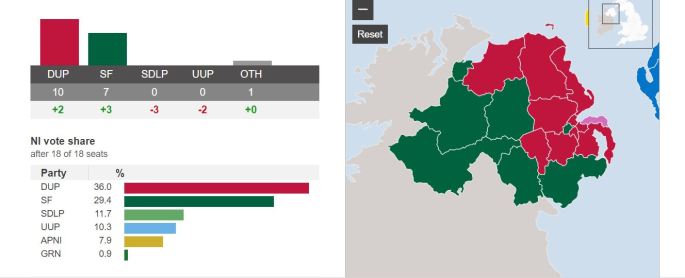
This Broadsheet column first appeared online on June 12th 2017. In it, I explore the ramifications of the 2017 Westminster election result on politics in Northern Ireland, and suggest – borrowing heavily from an Irish Times article by Denis Bradley – that politics on the nationalist/republican side may be set for a major change over the coming year… www.broadsheet.ie/the-perks-of-abstinence/

_____________________________________________

BBC NI

The results page from the BBC NI website – www.bbc.com/results/northern_ireland

While the outcome of the Westminster election was far from conclusive in England and Wales, the same cannot be said for Scotland and Northern Ireland.

Only for the resurgence of the Scottish Tories under Ruth Davidson, Theresa May would be moving furniture rather than clinging to office by her fingertips. While the same Scottish result has, sadly, delayed the prospect of an Indy2 referendum, as the SNP Westminster representation collapsed from 56 seats to just 35 thanks to a 13% drop in support.

Continue reading “The perks of abstinence…?”

I have my doubts about Enda Kenny’s emigrants’ votes plans

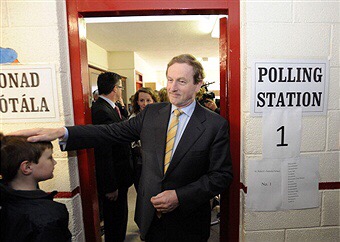
Enda Kenny’s fascination with his predecessor John A. Costello continues. Not only is Enda determined to beat Costello’s record for time served as Taoiseach, he now seems to want to eclipse Costello’s penchant from making major constitutional announcements outside the country.

Costello announced his intention for Ireland to abandon the External Relations Act (and effectively quit the British Commonwealth and declare itself Republic) during a visit to Canada in 1948, while Kenny announces in Philadelphia that he intends to hold a referendum to give the Irish diaspora votes in future Irish presidential elections – but only in elections after the next one.

There are many legends about Costello’s Ottawa announcement, including one version that claims he made it when was “tired and emotional” and another that asserts he did it after being offended by the placing of a replica of the Roaring Meg canon used in the Siege of Derry in front of him on the dining table at a formal dinner at the Governor General’s residence. But they are only legends.

Continue reading “I have my doubts about Enda Kenny’s emigrants’ votes plans”

I hate to admit it, but @JuliaHB1 and other #brexiteers may have a point, just not the one they think

Here is my Broadsheet article from Sept 28th regarding the calls for a second #Brexit referendum vote. I would love to be able to support the call, but I cannot. Experience of re-runs of Irish EU referendums tells me that this is not an option in the UK given the high voter turnout.

————– 

questiontimeI have to confess that my heart sinks a little whenever I hear English Tories or English nationalists, like Nigel Farage, mention Ireland during their rants about the EU. The reference is usually patronising or condescending or – even worse – is given in the form of advice that would have us join them in their march back to a glorious era that never existed.

This is why my heart sank when Julia Hartley Brewer, a British Talk Radio host, Leave campaigner and former political editor, stated on last Thursday’s BBC Question Time that the EU had forced Ireland, and other countries, to vote again on EU referendums.

Her comments came during the course of a discussion on whether Britain might have another referendum on Brexit – a proposal put forward by the failed Corbyn challenger, Owen Smith MP or that the UK might have a separate vote on the final deal hammered out on the conclusion of the Art 50 negotiations, an idea put forward by Tim Farron’s Liberal Democrats.

Though hearing Hartley-Brewer getting it badly wrong on the notion of the EU ‘forcing’ us to vote again made my heart sink a little, it sank even further when I realised that she and her fellow panellist that night Jacob Rees-Mogg MP (who looks like he is being portrayed by Joyce Grenfell) may actually have a point, just not the one they think.

Though I and other Remainers may wish it to be otherwise, the hard fact is that Ireland’s voting again on the Nice and Lisbon treaties is not relevant to the UK’s situation for one simple reason: turnout.

In the first referendum on the Nice Treaty (Nice I) in 2001 the turnout was just under 35% – the result then was 54% No: 46% Yes. At second referendum on the Nice Treaty (Nice II) in Oct 2002 the turnout shot up to just under 50% with Yes getting 63% and No dropping to 37%.

It was a broadly similar situation in the case of the two Lisbon Treaty referendums. In Lisbon I in June 2008 the turnout was 53%. No won by 53%:47%. At Lisbon II the turnout had again increased, this time to 59% with Yes now winning by 63%:37%

In both cases the turnout in the first referendum was low to start with, in the case of Nice I it was exceptionally low, just in the mid-30s, so there was a convincing argument to be made for a second vote, particularly when you felt that a second referendum would have a higher turnout.

This was not the case in the UK’s Brexit referendum. The turnout there was a whopping 72%. This is a substantial turnout. It is much higher that recent UK General Election turnouts, indeed you have to go back to Tony Blair’s 1997 election victory to find a UK general election turnout of over 70%.

The huge political risk you take by having a re-run second Brexit referendum in these circumstances is that you get a lower turnout. It is politically saleable to try to reverse one mandate with a smaller one?

To be clear, turnout alone was not the reason why there were re-runs of the Nice and Lisbon referendums. In both cases post referendum polling and analysis found that the main reason for voting “No” or abstaining was a lack of knowledge of either treaty. Both “Yes” and “No” voters were highly critical of what they viewed as a dearth of clear, accessible information on the treaty’s merits.

While the Remainers can clearly point to a lot of misinformation from the Leave side, not least the claims that leaving would mean £350 million extra per week for the NHS, they cannot yet point to any substantive research or analysis suggesting any changes in opinion.

Noted UK pollster, Prof John Curtice, reckons that there is little evidence of a “significant rethink” three months on from the result with those who voted Remain still convinced that they were right and likewise for the Leavers. Very few minds have been changed, though let us see if that remains the case as the details of the Brexit deal on offer emerge during the course of the next year or so.

The problem with all this abstract discussion on a second referendum is that it takes the focus away from the very real and tangible issues with the first result: most crucially that the Hartley Brewer, Farage and others do not want to honour the clear Remain majorities in Northern Ireland and Scotland. Instead they want to use the votes of English and Welsh people to forcibly drag Northern Ireland and Scotland out of the EU against their declared will.

This is no small issue, yet it is receiving scant attention in the UK and, sadly, here.

Voters in both Northern Ireland and Scotland voted convincingly to stay in the EU, by much bigger margins that the people across the UK voted to leave. Many of those voters in Northern Ireland hold Irish passports and are thus also EU citizens, even if the UK leaves. Can that citizenship – and the guarantees and privileges it offers – simply be snatched away from them on the say so of 50%+ of voters in the south of England?

As people like Michéal Martin and Colum Eastwood have repeatedly said over the past few weeks and months; trying to drag the North out of the EU against its will ignores the layered complexities of the Irish political process.

It is a refutation of the basic principles of the accommodation achieved in the Good Friday Agreement and that is something that concerns all of us on this island.

We should be debating and discussing this now. We should be looking at the significant consequences of Brexit for our economy, for our trade – both North/South and East/West, our education system, out health service.

We should not allow the foot dragging by the British Government on outlining its terms of exit to stop us from forcefully setting out our concerns and our alternatives. We need the speedy establishment of the all-island political/civic forum I called for here at the end of June. I know the Taoiseach and his team messed up their first attempt to get the idea up and running, but they need to go again and get it right this time.

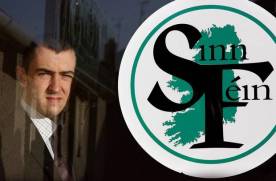
Sinn Féin is not so much a “party in transition” as it is “transitioning into a party”

This is my Broadsheet column from last Monday (Sept 19th) and appeared online here: www.broadsheet.ie/still-behind-you/

——————-

fu

Yesterday was a busy media day for Sinn Féin’s Deputy Leader, Mary Lou MacDonald. Within the space of an hour she had appeared on RTÉ’s The Week in Politics and BBC 1’s Sunday Politics.

Mary Lou was doing what she does better than anyone else in Sinn Féin: taking no prisoners, firmly holding the party line and all without seeming unduly hostile or aggressive.

During the course of her one-on-one interview with BBC Northern Ireland’s Mark Carruthers; Mary Lou described Sinn Féin as being a party “in transition”.  Given the context this was a reference to either: the potential for generational change in the Sinn Féin leadership or, to Sinn Féin’s ambition to be more seen as a potential party of government.

Perhaps it was a reference to both – either way, I am sure Mary Lou meant the phrase to convey the sense of a political party undergoing change and development.

I happen to agree that Sinn Féin is “in transition”, except that the transition I believe it is undergoing is into becoming a normal political party. It is a transition that it has been undergoing for some time, with varying degrees of success, but it is still an ongoing process.

Sinn Féin is not so much a “party in transition” as it is “transitioning into a party”.

The party leadership is an obvious example. It is not the only example. Normal political parties do not have T.D.s collecting convicted Garda killers from prison upon their release, nor do they hail convicted tax evaders as “good republicans”, but for the purposes of this piece, let’s just focus on the autocratic nature of Sinn Fein’s leadership.

Though he is over thirty-three years in the role, we are expected to believe that no one over that time in Sinn Féin has ever been unhappy with Gerry Adams’ leadership or ever willing to challenge openly it.

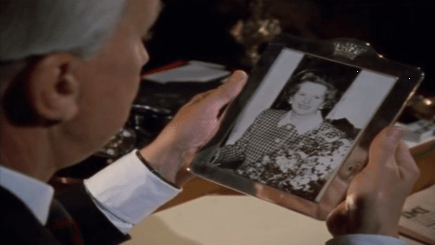
For most of those 33 years obedience to the leadership of Adams and McGuinness has been a core principle – one that seemed to trump everything else. But as the fictitious Chief Whip, Francis Urquhart, observes in the opening sequence of House of Cards: “Nothing lasts forever. Even the longest, the most glittering reign must come to an end someday.”

The blind obedience has started to slip over recent years. From the resignations of various Councillors North and South in the years after the 2007 election to more recent murmurings, including the resignations of 18 SF members in North Antrim in protest at the manner in which a replacement MLA was appointed and the Chair of Sinn Fein’s Virginia-Mullagh Cumann writing to the Irish News to say it was time for Adams to step down.

Even the most disciplined and united of political parties have various groups or factions not entirely happy with the leader. Our post popular and electorally successful party leaders like Jack Lynch, Garret Fitzgerald or Bertie Ahern have had their internal party critics, even at times when their leadership seemed at its most secure and assured.

They either feel the leader is too progressive or too conservative, too weak or too strong, or they believe that their personal talents and skills may be better recognised if there was a new leader in place.

These stresses and pressures are customary in a normal political party. They are the forces that keep a political party democratic. They are also forces that grow over time, particularly after a leader has been in place for a decade or more. They

Now, after over three decades of Gerry Adams’ leadership, it seems that Sinn Féin has a plan to do what other political parties do routinely and relatively seamlessly: change leader.

Except in Sinn Féin’s case it is a “secret” plan. Even the current Sinn Féin Deputy Leader concedes that she does not know what precisely is in this plan.

In most political parties the process for electing a new leader is transparent. People can see how potential leadership candidates are nominated and who has a vote in electing the new leader.

In some cases, this is done by an electoral college such as in Fine Gael where members of the parliamentary party have 65% of the votes; party members 25% and county councillors 10% or, as in the case of the Labour Party, it is done via a one member one vote system with all valid party members having a vote – though as we saw in the recent contest only the parliamentary party can nominate the candidates.

How will it happen in Sinn Féin? The stock answer from Adams and others is that the Sinn Féin Árd Fheis will decide, but how will that play out? Will it really decide? Will there be a real contest with rival candidates travelling to constituencies to meet those voting in the leadership election and set out their competing visions.

Or, will a new leader ‘emerge’, as the British Tory party leaders once did, following the intervention of a group of shadowy figures in Belfast with that decision gaining the semblance of democratic authority with a set-piece ratification at an Árd Fheis.

While I won’t hold my breath waiting for that change of leadership to actually happen, I am also a political realist and recognise that asking any leader to be specific as to when they plan to stand aside is to ask them to surrender their leadership at that moment.

How Sinn Féin conducts the change of leadership, whenever it happens, will be a major test of its transition. It will determine if the transition is merely an illusion or it is a sincere and genuine attempt to become a real political party.

Though I am clearly no fan of Sinn Féin, I believe that it is more the latter than the former, particularly as the organisation takes on new members and is compelled to allow more internal debate. Time will tell if I am right to be so optimistic.


Sinn Féin’s Martial Docility – my Broadsheet column from Aug 22

Here is my “Mooney on Monday” Broadsheet.ie column from August 22nd  www.broadsheet.ie/sinn-feins-martial-docility/ Here I discuss the resignation of a Sinn Féin MLA and how it serves as an indication of the level of strict and unfaltering discipline that still operates within Sinn Féin.


Sinn Féin’s Martial Docility

2016-08-19_new_23906427_i1If there is one thing the Provos do well, it is commemorations. Give them the slightest reason and out come the banners, wreathes, black polo-necks, replica uniforms and the gang is ready to march anywhere.

So zealous are they to remember and memorialise that the objects of their commemoration do not even require any direct connection. All that is needed is a rallying cry, a route map, a bit of media attention and they are all set to go.

It is therefore curious, given this penchant for marking the contribution and sacrifice of others, that neither former Sinn Féin M.L.A. Daithí McKay nor Sinn Féin activist Thomas O’Hara can expect to find their colleagues publicly commemorating them anytime soon.

Last week, McKay resigned his Stormont seat and O’Hara was suspended as a Sinn Féin member after the Irish News accused McKay, then chair of Stormont’s Finance committee, of arranging for O’Hara to coach a witness due to appear at McKay’s committee in September 2015.

The witness, loyalist blogger Jamie Bryson, was there to give evidence about allegations of political corruption linked to Nama’s £1.3 billion “Project Eagle” sale of Northern Ireland property. At the Committee hearing Bryson made allegations of kickbacks to a senior politician and, at the conclusion of his evidence, accused then Northern Ireland Peter Robinson of being that politician.

This is in line with the advice Bryson received from O’Hara on Sept 19th in their Twitter direct message exchanges:

O’Hara: When talking about Robinson refer to him as ‘Person A’. So say all you have to say about him referring to him as Person A. Then in your final line say: Person A is Peter Robinson MLA.

Means that the committee cannot interrupt you and means that you don’t have to say robbos name until the very last second. So then it’s job done!

Shortly after the Bryson evidence, McKay was at the Dáil’s Public Accounts Committee on October 1st to discuss his committee’s investigations into the Project Eagle deal. Responding to a specific question from Deputy Shane Ross on Bryson’s evidence and why the NI Finance Committee had decided to call him, McKay replied:

Mr. Daithí McKay: It is well known that he [Bryson] has blogged at some length on this. It is also well known that he appears to have a lot of material which some believe may have been fed to him from another source. It was an issue of debate for the committee. What the committee agreed to do was to set a bar. The bar that has been set for him and future witnesses is that they have to prove that they have some connection to the terms of reference of the inquiry.

Oh the irony of McKay talking about Bryson being “fed” and his setting the bar high.

So, why does any of this matter?

Well, there is more to this episode than just dodgy goings on by Sinn Féin at Stormont. Nama’s Project Eagle was the single biggest property sale in Irish history. The investigation by Stormont’s Finance Committee was supposed to establish the truth behind the accusations of wrong doing.

Perhaps that Stormont Committee was never going to be able to uncover the truth behind the deal and expose whose fingers were in the till, but as the SDLP Leader, Colum Eastwood, has pointed out: “Sinn Féin’s interference in that democratic investigation has only served the purposes of those who are alleged to have corruptly benefited from the Project Eagle deal in the first place”.

It is hard to imagine that was Sinn Féin’s primary intention, yet it is the likely outcome of it. So why, after months of posturing and calling for a full public investigation of this massive property deal, would Sinn Féin undermine an element of that investigation?

Were they just eager to get Robinson’s name on the record or could they have had other pressing political considerations at the time? At around this this time last year senior PSNI officers were linking a murder in east Belfast with the Provisional IRA. That killing was thought to have been in revenge for a killing in May.

We are now expected to believe that undermining of what is a very legitimate public concern was all done by two lone wolves: McKay and O’Hara without any input, sanction or direction from others? Really?

The current N.I. Finance Minister, Sinn Féin’s Máirtín Ó Muilleoir has described the contacts between Bryson and the Sinn Féin officials as “inappropriate”. He denies any involvement with or knowledge of their communications, though he was a member of the McKay committee when Bryson gave his evidence and was even mentioned twice in the O’Hara/Bryson exchanges.

If the positions were reversed down here and it was a Fine Gael or Fianna Fáil Minister facing such questions, it is hard to imagine Messrs McDonald, Doherty or Ó Broin being quiet as phlegmatic and dismissive as Ó Muilleoir appears in his statement this morning.

The fact that both McKay and O’Hara have so readily been thrown under the bus without even a whimper from either is not only a testament to their loyalty and commitment but an indication of the level of strict and unfaltering discipline that still operates within Sinn Féin.

Can you imagine a T.D., Senator or Councillor in any other party being so ready to walk away so silently? No, me neither.

While it is tempting to speculate that Michéal, Enda or Brendan might yearn to have such command and mastery over their flocks, I suspect they are content to forego such control as they see the bigger picture and know that democratic accountability is not well served by such martial docility.