Coalition Junior Partners Come Off Worse Eventually

My column from Thursday’s Evening Herald (27/Sept/2012)  on Eamon Gilmore’s travails following Dep Roisín Shortall’s resignation.

________________________________________________________________________________________________________________

Who would want to be the leader of the Labour party today? No doubt Éamon Gilmore still does, though perhaps with a little less relish than he exuded last Monday when he was sitting cheerfully behind me on the early morning flight to Brussels.

Former Labour Party Leader
The late Frank Cluskey – took a principled stand on Dublin Gas

While the dip in Labour’s fortunes revealed in the previous day’s RedC poll may not have demonstrably dampened his ardour, last night’s dramatic resignation by Roisín Shortall will.

Eighteen months in office and he is looking like the Mr Worthing character in the “Importance of Being Earnest:”: losing  one Junior Minister, may be regarded as a misfortune; to lose two looks like carelessness.

But isn’t this what happens to the smaller party in Government? When they get into battles with the larger party, don’t they usually come out the worst?

A quick glance at the history of coalitions and it would appear otherwise.

The electoral reality is that going into office costs the smaller party seats at the next election. It takes the bigger risk and, in return, gets a say in policy above its Dáil strength.

That’s the deal. Both partners they know they need the other. It is not for eternity, maybe not even for the full five years of the term, but each knows that without the other neither would in power. unless one sees an alternative, in which case the balance is disturbed.

I served in two Fianna Fáil led coalitions featuring feisty junior partners: the Greens and the Progressive Democrats. While there were the occasional stand-offs, indeed one partly led to my departure, these were the exception to the rule.

Coalition work and last where there is a well negotiated and defined programme for government around which they can agree.

Naturally, where there are two distinct parties with their own hinterlands and approaches, there will be tensions. In my experience these were confined to issues not specifically covered in the Programme for Government or those thrown up by unexpected events.

The other main source of disruptions were the interventions from senior figures, just outside of government, in the smaller party who saw themselves as the conscience of their party, Dan Boyle was particular master of this dark art. While the major partner was usually the main target of these outbursts they were just as often designed to embarrass, irk and provoke their own ministers.

While deeply frustrating, these things came with the territory.  The larger party in a coalition knows it needs the smaller one to stay in office. While it can never allow itself to be seen as a pushover, it also knew that the smaller party could not stay long in office if their members felt there were being used as a mudguard.

This is what makes Roisin Shortall’s resignation so significant. Unlike most ministerial resignations this was about policy. Yes, there are personality and political dimensions too, but essentially this is about adherence to the programme for government.

Her departure is reminiscent of the late Frank Cluskey’s 1983 resignation from Cabinet not only because it too was about policy, but also thanks to the increasing number of comparisons been drawn between both administrations’ handling of the economic problems facing them.

But, as with most parallels, it is not a perfect one. While his departure was a protest against Fine Gael’s stance on Dublin Gas, Shortall’s resignation is just as much about her own parties role in government as it is about Minister Reilly’s capacity to run a department.

When Frank Cluskey quit he made it clear that he did not expect other labour ministers to follow him out and bring down that government. There was no hint that he had lost any confidence in his colleagues. The feeling was mutual. At the meeting following his resignation he reportedly received a lengthy standing ovation from his parliamentary colleagues. Can Deputy Shortall expect to be cheered to the rafters by messers Quinn, Howlin, Gilmore and Rabbitte when they next week? I doubt it.
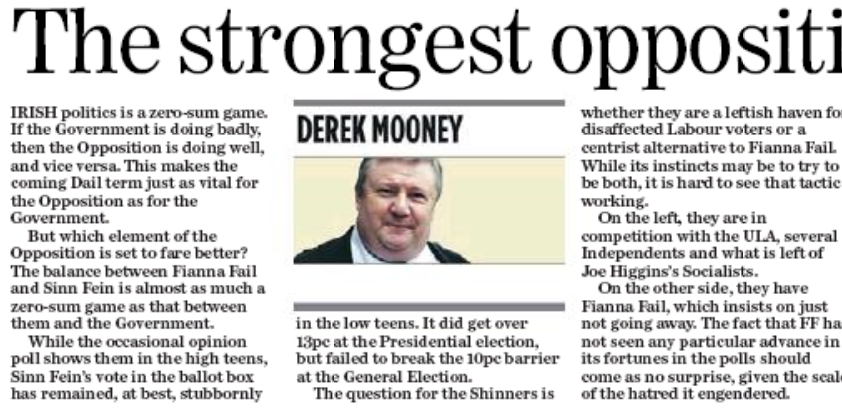
The Strongest Opposition may be within the coalition itself

The text of my column from tonight’s Evening Herald (Mon Sept 17th)

—————————————-

Irish politics is a zero sum game. If the government is doing badly; then the opposition is doing well, and vice versa.

Derek Mooney’s Column in tonight’s Evening Herald

This makes the coming Dáil term just as vital for the opposition as for the government.

But which element of the opposition is set to fare better? The balance between Fianna Fáil and Sinn Féin is almost as much a zero sum game as that between them and the government.

While the occasional opinion poll shows them in the high teens, Sinn Féin’s vote in the ballot box has remained, at best, stubbornly in the low teens. It did get over 13% at the Presidential election, but failed to break the 10% barrier at the General Election.

The question for the Shinners is whether they are a leftish haven for disaffected Labour voters or a centrist alternative to Fianna Fáil. While its instincts may be to try to do both, it is hard to see that tactic working.

On the left they are in competition with the ULA, several Independents and what is left of Joe Higgin’s Socialists.

On the other side they have Fianna Fáil, which insists on just not going away. The fact that FF has not seen any particular advance in its fortunes in the polls should come as no surprise given the scale of the hatred it engendered.

The past 18 months has been about Fianna Fáil stabilising its position. It has put a floor under its decline, which was no small task. The issue now is if it can recover former ground.

While FF may skirmish with SF over ex FF voters who went to Labour, the main battle will be fought elsewhere and with another enemy. Surveys suggest that up to 40% of those who said they voted FF in 2007 switched to FG in 2011.

This sizeable group are still angry and hurt. They have not been ready to listen to Fianna Fáil so far. Will they become disenchanted over the coming months with Enda Kenny and Fine Gael as it struggles to deliver on its election promises?

Will this be sufficient? Will the disenchantment be enough to allow them to listen to anything the party has to say, never mind be convinced by it? These are questions taxing Fianna Fail reps at their think in today and tomorrow.

The opposition parties and independents will also need to consider the competition they face from the emerging, and varied, opposition within government.

It ranges from Brian Hayes and Joan Burton’s fighting over pensioners to FG backbenchers bemoaning its failure to take on the public sector.

The greatest challenge, though, may come from within the Labour Party. There seems to be something about becoming chairman of the smaller party in government that makes the holder think they are the deputy leader of the opposition. I call it “Dan Boyle Syndrome”.

As a first time Deputy; sitting on the government backbenches; the new Labour Chairman may gaze longingly at the other side of the Dáil wishing he were there opposing and criticising the current Government, but he isn’t.

The public gets the difference between government and opposition. They understand the fundamental truth of Mario Cuomo’s famous maxim: “you campaign in poetry but you govern in prose”.

If he thinks doing solo runs will firewall him from the approaching barrage of criticism and unpopularity, then he is in for a nasty surprise. All he needs to do is Google “Dan Boyle” and “election results” to see how these tactics failed.

FG and Lab TDs would do well to heed the words of Mary Harney: “Even the worst day in government is better than the best day in opposition”. This may seem unlikely, but it is the case, especially if you believe politics is about improving things.

If they doubt it, then they only need call the Marine Hotel and ask any Fianna Fáil TD.

ENDS

Intriguing insight into the worklife of Minister Quinn

My column from today’s Evening Herald on Monday night’s RTE 1 #backtoschool documentary “Inside the Department” – a fly on the wall look at life in Education Minister, Ruairi Quinn’s office. 

——————————————————————————

There are times when you despair at how little choice of TV viewing there appears to be on the domestic channels.

Wesht Wing?
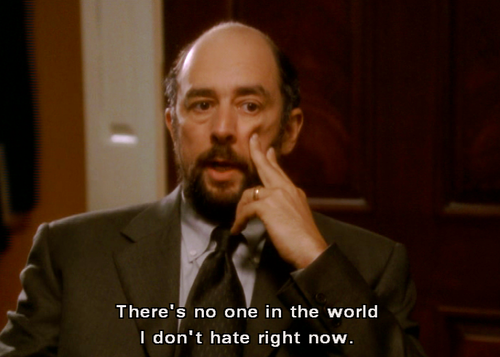
The West Wing’s Toby Ziegler….. not a young Ruairi Quinn TD

Last night was not one of those nights.

You could watch the fly on the wall documentary “Inside the Department” on RTE1 or the latest incarnation of Dallas on TV3.

What a choice. A programme about power, jealousy, feuding, lust, carnality, sumptuous offices, driving ambition, back stabbing, expense accounts and flash cars….. or you could watch JR and Bobby stare it out on Dallas.

As an ex ministerial adviser, I opted for the former and watched “Inside the Department”. Indeed, I not only watched it, I recorded it and watched it a second time.

This was not due to my not believing what I had seen the first time, but rather as a means of catching on the second viewing any gems or nuggets of information I missed on the first viewing.  I needn’t have bothered.

As a PR colleague from the North observed on Twitter last night: like all bad ideas making this documentary probably looked like a good one at the time.

That is not to say it was a bad idea for the producers, far from it. It was interesting programme. The problem is that it did not achieve its goal. It was less a look “inside the department” and more a look at Ruairi Quinn and his kitchen cabinet.

And what a kitchen cabinet it is. I think I counted five of them around a table at one point. When I was a special adviser at the Department of Defence there was just the two of us: me and the Minister’s press adviser. Even so, the then Fine Gael and Labour opposition told us we were over staffed

But even they, notwithstanding their numbers, failed to note that the title of the programme was “Inside the Department” and not “Inside the West Wing”.

They also forgot that they are there as servants of the Minister, not as players. Their role is to aid and assist the minister in implementing government policy. This is work you can best do silently and discreetly.

What possessed them to agree to do interviews to camera and offer what were, in my opinion, smug and ill-considered running commentaries on the events of the day?

Worse still, how did they allow themselves and their Minister to talk so loosely on camera about “summoning” Minister Rabbitte over to the northside and being “wary” of  the planned “off the record” meeting with Rabbitte and a delegation of Labour TDs?

As Minister Quinn said during the programme itself, we all make mistakes, I know that only too well myself, but having such a discussion on camera shows naivety at best.

On the broader front, I got the sense that the neither Minister nor the advisers were ever arguing the public’s side during any discussions: either on the Déis schools or reductions in teacher numbers.

It is called “going native”. It was the accusation that stuck to the last administration after 14 years in office. It is the impression that Ministers and advisers are there to represent and present the policy of the bureaucracy, not the voters.

While it took us the guts of 14 years to that that way, these guys seems to have achieved it in as many weeks.

Listening to them talk and interact with the officials it is almost impossible to believe that they had ever been in opposition. It was if they had no problems with the existing policy and saw it merely as their role to guarantee its seamless and uncritical transmission to the public, with the odd kick at Fianna Fáil thrown in to remind them that this lot is different.

Yes, there were the clips of Ruairi calling the Department “malevolently dysfunction” back in 2010, but where did we see it reflected in his discussion with his officials?

Rather than coming across as our representatives in Government, they came across as the system’s front men to us, more concerned with presentation than substance.

Perhaps the documentary caught the mood of the place accurately, but as someone who believes in the benefits of the adviser system, I sincerely hope it didn’t.

ENDS

Labour TDs could not cause an election: even if they tried

And so it starts. Only eighteen months into a five year term and some jumpy Labour TDs are talking about snap general elections.

While it may be an idle threat, intended to frighten Fine Gael backbenchers, it is the non unnatural response of inexperienced functionaries to the health cut provocations of an inexperienced and dysfunction Minister.

While Minister Reilly’s bluff and bluster approach to his portfolio has irritated and angered many, in his defence it is not as if these Labour backbenchers were not given plenty of warning about the impending health crisis.

Within a couple of months of the last Budget being passed it was clear that health spending was in trouble and that the Minister had not given the health service the tools and supports to make the almost €750 million in savings he was demanding, but were the Labour TDs threatening a general election then? No.

By July those initial worries were confirmed. The mid year numbers showed that health spending was running out of control and the deficit had almost reached €300 million, and was expected to rise to €500 million by year’s end, but were the Labour TDs threatening a general election then? No.

Only now, with the year almost over and the preparations for the next Budget underway, do they find their voices, so what good can they achieve? To be frank: precious little. While some of them may threaten snap elections, the Dáil mathematics suggests that they are powerless and they could not cause an election even if they tried.

Blessed or Reilly?
Minister Reilly tooling up for a meeting with Labour TDs?

While first time Labour TDs may think that sitting on the opposition back benches would be an easier life than sitting on the government ones, Labour front benchers don’t. Does anyone seriously think that the likes of Brendan Howlin, Ruairi Quinn or Pat Rabbitte are ready, willing or prepared to walk away from office?

These guys cannot believe their extreme good fortune to still be there after so long. Some of their Ministerial careers commenced two and three decades ago. Ruairi Quinn was first appointed a Minister back in 1982, Howlin in 1993. They have no plans to go now, or at any mid term re shuffle.

Similarly, many Labour backbench TDs know from reading the opinion polls in their own areas that an election now would only result in them losing out to other left wing parties or independents.

But even ignoring these two very important reasons, the Dáil numbers suggest that Labour withdrawal from Government would not necessarily result in a snap election.

The results of the last General Election gave Fine Gael 76 seats, Labour 37, Fianna Fáil 20, Sinn Féin 14, and 19 various left wingers and assorted independents. The death of Brian Lenihan and the resulting by-election increased Labour’s total by one at Fianna Fail’s expense.

The other changes to the maths are the election of Sean Barrett as Ceann Comhairle, reducing Fine Gael’s numbers by one and the fact that several Government TDs jumped ship, three Labour and one Fine Gael. The three dissident Labour TDs could be expected to follow Labour if it was to pull out.

The point that we forget, however, is that 5 independent TDs voted for Enda Kenny as Taoiseach when the Dáil first met on March 9th 2011.

If these five independents were to stick with Fine Gael that would give a single party Fine Gael Government 80 seats, just three short of an overall majority. Admittedly, this is a very big “if” though the likes of Michael Lowry would find it hard not to vote for his former friends and colleagues.

There is no guarantee that everyone else would vote together to bring about an election. All Fine Gael need is a few abstentions and it can struggle through. The most the combined left: Labour, Socialist, Sinn Féin, People Before Profit and assorted other left leaning independents can muster, at a very big push, is 65.

This gives Fianna Fáil and a few other independents, such as Shane Ross, the effective balance of power. Is that really what these jumpy Labour TDs want?

I doubt it. The bad news for them is that they are stuck on this rollercoaster to the end. They suggested last year that there was as easier way out of this.

There wasn’t. They cannot now just cut and run when the going gets rough. I suppose, in a way, this makes them very much like the rest of us.

ENDS

Switching banks should be as easy as switching mobile phone provider

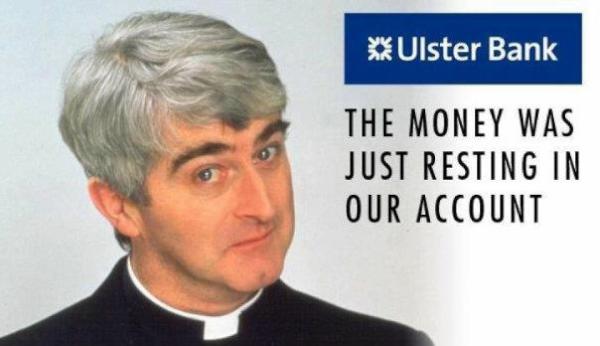
Fr Ted Resting
The money was just resting

I am always struck by how some people can confuse cause with effect. Take Ulster Bank’s Chief Executive, Jim Brown, for example.

Yesterday, as he looked back over the month of turmoil; he noted that no customers had left the bank and that balances had remained flat.

This was said as if it was a measure of his customer’s loyalty to the bank. Might I suggest it is the other way around? The fact that no one has yet closed their account says more about how tough and cumbersome it is to change banks than it does about allegiance

If you are not happy with your mobile phone provider you can switch to another one without any major hassle. You don’t even have to change numbers or go without service for too long. You just make a call and the process proceeds. The same is essentially true for other utilities like internet, gas or even electricity supplier.

In all of these services, competition is king. So, why not in banking?

Switching banks is not easy.

Think of all the new account numbers and PINs to be learned. Think of all companies with whom you have direct debits and standing orders – they all have to be notified and their details changed.

I know how difficult and complex it can be. A few weeks after my dad died early last year my mother called into her bank to sort out a few things following the funeral.

My Dad had never had his own current account or credit card. For years his salary was paid into my mum’s account. I think his name only started to appear on the cheque book around the time of his retirement, though I cannot recall him ever signing one, well not to me at least. The account had always been with the same bank.

I went with to the bank with my Mum that day as she wanted to lodge some cheques and draw out some cash. We had already been to the tax office, social welfare, the credit union and HSE earlier that morning to sort out transfer of entitlements pensions and other stuff. These were all dealt with without any fuss or bother.

But the bank was another matter. One of the cheques Mum was lodging related to my dad’s funeral expenses. When the cashier noticed it she called the assistant manager and we were ushered from the teller’s window to the customer service area.

There we were told that the bank was closing the current account and cancelling her credit card due to my dad’s passing. They said that as one of the names on the account was dead the account had to be closed. They said they would open a new current account and issue a new credit card, both with new numbers and new PINs in the following days.

I asked why this was necessary. They said that it was “bank policy”. I explained that the cheques had only ever required one signature and that my Dad had rarely signed cheques or used the card when he was alive and was probably even less likely to do so now. This somehow failed to reassure them.

Thanks to their policy we then had to spend the following days resorting direct debits and lodgements to a new account number. Even more stressful my mum had to try and learn new account numbers and PINs and forget an account number she had known by heart for over forty years.

Long story short – of all the paperwork we had to sort out following dad’s death, the bank’s was the most burdensome and pointless: and this wasn’t even about moving the account to another bank, it was just about leaving it there and changing one name on it.

Simplifying the process of changing banks and allowing you to keep the same account number when you do move would be a start to real banking reform at ground level and a sign that customers matter.

Why lobbysits are so vital for all communities

My Evening Herald column from last Saturday (23rd June 2012)

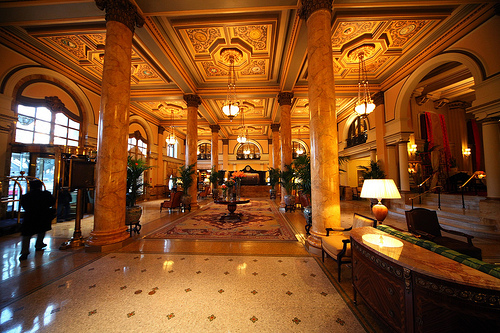
Lobby of The Willard Hotel in DC
Pic courtesy of biberfan on flickr

I have an aversion to the term: lobbyist. I resisted its use in describe myself when I worked with a range of national representative groups and I can’t recall ever using it to describe those whom I dealt with while I was a ministerial adviser.

The term “lobbyist” seems to have a pejorative tone to it. Lobbying is viewed with suspicion. Understandable enough after the Tribunal horror stories of men in well cut suits loitering outside Council chambers offering “incentives” to errant Councillors.

The reality is that lobbying is a practice as old as government itself. The origins of the term are often erroneously attributed to the post Civil War US President, Ulysses S. Grant.

Grant was fond of retiring to the bar of the old Willard Hotel across from the White House. News of his habit soon spread and he increasingly found himself besieged by promoters of this or that project as he passed through the lobby of the Hotel.

The term, in fact, well predates Grant and the Willard Hotel and most probably goes back to 17th century England and refers to the lobbies where constituents and petitioners could meet Members of Parliament.

Yet somehow the image of rail tycoons and land speculators in the lobby of the Willard smoking big cigars while stuffing cash into the pockets of pliable politicians seems to have stuck

This is a great pity as lobbying is an entirely legitimate and democratic activity. It is even protected by the First Amendment to the US Constitution which speaks of the right “…to petition the government for a redress of grievances.”

Substitute the words “advocacy” or “campaigning” for “lobbying” and you get a better sense of what it should be about: making the best case you can to the powers that be.

When it descends to kick backs and payola it is no longer lobbying, it is just corruption, plain and simple.

Yet this is the image that still persists: guys in the lobby of the Willard improperly influencing politicians, and their more modern day equivalents.

But it is a false image. Lobbyists today come in all shapes, sizes and types.

People can be advocates on their own behalf, or they can seek the services of others with experience and skills in presenting a case on behalf of others.

They can be from schools, universities, communities, companies, trade associations, trade unions, churches, charities, environmental groups or senior citizens groups

Not all lobbyists are paid. In my experience (from both sides of the divide) most are not. During my time in government I recall getting more calls and emails from volunteer lobbyists than paid ones.

Lobbying is not simply about getting access to a TD, Senator Councillor or Official. These meetings are just the final small step in a much more complex process.

Lobbying is about preparation. It is about research. It is about assembling the facts and honestly analyzing the implications of what you propose. It is a process – and one more about research, education and communication than it is just about persuasion.

I know, from being on the other side, that a dedicated individual pleading a case that they know and understand deeply can be infinity more persuasive than the most costly lawyer or public affairs consultant.

This was the case with those who campaigned for formal recognition of the bravery of those who fought at Jadotville in the Congo in 1961. Not only were they tireless and passionate, they had done their research. No one knew or understood the complexities of this tragic situation better than they. When presented, their case was undeniable.

Far from having something to fear from lobbying such as this, democracy needs it. Just as lobbyists and public affairs people will benefit from a transparent and fair system of regulation.

As Justice Brandeis observed, almost a century ago. “sunlight is the best of disinfectants”.

ENDS

Is Government the Biggest Threat to a Yes Vote?

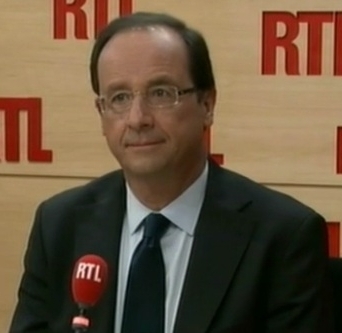
The next French President? François Hollande
(Photo taken from the Hollande Campaign site)

Though the early polls have been positive I am getting a sense that the No side may picking up some momentum as we near the May 31st polling date for the Fiscal Stability Treaty Referendum.

One of the main grounds for this sense of foreboding may indeed be the May polling date itself. I fear having the poll this early may prove the biggest threat to a Yes outcome for three reasons:

1. It allows no side to raise the prospect of a second referendum later in the year. The more astute and sophisticated side of the No campaign is starting to run an argument that goes as follows: We have voted twice on the last two EU treaties.In each case we have come back with a better deal the second time. This Treaty does not come into force until January 2013. We have the time to Vote No now and use the following months to go back and get a better deal and then Vote Yes later in the year. A late September polling date would have denied this argument to them

2. This Sunday see’s the first round of the French Presidential Elections, The Second roubnd of voting will be two weeks later at the beginning of May. While Sarkozy has had a good campaign to date and has closed the gap in the first round the polls there still suggest that Francois Hollande will win the Second Round by approx 55:45.Hollande is standing on recovery platform that rejects Sarkozy’s austerity plan and talks of renegotiating the Fiscal Compact,

While this position may be dismissed as a Gallic version of Gilmore’s “Frankfurt’s Way or Labour’s Way” – ie a promise that sounds good in the campaign but doesn’t survive past polling day – it does look like Hollande is serious. His determination to imeddiately set out a renegotiation the Fiscal Compact to include a growth programme, Euro Bonds etc has probably been strengthened by the attempts of Merkel and other Centre Right EU leaders to snub him.

We will be going to vote during the first days of a Hollande presidency, the background noise to ouyr vote to pass the existing threaty will be his moves to renegotiate that very treaty – almost making a farce of that vote. The politically astute move for our Government would have been to hold off until September and see if Hollande will make a difference.

3. The one great lesson learned from previous referenda, particularly NIce I & II and Lisbon I & II is that the public needs a longer run up/lead in period to tease out the issues. The traditional three or four week campaign has been found to be insufficient, particularly in the absence of “on the ground” campaigns.

Though polling day is about six weeks away there is little sign of that debate is starting yet. Will the Refendum Commission have the time to do the job? Based on the last referendums, it would certainly appear not.  The Tanaiste and Minister for Foreign Affairs had a thirty minute slot on RTE 1 last Saturday where he could have used 5/6 miinutes to explain why voting Yes is important. He didn’t. He chose instead to just give the poll a passing reference, 125 words in a script over 3100 words long. “referendum” featured only once in his script.

While the timing of the polling day is just one factor, it may prove a crucial one. The Treaty should stand or fall on its own contents alone. I am on record here as having my own qualms about the Treaty (see my post here on why I will be a reluctant Yes voter). The debate will be essential. This vote is not like others, we do not have a veto, we cannot delay or deny the progress of this Treaty by our vote alone. The EU has been horrendously slow to act to save itself from the start of this crisis. It has chosen the path of half measures over swift decisive action – usually at the behest of a Franco-German leadership that put domestic political considerations ahead of pan european ones. But we should not be blind to the developing EU real politik.

The appointment of Simon Coveney and Joan Burton as the Fine Gael and Labour campaign directors somehow does not imbue one with a sense of confidence. Coveney’s nomination does echo Charlie Haughey’s appointment of Paddy Lalor as Fianna Fáil national director of elections – a move that spurred the late Frank Cluskey to comment: “There’s confidence for ya”

I Don’t Like The Fiscal Compact Treaty, But I Will Still Vote Yes

My thoughts on why I am not impressed with this Fiscal Compact Treaty, but why I will vote for it and urge others to vote Yes too.  

A few nights ago I was on the cusp of penning a piece as to how it was possible to be a committed pro European and still urge a “No” vote at the forthcoming Fiscal Compact Referendum.

My reasoning broadly ran as follows.

  • While the Fiscal Compact does contain some important measures that would have addressed the fiscal problems that others, not Ireland, had experienced in the run up to the crisis – it effectively does nothing about the core issue facing the EU and the Euro: the dysfunctional European banking system.
  • The EU Council and Commission have wasted over two years taking pointless half measures that tinker about with the symptoms of the problem while studiously ignoring the core problem: the banking crisis.
  • This fiscal compact is just the latest in a series of well intentioned, but minimalist attempts to assure the markets that it ready to address the crisis. Like the others it will fail.
  • What the EU needs now is a short sharp shock to jolt it into effective and decisive action. By decisive action I mean tackling the banking and credit crisis head on and bolstering the role of the European Central Bank to become the lender of last resort.
  • Ireland can not only deliver that shock by rejecting the Fiscal Treaty as inadequate and lacking substance, but it can take the lead – particularly among the smaller, peripheral nations – in demanding that the Commission, particularly President Barroso stop acting as the servants of the French & German governments and get the EU back to being a Union of countries that work together, in partnership and in solidarity for our mutual benefit.

That was my broad theory.

It is not heresy or anti European to say that the Fiscal Compact Treaty does not address the biggest problem facing the economies in both the EU and the Euro.

The point is not that the Fiscal Compact goes too far – it is that it is too one sided. It addresses a secondary problem – not the primary one. It almost completely omits the measures required, specifically on the ECB, to tackle the real problems facing us all.

As I was writing the piece I realised that while I still fully believe in points 1 – 4 the reasoning underpinning Point 5 was fatally flawed.

Ireland rejecting the Fiscal Compact will not be seen as us rejecting it as a half measure. It will be seen as Irish petulance. We have thrown down the gauntlet before – on Nice 1 and Lisbon 1 for reasons that most in the EU failed to grasp.

The Taoiseach and his Ministers have shown not the slightest interest in showing Leadership at the EU Council or of building any consensus among the smaller peripheral countries.

Rather the Taoiseach has been content to roll over and have his belly tickled (metaphorically – I hope) by the big two, and hope that no one will ask him any difficult questions.

He has consistently underplayed his hand for the past year. Stories that talked tough and banged the table at his first Council meeting yielded nothing. Since then he has been content to keep his head below the parapet. The same applies to Eamon Gilmore.

There is nothing to suggest that either are capable of building a consensus across the EU. The reality is that neither have attempted it. Their antithesis to travelling to meet other leaders or hold bi-laterals here is mind boggling, especially when you consider how they howled in opposition that the last Government was allowing Ireland’s reputation to slip.

None of this augurs well for Ireland’s forthcoming EU Presidency, but that’s another story.

Those pointless rejections of Nice 1 and Lisbon 1, are now coming back to bite us. Those who urged us to say No then, are once again in the vanguard urging us to Vote No once more. Their reasoning has not changed. They are as Eurosceptic and anti European as they ever were.

Saying No now would be seen as biting the hand that feeds us – even when that hand has been making a few bob from what its been doing.

Worse still saying No would not gain anything by saying No – except to put ourselves in some undefined limbo beyond the revised European Stability Mechanism. Whereas our saying No in Nice 1 and Lisbon 1 held up the process of ratifying those treaties, saying No now will halt nothing.

We have no veto. We have no bargaining chips on this one. There is no point in threatening to pull the trigger when everyone else knows we have no ammo in the chamber.  UCD’s Dr Ben Tonra makes this point very clearly in an excellent post on the politicalreform.e page here.

The conclusion is that we must pass the Fiscal Compact treaty and then use that passing of the Treaty to build a coalition of smaller countries across the EU to tackle the real problem facing us.

I would love to think that saying No would urge the EU into actions that are long overdue. The sad reality is that it will not.

So, just like the French Socialists who were compelled to vote for Chirac in Round Two of the 2002 Presidential elections, rather than seeing Le Pen slip through, I may be taking a disinfectant mat with me to the polling station as I vote Yes.

I want a better treaty. I want a treaty that tackles the real problems. This treaty itself even acknowledges the need for a further treaty.

If passing this one is the price we must pay to get to that point – then let us do so – and quickly.

Taxes won’t make us quit fags. We’ll just smuggle them

A copy of my Evening Herald column from December 28th 2011 

I suspect most of us will be glad to see the back of 2011. As we prepare for its successor we will do so in the hope it will be better and with the traditional list of good intentions for 2012.

There are many things I hope to have the discipline and self will to both do and not to do in the year ahead. Fortunately, one of those things is not giving up cigarettes as I have never had that particular nasty habit.

I don’t smoke. I have tried it a few times, but I have never taken to it. Maybe this helps explain why I have never understood its allure. Sadly, I have seen the damage they can cause close up.

Just under ten months ago my Dad, Fergus, died following a four year battle with lung cancer. He had fought it bravely, but eventually his heart gave out. Not helped by the fact he spent decades smoking 40 a day, un-tipped ones at that.

I have an uncle who still smokes despite the damage it has already done to his health. I have a favourite aunt and various other relatives and friends who I would dearly love to see quit cigarettes.

Clearly, I am not unique in any of this, but I make the point as a background to why I think the recent increase in tobacco duty was a bad idea.

I was chatting with my Mum just before Michael Noonan rose to give his Budget speech. The wanted to see an increase in tobacco duty as she felt it might deter others from going through what my Dad had endured and also help stop her brother from continuing to smoke.

While she was happy with the Budget increase, I fear her hope that increasing the price of a packet of cigarettes by 5c, 10c or 50c will reduce the amount my uncle (or anyone else) smokes will not be realised.

I wish it would, but logic and factual analysis makes it increasingly clear that it won’t.

This is not just me picking conclusions out of thin air. It is the conclusion reached by the Revenue Commissioners’ Economics of Tobacco .report published last February.

It estimated that about 20% of cigarettes consumed inIrelandare not taxed here, ie, they come into the market illegally via smuggling. It also says this figure is rising. Some suggest their estimate is conservative and is probably somewhere nearer a third.

Whatever the precise figure, there are two things we know. We have the highest excise on tobacco products inEuropeand we have increasing levels of black market sales of smuggled tobacco.

The relationship between these two facts is so blindingly obvious that even the Department of Finance has been moved to admit it

Replying to a Dáil question last October, the Junior Minister for Public Expenditure & Reform stated that “The average price of a packet of cigarettes here is €8.65, whereas inHungary it is €2.06… raising tax on tobacco products further would simply encourage the illicit trade..”

So why go and do precisely that? Why indulge in a gesture that not only flies in the face of the facts, but also only serves to benefit the lowest in our society.
Some 218 million smuggled cigarettes were seized in 2009. This includes the 120m intercepted at Greenore Port, Co Louth: the largest ever seizure in the EU. But  we still only seize a fraction of the illicit trade. Countless millions of cigarettes, including fake illegally produced ones with prohibitively high tar contents, are making it on to the streets.

This smuggling is funding the activities of criminal and dissident terrorist gangs to the tune of probably €3million plus per week.

Meanwhile the Government loses about half a billion Euros a year in lost taxes that could be used to fund treatments that might actually combat nicotine addiction.

The sad truth is that there is no one simple action government can take to stop people from smoking: this includes plain packaging (a topic I will return to).

The sooner we grow up and acknowledge this fact the sooner we will start to really address the problem.

Twitter: @dsmooney

FF’s Sean Fleming quickly adds up the damage

My review of Minister Brendan Howlin’s day 1 budget speech. http://www.herald.ie/news/ffs-fleming-quickly-adds-up-the-damage-2954736.html

This is the first budget since Ruairi Quinn’s 1996 one where Fianna Fail have been in the position of having to respond as an opposition.

Only a handful of the remaining Fianna Fail TDs have any experience of replying to a budget statement on the hoof, like this.

Back then they had both the numbers in the chamber and in their research office to be able to respond robustly. Back then, they were also not hampered by seeng their economic strategy being implemented by the government.

In these circumstances, the party’s spokesperson, Sean Fleming, did reasonably well. His accountancy background enabled him to focus in on some of the finer and more damaging points that appeared in the tables, but somehow managed not to make it into the Minister’s script.

Sinn Fein’s Mary Lou McDonald gave one of her best Dail performances to date. Whereas Fleming stuck with the detail, she concentrated on the politics, excoriating and needling Fine Gael and Labour backbenchers for reneging on their election promises.

Over recent years we have been moving from the traditional westminster model of budgets where the finance minister goes into a self imposed silence or purdah in advance of the statement, to a european one where large elements emerge into the public arena in advance.

While recent budgets have seen their share of advance kite flying, this one brought the craft to new and dizzying heights. 

It is all about the management of expectations. It’s an old trick. Get your people spinning that medical cards might be hit, and then hope the public will break out the champagne, or possibly the Babycham given our straightened times, when they are not.
So the theory goes. In this case the audience was not so much the people at home, but the massed ranks of backbench government TDs who would like to be two term Deputies not one termers.
This may account for the very muted applause after Minister Howlin resumed his seat. Though this may just as much been due to how inappropriate and ill judged the loud cheers and fulsome applause the Fianna Fail deputies gave to their recent budgets seems now.