The system employed by a one man band does not suit the RTE symphony orchestra. 

My take on the recent spate of resignations from the board of the development aid charity, Goal, from toady’s Evening Herald

When well known and respected organisations start hitting the headlines more for their boardroom machinations than their achievements: then its time to start asking some questions.

This, regrettably, seems to be the case with one of Ireland’s known and most highly regarding international aid and development organisations: Goal. I say Goal, though in the minds of many people It has come to be known as: John O’Shea’s Goal.

Over the years the organisation has developed an enviable record for its tireless work in some of the world’s most dangerous and deprived areas. Much of this reputation has been down to the work of its high profile and out spoken Chief Executive, John O’Shea.

He has given the organisation and its cause a strong voice over the years. He has been fearless in speaking out for people in danger across the world and in reminding us of our responsibilities to those in the third world.

In doing this, John has often rubbed people up the wrong way. Including yours truly. During my time in the Department of Defence I feared his appearances on radio or TV and they would usually involve a call that the Irish government send more troops overseas to some new emerging humanitarian crisis.

I was often tempted to contact him to tell him that sending troops into a country or region to which they had not been invited was technically known in the business as an invasion.
I didn’t, as I knew his calls were a reflection of how highly he views the the skills and commitment of our Defence Force peacekeepers and the work they have done in humanitarian missions across the world.

Nonetheless, the fact that he would still issue such calls in the absence of UN mandates does suggest that he might have a bit of a penchant for rushing headlong into action.

John sees a problem and is compelled to act. Its an admirable trait, but it doesn’t work in every situation. Sometimes you need to heed the calmer voices around you who remind you that there are hurdles to climb before you can get to your goal.

It is not that they urge caution to frustrate your aims, they do so to ensure those aims can be more effectively achieved.

Could this account, in part, for the recent resignations from the board of Goal? Could it help explain why the charity has gone through two very effective and well regarded chairpeople in under a year?

The reasons cited in the media for the recent resignations of Directors Fran Rooney and Ken Fogarty were concerns over “corporate governance”.  Though this sounds like a complex subject, in reality it is very straightforward. In plain talk, this means how the organisation is run and who does what.

An experienced administrator from the charitable and voluntary sector once explained “corporate governance” to me as “management proposes, the board decides. Management implements, the board oversees”.

Both sides need to work in partnership, but neither should stray over into the ground of the other. It is a system of checks and balances that ensures best practise and protects both sides. It is especially important in the case of charitable organisations handling and processing millions of Euros per year.

Again, during my time in the Department of Defence, we saw controversy touch the Irish Red Cross when questions of corporate governance were raised. These have been addressed and more robust systems put in place suited to an organisation of its growing size. The organisation did endure some temporary reputational damage, but it also showed it had the capacity to come back and reestablish its reputation. Hopefully, this will prove the case here too.

As any organisation grows and develops, so too must its systems and structures. The system employed by a one man band would not suit the RTE symphony orchestra.
Though they may be cumbersome, these systems and rules are essential to protect those people in the organisation, both paid and voluntary, and to safegaurd the organisation’s goals.

Sometimes you need to stand back to see what it is you wanted to achieve.
Twitter: @dsmooney
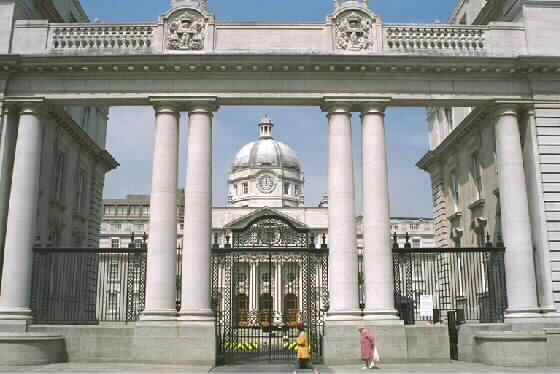
So tell me Minister, how exactly did we find €3.6bn?

My column from the Evening Herald (2nd November 2011) on the discovery by the Department of Finance that we owe €3.6Bn less than we thought; due to an accounting error in the Government’s figures. 

———————–

Wednesday November 02 2011

IN one of his early routines the American comedian Bob Newhart explained how he had to turn to comedy when his career in accountancy came to an abrupt end. He described how he had, as a fledgling accountant, developed his own theory of accountancy which stated that getting within 10pc of the total was enough.

While the idea did not catch on with his bosses in the 1960s, it appears the theory has been rediscovered and redeployed in the Department of Finance.

Finding that we have €3.6bn more that we had is a lot better than finding we have €3.6bn less — but don’t you just feel that if it had been the latter the cuts target for this December’s Budget would have doubled.

At this point I had intended to explain the discrepancy. Having spent about six years in Government reading and dealing with Government estimates and balance sheets I felt sure I was up to the job.

But after about 45 minutes of reading statements from various agencies my head melted and I needed to lie down in a darkened room.

Those who understand these things better, tell me that this has all got something to do with the amount being rolled over like a Lottery prize that isn’t won, though it is possible that I got the analogy wrong.

Liabilities

The one thing I know is that the problem stems from confusion between the National Treasury Management Agency (NTMA) and the Department of Finance.

Up to 1990 only the Minister for Finance could borrow money on behalf of the State. In 1990 that power, along with the responsibility to manage assets and liabilities and negotiate rates on the State’s borrowings, was given to the NTMA.

The NTMA proved itself quickly with savings on the interest paid on our debt roughly equivalent to reducing tax rates by about 10pc.

However, while the authority to borrow and manage the debt was delegated to the NTMA, the responsibility for the accounts and borrowings has always rested with the Minister for Finance and his officials.

There was a change in how the NTMA dealt with the State’s Housing Finance Agency and how it listed their assets and liabilities in its accounts which was not picked up on when the State’s general government debt was calculated.

It is vital that the confusion is cleared up and succinctly explained as soon as possible by the minister and his senior officials in both the Department and the NTMA.

The error is all the more embarrassing as the head of the Finance Department is due to take up an appointment in early 2012 as Ireland’s nominee to the European Court of Auditors.

This organisation is, according to its President , responsible for examining ” … whether financial operations have been properly recorded and disclosed, legally executed and managed so as to ensure economy, efficiency and effectiveness.”

Disciplines

It also raises an interesting general issue regarding the management of government departments. The Irish civil service uses a “generalist model”.

Department officials get a broad experience across a range of disciplines and policy areas. Across their careers, most civil servants can expect to be trained and work in a number of different areas. The benefit of this rotation system is that you get people with a broad vision, enthusiasm and wide experience of varying sectors.

Moving high flyers between sectors and departments helps stem the “it’s the way we have always done it here” mentality. But, it also has a downside. There are fewer specialists in those areas where they are specifically qualified and some posts that should require specialist skills and training are filled by people without them.

It’s just like Sir Humphrey said in a classic Yes Minister episode: “Well obviously I’m not a trained lawyer, or I wouldn’t have been in charge of the legal unit.”

Why current crisis is more political than economic

My latest Evening Herald column from August 8th 2011 – you can also see it online: here

——————————

Euro Parliament Committee Room - Bxl

Success has many fathers, but failure is an orphan. Clearly, no one has told the economists this.

In any other walk of life — architecture, dentistry, cake decorating — people run away when they see failure or disaster looming.

Not the economists. They embrace disaster. They revel in it.

As soon as a crisis looms they rush to the TV camera and the microphone to say how they predicted it.

They take a pride and pleasure in being associated with doom and failure that would do your heart good, if the consequences were not so dire for the rest of us.

In the wake of last week’s market turmoil, the weekend papers and discussion shows were full of economists doing what they do best.

Switching between the radio stations on Saturday and Sunday mornings was like playing some demented radio five-card stud — I see your dollar bond collapse and raise you an Italian bailout.

The Sunday newspapers were as bad with even more dire predictions of either the collapse of the euro or the dollar, or both.

We are living in uncertain economic times … and will be for some years to come. No one needs to tune into the radio to learn that.

This is a major culture shock for many, though not for those of us who lived through the Eighties … and no one wants to see another decade lost to despair and inactivity.

But I digress. So why have we seen renewed predictions of crisis this week? They do not seem to have been prompted by the publication of any eurozone statistics or hard figures.

Neither could they be reasonably explained away as just the result of a global slow news day.

While they may, in part, be due to the outworkings of the American debt ceiling compromise, the giveaway is in the word most often employed by economists in describing the crisis: confidence.

We have seen share values drop and bond costs increase over the past week because market analysts and investors do not have confidence in the capacity of eurozone countries to deal with all the debt in the system.

Could these possibly be the same investors who were protected from massive losses in banks and bad investments by those same governments?

Ironic, isn’t it? Eaten bread may be soon forgotten, but never with anything like the speed and hypocrisy with which socialised private losses are forgotten by the markets.

It is tough to make someone have confidence in you, particularly when you have not got much confidence or trust in them. But wringing our hands in anger on this won’t make the problem go away.

As I said earlier, the past week’s scare does not have its origin in a spreadsheet. It is fundamentally a political issue; not an economic one.

The real danger for us is that the dramatic actions and reforms the market is demanding in return for their “confidence” would be deeply unacceptable to people here and across the Eurozone.

This is the almost impossible balance that the eurozone leaders are trying to strike. To make the changes just about needed to gain market approval without totally alienating public opinion at home. The political spectre of Brian Cowen must stalk their deliberations.

Not that the eurozone leaders merit much sympathy. Merkel and Sarkozy’s slowness to act decisively in the early stages of this crisis has cost us all. Their dithering and loose talk threw Ireland to the market wolves in a futile attempt to stem the tide at no cost to themselves.

Their recent reforms to the European Financial Stability Fund have been more carefully judged, though these will take a while to work their way through.

Meanwhile, the next time you hear an economist demanding firmer and more determined actions, just remember that translates in higher taxes and higher charges for you and yours.

– Derek Mooney

Ireland and Norway are very alike. So, could it happen here?

This article can also be viewed on the Herald.ie site here


Monday July 25 2011

Not only has Norwegian PM Jens Stoltenberg shown great leadership in his measured response to the atrocity which had befallen the Norwegian people, he has also given a new measured response to such attacks with the words: “The answer to violence is more democracy, more humanity, but not more naivety.”

The appalling atrocities in central Oslo and the island of Utoya have rightly shocked us all, not just for their ferocity and callousness but for the fact that they have been perpetrated in the city and a country one associates most with peace building and peace making.

Oslo is not just the home of the Nobel Peace Centre and the location for the awarding of the Nobel Peace Prize, it has also given its name to the 1993 foundation on which peace negotiations between Israel and the Palestinians were based: the Oslo Accords.

Briefly, during the first hours after the car bomb exploded in Oslo many minds turned to the possibility that the attack was the work of Islamist terrorists. The attempted car bombing in Stockholm just before Christmas was as hard to understand, but that attack was linked to Islamist terrorism: the first such attack in the Nordic nations.

It took some time for the full scale of the slaying to emerge for experts and analysts to realise that this was not an attack from extremist Islamists.

It was the polar opposite. It was from a local home-grown ultra-nationalist who feared and hated Islam.

This attack, on his own people, was perpetrated by a man whose own warped world view sees Islam as a threat to the Western way of life and whose online writings denounced Norwegian politicians as failing to defend Norway from Islamic influence.

As we look at the horror, should we consider if such a thing could happen here?

Up to last Friday afternoon the Norwegians did not think such a thing was likely.

They, like us, considered this to be something one only read about in other larger cities and countries. Yet, it happened.

In many ways Norway and Ireland are alike. We are both small, quiet, friendly, liberal democracies most noted in the international context for our contributions to peace support and international diplomacy.

During those brief few hours when speculation focused on an external terrorist cause some suggested Norway’s having troops in Afghanistan as a possible reason why it could be a target.

We too have troops serving in Afghanistan since 2002, so it could also potentially make us one, though Norway’s membership of Nato and participation in the Libyan campaign were also cited as possible causes.

But, as we now know, the reason was not external – it was internal. In Norway’s case this domestic threat was aided by their gun laws: Norway’s large hunting and sports shooting traditions does allow regulated access to a range of firearms.

Back in 2008 the Justice Minister, Dermot Ahern, moved to clamp down on gun controls, especially on the numbers of legally held handguns. Yet there are still many thousands of legally and illegally held guns on this island.

The one thing we cannot legislate for, though, is what goes on in someone’s head. A society cannot protect itself 24/7 from the actions of a lone crazed attacker.

To tackle that we need to turn to the last part of Stoltenberg’s advice: we cannot be naive. While the likelihood of such a thing happening here may be small: it is not zero. We must not be naive, we do need to be vigilant.

My Herald Column: Man overboard as ‘Capt Birdseye’ Reilly caught in storm of his own making

See online here:

Man overboard. Just four months in office and the Government has lost its first back bencher. In fairness, they have a lot of them, so one could hardly matter that much.

The 2011 intake of new Fine Gael and Labour TDs are still so unfamiliar to us that, in all likelihood, it could take a while to notice that two or three of them had gone missing.

At this rate — losing one backbencher every four months — the Coalition could hold on to its 58-seat majority for another 10 years. That is if there wasn’t a general election due in just under five years’ time.

And that’s why this first defection might have slightly largely ramifications than originally thought.

Pressure

Denis Naughten defied the party whip by voting for a Dail motion calling for accident and emergency facilities in Roscommon Hospital to remain open.

In doing so, he has significantly raised the pressure on his former colleagues. The Roscommon Hospital Committee has got a scalp. Other hospital committees and pressure groups committees will be taking notes.

Minister of State John Perry, who promised before the election to return breast cancer services at Sligo General Hospital, will find the heat being turned on him. He won’t be alone in the simmering pot. Government backbenchers in Portlaoise and across the country will find more targeted and co-ordinated campaigns being whipped up over the summer.

Never mind a winter of discontent, this government faces an autumn of anguish. Correction: the Fine Gael TDs face an autumn of anguish on the hospitals issue thanks to the Health Ministers upping the ante just before the election. (He’s the one who looks like a cross between Brian Blessed and Captain Birdseye)

If only he had played it calmer and cooler. Everyone could see Fine Gael and Labour were coasting to victory, but that was not enough for Fine Gael’s health spokesperson and deputy leader. Captain Blessed Birdseye wrote an open letter to the voters of Roscommon saying: “Fine Gael undertakes to retain the emergency surgical, medical and other health services at Roscommon Hospital.”

Last week the Taoiseach sought to defend the good Captain with the argument that Dr Reilly said this when he ” … was contesting the general election (and) he was not in possession of the information about the difficulties surrounding the recruitment of non-consultant hospital doctors”.

This did not, however, explain Deputy Naughten’s announcement at the end of March that Fine Gael had firmly “put a halt to any plans by the HSE to withdraw services from smaller hospitals”, and that it would not only protect, but would also enhance and develop these services.

One presumes that his words had Captain Blessed Birdseye’s blessings. If not, the Roscommon Deputy has made a rod for his own back. If he had, then there is still some considerable mileage left in this story.

This is also about management of expectations. The last government reduced expectations enormously, though as often by accident as by design. This Government came in building up expectations beyond anything that was deliverable.

Enda may come to regret leaving ministers in the portfolios they held in opposition. Yes, they are familiar with the minutiae of the issues, but they are also left to face those promises they made. Fine Gael could well end up reaping a whirlwind it started by itself and for itself. To quote the Book of Proverbs: “He that troubleth his own house shall inherit the wind.” Put that in your sails, Captain.

Derek Mooney was political and policy adviser to a Cabinet Minister 2004-2010 and has worked as a public policy consultant since the mid-1990s

– Derek Mooney

Germany lectures us on debt — forgetting the lessons of its own history

Here is my column on Germany forgetting the lessons of its own history from the Herald (Tuesday June 28 2011)

—————————————————————

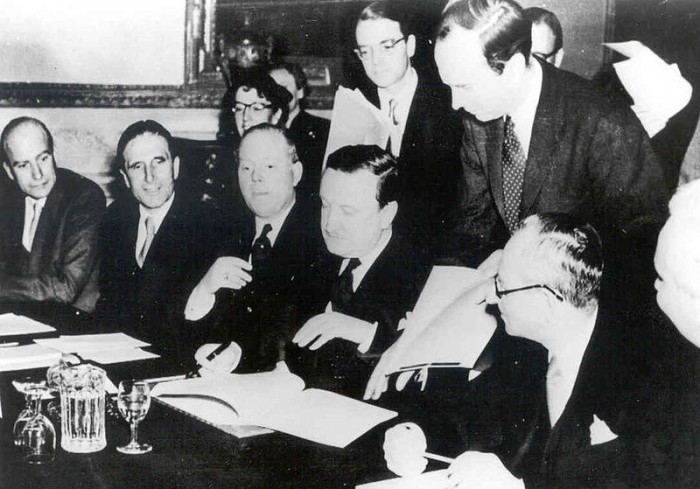
Signing the London Agreement on 27 Feb 1953 (Pic via: http://www.tlaxcala-int.org/article.asp?reference=8440)
Signing the London Agreement on 27 Feb 1953
(Pic via: http://www.tlaxcala-int.org/article.asp?reference=8440)

The media has been full of hourly reports of how the Greek debt crisis has the capacity to send the global economy back into the doldrums.

The Greeks, and by extension, the Portuguese, Irish and Spanish have had to endure tough lectures from France and Germany about the need for austerity.

The German government has been particularly forceful in delivering these lectures. Its leaders tell us their taxpayers do not want to subsidise bloated public sectors or unproductive workers across Europe.

And who could blame them? It is understandable that German workers do not want to pay extra taxes to send money across Europe, even if it is in the form of a loan with generous interest payments attached.

Understandable … but only if you have a short memory and disregard the history of the past century.

An economic historian at the LSE, Prof Albrecht Ritschl, has pointed out that the worst debtor nation of the past century is not Greece, it is Germany — and by a wide margin too. Worse still, Germany is denying to Greece, Portugal and Ireland the precise remedies it needed to rebuild itself. Twice in the last century, after WWI and WWII, Germany has ran up levels of debt that would make the Greek crisis look like a bad night at a mythical Tipperary Casino.

The cost of Germany’s 1930s debt default was as significant as the 2008 financial crisis. A default they were forced into as they could not repay the debts and war reparations set out in the Versailles Treaty following WWI.

This was the result of the rest of the world doing to Germany what Germany and others in the EU are now doing to us. Tons of new debt (in Germany’s case it was war reparations) were heaped on top of existing debt thereby draining the German economy of the ability to rebuild itself.

By the end of WWII, the rest of the world had learned a lesson. It recognised that lumbering a devastated and demoralised Germany with more debt was not a workable solution.

In the 1953 London Agreement on German External Debts, the Allied powers did the exact opposite of what the German and French governments are doing today. They wrote off half of Germany’s total mountain of debt and gave it additional time to repay the monies it owed.

It was thanks to the foresight and generosity of former enemies that West Germany was able to deliver the Wirtschaftswunder (economic miracle) of the 1950s.

This was a deal negotiated between leaders who had learned from the mistakes of the past and could see beyond the political demands of the next election, particularly Germany’s own Konrad Adenauer.

Remember, also, that one of the occupied countries owed money by Germany was Greece. Those protesting in Athens remember that their parents and grandparents had to forego the compensation owed to them.

How galling must it be for them to take lectures from the current German Chancellor on the virtues of paying your debts?

And, in case anyone thinks this is all reaching too far into the past, think again. According to Prof Ritschl, Germany defaulted on one of the conditions of the 1953 London Agreement as recently as 1990.

TOOLS

It is a sad indictment of the current German leadership that it cannot see that denying others the tools that it required to rebuild itself is only storing up trouble for the future.

It does not take a Konrad Adenauer or a Willy Brandt, however, to recognise that Germany’s economic fortunes are so closely intertwined with the other eurozone countries that if part of the eurozone falls, Germany could flounder.

So, even if heeding the lessons of history cannot bring Germany to realise the current policy is not working, self interest just might.

– Derek Mooney