
Why lobbysits are so vital for all communities

My Evening Herald column from last Saturday (23rd June 2012)
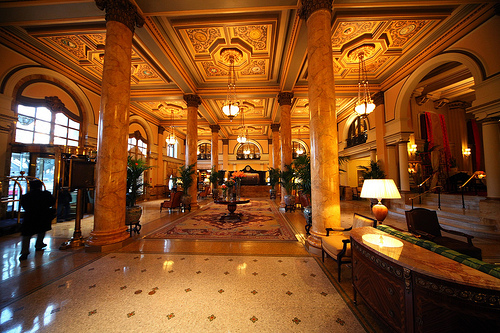
Lobby of The Willard Hotel in DC
Pic courtesy of biberfan on flickr

I have an aversion to the term: lobbyist. I resisted its use in describe myself when I worked with a range of national representative groups and I can’t recall ever using it to describe those whom I dealt with while I was a ministerial adviser.

The term “lobbyist” seems to have a pejorative tone to it. Lobbying is viewed with suspicion. Understandable enough after the Tribunal horror stories of men in well cut suits loitering outside Council chambers offering “incentives” to errant Councillors.

The reality is that lobbying is a practice as old as government itself. The origins of the term are often erroneously attributed to the post Civil War US President, Ulysses S. Grant.

Grant was fond of retiring to the bar of the old Willard Hotel across from the White House. News of his habit soon spread and he increasingly found himself besieged by promoters of this or that project as he passed through the lobby of the Hotel.

The term, in fact, well predates Grant and the Willard Hotel and most probably goes back to 17th century England and refers to the lobbies where constituents and petitioners could meet Members of Parliament.

Yet somehow the image of rail tycoons and land speculators in the lobby of the Willard smoking big cigars while stuffing cash into the pockets of pliable politicians seems to have stuck

This is a great pity as lobbying is an entirely legitimate and democratic activity. It is even protected by the First Amendment to the US Constitution which speaks of the right “…to petition the government for a redress of grievances.”

Substitute the words “advocacy” or “campaigning” for “lobbying” and you get a better sense of what it should be about: making the best case you can to the powers that be.

When it descends to kick backs and payola it is no longer lobbying, it is just corruption, plain and simple.

Yet this is the image that still persists: guys in the lobby of the Willard improperly influencing politicians, and their more modern day equivalents.

But it is a false image. Lobbyists today come in all shapes, sizes and types.

People can be advocates on their own behalf, or they can seek the services of others with experience and skills in presenting a case on behalf of others.

They can be from schools, universities, communities, companies, trade associations, trade unions, churches, charities, environmental groups or senior citizens groups

Not all lobbyists are paid. In my experience (from both sides of the divide) most are not. During my time in government I recall getting more calls and emails from volunteer lobbyists than paid ones.

Lobbying is not simply about getting access to a TD, Senator Councillor or Official. These meetings are just the final small step in a much more complex process.

Lobbying is about preparation. It is about research. It is about assembling the facts and honestly analyzing the implications of what you propose. It is a process – and one more about research, education and communication than it is just about persuasion.

I know, from being on the other side, that a dedicated individual pleading a case that they know and understand deeply can be infinity more persuasive than the most costly lawyer or public affairs consultant.

This was the case with those who campaigned for formal recognition of the bravery of those who fought at Jadotville in the Congo in 1961. Not only were they tireless and passionate, they had done their research. No one knew or understood the complexities of this tragic situation better than they. When presented, their case was undeniable.

Far from having something to fear from lobbying such as this, democracy needs it. Just as lobbyists and public affairs people will benefit from a transparent and fair system of regulation.

As Justice Brandeis observed, almost a century ago. “sunlight is the best of disinfectants”.

ENDS
Who impressed you most during referendum campaign?

Time to Postpone #EURef ?

Text of my Evening Herald column considering the consequences of the French & Greek election results for our forthcoming Stability Treaty Referendum vote

The EU political landscape has changed dramatically in the last 24 hours. The election of Francois Hollande in France and the defeat of the pro bailout parties in Greece will have repercussions far beyond the borders in both countries.

While both results will come as no great surprise to politicians who have been following the campaigns in France and Greece; it seems no one has given any serious thought as to what may now happen.

The focus of such thought, in so much as there has been any, has been on what Hollande might do to make good on his campaign promise to move the EU’s focus on to growth and investment.

There seems to have been very little thought as to what might happen in Greece. As recently as last week, pundits were citing polls that showed that up to two thirds of the Greek electorate accepted the need for a bailout.

Perhaps they did tell the pollsters that but, as we discovered last night, that sentiment did not transfer itself to the ballot box. The reality is that two thirds of Greek voters opted for anti bailout parties of various hues – from far left to far right, leaving the two pro bailout parties in tatters.

The net result, in the short to medium term, will be political stability that will make markets jumpy and herald problems for counties such as Spain and Italy when they go to the markets to borrow money.

The instability in the Eurozone that we thought had abated for a while looks like returning with a vengeance. M Hollande may not have time to set out his vision for a growth and investment plan for the EU – events may well overtake him.

Uncertainty may now be the name of the game in the EU and the Eurozone – yet the Government here seems to think that nothing that has happened in the last 24 hours has changed the mood music here.

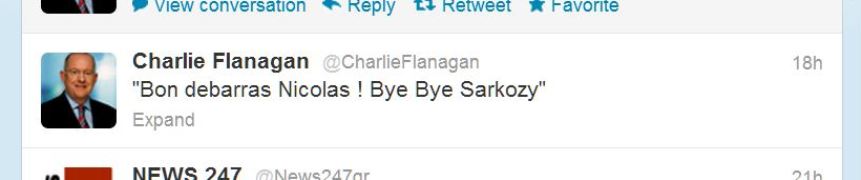
To judge from Tánaiste Eamon Gilmore’s comments the coalition government here believes that the result there has no consequence for the Stability Treaty referendum. The Tánaiste was in Paris, in a signal of European Socialist grouping solidarity, with PES colleague M Hollande. This contrasts with the fickleness of the FG party chairman,Charlie Flanagan’s “Bon debarras (Good Riddance) Nicolas ! Bye Bye Sarkozy” tweet last night.

@Charlie Flanagan FG Chairman
@Charlie Flanagan FG PP Chairman

In Feb 2011 Fine Gael were championing their relations with Sarkozy, Merkel and the EPP – now they deny their former friends. You could almost hear the cock crow three times.

I am no fan of the Stability Treaty. Like others. I believe it is a missed opportunity. It fails to tackle the root cause of the problems in Ireland and Europe – a failed and dysfunctional banking system. But I am not convinced that voting it down brings us one millimetre closer to resolving our problems.

I am a reluctant Yes voter. I hope that passing it may give Germany the cover it needs to allow real reforms to the European Central Bank and the Euro architecture,

For that reason I want to give the Treaty every chance to gain public support. I do not believe that ploughing ahead with a vote on a Treaty that may yet be further reformed – or even improved – serves any purpose. I genuinely fear that going ahead against a background of uncertainty and volatility puts the outcome in doubt.

It is not that I think the combined forces of Sinn Féin and the ULA will convince the people to vote No, but rather that the public will opt not to endorse a Treaty that may be defunct within weeks of passing it.

This is not a new fear. I wrote about the imprudence of holding the vote this early on my website some weeks ago. While I know many would suggest that postponing the referendum sends out the signal that the Government is weak, I think that is better than landing itself with a no vote based on bad timing.

While the Tánaiste is technically right in saying that we wouldn’t need to come back and vote again if a growth package were eventually added to the Treaty – can he really justify putting only half the question to a vote? Would it not be wiser, and more democratic, to wait a few months and put a definitive position to the people?#

It would require more courage and leadership to postpone the referendum than proceed with it. This just may be the reason why it doesn’t happen
May 7th 2012

Independent Study Shows Ireland had 5th Highest Attendance at EU Council Meetings 2000 – 2010

The attached research paper Report on EU Attendance was conducted by Markus Johansson and Daniel Naurin of the Dept of Political Science at the University of Gothenburg and presented at the SNES spring conference in Uppsala 22-23 March 2011.

SNES (Swedish Network for European Studies in political science) is Sweden’s leading research network dealing with questions of European politics and governance.

The study examined 808 EU Council meetings between 2000 and 2010 and found that Ireland had one of the highest average Ministerial attendances at Council of Minister’s meetings, 5th out of the 27 member states.

The authors of the study argue that attendance is an integral part of EU engagement and reflects the priorities of the governments involved. Ireland’s position as 5th highest out of the 27 member states from 2000-2010 is a testament to Fianna Fáil’s committeeman to Europe and strong engagement

This exposes the hollowness of claims repeatedly made by Government Ministers and the Taoiseach that Fianna Fáil failed to attend EU meetings.

Rebel Ó Cuiv is risking a life in political exile

My column from today’s Evening Herald on Éamon Ó Cuiv’s Craggy Island Act

Craggy Island


If you think Fine Gael or Labour party backbenchers have it tough; spare a thought for Fianna Fáil’s sole backbencher: Éamon Ó Cuiv. He has been rarely out of the headliners since quitting as his party’s deputy leader and communications spokesperson.

Though he served as a Minister for the duration of the 1997 – 2010 Fianna Fáil led governments, it took a few disloyal acts as a back bencher to bring him to some form of public fame.

His newly found rebellious streak comes as a bit of a shock to those who remember his ministerial days, particularly his almost eight year stint as Minister for Community, Rural and Gaeltacht Affairs.

That department’s acronym (D/CRGA), coupled with his peculiarly laconic style, earned it the title Craggy Island during his tenure – though whether this was a reference to Fr Jack, Fr Ted Crilly or Fr Dougal was never fully established.

His reinvention as a latter day rebel is not his first metamorphosis. Despite his Man of Aran manner and demeanour he actually hails from the leafy and affluent, Dublin 4. His success at portraying himself as the archetypal westerner possibly owes as much to his lineage as it does to his conscious efforts.

His excellent track record as a public representation in West Galway, has gained him much respect in the party: almost as much as his position as Dev’s grandson.

This is the Catch 22 he seemed to have missed. While the reduction in the size of the parliamentary party has made him a bigger player, the cachet his political heritage confers is also somewhat diminished. The events of the past few years have reduced the currency value of dynasties in the new leaner Fianna Fáil. Isn’t the concept of dynasty incompatible with a truly republican party?

His outspoken comments on Europe, urging the party to a more Tory-esque euro sceptic position have not been the rallying cry he may have hoped for. Many share his view that Europe has not been working together in partnership or solidarity. They see that Europe’s “failure to act decisively and cohesively damaged its reputation and standing amongst its own citizens”.  But they do not see voting No as the logical or sane answer to that problem.

I put that last line in quotes as, significantly, it does comes not from an Ó Cuiv speech, but rather from Michael Martin’s February 9th address to Institute for International and European Affairs, Dublin.

Ó Cuiv’s belief that he is the lone voice criticising the EU does not stand up. Despite his contentions, voting Yes does not require one to draw a veil over the glaring flaws in what the EU have done in addressing the European banking and economic crisis.

While many in the party may be prepared to allow him the occasional euro-sceptic outburst, they draw a definite line at his idea that Fianna Fáil should be cosying up to Sinn Féin. That is simply not on the table for the vast majority of the party’s public representatives at national and local level.

While some see Ó Cuiv’s grá for such an arrangement as a product of the shinner’s relative weakness in his bailiwick, others suggest it exposes his ill-founded, romantic notions of reuniting republicanism.

The Shinner’s provo-ism is the antithesis of Fianna Fáil’s republicanism. The two strands are simply incompatible and have been for generations. For Ó Cuiv to imagine that they are reconcilable does a disservice to those who adhered to the constitutional republican path and underestimates the ambitions of those who espoused the provo alternative

The irony is that Ó Cuiv’s truculence runs counter to the approach his grandfather adopted. Dev believed that being an elected representative of a political party brought responsibility and required discipline. The party decided its policies behind closed doors and everyone stuck to the party line, whether they personally agreed with it or not.

While there is no desire to grant Ó Cuiv the martyrdom that some think he seeks, he may yet force their hand and find himself banished to a Craggy Island of his own making.

May 4th 2012

Labour didn’t know magnitude of problems facing Ireland?

Irish Labour Party - Didn't Know

I have just been watching Labour’s Dominic Hannigan on The Week in Politics and was amazed to hear him claim that Labour didn’t know the magnitude of problems facing Ireland during the General Election campaign last year. He offered this as the reason why they have abandoned so many of the promises made in that campaign.

It is the same attitude you hear when Ministers trot out the glib little phrase “we inherited this from the last government”.

I am long enough around in politics to know that the Government will be using variations on this theme for a long time to come. When there is a change of government, particularly on the scale we saw last year, the incoming Government is naturally going to dump on the previous one.

It happens everywhere. In the UK, although he is well now two year ins office, David Cameron starts off almost every reply to Prime Minister’s questions saying how he is trying to tackle the problems left by Gordon Brown.

Doubtless he will continue to trot out the line for a while more, though polls there are suggesting the British electorate are starting to tire of it,

I understand that the Taoiseach and his assortment of Ministers are going to spend the next year or more prefacing every utterance with the “it wasn’t me, it was like this when I got here” line of attack.

I just wish they would drop the “inheriting” hook and find a line that does not make them sound as if they are some unwilling group plucked from obscurity and press-ganged into taking on the Ministerial offices, salaries and cars against their will.

Most people “inheriting” a situation have found themselves in that space despite their wishes, not because of them. As far as I know you cannot legally inherit from someone you have helped to do in, even when that someone was already doing a good job of doing themselves in.

This government came into office knowing the situation they faced full well. They set it out clearly in their election campaigns and went to the people asking them for their mandate to tackle the enormous problems we face. Labour’s Finance spokeperson said the economy was banjaxed:

The two parties now holding the levers of power have every right to talk about the size of the problems, the need for difficult decisions and to throw a few belts into the outgoing government for good measure.

They should not, however, be talking as if this all something that has taken them somehow by surprise. They also forfeit the right to lash their predecessors on every single issue by effectively taking the same policy approaches.

The health issue and the fate of local A&Es is a good case in point. There is no credibility in the Health Minister outbidding the outgoing Government by writing open letters to the voters in February saying “Fine Gael undertakes to retain the emergency surgical, medical and other health services at Roscommon Hospital”, only to reverse that commitment a few weeks later.

The Taoiseach only adds salt to the wound by offering the defence that when Dr Reilly “…was contesting the general election he was not in possession of the informati

on about the difficulties surrounding the recruitment of non-consultant hospital doctors.”

Labour Leader Gilmore Ranked Second Worst in Poll of Ministers’ Performance

Over the past few days (Tues Apil 11 – 13) I ran a simple poll on my website www.derekmooney.ie . In it I asked people to select the three government ministers they believed were performing best in office.

 182 people voted in the online poll.

The results are as follows: You can download the results in pdf format Rate the Ministers

1

Finance Minister Michael Noonan

2

Welfare Minister Joan Burton

3

Agriculture Minister Simon Coveney

4

Pub Exp Minister Brendan Howlin

5

Transport Minister Leo Varadkar

6

Education Minister Ruairi Quinn

7

Enterprise Minister Richard Bruton

8

Children’s Minister Frances Fitzgerald

9

Communications Minister Pat Rabbitte

10

Arts Minister Jimmy Deenihan

11

Justice Minister Alan Shatter

12

Foreign Minister Eamon Gilmore

12

Health Minister James Reilly

13

Environment Minister Phil Hogan*

If they squabble this much over small stuff… what happens when the big probs arrive?

About a week ago I wrote a piece for the Herald defending the government giving politicians a three week break for the Easter.

Scousers
Calm down lads, calm down

This was, I argued, a welcome opportunity for Ministers, TDs and their advisers to do some of the other boring, but important, work and also to take some time to reflect and think about the issues of the day.
Talk about getting it wrong. No sooner has the ink hit the pages than almost everyone in Government was out in public tearing strips off each other.
The whole cast of characters were involved: Environment Minister: Big Phil Hogan, Health Minister: James “Capt Birsdeye O’Reilly, Finance Minister: Michael Noonan, Arts Minister: Jimmy Deenihan, Welfare Minister: Joan Burton, Communications Minister: Pat Rabbitte, Justice Minister Alan Shatter, FG Party Chair Charlie Flanagan plus a few Government backbenchers including Labour’s Colm Keaveney and Fine Gael’s Regina Doherty.

The week before had seen some on the Labour side saying that Big Phil could have handled the whole household charge thing a lot better. Just as it appeared that that particular row had run its course, news broke that Big Phil was meeting with Moriarty Tribunal favourite and Tipp North TD, Michael Lowry only a few days after the publication of that Tribunal’s final report.

Within hours other Ministers, namely Birdseye O’Reilly and Noonan, were confirming that they too had meetings with Lowry. This was all too much for Joan who questioned the wisdom of this. So too did Jimmy, but more subtly.

Joan’s words riled Charlie who went on Twitter to ask if Joan had a Government death wish. Regina subsequently went on Radio to say Charlie was right and that Joan was wrong. Others thought Joan was right, including Colm, who also went on to Twitter to call the judgment of senior figures in Fine Gael into question.

Meanwhile Pat spoke to the Sunday Independent to say that he was frustrated by the “interminable delay” in bringing prosecutions following Mahon and Moriarty. Within hours of the paper hitting the breakfast table Alan had issued a broadside that had Pat in mind when it stressed the importance of not making public comments that might prejudice proceedings.

By lunchtime the Taoiseach was doing a bad Harry Enfield scouser impression telling everyone to “calm done”. All that was missing was him donning a Kevin Keegan wig and finishing off the interview saying: “Dey do do dat dough don’t dey dough”

Not only did all of this happen in just one week, it happened in very quiet week at that. If this is how the members of the Government deal with minor matters, Lord help us when the big problems come. And come they will.

The Government has had a fairly charmed existence since coming to office. While things are clearly not improving, they have not had to face any genuine crises or policy dramas.

Both parties have endured some setbacks early into their term. but none that really tested them. For Fine Gael it was the losses in the presidential election and referendum, plus the Roscommon hospital fiasco. For Labour it was the loss of three TDS, including a Junior Minister and a by-election winner, though these were offset by their man winning the presidency.

The handling of the household charge suggests they lack a certain deftness of touch, yet it pales into significance against the problems they may yet face in the years ahead.

How will a government that descends into public squabbling and faction fighting at the mere mention of the names of Moriarty Lowry or O’Brien cope if Merkel Draghi or Barroso decide to turn the thumbscrews on Corporation tax or whatever?

Have they all forgotten that they will be asking the people to take their collective advice at the end of May and vote yes to the Fiscal Compact Treaty? Might it not help their case to give the appearance of knowing what they are doing and all pulling in one direction?

As to the internecine squabbling, there are several systems in place to stop such petty rows escalating and getting into the public arena. One is called common sense. Another is the special adviser/programme manger system. Isn’t it time to get working on both?

ENDS

Cowen Talks Ireland Up Seeking Inward Investment

The speech at Washington DC’s Georgetown University by former Taoiseach, Brian Cowen, has attracted some comment since it was reported last week in the Financial Times and Irish Times. Much of that comment has focussed upon just about everything about from its contents. It is a well drafted and cogently argued analysis of the crisis that befell both Ireland and the EU and well worth reading in full: Speech By Fmr Taoiseach B Cowen – 21.03.12

Given the venue and context it is evident that this was meant as a low key, considered and informed contribution and not as a political foray. While I think it will, in time, be seen as an important analysis of the situtaion from 2007/08 onwards. I also think it is important to note how the former taoiseach took the opportunity present to talk Ireland up and to touts for business and investment for Ireland. This is particularly evident in the final paragraphs of the speech:

“I believe Ireland is one of the best locations in the world to establish and to grow a business. This is not just rhetoric but is reflected in the rapid on-going overseas investment which is occurring in Ireland. Ireland is not just open for business but as, I believe, any independent assessmentwould indicate it is among the best places in Europe to start and grow an international business. This will ultimately pay off for our citizens. Indeed all of the fundamental strengths which prior to the crisis meant that Ireland had one of the highest growth rates of GNP per capita among advanced countries for a very long period are still in place and in many respects our advantages have improved in terms of increased cost competitiveness.”


Dáil breaks can only benefit both sides

My Evening Herald column from Saturday March 31st arguing that breaks in Dáil sittings are necessary and beneficial


Leinster House

On Thursday Dáil Éireann takes a break for the Easter recess. It is set to return on April 18th. Cue a hue and cry from opposition TDs and assorted political hacks demanding that the Dáil return sooner or sit longer or whatever.

These protests are not only regular and predictable, they are just as entertaining as they are pointless.

These sham battles seem to be based on the notion that the more the Dáil sits the better. Really? It is hard to sustain that argument when you look at the household charge fiasco.

In its recent annual report the Government commends itself for increasing the number of sitting days, saying that the Dáil sat for about 127 days, roughly 36/37weeks, in its first year.

According to the government’s calculations this is a 44% increase on the number of sitting days in the first year of the previous Dáil (2007/08).

A major achievement you’d think. Though not quiet as impressive when compared with the years 2008/09 and 2009/10 when the Dáil actually sat for 35 weeks per annum.

But what’s a week or two between old sworn enemies?

It is the old public sector problem: measuring inputs, not outcomes. Successive governments have been guilty of it.

The Government’s legislative programme should be driven by the number of pieces of legislation it wishes to pass into law, not by a need to produce bits of legislation to fill up some allotted time slot.

TDs should not be apologising for the Dáil not sitting in plenary session over the next three weeks.

Yes, various Oireachtas committees will be sitting during that time – but something else should also be happening. Something that is, in my opinion, far more important.

Politicians and their policy advisers should be availing of this break to do something they rarely get to do: think and prepare.

There is a story, probably apochryphal, about a Minister walking along a corridor in his Department when he spies a senior policy maker sitting back with his feet up on the desk. “Have you no work to do?” asks the Minister, “I have…” comes the reply “…I am doing it now, I’m thinking”.

These short breaks in Dáil sittings afford Ministers and senior officials some time and space away from debates, motions and parliamentary questions to think and to focus on other matters in their departments – things that don’t often make the headlines at Leader’s questions.

Central to this is standing back and taking stock of where they are.

When the Dáil is sitting a surprising amount of time in a government Department can be taken up in answering TDs questions alone, particularly when its that Minister’s turn at oral PQs.

Parliamentary accountability and scrutiny is an essential part of the democratic process, but you also need time to go and effectively do all those things that the parliament will subsequently want to scrutinise.

But if the need for this “thinking” time is important for Ministers and officials is it absolutely vital for an opposition and its support teams.

The Minister has a full time team of 8 or more in his office to fetch, carry and prepare – plus those other senior officials along the corridor to advise and research – the opposition spokesman is often depending on two or three.

But it is not a matter of resources. While the Dáil is sitting the agenda is set by the government. The opposition is usually just reacting to it – or reacting to the media reaction to events.

This is not always a bad thing, especially for an opposition that is effective at harrying the administration. This was the case in the latter half of the last government. The only crumb of comfort it got from the polls was when the Dáil was in recess. When it was in session both oppositions parties’ ratings went up, especially Labour’s.

But an opposition also needs to set the agenda too. It takes a lot of preparation and planning for an opposition to get the focus on its agenda. These breaks can often provide that space.

Politicians on both sides should acknowledge this fact. Who knows, maybe the reporters who cover the Dáil and actually benefit from the break might even credit them for it.

Ends