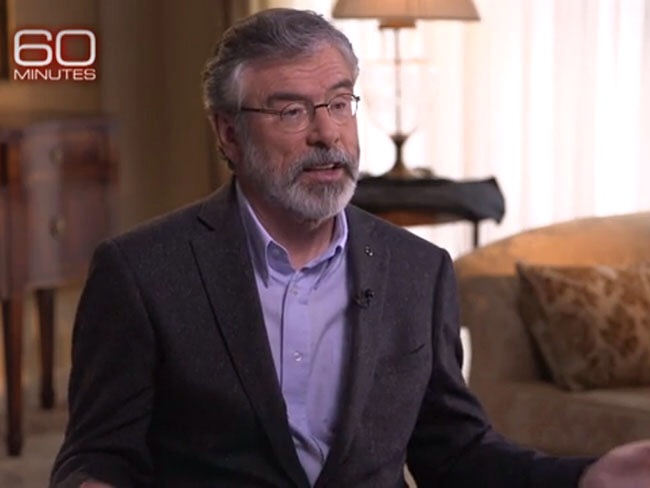
In his interview on CBS’s long running 60 Minutes news show, Gerry Adams describes the murder of Jean McConville as just “what happens in war” going on to say: “That’s not to minimise it. That’s what American soldiers do, British soldiers do, Irish Republican soldiers do. That’s what happens in every single conflict.”
Not only is this a glib response, albeit masked by the inclusion of the phrase “that’s not to minimise it”, it is a starkly inaccurate one on several levels.
Let us take his claim that it is simply “what happens in war”. This serves to give the impression that the killing of Jean McConville is on a par with the very many regrettable but unintended killing of civilians. Without doubt there have been very many innocent civilian victims in wars. Take the bombing of Hiroshima, the bombing of Dresden or the London blitz. In each of these the attackers killed countless thousands of mothers and children, but the killing of Jean McConville was different.
It was not an unintended evil perpetrated by ‘the other side’, it was the very intended and deliberate act of a self proclaimed army against one of the most vulnerable members of its own community. A community of which, let us not forget, that this supposed army declared itself the sole protector and defender. Jean McConville was killed by the very people who claimed to be her protector. Her ten children were orphaned by the people who claimed them as their mandate.
You can imagine the justifiable outcry in the West if it were to emerge that the Israeli Defence Forces had summarily executed a young Israeli mother for offering succour or protection to a young Palestinian? Gerry Adams and the provisional Sinn Féin organisation would be to the forefront in that outcry, yet what is the difference?
The other falsehood is the hidden notion that this all happened in a terrible time of war and was perpetrated by soldiers in a constituted army. This is yet another element in the ongoing manufacture of the provisional mythology. Once again they fabricate the illusion of legitimacy or popular mandate for their imposition of a state of effective martial law on their own people.
There was no such mandate or endorsement. The Provos were not belligerents in a war, they were the propagators of a campaign a terror and violence, a campaign that was as often targeted against its own people as it was against its supposed ‘enemy’.
A campaign that for far too long allowed the UK government to treat Northern Ireland as just a security problem, not a political problem. The campaign had no achievement except to make Sinn Féin and Gerry Adams forces which needed to be acknowledged and dealt with. As we saw in the slow negotiation, and even slower implementation, of the Good Friday and St Andrews Agreements when it comes to putting the interest of Sinn Féin or the people first, the Shinners first, the Shinners win every time.
I have now updated my initial thoughts, musings, observations and mild rantings on the implications of the local election results, particularly Fianna Fáil’s stronger than expected showing.
This was first posted on Sunday morning – updated on Monday morning to reflect the revised party national totals in the Local Elections.
Local Election Results national overview
“If history repeats itself, and the unexpected always happens, how incapable must Man be of learning from experience.” – George Bernard Shaw.
Quite a lot, it seems.
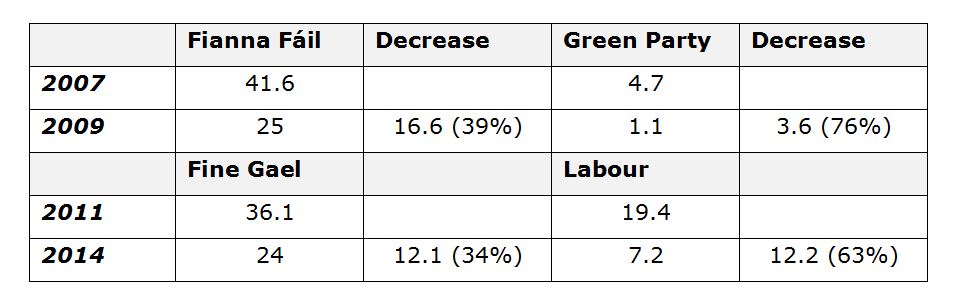
Yesterday we saw history repeating itself, with the electorate visiting upon Fine Gael and Labour almost exactly the same devastating blow it had served up to Fianna Fáil and Labour five years earlier.
In 2009 Fianna Fáil lost around 39% of its support (when compared with 2007) while the Greens endured a massive reduction in its vote of 76%.
Yesterday, based on the Local Election results to hand, Fine Gael lost 34% of its support and Labour lost 63%.
While the story of the Local Elections is the rise in support for Sinn Féin and the Independents and the scale of the loss for Labour, the Fine Gael haemorrhaging of support should not be ignored.
Indeed, the case can be made that the real story of the election is this massive Fine Gael loss – a loss that should not be glossed over by what might appear to be its reasonable performance in the European Elections.
Losing 100 plus Councillors, on a day when you have increased the number of available council seats, is a political meltdown of Fianna Fáil in 2009 proportions. It will send a shiver around the Fine Gael backbenches that will match that currently coursing along the spines of their Labour colleagues.
Leo Varadkar’s line that the next election will be a battle between Fine Gael and Sinn Féin was a clever attempt to calm the troops with the notion that their lost support will come back when the Irish voters realise that Fine Gael is all that stands between them and the Shinners.
It’s clever line, but a flawed one.
For it to offer any comfort it would need to be underpinned by Fine Gael still remaining the largest party – but it hasn’t. By the time the dust settles it will become clear that the other big story of the locals is the return to frontline politics of Fianna Fáil, even if its European results are a bit rocky.
If the battle of the next election is, as Varadkar suggests, to be fought on the question of where you stand with regard to Sinn Féin then Fianna Fáil, with a few more weapons in its armoury, is standing on better – and now even firmer – ground than the depleted followers of Enda.
While Fine Gael may see itself as the antithesis of Sinn Féin, Fianna Fáil can challenge SF’s voodoo economics every bit as credibly as FG, but with the added bonus that that can better undermine and dismantle the Shinner’s fallacious claim to Republicanism, especially in its back yard.
The other story of the Fianna Fáil result is its incredible variety. Its national level of support at just over 25% belies some very good and incredibly bad local results, especially in urban centres.
They range from the sublime such as its 49% in Bailieborough-Coothall 39% in Castlecomer and 38.4% in Ballymote-Tobercurry to the ridiculous: such as its 4.9% in Dublin North Inner City, 6.8% in Tallaght South and 8.7% in Lucan.
While there are several other disappointing low teen results in urban centres across the country e.g 9.6% in Waterford City South, 10.5% in Bray and 13% in Limerick City North, it is no coincidence that the single digit performances are in Dublin.
That is not to say that the Capital is a wasteland for Fianna Fail. Contrast the single performance mentioned above with the parties stunning 27.3% in Castleknock, its 24.2% in Clontarf and its 22.3% in Stillorgan.
While the overall Dublin result of 16% points to a major problem for the party, the variety in results, highlighted above, shows Fianna Fáil’s further potential for growth and renewal in large swathes of Dublin.
It is the very patchiness of its result that points up where the party needs to work harder and better. Far too many candidates in Dublin were left to struggle on by themselves with no structured national campaign to underpin their efforts.
Having “Fianna Fáil” on your poster does not guarantee a good new candidate a certain base level of support in Dublin and other urban centres in the same way as having “Sinn Féin” on your poster did for their new first time candidates. Indeed it does not offer the prospect of that base level of support as it does in non-urban Ireland.
The candidates in Dublin raised the Fianna Fáil vote to their level, not the other way around. The vote in Dublin and other urban centres, is not the party vote plus the candidate’s unique personal support – it is just the latter. In certain parts of the city is it the unique personal support minus the residual antagonism to Fianna Fáil.
The “Fianna Fáil” identity is Dublin is not a coherent identity based on a core defining message from the party as a national political party: it is the collective identities of its various candidates.
This is not to underestimate the particular nature of Dublin voters, especially their looser party allegiances; it is just to point out that Dublin voters are just as likely to be receptive to a national message, just less continuously loyal to it.
Despite some clearly very good results in Dublin, most Fianna Fáil supporters still struggle to answer the questions: why should I vote Fianna Fáil and what does Fianna Fáil stand for. Most of the successful candidates I have encountered in Dublin answer it with the words: here is what I stand for…
It is not that there are not answers to these questions, but rather that the party has not sufficiently defined and substantiated them.
It is work that can and must be done. That work is not aided or encouraged by intemperate outbursts or Quixotic threatened heaves. The issues are policy and organisation – not personality.
The 24.3% of voters who abandoned Fine Gael and Labour saw their political alternatives this week. Some said independents, some said Sinn Féin – though not by a large margin as the swing to Sinn Féin since the 2011 election is in the 5.3%, but even more said Fianna Fáil with a swing of just over 8%, but the point should not be lost that the biggest single section of them said: none of the above.
The ones who stayed at home are the ones who were badly let down by Fianna Fáil and are now just as angry with Fine Gael and Labour for promising them a new politics and then delivering the old failed politics as usual.
Perhaps they concluded that they could afford to sit out these second order elections, as they do not see how the results will change their lives, they will not be as sanguine at the next election.
While there are worse jobs in the world: the worst job in politics is certainly leader of the opposition.
If he didn’t already know this, it is certain that Fianna Fáil’s leader Micheal Martin will know this in just over a week.
The 2014 European and Local Election campaigns for which he and his HQ team have prepared and planned for over 18 months are proving themselves to be a source of unalloyed joy. It is hard to believe that these are the campaigns they wanted.
The latest round of opinion poll findings only confirm this. They suggest that
His Dublin Euro candidate will fail to take the seat
His Midlands North West duo may struggle to win a seat
While his Ireland South candidates have the best part of two quotas between but are so imbalanced as to render a second seat impossible.
If the ballots cast on Friday confirm these poll findings, then it will be hard to make any of this sound like an achievement.
Apologies for delay in posting this column which appeared in the Herald just before Christmas (on December 18th)
_____________
THE people of Belfast were forced to endure a trip back in time to the bad old days last Friday – courtesy of yet another dissident republican group.
In placing a bomb in one of the city’s busiest areas, this latest dissident collective showed a terrifying disregard for lives of the people in whose name they claim to fight.
Ironically, they attempted their vicious deed just two days before the 20th anniversary of the Downing Street Declaration, the landmark joint statement from the then Taoiseach, Albert Reynolds and British Prime Minister John Major that set the course for the 1998 Good Friday Agreement.
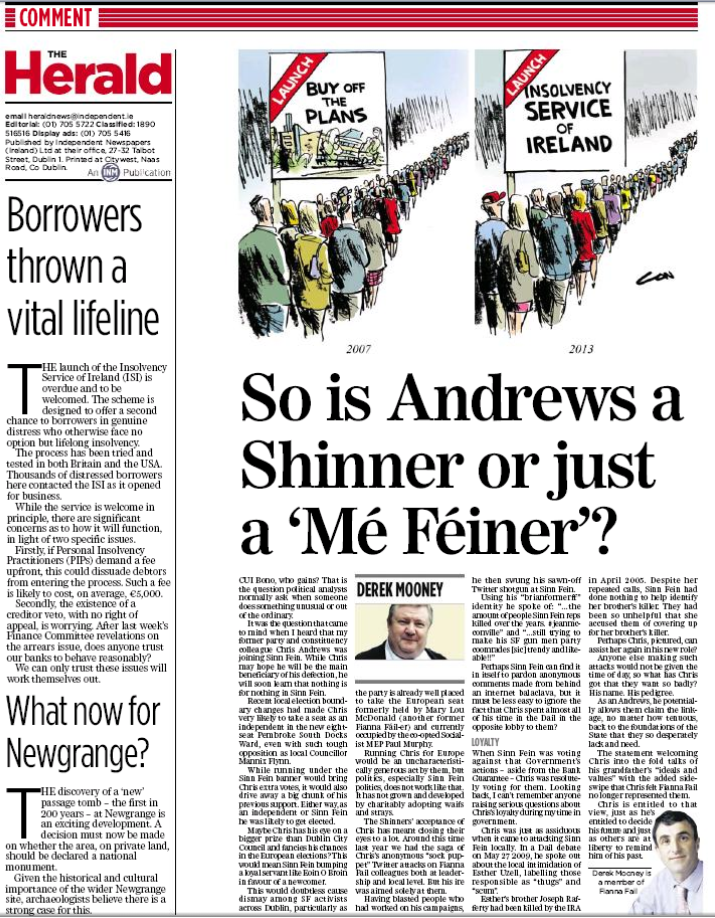
My column from today’s Herald on Chris Andrew’s joining Sinn Féin
My column in today’s Herald
————————————————————————
Cui Bono, who gains? That is the question political analysts normally ask when someone does something unusual or out of the ordinary.
It was the question that came to mind when I heard that my former party and constituency colleague Chris Andrews was joining Sinn Féin.
While Chris may hope he will be the main beneficiary of his defection, he will soon learn that nothing is for nothing in Sinn Féin.
Recent local election boundary changes had made Chris very likely to take a seat as an independent in the new eight seat Pembroke South Docks Ward, even with such tough opposition as local Councillor Mannix Flynn.
While running under the Sinn Féin banner would bring Chris extra votes, it would also drive away a big chunk of his previous support. Either way, as an independent or Sinn Féin he was likely to get elected.
Maybe Chris has his eye on a bigger prize than Dublin City Council and fancies his chances in the European elections? This would mean Sinn Féin bumping a loyal servant like Éoin Ó Broin in favour of a newcomer.
This would doubtless cause dismay among SF activists across Dublin, particularly as the party is already well placed to take the European seat formerly held by Mary Lou McDonald (another former Fianna Fáil-er) and currently occupied by the co-opted Socialist MEP Paul Murphy.
Running Chris for Europe would be an uncharacteristically generous act by them, but politics, especially Sinn Féin politics, does not work like that. It has not grown and developed by charitably adopting waifs and strays.
The Shinner’s acceptance of Chris has meant them closing their eyes to a lot.
Around this time last year we had the saga of Chris’s anonymous “sock puppet” Twitter attacks on Fianna Fáil colleagues both at leadership and local level. But his ire was not aimed solely at them.
Having blasted people who had worked on his campaigns, he then swung his sawn off twitter shotgun at Sinn Féin. Using his “brianformerff” identity he spoke of: “…the amount of people Sinn Féin reps killed over the years. #jeanmcconville” and “…still trying to make his SF gun men party coomrades [sic] trendy and likeable!!”
Perhaps Sinn Féin can find it in itself to pardon anonymous comments made from behind an internet balaclava, but it must be less easy to ignore the fact that Chris spent almost all of his time in the Dáil in the opposite lobby to them?
When Sinn Féin was voting against that Government’s actions – aside from the Bank Guarantee – Chris was resolutely voting for them. Looking back, I can’t remember anyone raising serious questions about Chris’s loyalty during my time in government.
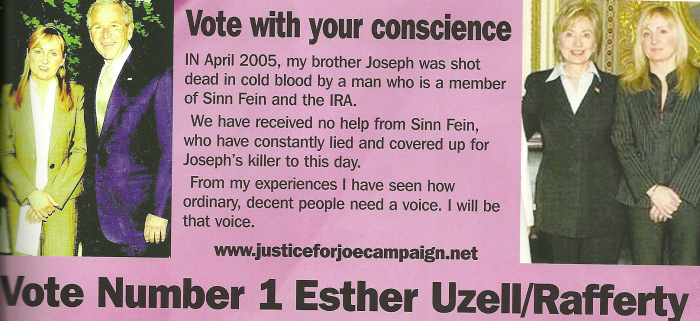
Chris was just as assiduous when it came to attacking Sinn Féin locally. In a Dáil debate on May 27 2009 he spoke out about the local intimidation of Esther Uzell, labelling those responsible as “thugs” and “scum”. Esther’s brother Joseph Rafferty had been killed by the IRA in April 2005. Despite her repeated calls, Sinn Féin had done nothing to help identify her brother’s killer. They had been so unhelpful that she accused them of covering up for her brother’s killer.
Perhaps Chris can assist her again in his new role?
Anyone else making such attacks would not be given the time of day, so what has Chris got that they want so badly? His name. His pedigree.
As an Andrews he potentially allows them claim the linkage, no matter how tenuous, back to the foundations of the State that they so desperately lack and need. The statement welcoming Chris into the fold talks of his grandfather’s “ideals and values” with the added sideswipe that Chris felt Fianna Fáil no longer represented them.
Chris is entitled to that view, just as he’s entitled to decide his future and just as others are at liberty to remind him of his past.
As a firm believer in Seanad reform – and consequently a trenchant opponent of Seanad abolition – the Sunday Independent’s Millward Brown poll showing the No to Abolition side gaining further momentum is gratifying.
The past few weeks have hardly been great for the No side. Fine Gael has been pretty active on the airwaves over the Summer break, while Sinn Féin’s opportunistic decision to campaign for a Yes, having vehemently opposed the Government’s proposal in both the Dáil and Seanad, hasn’t helped the No cause either.
All this makes the increase in the pro Seanad reform level of support all the more re-assuring. Not that the poll suggests that the campaign is done and dusted. Far from it.
More than almost any other, this Seanad abolition policy, is the lone brain child of Enda Kenny. Though there seem to be no research papers, discussion documents or policy positions he can produce to justify the origins of this initiative, he is the man behind it and he has more to lose by its defeat than anyone else.
While Labour nominally favours abolition, its TDs and Ministers can reasonably see their policy obligations as fulfilled by the holding of a referendum. Don’t expect to see many of them working too hard for a Yes to abolition vote. Indeed, as the Labour Chief Whip has indicated, at least half the Labour parliamentary party may actually work for a No vote seeing it as the best way to secure a popular mandate for Seanad reform.
One of the two authors of Labour’s 2009 position paper on Seanad reform, Junior Minister, Alex White has not commented on the issue much, while the other author, Joanna Tuffy TD has indicated that she will be campaigning for a No vote.
The worrying shift in the poll numbers make it necessary for Fine Gael to up the ante over the weeks ahead.
Given that the main shift has been in the group who describe themselves as favouring reform expect to see Fine Gael focus its attentions there and try to convince them that a Yes vote is a vote for reform.
We already had a glimpse of this approach last week via its neophyte Wicklow TD, Simon Harris’s speech at the Parnell Summer School.
Harris advanced the argument that abolishing the Seanad counts as reform and gives power back to the people as it means the single remaining chamber of the Oireachtas: the Dáil will be 100% elected by the public.
Harris’s reasoning seems to hinges on the statistic that the number of people registered to vote in Seanad elections, under current legislation, is around 156,000; about 5% of the approx 3.1 million entitled to vote at the February 2011 Dáil election.
What Harris misses, however, is that this 156,000 (Councillors, Oireachtas members and NUI and TCD graduates) is defined in legislation – not the Constitution. Everyone in the North and South could be given the right to vote with the passing of an Act by the Dáil and Seanad. Indeed the Seanad has already voted for such a piece of reform with the Second Stage vote on the Quinn/Zappone Seanad Reform Bill.
The extension of the Seanad franchise to all is now completely within the gift of Deputy Harris’s colleagues on the government benches.
The only real obstacle to such a real reform is the Taoiseach’s obduracy in insisting on Seanad abolition instead of reform.
Though not central to the argument it is worth noting that the 156,000 figure is probably an understatement as it just counts the NUI and Trinity graduates who have registered to vote. Many 100s of 1000s more are entitled to vote by virtue of their graduation.
The other problem with Harris’s reasoning is the idea that the answer to existing disenfranchisement is more disenfranchisement. It defies all democratic principles to propose removing someone’s voting rights when you have it in your power to extend them.
If you were to apply Deputy Harris’s quirky logic to the campaign for women’s suffrage a century back you would determine that the way to ensure equal voting rights for all was to remove the vote from men so that the two genders were equally disadvantaged.
The very legitimate criticism that not enough people are entitled to vote in Seanad elections is properly addressed by giving everyone the right, not by removing it.
I would hope that Deputy Harris’s espousal of a position that is the absolute antithesis of reform is informed by loyalty to his party leader and desire for advancement rather than by belief in the argument itself.
If it is the former then the case for reform is all the greater, if it is latter then it is time to worry.
Today’s RedC poll for Paddy Power brings very little good news unless you are an independent or a don’t know. The unadjusted core figures rank the parties in descending order as:
Fine Gael 23%
Fianna Fáil 18%
Don’t Knows 18%
Independents 17%
Sinn Féin 13%
Labour 9%
After adjusting the figures by excluding 50% of the don’t know and adjusting the other 50% back to how they voted in 2011 the ranking positions stay the same. Only the relative gaps between Fine Gael and Fianna Fáil and between Fianna Fáil and the Independents widen.
Fine Gael 29%
Fianna Fáil 22%
Independents 21%
Sinn Féin 15%
Labour 11%
Sinn Fein’s lead over Labour remains at a steady 4%. While this may, at first glance, suggest some good news for Sinn Féin, the party has been in this territory before only for its good polling numbers to fail to translate into votes.
Back in December 2010, on the eve of a general election, three polls showed the party in the mid teens. A Red C Poll for The Sun on 03/12/2010 gave the party 16%. The MRBI/Irish Times poll on Dec 16th put it on 15% while a third, the Red C/Sunday Business Post poll of December 18th put its support at 14%. On polling day, two months later, the voters gave it 9.9%.
This is not to discount its advance since. Sinn Féin has been consistently polling in the mid teens since September 2011. That said, though an Irish Times poll in early October 2011 put party support at a hefty 18% its Presidential candidate and possibly most charismatic figure, Martin McGuinness still could not get the party’s actual vote past the 13.7% mark in the ballot boxes a few weeks later.
Despite its considerable and well resourcing organisation it seems to still have a problem translating favourable poll numbers into actual votes.
Though of cold comfort to Fianna Fáil it does not, at least, have this particular problem. The MRBI/Irish Times and Red C/Sunday Business Post polls conducted on the eve of the 2009 Local elections put Fianna Fáil’s support at 20% and 21% respectively. On polling day, the party managed to scrape its way up to 25.4%.
Fianna Fáil problems are more significant. While it has won back some of its lost “soft” support and pulled itself up from the 2011 hammering it has yet to say or do anything substantive to win back many of those who had voted for it in 2002 and 2007 but rejected it in 2011. There is nothing to suggest it is doing any better with potential first time voters either.
Despite the speculation of last weekend, Fianna Fáil’s problem is not its leader. The notion that Fianna Fáil picking a new leader whose only virtue is that they were not a member of the previous government is almost laughable. Surely no one in the party or the commentariat is delusional enough to think that the electorate is so naïve that it will flock to Fianna Fáil’s cause just because it has a leadership team devoid of anyone who served under Ahern or Cowen?
Despite its apology and acknowledgement of past mistakes, Fianna Fáil has yet to present a researched and substantive alternative policy programme. It has come up with some good micro-policies, not least its family home protection and debt resolution Bills, but many have been light on substance and appear to have been produced as well intentioned responses to specific representative groups, e.g. the Mobile Phone Radiation Warning Bill
Try finding the party’s April 2013 Policy Guide on its website. It is there, but you have to know what you are looking for to find it. Click on the “issues” button on the homepage and you get the Spring 2012 version, to locate the latest version you need to do a search for it by name.
The April 19th 2013 document shows the party has been doing some serious work on policy, but you would be hard pushed to know it from the statements coming from its spokespeople. These still read as knee jerk responses to government statements rather than as co-ordinated parts of a coherent alternative. Fine Gael may have gotten away with tactic this during its time in opposition, but Fianna Fáil does not have the luxury they had: a Government unwilling and unable to communicate with its own supporters.
Perhaps the criticisms of a small and possibly over stretched clique around the leadership have some basis in reality, but as someone who has spent a long time around the party, on both the inside and outside tracks, I think the problem lies elsewhere.
Michéal Martin has shown a remarkable capacity for getting out and about and engaging with members and voters alike, it is curious, therefore, to read of him being less engaged and accessible to members of his own very diminished parliamentary party.
Might I suggest that the fault lies on both sides. Yes, he should be having regular one to one meetings with his 33 parliamentary colleagues – God knows there are not that many of them to make such regular meetings impractical – but they too should be engaging with him.
The traditional deference to the leader needs to change. Gone are the days when you had to wait ages to have an audience with the great leader as he busied himself with the great affairs of state in the Taoiseach’s office. Parliamentary party members have the opportunity for unique access, let them use it. A minority can only exercise sole access when allowed by the majority indifference or reticence.
Despite the job losses and the massive reduction in resources, there still appears to be a sense that the party structures are operating and running as if the party is still as big as it once was. Worse still many of those working those structures have no sense memory of how the party should operate in opposition.
A small number of paid officials are being expected to do the party’s policy research and formulation with minimal input from a vast array of experts across the volunteer membership. Too much power and control is being retained around the centre and around Leinster House: not by the leadership and his supposed clique, but also by members of the parliamentary party who are criticising him for just that.
I am old enough to remember what was put in place between 1982 and 1987, the last time the party was truly in opposition. Back then a series of policy committees were established by the leadership and mandated, working with the various spokespeople, to produce credible and researched policies for submission to the party for adoption.
These committees worked with the TDs and Senators but were not run by them. Outside experts were brought in to assist and work with them.
To borrow a phrase from Fianna Fáil’s past – the phase of its recovery will be dependent on policies and substance – not personality. The party already has the potential to bring itself back into the upper 20s in terms of actual voter support – the question now for the leadership and the party as a whole is if it has the energy, expertise and inclination to innovate the policy approaches that could bring support up into the 30% plus range.
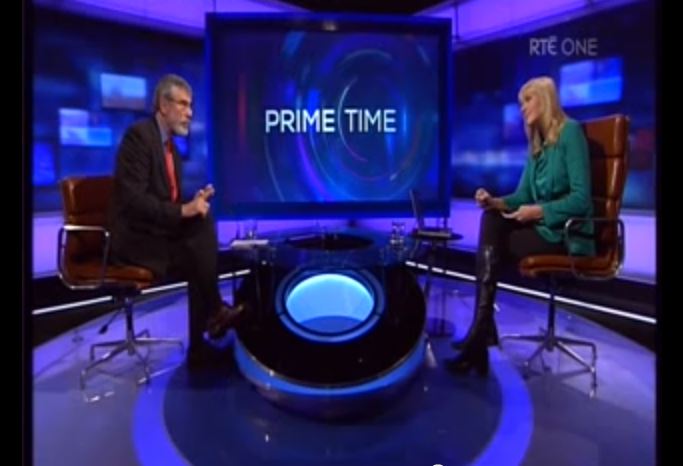
Monday night’s Primetime interview with Gerry Adams was a reminder that RTE is well capable of doing thorough, professional and researched public service broadcasting.
It did much to dispel the doubts cast about the station’s reputation by both the Frontline presidential debate and “Mission to Prey” debacles.
It also showed that Sinn Féin is not as clever, strategic and skilled in the political dark art of spin as many in other political parties and the media presume.
Watching the programme last night, and again today on Youtube, raises the obvious question: why did Gerry Adams agree to do this 24 minute interview in which he essentially spent his time talking about murder?
In part the interview was the consequence of the remarks he made in the Dáil on January 29th last during the expressions of sympathy on the killing of Garda Adrian Donohue.
He used that occasion to offer his condolences and solidarity with the family of Garda Donohue, but also to broaden that expression of sympathy to include others murdered in the line of duty; saying: “I apologise to Mrs. McCabe and the McCabe family, Garda Ben O’Sullivan and the families of other members of the State forces who were killed by republicans in the course of the conflict.”
But, having offered that apology in the Dáil, why did he seem so incapable last night to expand on that and adequately apologise, sympathise and console those who had lost relatives to so called republican paramilitaries over the years?
Why go on to the programme and give such an interview, when you know you are either unable or unprepared to answer the questions and offer the information that is going to be asked of you?
Could it be that the reason for his appearance was less to do with expanding upon his comments of January 29th and more to do with trying to pre-empt what he fears may be revealed when the Boston Tapes are released?
Could it also be an attempt to deflect attention away from the recent Belfast court case involving Adam’s brother Liam?
Deflecting attention away from one difficult story by opening up about another one is not a tactic unfamiliar to Mr Adams and Sinn Féin. Recall how Gerry Adams revealed how his own was father was both a paedophile and a thug while he was being criticised for his handling of the allegations of abuse made to him by his niece Aine Tyrell about her father, Liam Adams.
The revelation about his father came around the time that he acknowledged that he not dealt well with the allegations and that his actions when he discovered that Liam Adams was working with children were wrong – he had approached his brother rather than his employers.
While Adams’ performance last night will do little to diminish his standing with the bulk of Sinn Féin activists, it may cause some of the newer and younger intake people who considered Sinn Féin as an idealistic alternative to mainstream politics to think again.
Adams’ supporters will justify their continuing support with claims that this is all a smear against their leader – echoes of what we have heard in recent days from UKIP, but the defence used by some that this is all a very long time ago does not hold water.
Another defence offered online by defenders of Adams is that this is all RTÉ bias against their party. Why, they asked, wasn’t RTE asking Labour party leaders if they were in Official IRA?
Frankly, I have no problem with RTÉ asking them that, at least it suggests that some in Sinn Féin may unconsciously realise that Miriam O’Callaghan’s questioning of their leader last night was both fair and legitimate
The text of my column from tonight’s Evening Herald (Mon Sept 17th)
—————————————-
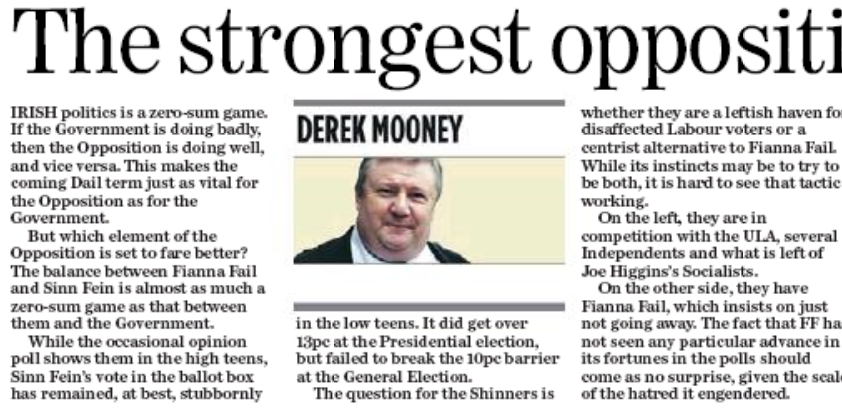
Irish politics is a zero sum game. If the government is doing badly; then the opposition is doing well, and vice versa.
Derek Mooney’s Column in tonight’s Evening Herald
This makes the coming Dáil term just as vital for the opposition as for the government.
But which element of the opposition is set to fare better? The balance between Fianna Fáil and Sinn Féin is almost as much a zero sum game as that between them and the government.
While the occasional opinion poll shows them in the high teens, Sinn Féin’s vote in the ballot box has remained, at best, stubbornly in the low teens. It did get over 13% at the Presidential election, but failed to break the 10% barrier at the General Election.
The question for the Shinners is whether they are a leftish haven for disaffected Labour voters or a centrist alternative to Fianna Fáil. While its instincts may be to try to do both, it is hard to see that tactic working.
On the left they are in competition with the ULA, several Independents and what is left of Joe Higgin’s Socialists.
On the other side they have Fianna Fáil, which insists on just not going away. The fact that FF has not seen any particular advance in its fortunes in the polls should come as no surprise given the scale of the hatred it engendered.
The past 18 months has been about Fianna Fáil stabilising its position. It has put a floor under its decline, which was no small task. The issue now is if it can recover former ground.
While FF may skirmish with SF over ex FF voters who went to Labour, the main battle will be fought elsewhere and with another enemy. Surveys suggest that up to 40% of those who said they voted FF in 2007 switched to FG in 2011.
This sizeable group are still angry and hurt. They have not been ready to listen to Fianna Fáil so far. Will they become disenchanted over the coming months with Enda Kenny and Fine Gael as it struggles to deliver on its election promises?
Will this be sufficient? Will the disenchantment be enough to allow them to listen to anything the party has to say, never mind be convinced by it? These are questions taxing Fianna Fail reps at their think in today and tomorrow.
The opposition parties and independents will also need to consider the competition they face from the emerging, and varied, opposition within government.
It ranges from Brian Hayes and Joan Burton’s fighting over pensioners to FG backbenchers bemoaning its failure to take on the public sector.
The greatest challenge, though, may come from within the Labour Party. There seems to be something about becoming chairman of the smaller party in government that makes the holder think they are the deputy leader of the opposition. I call it “Dan Boyle Syndrome”.
As a first time Deputy; sitting on the government backbenches; the new Labour Chairman may gaze longingly at the other side of the Dáil wishing he were there opposing and criticising the current Government, but he isn’t.
The public gets the difference between government and opposition. They understand the fundamental truth of Mario Cuomo’s famous maxim: “you campaign in poetry but you govern in prose”.
If he thinks doing solo runs will firewall him from the approaching barrage of criticism and unpopularity, then he is in for a nasty surprise. All he needs to do is Google “Dan Boyle” and “election results” to see how these tactics failed.
FG and Lab TDs would do well to heed the words of Mary Harney: “Even the worst day in government is better than the best day in opposition”. This may seem unlikely, but it is the case, especially if you believe politics is about improving things.
If they doubt it, then they only need call the Marine Hotel and ask any Fianna Fáil TD.




 derekmooney.ie