My Evening Herald column from today’s (Thurs May 24th) edition:
Many different reasons to vote yes or no
With less than a week to go the referendum campaign seems more and more to be about less and less.
On the face of it, if you believe the posters, the choice is to Vote Yes to achieve stability or to Vote No to end austerity.
But do any of us really believe these claims? Regrettably, like previous EU referendums the debate has been conducted at the extremes, not the centre. It was the case in the Nice and Lisbon referendums, remember those “€1.84 Minimum Wage after Lisbon” posters?
Mercifully, we have been spared the malign input of Cóir and Youth Defence this time. The are no loss, especially as most of them wouldn’t know a treaty from a tea-bag (to rob a line I recently overheard)
But this absence of any significant ultra right involvement on the no side does highlight a curious undercurrent to the campaign, one, which I suspect, may be a factor in how some people decide how to vote next week.
While the slogans maybe about the EU and the Euro the referendum has morphed into a proxy battle on the future of left / right politics in Ireland.
From the start the battle front was drawn up along left versus right lines.
On the Yes side you had the right and centre right parties: FG, FF and Lab (more about them later), the employers’ and business organisations, the farmer’s groups and the more established/mainstream trade unions.
On the No side you had the socialist and hard left parties, People Before Profit, Joe Higgin’s Socialists, Sinn Féin, the more radical trade unions.
While the entrance of The Declan Ganley somewhat clouded the the Left/Right delineation, it hasn’t ruptured it.
The sight of him sharing No platforms with irredentist left firebrands is a joy to behold, especially when you consider that they agree on virtually nothing, including Europe. Most on the hard left are euro-sceptic while The Ganley is avowedly Euro-federalist.
While passing the Fiscal Treaty will herald no major day to day changes – mainly because it just restates the centre/centre right economic orthodoxy in place since 2008 – it will cement it into domestic law for the foreseeable future.
It is this that the left fears and opposes most.
Passing the Treaty would recalibrate the centre of the Irish political spectrum a few points to the right. It won’t be a seismic or noticeable shift, but it torpedoes the Left’s ambitions of shifting it the other way.
It doesn’t vanquish them, nor does it make them to tone the rhetoric down. If anything, it will do the opposite, but in their hearts they will know that their ambition to shift Ireland economically to the left has been reversed.
This explains why the campaign from Joe Higgins, Boyd Barrett and Sinn Féin has been so fierce. But not as fierce as when its over and they start to target each other.
I am not predicting that their poll rating drops are set to drop. They won’t. They will probably rise as voters use them to express their disapproval of government parties going pack on pre election pledges.
But the Irish electorate is sophisticated. It is overwhelmingly aspirational. This applies across all social classes and communities. They want their kids to do better than they did. That decides voting intentions more than anything.
In the meantime Sinn Féin will continue to do well at Labour’s expense, after all Gerry and Mary Lou are saying now what Éamon and Joan were saying two years ago.
It is Labour who will be the biggest casualty. Polls showing 40% of Labour supporters voting No could have longer term ramifications for the leadership. But whatever they may be, they can be so where near as damaging as Gilmore’s infamous “Frankfurt’s Way or Labour’s Way” slogan.
It may turn out to be the most devastating political slogan of recent times – devastating to its authors, that is.
What will we be voting about on May 31st? It is one of the toughest Treaty referendum questions to answer.
The ECB on Frankfurt’s Way?
If you are to believe the thousands of posters that adorn our street lamps we are either voting yes to stability and jobs or voting no to austerity. A simple enough choice… or so you’d think? Unfortunately, as the campaign progresses, it is becoming clear that neither the Yes nor the No poster claims stands up to much scrutiny.
Do we really think we will suddenly achieve stability and more jobs if we vote yes? I suspect that even the most ardent of yes voters believes that to be case.
On the other hand does the most convinced no voter think that the austerity measures, including household and septic tank charges will disappear if 50% plus one of us votes no? I doubt it.
So what are we voting about?
The best answer I have heard so far has not come from a member of government, the ULA or Sinn Féin. It came, peculiarly enough, from a Euro bureaucrat, a former member of the board of the European Central Bank member. Not the type of person you would expect to speak with simplicity and clarity, yet he did.
Speaking on RTE Radio One’s This Week programme, Lorenzo Bini Smaghi described the decision before us with a cheque book analogy. After years of having separate current accounts, he explained, the Eurozone countries have decided to have one current account and one single chequebook between them for certain purposes.
The risk with this is that any individual country could abuse their access and stick others with the bill, so it is important to agree a set of strict and enforceable rules beforehand. These rules are set out in the Fiscal Treaty. If you want to be able to use the joint account, you need to agree the rules. Refuse to agree the rules and you won’t be allowed near the chequebook.
It is a simple and effective explanation.
What we are voting about is our relationship with the Eurozone countries. Do we want to continue and strengthen that relationship or do we want to weaken it. This does not mean that voting No is the same as being against the Europe, but the choice we are facing has become starker than we would like it to be.
Ok. So now that I have attempted to make the issue a little clearer and get behind the hype and hysteria printed on the posters let me now reverse the process and confuse it again.
While much of the debate has been about the EU and the Euro let me point to another level in the debate. Though it does not get mentioned so much, this referendum has become a proxy battle on the future of left versus right politics in Ireland.
Before The Declan Ganley entered the fray the battle lines had been drawn up along clear Left/Right lines.
On the Yes side you had the right/centre right parties (FG, FF and even Lab), the employers’ and business organisations, the farmer’s groups and the more conservative trade unions.
On the No side you had the radical and left parties, People Before Profit, Joe Higgins Socialists, Sinn Féin, the more radical trade unions.
A Yes result would recalibrate the centre of the Irish political spectrum several degrees to the right. While this would not vanquish the left, it would limit their scope and hem them in.
This could help explain why Sinn Féin has been so fierce in urging a No. A Yes vote would place a definite ceiling on their ambitions and make the centre/centre right economic approach the norm for at least the next decade.
This would leave the hard left /socialist factions with no influence, just sitting on the sideline spouting rhetoric – so, no change there.
The main casualty could be Irish Labour Party, no matter what the result. “Frankfurt’s Way or Labour’s Way” may turn out to be the most devastating political slogan of recent times – devastating to its authors, that is.
Text of my Evening Herald column considering the consequences of the French & Greek election results for our forthcoming Stability Treaty Referendum vote
The EU political landscape has changed dramatically in the last 24 hours. The election of Francois Hollande in France and the defeat of the pro bailout parties in Greece will have repercussions far beyond the borders in both countries.
While both results will come as no great surprise to politicians who have been following the campaigns in France and Greece; it seems no one has given any serious thought as to what may now happen.
The focus of such thought, in so much as there has been any, has been on what Hollande might do to make good on his campaign promise to move the EU’s focus on to growth and investment.
There seems to have been very little thought as to what might happen in Greece. As recently as last week, pundits were citing polls that showed that up to two thirds of the Greek electorate accepted the need for a bailout.
Perhaps they did tell the pollsters that but, as we discovered last night, that sentiment did not transfer itself to the ballot box. The reality is that two thirds of Greek voters opted for anti bailout parties of various hues – from far left to far right, leaving the two pro bailout parties in tatters.
The net result, in the short to medium term, will be political stability that will make markets jumpy and herald problems for counties such as Spain and Italy when they go to the markets to borrow money.
The instability in the Eurozone that we thought had abated for a while looks like returning with a vengeance. M Hollande may not have time to set out his vision for a growth and investment plan for the EU – events may well overtake him.
Uncertainty may now be the name of the game in the EU and the Eurozone – yet the Government here seems to think that nothing that has happened in the last 24 hours has changed the mood music here.
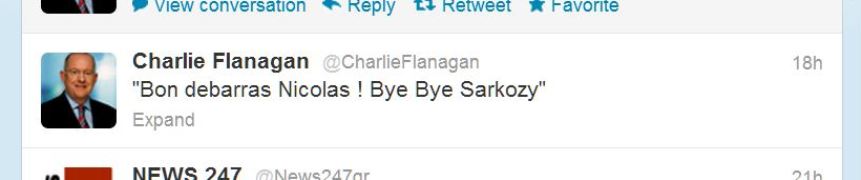
To judge from Tánaiste Eamon Gilmore’s comments the coalition government here believes that the result there has no consequence for the Stability Treaty referendum. The Tánaiste was in Paris, in a signal of European Socialist grouping solidarity, with PES colleague M Hollande. This contrasts with the fickleness of the FG party chairman,Charlie Flanagan’s “Bon debarras (Good Riddance) Nicolas ! Bye Bye Sarkozy” tweet last night.
@Charlie Flanagan FG PP Chairman
In Feb 2011 Fine Gael were championing their relations with Sarkozy, Merkel and the EPP – now they deny their former friends. You could almost hear the cock crow three times.
I am no fan of the Stability Treaty. Like others. I believe it is a missed opportunity. It fails to tackle the root cause of the problems in Ireland and Europe – a failed and dysfunctional banking system. But I am not convinced that voting it down brings us one millimetre closer to resolving our problems.
I am a reluctant Yes voter. I hope that passing it may give Germany the cover it needs to allow real reforms to the European Central Bank and the Euro architecture,
For that reason I want to give the Treaty every chance to gain public support. I do not believe that ploughing ahead with a vote on a Treaty that may yet be further reformed – or even improved – serves any purpose. I genuinely fear that going ahead against a background of uncertainty and volatility puts the outcome in doubt.
It is not that I think the combined forces of Sinn Féin and the ULA will convince the people to vote No, but rather that the public will opt not to endorse a Treaty that may be defunct within weeks of passing it.
This is not a new fear. I wrote about the imprudence of holding the vote this early on my website some weeks ago. While I know many would suggest that postponing the referendum sends out the signal that the Government is weak, I think that is better than landing itself with a no vote based on bad timing.
While the Tánaiste is technically right in saying that we wouldn’t need to come back and vote again if a growth package were eventually added to the Treaty – can he really justify putting only half the question to a vote? Would it not be wiser, and more democratic, to wait a few months and put a definitive position to the people?#
It would require more courage and leadership to postpone the referendum than proceed with it. This just may be the reason why it doesn’t happen
May 7th 2012
Besides our Fianna Fáil backgrounds, Sean Gallagher and I have something else in common: an errant tweet has contributed to us both losing out on a job.
In my case it partly caused me to lose a job I already held. I was Willie O’Dea’s adviser and programme manager when Dan Boyle sent his infamous tweet.
Its claim that there would: “Probably be a few chapters in this story yet” proved baseless, nonetheless 24 hours later the Minister had resigned and yours truly was clearing out his desk. C’est la vie. The tweet only brought the inevitable forward by twelve months.
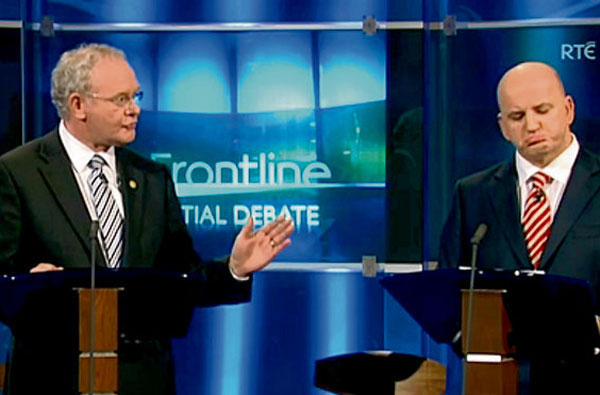
In Sean’s case the broadcast of a bogus tweet during the Frontline Presidential Debate played a major play in derailing his campaign and denying him the job he wanted.
Yesterday the Broadcasting Authority of Ireland gave its verdict on his complaint against RTE, The Frontline and The Pat Kenny Show.
It was a fairly damning judgement. The BAI found that Sean Gallagher had been treated “unfairly” on three counts.
One: by the broadcast of the initial bogus tweet from an account that purported to be from the official Martin McGuinness for President campaign.
Two: by the failure of the Frontline to tell the audience of the subsequent tweet from the official McGuinness campaign denying that it had issued the bogus one.
Three: by the continuing failure of the Today with Pat Kenny radio show the next morning to properly clarify the status and background of the two tweets.
Given that it found that a programme that was intended as a Presidential Debate was unfair to one particular candidate, it was amazing to see the BAI go on to say that no further investigation or inquiry is required as the complaint “was not of such a serious nature as to warrant an investigation or public hearings”.
It is not as if this might have affected the outcome of an election or anything….. oh, hang on a minute…. Yes, it might.
No one can definitively state whether the tweetgate affair altered the outcome, but we do know that Sean Gallagher was the poll leader before the debate and he wasn’t a few days later. We also know that tallies of the postal votes – ie those votes cast and returned to the presiding officers before the Frontline debate – showed Gallagher topping the poll.
On the other hand, it is entirely possible that viewers watching the Frontline debate might have switched from Gallagher to Michael D Higgins even if the tweet had never been mentioned.
All this is in the realms of speculation. What is not speculation however it that someone sent that tweet to undermine the front runner and affect the race.
So, yes, this matter does require further investigation.
The BAI has determined that Mr Gallagher was treated unfairly in how the tweet was handled. RTE’s Director General made a sincere and genuine apology and the RTE Authority is to examine the BAI’s finding.
This is all right and proper. But RTE’s actions are only part of the case.
Like others watching the campaign on the internet I was not aware of the difference between the real and fake McGuinness for President twitter accounts until the controversy broke that night.
The confusion was easy as, according to some Social Media watchers, both twitter accounts were created on the same day. Indeed, as part of its own defence, RTE argued that many other journalists were similarly confused and had taken the first bogus tweet as genuine. (A defence rejected by the BAI)
The question remains: who was responsible for sending out the tweet? Are we going to tolerate a situation where an election outcome can potentially be so easily influenced by one person or group of people acting in the shadows?
We have seen thousands of people protest on the streets of Moscow regarding accusations that Putin rigged their Presidential election, are we not to try and look a bit deeper into this case?
Isn’t the integrity of our democratic process worth a bit more effort?
my take on the recent Sunday Times poll as seen from a different perspective, both in terms of distance and time. I never cease to be intrigued how distance can change your perspective. It is true whether that distance is in time or in space. Indeed not only does it change it, it usually improves it.
This blindingly obvious conclusion struck me late on Saturday night as I sat in my Hotel room on the Costa Blanca coast watching my twitter feed to find the results of the latest Sunday Times opinion poll.
As the old joke goes: it was like deja vu all over again. Exactly one year earlier I was sitting in another room at the same Hotel trying to follow the results of the General Election online.
Though I managed to log in every few hours to catch the resulting coming in online, I still failed to fully grasp the full impact of Fianna Fail’s defeat at the time. My mind was elsewhere. My Dad had died suddenly at my parents’ home in Spain on the eve of polling day. I had, along with other family members, rushed over for the funeral in the days that followed.
It therefore took a week or so for the full enormity of what had happened at the polls to sink in. When it did, I found myself almost detached from its consequences and outworkings. I had not been at the count centres for the emotional traumas. By the time I was back home and chatting with former colleagues; they were reconciled with their fates to the point of being phlegmatic.
Anyway, that was a year ago. Back to last Saturday night. Sitting in a similar room, one year on and almost 1800km away, I found myself having quite a different perspective on the latest opinion poll figures.
As I looked at the RTE news online I was taken aback to see them running the line that big news in this poll was the drop in support for Fianna Fail.
Really? Not from where I was sitting.
Perhaps it was the night breeze drifting in off the Mediterranean. Maybe it was the over generous Soberano.
Either way; it appeared to me that the big news in this poll lay elsewhere.
To my mind the first piece of news in the Sunday Times B&A poll was the halving of Labour’s support in one year – from 19.4% on polling day to 10% today.
Second was the dramatic increase in support for Sinn Fein. from just under 10% at the General Election to a whopping 25% in the poll.
Indeed, there is a third equally significant story, namely the finding that, at 70%, almost three times as many people are disatisfied with the Government than are satisfied with it (26%). Not a ringing endorsement for a government just one year into its term and yet to face any seriously testing challenges.
Though it would be foolish to read too much into just one poll, Sinn Fein’s strategists North and South will be feeling understandably satisfied that their tactic of placing the Labour Party firmly in their sights is paying dividends.
In comparison with these almost double digit changes, Fianna Fail’s decrease from 17.4 to 16 is modest, though disappointing.
Yes, it is the type of news Michael Martin and Co can do without with the first Ard Fheis in two years only a week away and the Mahon report looming. But who, in their right mind, really expected voters, who were bitterly angry with Fianna Fail, to suddenly turn and cry “this shower is even worse than you lot: all is forgiven” barely one year on?
Maybe it is a back handed compliment of sorts that the party’s fortunes still merit such attention and coverage: even when the figures don’t exactly back it up.
If so, then expect plenty more of the same for the rest of the year as further polls emerge and more pundits line out to say what it all means for Fianna Fail. Meanwhile, I will see if I can manage to be away for their publication. It appears to be the best way to view them.
This was written for the Evening Herald of Mon Oct 17th.
There are ten days to go until polling day in Aras11. That means that two thirds of the campaign is behind us and, if the polls are correct, so are two thirds of the candidates.
Michael D Higgins, who has been in the top two in the polls almost since the beginning of the campaign, is now joined at the top of the poll, by Sean Gallagher.
Indeed he is not merely joined at the top of the poll by Gallagher; he is surpassed by the independent who appears to have caught the big momentum just at the right point.
The curious thing about the last RedC poll is that Gallagher’s surge has not been at Higgin’s expense. Both candidates actually increased support. In a role that may not sit too comfortably with him or the Labour Party, Higgins is becoming the traditional mainstream established party candidate while Gallagher is taking the role of non establishment figure garnering the non-party and independent backing.
Around 50% of voters have backed an independent candidate since the start of the campaign. With ten days to go they now appear to be backing the independent candidate who seems the strongest and has the best chance of winning.
This trend had begun to emerge in the last RedC poll on October 6th. While 21% of voters said in that poll that they were likely to vote for Gallagher, only 5% said they thought he could actually win the race.
His emergence as a front runner among the independents in that poll has seen him take support from other independents, like Davis and Norris. They will now need to fight hard if they are to have any chance of putting in a decent showing.
Gallagher would also appear to be getting considerable backing from remaining Fianna Fáil supporters, something he had not been achieving before this.
The latest RedC poll does come with the health warning that it was conducted just before last Wednesday night’s Primetime debate with Miriam O’Callaghan. That was not Gallagher’s greatest moment, though RedC researchers believe that these debates are not having significant impact in the results in their polling.
There are two other interesting features in this poll. The decline in support for Martin McGuinness must run contrary to what the Sinn Féin big strategy. He had appeared to be holding his support in the face of a fairly constant barrage about his past, mainly from Gay Mitchell and Fine Gael.
Then along came David Kelly. In one short but painfully honest encounter he encapsulated in a harrowing personal story what others had been trying to say abstractly. The fall in McGuinness’s support makes his Mansion House fiesta now look like Neil Kinnock’s ill judged Sheffield rally.
The other is the continuing decline in support for Gay Mitchell. I am personally at a loss to explain this, except to return to the analysis that this race for the park is turning into a competition between the strongest traditional party candidate: Higgins and the strongest independent candidate: Gallagher.
While Gallagher is cannibalising independent support on one side, Higgins is doing the same on the traditional party side – and at Mitchell’s expense.
I live in what would be regarded as a true blue Fine Gael area. In past local and general elections I have been inundated by Fine Gael canvassers and leaflet drops.
This time: nothing. Apart from the infamous “Litir Um Toghacan” I have not received once call, one leaflet or one attempted contact from the local Fine Gael organisation, and these are people who know Gay Mitchell well.
A campaign that cannot even convince its own activists and core supporters can only be described as an unmitigated disaster.
The one ray of hope from the polls for Mitchell is the enormous volatility there has been in recent weeks.
Yes, the voters would seem to be splitting into two camps, one pro party, the other anti-party, but within those camps they are still volatile. All could change in the last week with one big revelation or story on either side.
My Evening Herald column on the current state of the race for the Park – see it online here:
When the story of this presidential contest is eventually written, presuming it ever actually ends, it will focus on a number of unusual features.
One of the most unusual concerns you: the voter.
For a sizeable proportion of the electorate this contest is a first. Virtually no one under the age of 32 in this country has ever voted in a Presidential election before. That is roughly 20-25% of the approx 3.2million people entitled to vote.
While it is hard to say what precise impact this is having, it may play in part in explaining why this contest not going exactly to plan: well, not to the plans of certain parties.
This election should have been Fine Gael’s for the taking. With the exception of Mary Robinson’s 1990 victory, the presidency has been the almost exclusive preserve of Fianna Fáil. Fine Gael has dethroned its old adversary, yet its campaign strategy is sending its candidate’s poll figures into reverse.
Another two weeks like this and poor Gay will be in negative ratings. While that may be a mathematical impossibility his getting less than a quarter of a quota and Fine Gael failing to get any reimbursement of campaign expenses is not.
Call me old fashioned but I really cannot believe that loyal Fine Gael voters will continue to allow a man who has loyally defended his leader to languish in the polls just ahead of Dana.
The problem for Gay is twofold. First, there is no hint of the core support rallying to him. Fine Gael activists have grown accustomed to easy canvasses and getting good responses. They do not relish the thought of having to knock on doors and listen to the flak just yet.
Second, the pundits are over estimating the level of that core support. They point to poll findings that Mitchell is getting only 15% of Fine Gael support.
This is a slight misreading of the RedC poll in my view. What it has found is that only 15% of those people who voted Fine Gael at the last election are planning to support Gay. Not all of the 36% of the electorate who voted for them in February now perceive themselves as Fine Gael.
Many are ex Fianna Fáil voters. They felt betrayed by the party they had supported and now feel free to change allegiances depending on the policies and personalities presented to them.
Speaking of Fianna Fáil; the last two polls seem to give the lie to the assertions that Sean Gallagher’s Soldiers of Destiny background would be a millstone. His increased support suggests that many voters are not bothered by his political past. This does not appear to be the situation for remaining Fianna Fáil supporters however. He is only their second choice, behind Higgins.
Sean’s increased poll ratings come with a bigger target for his back. Doing well in a poll can be a major risk. Ask Mary Davis. Her surge two weeks ago was followed by an intensive period of dark murmurings and attack. Indeed, Sean was not slow to join in on that. What comes around – goes around.
Were her rise and attacks entirely unrelated? Hardly, though maybe it is just the cynic in me. Either that or it is the fact that I am considerably over 31 and have seen my fair share of presidential campaign black ops.
Whatever the case, the Gallagher team will be girding their loins, shins and other sensitive regions for onslaught to come.
We are just at the half way mark. The field does seem to be dividing itself into two leagues. A premier league which this week stars Higgins, Gallagher and McGuinness and a first division featuring the just relegated Mary Davis alongside Gay Mitchell, Dana and one time premier favourite Norris.
But there are still two more weeks to go. There is still a lot to play for, hopefully that the play will be confined to the ball and not the man – or woman.
The presidential campaign is barely a week old and already we have candidates producing P60s showing how much they have earned over the years. This was in response to dark propaganda about earnings and directorships.
And they say that negative campaigns don’t work. If we are at this stage just one week into the race then it cannot be long until the demands come that this candidate or that one produces their birth, baptismal or parents’ marriage certs.
We should not really be that surprised. Academic/college politics is said to be so much more vicious than real politics because the stakes are so low. It could just as easily be said about Irish Presidential elections.
It is not that the office is unimportant; it is that the powers are limited and the office appears to fade into the background once the campaign is over.
The fact that Mary McAleese has been an excellent President somehow adds to the notion that it doesn’t matter an awful lot as to who succeeds her.
As none of the candidates have so far convinced us that they are cut from the same cloth as her, the debate is slowly turning to which of them will be the least worst.
The office of President is so tightly defined and closely managed that almost no occupant could manage to go truly rogue. So, while many people, myself included, have severe misgivings about the possibility of McGuinness occupying the office, the truth is that his being President would not change anything. Martin McGuinness being President will not make a significant difference to anyone’s daily life – apart from his own.
The reality of the past decade is that Sinn Féin has been moving steadily to the centre in the North. No sooner do they move into office but they very quickly adopt the policies and strategies of those who were there before them. Sinn Féin in Government in the North is not a thorn in anyone’s side, least of all the DUP’s. They may head up anti hospital closure committees in the 26 counties, but in the North they merrily implement the cuts imposed byLondon.
So, while his election may not herald the end of civilisation as we know it, it could send out a very embarrassing signal at this crucial time.
Almost any of the other candidates: Michael D Higgins, Mary Davis, Sean Gallagher or Gay Mitchell could each fulfil the role in their own individual ways without causing us any embarrassment or sparking an international crisis.
This least-worst approach appeared to be the underlying theme to last night’s TV3 debate. Unlike past encounters, there was some spark to it. The cross talk between the candidates did not yield much and at times became insufferably twee. The competition to be the most concerned by the trauma of suicide bordered on distasteful.
It was the questioning and serial grilling by the moderator that managed to reveal something more about each of the candidates. As someone said on Twitter last night, it was not that any one candidate emerged as the winner: it was more that some managed to emerge less damaged and scarred.
David Norris and Dana were not among them. Though a veteran of past campaigns, Dana seemed the least prepared and most unfocused. While Norris’s continuing obfuscation in the face of very specific questions from Browne on who it was inIsraelwho had advised him not to publish the remaining letters was telling.
David’s protestations that the public will decide this issue ring particularly hollow when he refuses to give them access to the full facts by releasing the outstanding letters. This issue is not going away and the longer it continues the worse he will get for him.
His media adviser is a big admirer of Tony Blair’s spin doctor, Alastair Campbell, He should remind his client of Campbell’s famous rule that if you allowed a bad news story to dominate the headlines for more than four days, you are in trouble.
David has had more than four days of such headlines and the only end in sight is his own. And, to think, we still have three weeks more of this to go.
For the last few months some people have been complaining about how impossible, unfair and stitched up the Irish presidential nomination process can be. True, these were mainly people aligned to one candidate or another, but even so, at least they cannot say now that is not exciting.
The massive flurry of activity in Council chambers across the country has been something to behold. Meetings have been called at the last minute in Councils from Donegal to Waterford and from Cork to Dublin.
They have become like our very own mini Primaries and Caucuses – mirroring those in theUSAwhere each States holds primary elections to mandate delegates in each of the two main parties to select their respective Presidential Candidates.
With eight Councils meeting today, this could be described as our own “Super Tuesday”. Just as in the States, today will decide the fate of the two remaining ballot paper hopefuls.
I am not sure if this is ironic or just a symptom of poor campaigning, but one of the candidates, Dana Rosemary Scallon is the last one into the field, while the other Senator David Norris was the first one in, having launched his campaign as far back as March.
Back on May 9th Sen Norris was the first candidate to get Council backing, in his case Fingal. He only had to wait a mere twenty weeks to pick up his second one, securing the backing of Laois County Council yesterday. But, as we all know, a great deal has happened in those twenty weeks.
Highlighting the drama of his situation only three individual votes yesterday separated the Senator from his goal. First, te lost Carlow Council on the casting vote of the Fine Gael Chairman and then he went on to be defeated in Dublin South Council 11 – 12. Two more votes, or rather two more abstentions, from Fine Gael, Labour and Sinn Féin would have made all the difference.
On the other side, Dana managed to take two Councils in quick succession. Norris’s loss in Carlow was her gain plus support from Roscommon. Today she turns her sights on Donegal, Longford and Westmeath, two of which backed her at her previous bids for the office.
One indicator of how Councillors might vote at the Council meetings today can be gleaned from last Sunday’s Business Post/RedC Opinion Poll. Fortunately, for sad political junkies like me, the pollsters used two sample ballot papers – one without Norris and Dana on it and another with both included.
On the face of it Norris’s nomination today would not only see the race having a new front runner, it would also damage the campaigns of the candidates from the two Government parties. According to the Poll Michael D Higgins could lose up one third of his support to Norris, while Mitchell, who cannot afford to slip much more, could haemorrhage anywhere in the region of one quarter of his support to him.
Expect the Fine Gael and Labour Councillors to weight this possible outcome carefully when they consider how they will vote today, particularly when it comes to backing Norris. The outcomes will depend on how these considerations are balanced against the fear of a backlash against those who kept Norris out of the race.
Not that Higgins and Mitchell are the only ones affected by an expansion of the field. The entrance of Norris and Dana to the race could see Mary Davis lose up to a third of her support, Sean Gallagher lose about one quarter of his and Martin McGuinness lose about a fifth.
In the case of these three, their capacity to influence the outcomes today will not be anywhere as great as for the two main parties. Plus their supporters will also want to size up if the damage done to the FG and lab candidates outweighs the impact on theirs.
Later this evening, as our Super Tuesday draws to a close with votes in Dublin Corporation and Cavan County Council we should know the final outcome. But, if not there is always Average Wednesday’s early morning’s meeting of Kilkenny County Council.



 derekmooney.ie