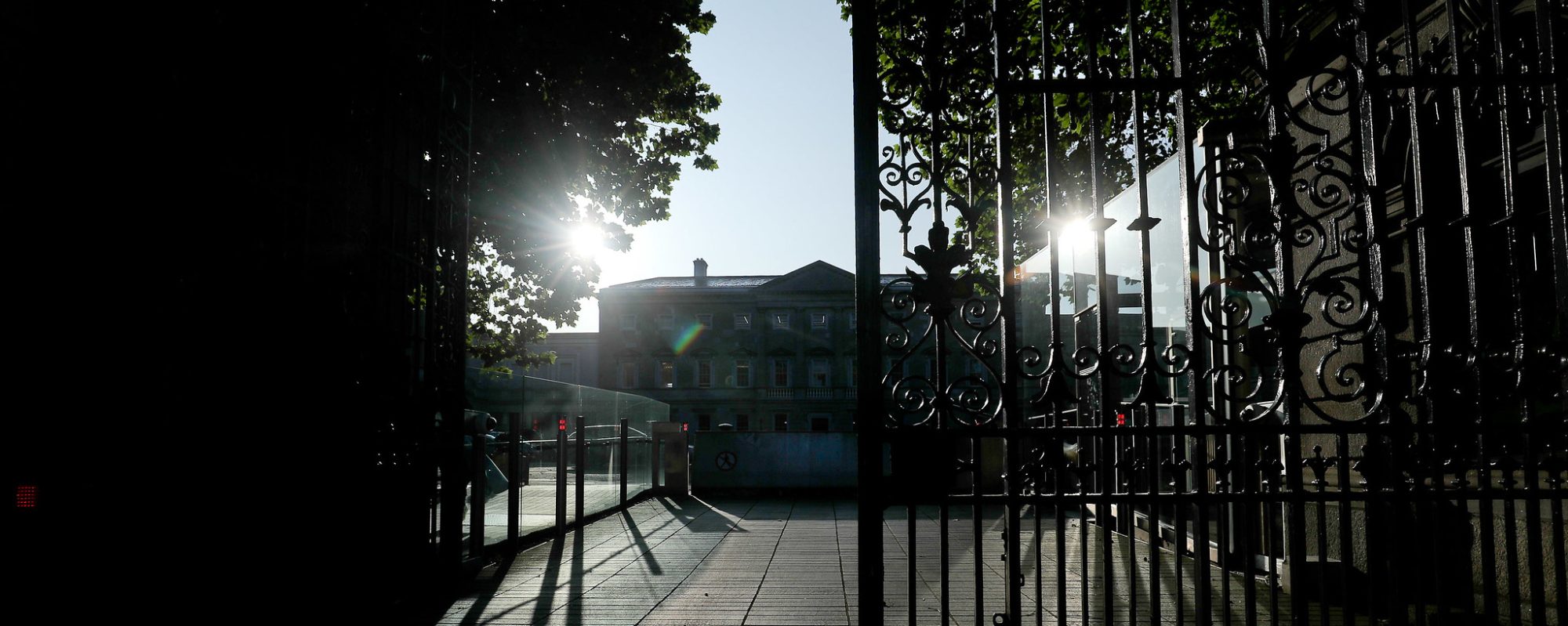
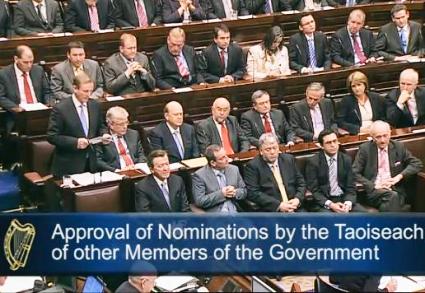
The reshuffle is approaching, so which of the current batch of Ministers should stay in Cabinet (though not necessarily in their current job) and which should be dropped entirely.
For the purposes of this poll I am presuming that Joan Burton is elected Labour Leader and is thus assured of a seat at the cabinet table.
This is an article I have written for the March 2014 Árd Fheis issue of Fianna Fáil’s members’ magazine Cuisle.
————————————————————————————————–
A few months before the 2011 election, Michael Gallagher (the TCD Professor of Politics, not the Donegal postman and amateur weather forecaster) posted a blog where he asking how long Fianna Fáil could expect to spend in opposition. In it he wrote:
“Fianna Fáil is not a party accustomed to spending time there. Its longest spell on the opposition benches is still the nearly six years between its foundation in May 1926 and its entry into government in March 1932. Since then, the party has never spent more than one consecutive Dáil term in opposition and the longest spell it has been out of power remains the 4 years and 4 months of the Cosgrave coalition in the mid-1970s.”
Underpinning Gallagher’s 2010 comments is the idea that Fianna Fáil has never been that good at opposition. It is a fair point.
Not only have we not spent much time in opposition, as Gallagher points out, it is almost 30 years since we last spent a full Dáil term there.
In asking a High Court Judge to re-examine and review the documentation and material already available the Cabinet, and in particular the Taoiseach, Enda Kenny and the Minister for Justice and Defence, Alan Shatter are attempting to out-Nixon Nixon.
Back in early 1973, as the scandal of the Watergate Break In and Cover Up began to break, the then US President Richard M Nixon, in conjunction with his advisers John Ehrlichman and Bob Haldeman, devised a plan to get Nixon’s White House Counsel John Dean to write a report for the President on Watergate that “basically clears the President and White House staff of involvement”. Their plan was that they could cite Dean’s Report as what they had relied upon and that they could blame Dean for deceiving them.
While Dean did initially agree to go to Camp David at the President’s request to write such a report, but he soon came to realise that he was being lined up as the scapegoat and decided not to complete the report. Nixon sacked him shortly afterwards, on the same day as he announced the resignations of Ehrlichman and Haldeman.
While the Government is not asking a retired High Court Judge to become is scapegoat, it does seem to be looking to get a supposedly independent review that it determines will verify its own jaundiced version of events.
How else can we interpret the fact that while the Justice Minister was indicating how the review would operate he announced that he had decided on the review as he had received a review of the Verrimus report from RITS, a Dublin based IT security firm, that concluded that there was “no evidence at all”.
So, even as the Minister announces the review he sets out his view on what it should, if not must, conclude.
This, as with Nixon’s Dean Report, is all about attempting to draw a line under a growing political scandal rather than getting to the core of what caused it: allegations of bugging at GSOC’s premises?
Why opt for such a limited review, reporting to the Justice Minister and with Terms of Reference set by the Minister instead of an inquiry under the Commissions of Inquiry legislation?
Today’s Cabinet decision, albeit deeply flawed, runs counter to last week’s comments by both An Taoiseach and the Justice Minister and suggests either 1). A realization that the government’s spinning on the subject is not having the same impact now as it had at the start, and/or 2). Pressure from Labour members of the Cabinet growing tired of defending the Justice Minister.
—————
Background material on the Nixon/Dean Watergate Report
The timeline for Dean’s Watergate Report
March 20, 1973: In his conversation with chief of staff H. R. Haldeman about White House counsel John Dean’s phony “Dean Report,” which will say that no one in the White House was involved in the Watergate conspiracy, President Nixon says: “[The report] should lay a few things to rest. I didn’t do this, I didn’t do that, da-da, da-da, da-da, da-da, da-da, da-da, da-da. Haldeman didn’t do this. Ehrlichman didn’t do that. Colson didn’t do that. See?”
March 22, 1973: President Nixon tells his aides to ensure that the nation never learns of the political and financial machinations that surround the Watergate burglary from his aides under investigation: “And, uh, for that reason, I am perfectly willing to—I don’t give a sh_t what happens, I want you all to stonewall it, let them plead the Fifth Amendment, cover-up or anything else.” But he wants something on paper that he can point to and say he knew nothing about the Watergate conspiracy, and that he had ordered an internal investigation of the matter. He sends counsel John Dean to Camp David for the weekend to write the document
March 27, 1973: President Nixon orders senior aide John Ehrlichman to conduct his own “independent investigation” of the conspiracy, since White House counsel John Dean has not yet produced the results of his own “investigation”
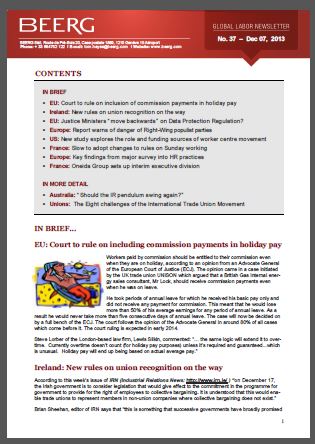
BEERG’s Director of Public Affairs Derek Mooney writes: The ongoing problems in reaching agreement on the content and detail of the General Data Protection Regulation were highlighted yesterday (Friday Dec 6th) at the EU Council’s meeting of Justice & Home Affairs Ministers.
Despite months of discussions among officials and experts from the member states; Ministers were still unable to reach a consensus on the detailed operation of the “one stop shop” principle central to the Regulation. The issue, just one of several still to be resolved, is now pushed back into the forthcoming Greek EU Presidency, due to run for the first six months of 2014.
After the meeting Commission Vice President and Justice Commissioner, Viviane Reding seemed unable to hide her frustration at this further delay, saying
“…we have moved backwards… Instead of seeing the wood for the trees Ministers got bogged down in details with the solution that even after three months of discussions on the one-stop-shop principle there is still no workable solution on the table.”
Her comments contrast with those of the current Chair of the Council of Justice Ministers, Lithuanian Minister of Justice, Juozas Bernatonis who said:
“We prefer a strong agreement to a fast one, and must work to ensure a proper balance between business interests and fundamental rights of citizens.”
The EUObserver.com website later cited an EU diplomat as saying that Germany, with the support of Sweden and Belgium, was partly responsible for the delay adding that Berlin does not want the EU law to be any weaker than its domestic one. Other countries are said to have problems with the actual operation of the systems, believing it to be overcomplicated.
As currently drafted the “one stop shop” principle means that when activities of the undertaking in the EU takes place in more than one Member State, the obligation for cooperation with national data protection authority would be limited to the authority of the main establishment of that undertaking.
As we have previously reported here, Commissioner Reding has spent most of 2013 attempting to railroad the Data Protection Regulation through the EU with a minimum of discussion on the detail, particularly the unnecessary burdens and costs it will create for businesses, large and small, across the EU. Reding’s target was to get the Regulation passed before the current EU parliament and Commission mandates finish in mid-2014 – just in time to further her ambitions to become the next Commission President
While she had some success in speeding up its passage through the Justice & Civil Liberties Committee (LIBE) in the European Parliament, her tactic has not worked with the member state governments. Both the Irish (Jan – June 2013) and Lithuanian (July – Dec 2103) Presidencies have focussed on the detailed operations of her proposal as worded.
Their insistence on fleshing out the implications of the draft Regulations many complex provisions have not only stymied her April 2014 timetable, but perhaps also her own personal ambitions? Could this account for her attack on those Ministers yesterday:
“I wonder how Ministers will face citizens back home, who are calling for stronger and uniform data protection rules in Europe? But fortunately this is not a question that I have to answer.”
With her Commissionership looking certain to end in 2014, it is likely a question she will soon not be around to answer.
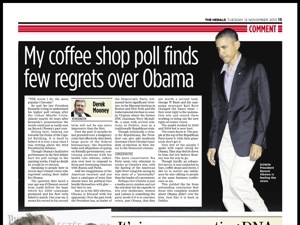
My column for The Herald from Washington DC on my “coffee shop” poll one year on from President Barack Obama’s second term win.
My “in Washington” Herald column
“The worse I do, the more popular I become”. So said the late President Kennedy trying to understand his higher poll ratings after the Cuban Missile Crisis.
Almost exactly 50 years after Kennedy’s assasssination the words could just as easily sum up Barack Obama’s past year. Sitting here, looking out from my Washington DC hotel bedroom towards the Dome of the Capitol building; it is hard to believe it is over a year since I was writing about the 2012 Presidential debates. Though his lack lustre performancein the first debate hurt his poll ratings in the opening weeks, I had no doubt he would be re-elected.
The real question one year ago was if Obama’s second term could deliver the hope and promise which his 2008 campaign promised and his first term failed to match. One year on, it seems that his record in his second term will not be any more impressive than his record in the first.
Over the past 12 months he has presided over a budgetary crisis that effectively shut down large parts of the federal bureaucracy; the Snowden leaks and allegations of spying on friendly governments; continuing problems with his health care reforms, indecision over how to respond to the Syrian crisis and worsening relations with Russia and Putin. Add the sluggishness of the American recovery and you have a catalogue of woes that should have his political foes beside themselves with glee – but they’re not.
Just as in the 2012 election: Obama is blessed with his opponents. Over the past week the President has, as leader of the Democratic Party, witnessed three significant victories: in the Mayoral elections in Boston and New York and the Gubernatorial election in nearby Virginia where the former DNC Chairman Terry McAuliffe, a man with several relations in Dublin, won in a traditionally Republican State.
Though techically a victory for the Republic Party, the President can also add moderate Governor Chris Christie’s landslide re-election in New Jersey to the Democrat column. The more conservative “tea party” republicans seem very reluctant to rejoice in Christie’s win, with the darling of the American right Newt Gingrich saying that he was more of a “personality” leader rather than the leader of a movement.
Maybe he is right. Perhaps Gov Christie is just media savvy creation and not the real deal, but his capacity to win over moderates, women and Latinos is something the Republican Party needs if it is to convince voters, post Obama, that they are worth a second look.
For decades before George W Bush presidential elections were fought on the basis of the Democrat lurching to the left to win the nomination but steering back to the centre to win the election itself and the Republican doing likewise, only to the right first,then back to the centre. Bush and his campaign stratagust Karl Rove changed that – they went right towin the nomination and then stayed there working on bring out new right of centre voters. The model worked in 2000 and 2004, but is now bust. The voters know it. The people at the top of the Republican Party know it. Only their grassroots don’t get it. Very few of the people I spoke with over the past few days here in Washington DC and in neighbouring Virginia, regret voting for Obama. They may feel let down by the President, but almost none believe that Romney was the way to go. Though hardly an exhaustive or scientic survey. To be frank it was conducted mainly in bars, coffee shops and stores. I did try to correct any imbalance in the sample due to my social habits by also talking to people attending the same business conference as me. Those interviews yielded the far from astounding conclusion that those who complain most loudly about Obama, never voted for him. Just like it is back in Dublin.
Here is the text of a column by Tom Kelly in today’s Irish News You can download the text of the column from here: Tom Kelly Seanad
Abolition of the Senate is an insult to the proclamation guarantees – Tom Kelly
Tom Kelly
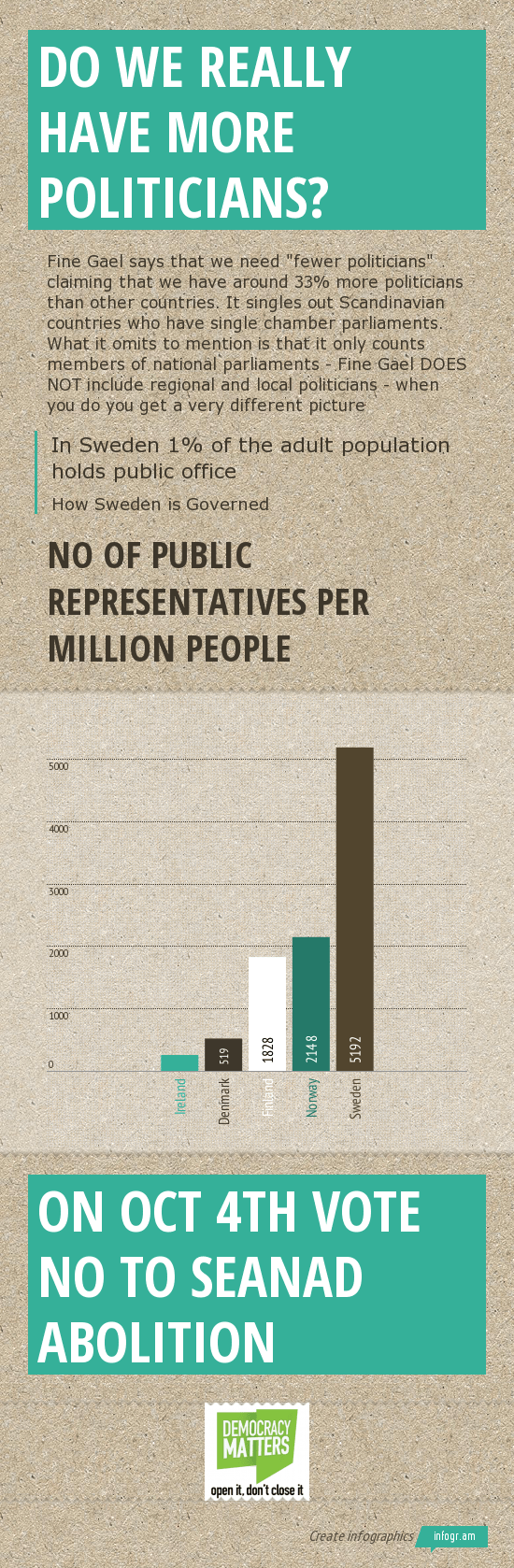
As a rule I am in favour of less politicians as they have long since abandoned their representative roles in exchange for a cosy coalition of partisan elites. It’s clear too that in all walks of life we are grossly over governed. Here in Northern Ireland we have one hundred and eight representatives for approximately 1.7 million people. To put that in context Greater Manchester has 2.68 million people.
Soon our grand Norn Iron council will debate the reform of local government which is less about reform and more about a sectarian carve up, but such a debate in a place so small, that only focuses on one aspect of government reform is unlikely to see any direct improvement in the provision of local services or indeed local accountability and transparency.
At the moment we have to drag public information on public expenditure from very unwilling and uncooperative public bodies and public representatives via the cumbersome and costly freedom of information process. Politicians who pay family members from the public purse somehow feel immune to public scrutiny. At each election a simple leaflet should be dropped through the door of every constituency telling us exactly what political nepotism costs us.
Yet there is a fashion for arrogance in Irish politics at the moment that transcends the border. Gifting a large majority to any single party is fraught with danger. The Irish electorate wisely avoided doing so for over thirty years. Ministers in such governments can become magisterial in their pronouncements and Prime Ministers become almost monarchical.
Such is the nature of the government currently blighting the Republic of Ireland. The Taoiseach Enda Kenny has learned much from his one time nemesis, Bertie Ahern. He assiduously avoids media interface unless its at a jobs announcement, rubbing shoulders with a foreign dignitary or climbing Croagh Patrick with Trappatoni. He is a copious student of the sound byte over substance. In the run up to the last General election he got a spur of the moment ‘big idea’ -something not always greeted with enthusiasm by political handlers trying to win an election. Enda’s spurt of ill defined genius was that his incoming government would abolish Seanad Eireann.
Now it’s true that the Irish Senate thanks to the actions of successive Fianna Fáil and Fine Gael governments has long since lost its mojo. Indeed both main parties and the Labour Party stuffed the place with aspirant political wannabes and electoral rejects. It’s also true that to have a second chamber with long outdated panels of election and a significant number of appointees at the partisan whim of a ‘dear’ leader is embarrassing and antiquated; yet for all its faults it is still better than no second chamber at all.
It’s amazing, even bizarre that as we approach the hundred anniversary of the Irish Proclamation with its high minded guarantees of ‘religious and civil liberty for all’- that an Irish government led by people who are torch- bearers to signatories of that Proclamation and political successors to the every creators of the first pluralist Irish senate; would dismantle an important part of a bicameral political system in a multi-cultural and diverse nation, that protects minority rights and those marginalised.
Activist and past member of the Seanad, Kathleen Clarke, wife of Thomas Clarke, first signatory to the Irish Proclamation must be turning in her grave. The Seanad for all its shortcomings gave Ireland two outstanding and unifying Presidents- Douglas Hyde and Mary Robinson. It possibly also gave the current incumbent, a life line that had he lost could have meant he only got to the Aras as a visitor.
Whether its been WB Yeats, David Norris, Feargal Quinn, Ivana Bacik, or even Pearse Doherty, the Seanad has given diverse and unrepresentative audiences an voice. In an all island context too, Ireland would have been a poorer place without the critical voices of senators Seamus Mallon, Maurice Hayes, Gordon Wilson, Sam Mcaughtery, Brid Rodgers and John Robb. A country is truly enriched when it can harness the independent minds and talents of all its people.
Perhaps more importantly we need checks and balances in a democracy. Imagine Charles Haughey’s Fianna Fáil with unbridled authority in Leinster House or what if there were no dissenting voices to the rise of a would be Mussolini such as Fine Gael’s own spectre – Eoin O’ Duffy? The Seanad needs to be reformed not abolished; because once its gone who will be left to apply the brakes to the threat of absolute majoritarian rule ?
From Democratic National Conventions in Atlanta and New York to the international Progressive Governance Conference involving 30 heads of state in London, and from President Clinton’s historic Belfast visit to the Dalai Lama’s recent press conferences in Ireland, Stakeholder CEO Tom Kelly has played various roles in making these major global events happen. Amongst the citations of commendations he has received for his work include endorsements from former US President, Bill Clinton, former British Prime Minister, Tony Blair, former Irish Taoiseach, Bertie Ahern, and His Holiness, the Dalai Lama. Each international figure acknowledged not only the work Tom did, but also the professionalism with which he carried out his assignments.
It is widely recognised that few in the communications industry would have the breadth, scope and scale of Tom’s public relations and public affairs experience. He has consulted on many complex and difficult matters for organisations, businesses and individuals, from providing strategic advice to the bakery industry on its pricing policy and referral to the Competition Commission to carrying out media relations for Irish Catholic hierarchy on the handling of allegations of child sexual abuse against clergy. He has contributed to the community consultation programme of change management as the RUC transformed into the PSNI, provided lobbying advice to the Trustees of the Presbyterian Church working on the fall-out of the collapse of the Presbyterian Mutual Society and co-ordinated a public affairs strategy on behalf of the major Northern Ireland newspaper industry groups.
Tom has also demonstrated his capability in the financial sector by co-ordinating a hearts and minds campaign which underpinned the Irish League of Credit Unions’ successful ‘Dirt’ exemption bid, as well as working with the Irish Bank Officials Association on its successful opposition to employment and benefit changes for members.
Streamed live on Sep 27, 2013
DigitalLunch coversation chaired by Mick, between Fine Gael TD Joe McHugh and Democracy Matters rep Derek Mooney on whether Seanad Eireann should be abolished?
As my dad used to say: “No good deed goes unpunished.”
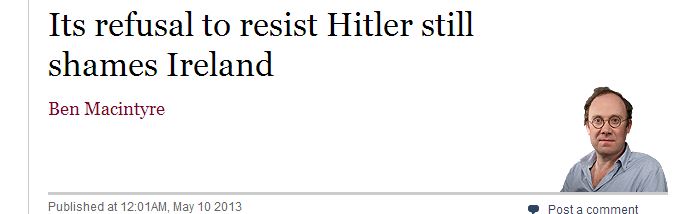
His words came to mind reading Ben McIntyre’s extraordinary opinion piece in last Friday’s Times entitled ”Its refusal to resist Hitler still shames Ireland”.
The article’s sub-head read: “Dublin has pardoned soldiers who fought the Nazis. Now it must withdraw its condolences on the Führer’s death.” Thus McIntyre uses Minister Shatter’s WWII Amnesty and Immunity law as a pretext for demanding a withdrawal of condolences made 68 years ago this month.
I can understand why people feel we should now apologise for the subsequent treatment of those who deserted the Irish army to join the British army, even at a time when there was a real threat of invasion here.
Even so, after six years advising a Defence Minister I‘m uncomfortable with a law which seems to concede that there are circumstances where members of our Defence Forces can break the oath they take to:
… be faithful to Ireland and loyal to the Constitution and that while I am a member of the Defence Forces I will obey all lawful orders issued to me by my superior officers…
More worrying, however, are Shatter’s comments launching the Bill in which he dismissed our neutrality during WWII as “a principle of moral bankruptcy”. This makes his gesture look like a re-writing of history into what he wishes it had been.
This fear is exacerbated by McIntyre using Shatter’s comments to call our neutrality: “at the very least, an abdication of moral responsibility.”
Would Minister Shatter or Mr McIntyre dismiss the United States’ decision to remain neutral up to the end of 1941 as “moral bankruptcy” or shameful? Should it now amend its entry into the war to read 1939?
Of course not. The Nazi’s atrocities were no better known in Ireland at the time than they were in the States. So why, from this distance in time and perspective, level the charge at us?
America’s entry into WWII was not precipitated by its abhorrence of what was happening in Europe but by an attack on its sovereign territory at Pearl Harbour.
Though Roosevelt had been trying to gradually shift American opinion from an isolationist stance to one of supporting Britain, it took a direct attack to achieve it. Yet Ireland, which wasn’t attacked, is to be pilloried for not doing the same, less than 20 years after the Black and Tan’s were here attacking and terrorising us?
Following American’s entry into the war De Valera re-termed our position as “friendly neutral”. The practical impact was acknowledged at the time by Viscount Cranborne, the British Secretary of State for Dominion Affairs, who reported, amongst other things that:
• Senior British and Irish army officers were contact in regarding co-operation against a possible German invasion of the South.
• The Irish granted the Allies permission to use the Atlantic Air Corridor (Lough Erne through Sligo/Donegal) and
• The Irish did not obstruct the departure from Ireland of those who wanted to serve in the UK Forces nor to their returning home on leave, provided they travelled in plain clothes.
Yet, when weighing up the effect of Ireland’s neutrality, rather than factoring in these actions McIntyre focuses just on Dev’s adherence to the diplomatic protocol of neutrality to the very end – Dev was Minister for External Relations as well as Taoiseach.
As Dev told the Dáil he saw the German Ambassador, Hempel, “as the representative of the [German] people and of the nation, not of the particular Government”. He also observed that his critics ignored his adjourning the Dáil a few weeks earlier as a mark of respect on the death of the President of the United States (FDR).
If Mr McIntyre wants to re-write history perhaps he can start a little closer to home and demand that the Tories erase Neville Chamberlain’s signature from the 1938 Munich Agreement?
My analysis piece entitled “Back from the Brink” from the April 2013 (Árd Fheis) edition of Fianna Fáil’s Cuisle magazine
Back in April 2011 the possibility of Fianna Fáil seeing its poll ratings even just break through the 20% barrier seemed like a pipe dream. But more than that, it was one that you dared not talk about in public in case people might question 1: Your political judgement or 2: Your grip on reality.
Yet, barely two years on, our party’s support heading into the mid 20s and we have confounded the pundits with two better than anticipated by-election performances in Dublin West and Meath East.
Back in 2011 things looked a lot darker. There had been a number of occasions between late 2008 and early 2011, as support plummeted, where we thought: it cannot fall any further. Yet it did.
Two years on from what I described in my Herald column as our electoral “punishment beating” our main achievement is not the increase in the polls, but rather the halt in the party’s decline achieved in the months following the February 2011 defeat.
That was the critical point. It was when the party’s future was most at risk. Remember those political pundits who advised that the only future lay in lurching to the right or trying to outflank the Shinners on euro-scepticism?
That was when we faced the key test for a venerable and established political party: its ability to adapt and respond effectively to change. The alternative was stark: descend into factionalism and fade slowly into oblivion.
By the time of last year’s Árd Fheis the party had determined that its future lay in change: real change. The decision to invite Prof Tim Bale to address the Árd Fheis was both timely and inspired. His presentation, based on his research into the Tories 13 years in the wilderness, listed the 12 key lessons points a party in our position needs to learn. The first two are:
1: Fully understand the scale of the defeat and
2: Not to underestimate your opponents.
Yet they are two lessons large established parties find it hardest to grasp. Having represented the political centre of gravity for so long it is hard to grasp that it has moved away and that you need to regain its trust.
This was not just true of the Tories, but of other big political parties who have lost and recovered: from the British Labour Party to the Japanese Liberal Democratic Party (LDP).
The temptation is to believe that your rejection is just a temporary phenomenon: that your former voters have just been misled by siren voices from the opposition and will return to the fold when the weaknesses and failings of the other crowd are exposed.
This was the mistake the Tories made about New Labour under Tony Blair and, conversely the mistake that Old Labour made about Thatcher. Both seriously underestimated their opposition and considerably overestimated their apparent entitlement to govern.
But there is another point on Prof Bale’s list. It is number 12: Political parties with respected traditions rarely disappear
While the SPD still languishes behind its rival CDU some nine years after Gerhard Schröder lost the Chancellorship to Merkel, it is still a major force in German politics. While Schröder’s resignation and the formation of the left wing Die Linke hurt Germany’s oldest political party, it focussed on the future; reformed and changed.
The same can be said for the Swedish Social Democrats – once Fianna Fáil’s main challenger for the title of Europe’s more successful political party. While its support has been falling steadily since the early 1990s, it still remains a major force in Swedish politics, though in opposition since 2006.
Japan’s LDP
While these parties suffered successive defeats, they were not on the scale of Feb 2011. To find an example of a party that came back from an electoral mauling of similar magnitude you need to look to Japan’s LDP. Sometimes hailed as the world’s most successful democratic party, the LDP held power in Japan almost continuously from 1955 to September 2009.
The seeds of its 2009 defeat (where it went from 296 seats to 119) were sown in the mid 90s where there were a number of major political reforms.
While the LDP continued to win elections, other parties were adapting better. It could still boast a popular leader in Junichiro Koizumi but, behind the scenes, the LDP was losing its advantage. It went from winning the 2005 election with one of the largest majorities ever to losing 60% of its seats in 2009.
The loss provided an initial shock to the system with some MPs jumping ship, but the LDP is a big and long established beast. It soon adapted to the 1994 reforms and worked at providing a very effective opposition. After just three years it completely reversed the 2009 defeat winning 294 seats at the December 2012 election.
Clearly there were other factors at play, but it does show what a political party that is deeply rooted in its communities and has a wide and diverse membership can achieve when it faces up to realities.

 The reshuffle is approaching, so which of the current batch of Ministers should stay in Cabinet (though not necessarily in their current job) and which should be dropped entirely.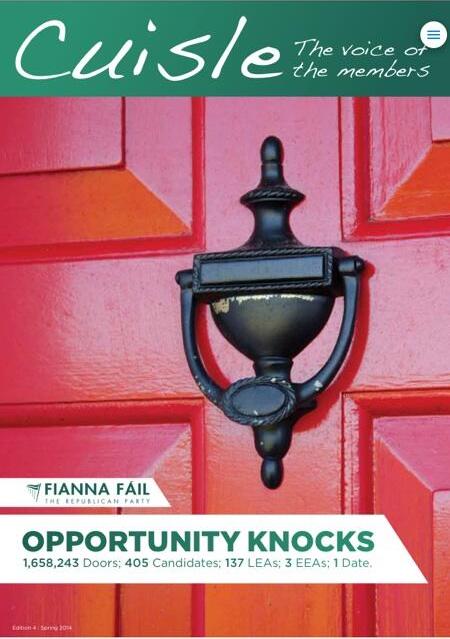




 derekmooney.ie