
“Bayonets and horses” one-liner wins debate for Obama, but will it impress voters

My take on the third and final presidential debate between President Barack Obama and Gov Mitt Romney, from tonight;s Evening Herald.  The print edition features an abridged version of the full piece below.


If recent polls are right then last night’s presidential debate outcome will please about 95% of us, even if a deal on Irish bank debt never made the agenda!
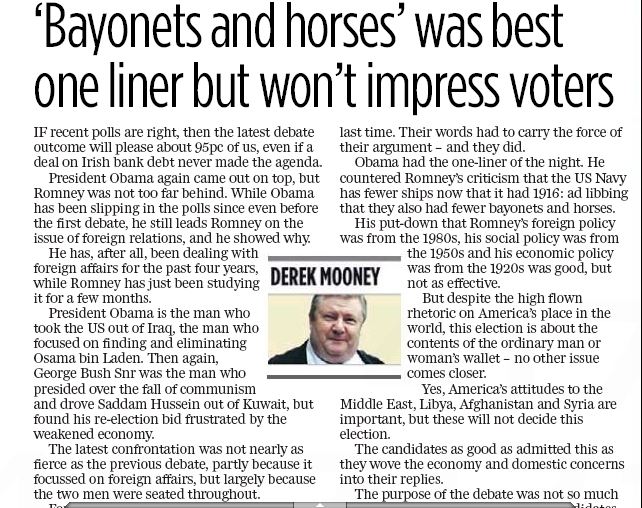
Derek Mooney column as it appeared in print version

In their third encounter President Obama again came out on top, but Romney was not too far behind. While Obama has been slipping in the polls since even before the first debate, he still leads Romney on the issue of foreign relations and he showed why last night.

He has, after all, been dealing with foreign affairs for the past four years, while Romney has just been studying it for the past few months. President Obama is the man who took the US out of Iraq, the man who focused on finding and eliminating of Bin Ladin. Then again George Bush I was the man who presided over the fall of communism and drove Saddam Hussein out of Kuwait, but found his re-election bid frustrated by the weakened economy.

Last night’s confrontation was not nearly as fierce as the previous debate, partly because it focussed on foreign affairs, but largely because the two men were seated throughout.

For this rsason their individual body language was not as noticeable as it had been last time. Their words had to carry the force of their argument – and they did. Both went on the attack – Obama attacked Romney’s grasp of the issues, while Romney dismissed the President’s foreign policy record as faltering.

Obama had the one-liner of the night. He countered Romney’s criticism that the US Navy has fewer ships now that it had 1916: ad libbing that they also had fewer bayonets and horses. Obama’s prepared put down saying that Romney’s foreign policy was from the 80s, his social policy was from the 50s and his economic policy was from the 20s was good, but not as effective.

The reality that dare not speak its name last night is the fact that foreign relations is not nearly as important as everyone likes to pretend.

Despite the high flown rhetoric from both on America’s place in the world, this election is about the contents of the ordinary man or woman’s wallet – no other issue comes closer.

Yes, America’s attitudes to the Middle East, Libya, Afghanistan and Syria are important, but these will not decide the outcome of this election, jobs and living standards will.

The two candidates as good as admitted this as they wove the economy and domestic concerns into their replies. The purpose of the debate was not so much to debate foreign policy, but to see how both candidates could handle complex issues.

As with the past two debates the role of the moderator was almost as important as the performances of the two contenders. Across the three debates it has had something of a Goldilocks quality to it. In the first Jim Lehrer was judged to have taken a bit of a back seat. Candy Crowley, the moderator of the second debate was accused of taking too big a role in the encounter, framing supplementary questions and, most notably, pulling up Gov Romney on his alleged misquoting of the President.

If Lehrer and Crowley had made the presidential porridge too cold or too hot, last night’s moderator, veteran news man Bob Schieffer, worked to get the balance just right. Schieffer was more forceful than his close friend Lehrer in enforcing the agreed rules, but was less interventionist than Crowley.

Most american commentators agree that these have been the most exciting debates in decades, but they have not done much to reduce the numbers of undecided voters.

As in previos elections the debates have envigorated those whi have already decided who they will support. The battle for undecideds will be won or lost on the ground in a handful of states, particularly Ohio.

The outcome of this election will be tight, the next fortnight will be fraught.

ENDS.
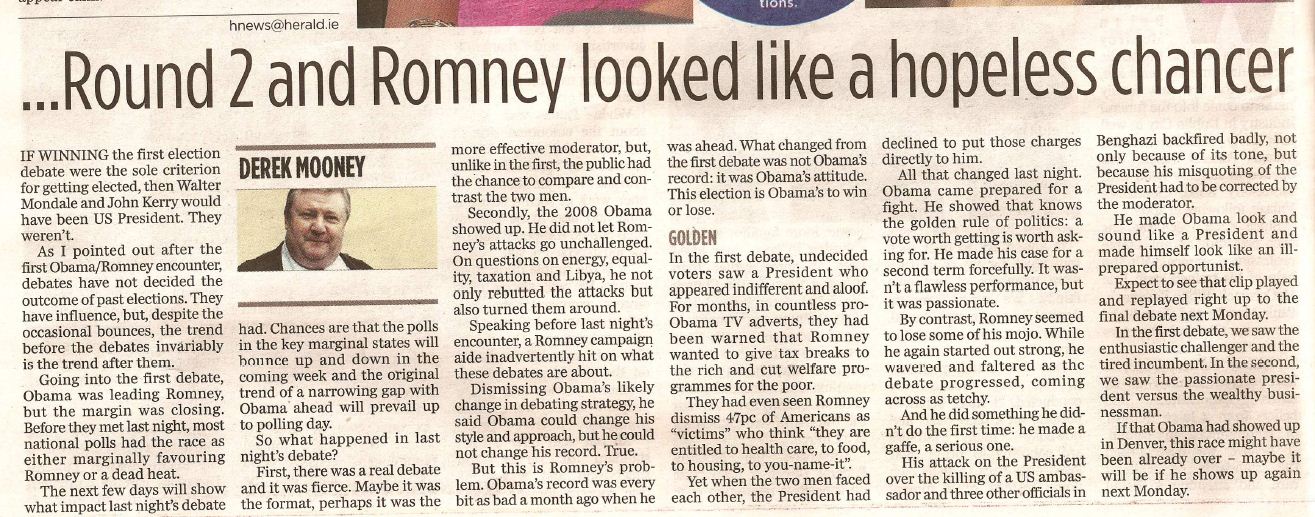
Round 2 and Romney looked like a hopeless chancer

My analysis of the Second Obama Vs Romney debate from tonight’s Evening Herald

——————————————————————————————————————————————————————————-

My Evening Herald Column

If winning the first election debate were the sole criteria for getting elected then Walter Mondale and John Kerry would have been President. They were not.

As I pointed out after the first Obama/ Romney encounter, debates have not decided the outcome of past elections. They are influencers but, despite the occasional bounces, the trend before the debates invariably is the trend after them.

Going into the first debate Obama was leading Romney but the margin was closing. Before they met last night most national polls had the race as either marginally favouring Romney or a dead heat.

The next few days will show what impact last night’s debate had. Chances are that the polls in the key marginal States will bounce up and down in the coming week and the original trend of a narrowing gap with Obama ahead will prevail up to polling day.

So, what happened in last night’s debate?

Firstly, there was a real debate and it was fierce. Maybe it was the format, perhaps it the more effective moderator, but unlike the first the public had the chance to compare and contrast the two men, especially when they clashed directly – and they certainly did that.

Secondly, the 2008 Obama showed up. He did not let Romney’s attacks go unchallenged. On questions on energy, equality, taxation and Libya he not only rebutted the attacks he turned them back on him.

Speaking before last night’s encounter one of Romney’s own campaign aides inadvertently hit on what these debates are about. Pre-emptively dismissing Obama’s likely change in debating strategy, he said Obama could change his style and approach, but he cannot change his record. True.

But this is the Romney campaign’s problem. Obama’s record was every bit as bad a month ago when he was ahead.  What changed at the first debate was not Obama’s record: it was Obama’s attitude. This election is Obama’s to win or lose.

At the previous debate undecided voters saw a President who appeared indifferent and aloof. For months, in countless pro-Obama TV adverts, they had been warned that Romney wanted to give tax breaks to the rich and cut welfare programs for the poor.

They had even seen Romney dismiss 47% of Americans as “victims” who think “they are entitled to health care, to food, to housing, to you-name-it.”

Yet, when the two men faced each other the President had refused to put those charges directly to him. Worse still, Obama came across as being every bit as ineffectual as the pro Romney ads had claimed.

All that changed last night

Obama came prepared for a fight. He showed that knows the golden rule of politics: a vote is worth getting is worth asking for. He made his case for a second forcefully. It was not a flawless performance, but it was passionate.

By contrast, Romney seemed to lose some of his mojo. While he again started out strong, he did waiver and falter as the debate progressed, coming across as tetchy as he argued with the moderator over the rules and time allowed.

But he did something he didn’t do the first time: he made a gaffe, a serious one. His attack on the President over the killing of the American Ambassador and three other officials in Benghazi backfired badly, not only because of its tone but because his misquoting of the President had to be corrected by the moderator.

He made Obama look and sound like a President and made himself look like an ill prepared political opportunist.

Expect to see that clip played and replayed on TV and the internet right up to the final debate on foreign policy next Monday.

In the first debate we saw the enthusiastic challenger and the tired incumbent. In the second we saw the passionate President versus the wealthy businessman.

If that Obama had showed up in Denver, this race might have been over already – maybe it will be if he shows up gain next Monday.


Obama lost first TV battle – but he’s still on course to win the war

My analysis of Wednesday night’s US Presidential Debate from tonight’s Evening Herald (Oct 4th 2012) .

—————————————————————————————————————-

Before last night’s Obama/Romney debate the American political rulebook said that debates do not swing elections. While the debates can give a candidate a short term bounce, the trend after the debates tends to be the same as the trend before them.

Sesame Street
Obama never mentioned Romney’s infamous 47%, though it seems Big Bird and pals are part of it.

Without a doubt Romney had a good night. But nothing happened in Denver to change the political rulebook. While commentators, especially the network TV ones, like to think that TV debates swing elections, the reality is that they haven’t.

Yes, there have been some incidents like President Bush Sr’s constant looking at his watch at the 1992 debate or President Ford’s assertion in the 1976 debate against Jimmy Carter that eastern Europe was not dominated by the USSR, but none of these reversed the course of the elections.

Bush Sr had started to lose ground to Clinton before the debate. Ford was trailing Carter badly by the time they debated. Indeed Ford only agreed to the debate because he was behind. Though we think these TV debates have been the norm in the US since the famous Nixon/Kennedy debates of 1960, the 1976 Carter/ Ford one was the first in 16 years.

Presidential debates by their nature tend to favour the challenger. The format raises the challenger’s status presenting the two candidates as equals. The challenger can put the President on the back foot by going on the attack and picking apart the incumbent’s record.

That is what Romney did last night, and he did it effectively.

While the current race is relatively tight, the polls have favoured Obama since before the summer. As with Carter in 1980 the Democrats should be in trouble. Polling suggests that Americans believe their country is on the wrong track by a margin of almost 20%. Optimism is on the decline. Only 43% of middle class Americans expect that their children’s standard of living will be better than their own. This compares to 51% four years ago.

These numbers should be poison for Obama and the Democrats and make the election a slam dunk for the Republicans, except the same Americans either do not understand or do not believe the alternative vision offered by Romney.

Romney’s people know this. He went into last night’s debate with a mission to change American’s views of him. He did himself some good in that regard. He not only went on the attack on Obama’s record he also scored several points in denying the Democrats portrayal of him as a tax cutter for the rich. The issue for him is that he did this at the expense of discussing the details of his alternative.

Perhaps his position behind Obama convinced him that he had nothing to lose with this approach, but the other risk for Romney is that his lurch to the centre may mean leaving some right wing voters at home?

In contrast, Obama seemed aloof and remote. He was reluctant to attack and take Romney on directly. This may have been a deliberate tactic. His people may have felt that scrapping and politicking with Romney wouldn’t look Presidential – he never mentioned Romney’s 47% remarks even once – however, it also meant that he allowed several very answerable attacks on his record go unchallenged.

While Romney didn’t land a knock out blow, he did win in terms of punches landed. He also did well in terms of appearance and body language, he dominated the debate. These things matter. This is television after all. We get as much information from what we see as what we hear.

Arguably the real impact these debates will have will be down to the clips the TV news shows choose to use in the coming days, though neither man gave a hostage to fortune.  The late night comics will have fun with Romney’s threat to cut public funding for PBS and Big Bird, but I don’t see last night’s rather boring exchanges as switching anyone’s vote.

Romney may have won the debate – but I reckon he will still lose the election

ENDS

Obama lost first TV battle – but he’s still on course to win the war

My analysis of Wednesday night’s US Presidential Debate from tonight’s Evening Herald (Oct 4th 2012) .

—————————————————————————————————————-

Before last night’s Obama/Romney debate the American political rulebook said that debates do not swing elections. While the debates can give a candidate a short term bounce, the trend after the debates tends to be the same as the trend before them.

Sesame Street
Obama never mentioned Romney’s infamous 47%, though it seems Big Bird and pals are part of it.

Without a doubt Romney had a good night. But nothing happened in Denver to change the political rulebook. While commentators, especially the network TV ones, like to think that TV debates swing elections, the reality is that they haven’t.

Yes, there have been some incidents like President Bush Sr’s constant looking at his watch at the 1992 debate or President Ford’s assertion in the 1976 debate against Jimmy Carter that eastern Europe was not dominated by the USSR, but none of these reversed the course of the elections.

Bush Sr had started to lose ground to Clinton before the debate. Ford was trailing Carter badly by the time they debated. Indeed Ford only agreed to the debate because he was behind. Though we think these TV debates have been the norm in the US since the famous Nixon/Kennedy debates of 1960, the 1976 Carter/ Ford one was the first in 16 years.

Presidential debates by their nature tend to favour the challenger. The format raises the challenger’s status presenting the two candidates as equals. The challenger can put the President on the back foot by going on the attack and picking apart the incumbent’s record.

That is what Romney did last night, and he did it effectively.

While the current race is relatively tight, the polls have favoured Obama since before the summer. As with Carter in 1980 the Democrats should be in trouble. Polling suggests that Americans believe their country is on the wrong track by a margin of almost 20%. Optimism is on the decline. Only 43% of middle class Americans expect that their children’s standard of living will be better than their own. This compares to 51% four years ago.

These numbers should be poison for Obama and the Democrats and make the election a slam dunk for the Republicans, except the same Americans either do not understand or do not believe the alternative vision offered by Romney.

Romney’s people know this. He went into last night’s debate with a mission to change American’s views of him. He did himself some good in that regard. He not only went on the attack on Obama’s record he also scored several points in denying the Democrats portrayal of him as a tax cutter for the rich. The issue for him is that he did this at the expense of discussing the details of his alternative.

Perhaps his position behind Obama convinced him that he had nothing to lose with this approach, but the other risk for Romney is that his lurch to the centre may mean leaving some right wing voters at home?

In contrast, Obama seemed aloof and remote. He was reluctant to attack and take Romney on directly. This may have been a deliberate tactic. His people may have felt that scrapping and politicking with Romney wouldn’t look Presidential – he never mentioned Romney’s 47% remarks even once – however, it also meant that he allowed several very answerable attacks on his record go unchallenged.

While Romney didn’t land a knock out blow, he did win in terms of punches landed. He also did well in terms of appearance and body language, he dominated the debate. These things matter. This is television after all. We get as much information from what we see as what we hear.

Arguably the real impact these debates will have will be down to the clips the TV news shows choose to use in the coming days, though neither man gave a hostage to fortune.  The late night comics will have fun with Romney’s threat to cut public funding for PBS and Big Bird, but I don’t see last night’s rather boring exchanges as switching anyone’s vote.

Romney may have won the debate – but I reckon he will still lose the election

ENDS