
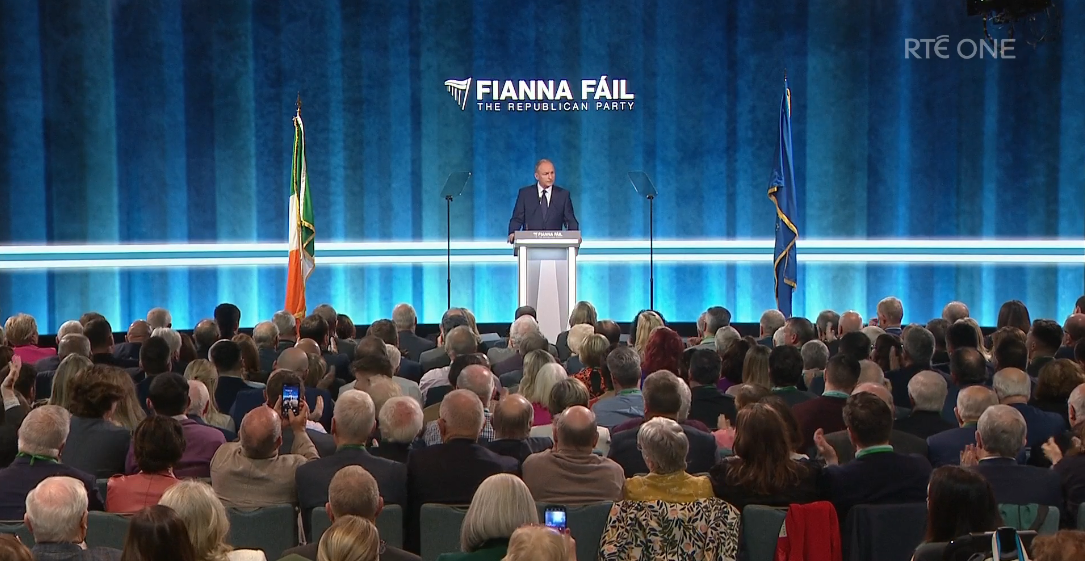
In this week’s column I perform my regular analysis of the party leader addresses given over the past two weeks by An Tánaiste Micheál Martin and Taoiseach Simon Harris. I consider the two scripts as pieces of political communications. I examine the numbers and wonder if parties no longer see these set piece speeches as worthwhile in themselves, but simply the price of getting their leader on the Sunday TV and Radio interview slots and getting some soundbites into print and Social Media? This article can also be heard as a Podcast

Though Mark Twain may not be the first name to spring to mind when considering Micheál Martin and Simon Harris’s Árd Fheis speeches of, it is the one that pops into mine.
The reason is the line usually associated with Twain: “I didn’t have time to write a short letter, so I wrote a long one instead” (the quote is sometimes attributed to Blaise Pascal).
In both speeches, Harris and Martin delivered scripts that were, to my mind, far too dense and over packed with unnecessary detail. As a consequence, both speeches were delivered at a speed and pace that left any viewers at home struggling to catch up.
Both delivered speeches that were more designed be informative and demonstrative, than persuasive or motivational. Put bluntly, they were of the “one for everyone in the audience” with long lists of achievements or of future promises.
While this should not come as a shock to those who have sat through any of Martin’s 9 previous Árd Fheis speeches (This one was his 10th speech in his near 14 years as Fianna Fáil leader) it is decidedly odd that Harris, who we are all assured is the great communicator chose to do the same?
Though the sobriquet great communicator can often be a euphemism for something else… wasn’t Boris Johnson once hailed as such?
However, back to those two Saturday night speeches. Neither one scrimped on either facts or stats, but is that really the right diet to serve to a less than interested viewing public on a Saturday evening? I think not.
It increasingly seems that the Saturday night Árd Fheis speech is now the price a party leader must pay to get a solid one-to-one interview on the following day’s The Week in Politics on RTÉ TV and This Week on RTÉ Radio One.
Having waded through both speeches, three or four times each to check timings, see what parts were omitted and gauge the reaction of folks in the hall, I can assure you that you will get a far better understanding of what the two leaders are about from those interviews than you will from the speeches. This may help explain why Sinn Féin is not planning to have its Árd Fheis until the autumn and is not use its airtime on the Locals and Europeans?
The two speeches, in numbers:
| Martin | Harris | |
| Time slot | 22m 34s | 24m 48s |
| Applause breaks | 23 | 43 |
| Applause time | 2m 18s | 5m 40s |
| Actual speaking time | 20m 16s | 19m 08s |
| Words spoken | 3,350 | 3004 |
| Sentences | 412 | 218 |
| Word per minute | 165 | 157 |
By the way, while both the Harris and Martin speeches are filled with statistics, not all of them stand up to scrutiny. Take these contrasting lines on housing.
While Martin framed the government’s record on housing since 2020 in the following terms:
In the last four years more houses have been built than in the previous nine years combined. There is more to be done, but that is real momentum.
Harris described that same achievement, this way:
Under Fine Gael, the number of homes being built has increased six-fold. The number of social homes has increased more than ten-fold. But we need more homes and more home ownership.
While I would strongly argue that Martin’s depiction is the more accurate, An Tánaiste was in such a rush to get to his next line and to deliver his script within the allotted time that he, once again, undersold a key line.
Fianna Fáil argues that it put country above politics and went into government with Fine Gael, a party that had twice been rejected by the voters, to impose a major public policy shift on housing… and yet its leader blurts out this key achievement without punctuating the point.
This single line should have had the crowd in the hall on their feet to congratulate their leader, and their ministers, on pushing through a major policy shift.
But it didn’t.
There was no applause break. No cheers.
Instead, the Fianna Fáil ploughed on with his busy text to talk at speed about the Help to Buy, First Home and Vacant Property Refurbishment schemes. Each one a most worthwhile policy, but none as important as this political point.
But this is not the only problem with going for this shopping list approach.
When you opt to have one for everyone in the audience then you better deliver one for everyone. Though both took the same approach, I would venture than perhaps Harris did it more effectively, in rhetorical terms.
This was most evident on the two occasions where Harris directed his comments to the audience at home. The first was his assurance to people with disabilities that their voice would be heard. The second was his call to action, directly asked those watching for their trust, support and especially their votes.
Maybe both men should have heeded the advice of Bertie Ahern, when he advised Harris to only take on a ‘small number of issues’ as Taoiseach.
Well, the same applies to speeches.
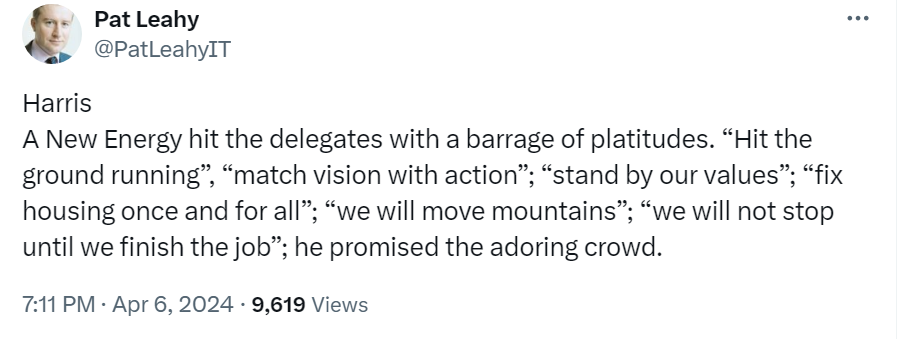
This is not to say that Harris was more convincing than Martin. Frankly, while Harris’s writers may have served their man better, the script they gave him was loaded with far too many clichés. A point succinctly made by Pat Leahy in this tweet.
To his credit, Martin’s gravitas and more assured and polished delivery made up for the dense paucity of the script.
When you look at the list of themes Martin highlighted in his script you can see that this was largely dictated by the cabinet portfolios held by Fianna Fáil ministers.
There were sections on Housing, Education, Health, Agriculture, Finance and Foreign Affairs and even Gaeltacht, all portfolios now held by members of Fianna Fáil in government.
But while all these portfolios are held by Fianna Fáil, these are not all the portfolios held by Fianna Fáil. There was one that merited no mention by the Tánaiste whatsoever… Defence.
It is the responsibility held by the Tánaiste himself, yet he could not be bothered to make even a passing reference to it. There was no mention of the recruitment and retention crisis, no mention of his plans to shred Fianna Fáil’s long standing commitment to the triple-lock.
Not that the singular defence reference in Simon Harris’s script was all that important, comprising one short non-specific promise to do more to support and resource our Defence Forces. No mention of the decade plus of neglect by his party of defence.
Ironically, Harris’s speech focused almost as much on Fianna Fáil policy areas as Martin’s. Harris was forthright in parking his policy tanks on the lawns of Fianna Fáil departments with big ticket pronouncements on housing, agriculture, and health.
The one non-Fianna Fáil held department to get a major mention in Harris’s speech was Justice, with Harris pivoting to reposition Fine Gael as the party of Law and Order. It was a pitch that led many in the commentariat to see Helen McEntee’s time in Justice as coming to a close a few days later.
The fact that McEntee has continued on Justice Minister is rightly seen as evidence that Harris’s Árd Fheis speech was less about substance and all about messaging, but messaging that has a lower shelf life than a Tik Tok video.
The fact that An Tánaiste did not mention crime or the Gardaí and had nothing to say about what had happened in Dublin a few months earlier, despite the presence in the hall of one of the highest profile and effective Fianna Fáil Lord Mayors of Dublin in decades, truly puzzles me.
As does the lack of any direct reference to a distinct Fianna Fáil position on migration, despite his party producing a policy document on migration – one largely framed by comments and analysis from Jim O’Callaghan T.D. only a day earlier. Indeed, proposals from that document were front page news on Saturday’s Irish Independent.
Before I conclude my analysis let me quickly turn my analysis to the other key actor in any Árd Fheis, the party audience in the hall. Their reaction, their loyal approval of key lines and key phrases can subliminally point the increasingly disinterested viewer at home to a point that they may have other wise missed.
Just as the dreaded laughter track in a sit com can point you were the writers put their jokes. The whoops and hollers of the party faithful help tell the viewing public that these are the important political takeaways.
Viewed in this context, Harris’s speech, was the hands down winner, with his Fine Gael crowd cheering and clapping twice as much and for twice as long as Martin’s more jaded and borderline apathetic cohort.
Let me demonstrate by comparing the audience reaction to their comments on what is happening in Gaza. For both leaders, this was a key moment in their speech. Their message was almost similar. But listen to the audience response.
This does not make Harris’s speech better, however.
Frankly both speeches were wasted opportunities with both parties opting to churn out formulaic scripts containing disjointed soundbites, but 100% free of any over arching narrative. These speeches could have been serious attempts to communicate directly with the audience at home. They weren’t. So, in that context, both failed.
They were not spectacular fails… but they were still fails nonetheless.


 derekmooney.ie