My Herald Column: Man overboard as ‘Capt Birdseye’ Reilly caught in storm of his own making

See online here:

Man overboard. Just four months in office and the Government has lost its first back bencher. In fairness, they have a lot of them, so one could hardly matter that much.

The 2011 intake of new Fine Gael and Labour TDs are still so unfamiliar to us that, in all likelihood, it could take a while to notice that two or three of them had gone missing.

At this rate — losing one backbencher every four months — the Coalition could hold on to its 58-seat majority for another 10 years. That is if there wasn’t a general election due in just under five years’ time.

And that’s why this first defection might have slightly largely ramifications than originally thought.

Pressure

Denis Naughten defied the party whip by voting for a Dail motion calling for accident and emergency facilities in Roscommon Hospital to remain open.

In doing so, he has significantly raised the pressure on his former colleagues. The Roscommon Hospital Committee has got a scalp. Other hospital committees and pressure groups committees will be taking notes.

Minister of State John Perry, who promised before the election to return breast cancer services at Sligo General Hospital, will find the heat being turned on him. He won’t be alone in the simmering pot. Government backbenchers in Portlaoise and across the country will find more targeted and co-ordinated campaigns being whipped up over the summer.

Never mind a winter of discontent, this government faces an autumn of anguish. Correction: the Fine Gael TDs face an autumn of anguish on the hospitals issue thanks to the Health Ministers upping the ante just before the election. (He’s the one who looks like a cross between Brian Blessed and Captain Birdseye)

If only he had played it calmer and cooler. Everyone could see Fine Gael and Labour were coasting to victory, but that was not enough for Fine Gael’s health spokesperson and deputy leader. Captain Blessed Birdseye wrote an open letter to the voters of Roscommon saying: “Fine Gael undertakes to retain the emergency surgical, medical and other health services at Roscommon Hospital.”

Last week the Taoiseach sought to defend the good Captain with the argument that Dr Reilly said this when he ” … was contesting the general election (and) he was not in possession of the information about the difficulties surrounding the recruitment of non-consultant hospital doctors”.

This did not, however, explain Deputy Naughten’s announcement at the end of March that Fine Gael had firmly “put a halt to any plans by the HSE to withdraw services from smaller hospitals”, and that it would not only protect, but would also enhance and develop these services.

One presumes that his words had Captain Blessed Birdseye’s blessings. If not, the Roscommon Deputy has made a rod for his own back. If he had, then there is still some considerable mileage left in this story.

This is also about management of expectations. The last government reduced expectations enormously, though as often by accident as by design. This Government came in building up expectations beyond anything that was deliverable.

Enda may come to regret leaving ministers in the portfolios they held in opposition. Yes, they are familiar with the minutiae of the issues, but they are also left to face those promises they made. Fine Gael could well end up reaping a whirlwind it started by itself and for itself. To quote the Book of Proverbs: “He that troubleth his own house shall inherit the wind.” Put that in your sails, Captain.

Derek Mooney was political and policy adviser to a Cabinet Minister 2004-2010 and has worked as a public policy consultant since the mid-1990s

– Derek Mooney
Germany lectures us on debt — forgetting the lessons of its own history

Here is my column on Germany forgetting the lessons of its own history from the Herald (Tuesday June 28 2011)

—————————————————————

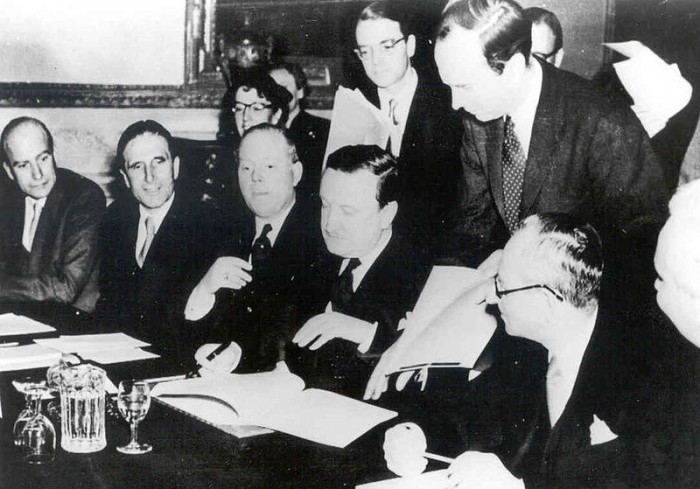
Signing the London Agreement on 27 Feb 1953 (Pic via: http://www.tlaxcala-int.org/article.asp?reference=8440)
Signing the London Agreement on 27 Feb 1953
(Pic via: http://www.tlaxcala-int.org/article.asp?reference=8440)

The media has been full of hourly reports of how the Greek debt crisis has the capacity to send the global economy back into the doldrums.

The Greeks, and by extension, the Portuguese, Irish and Spanish have had to endure tough lectures from France and Germany about the need for austerity.

The German government has been particularly forceful in delivering these lectures. Its leaders tell us their taxpayers do not want to subsidise bloated public sectors or unproductive workers across Europe.

And who could blame them? It is understandable that German workers do not want to pay extra taxes to send money across Europe, even if it is in the form of a loan with generous interest payments attached.

Understandable … but only if you have a short memory and disregard the history of the past century.

An economic historian at the LSE, Prof Albrecht Ritschl, has pointed out that the worst debtor nation of the past century is not Greece, it is Germany — and by a wide margin too. Worse still, Germany is denying to Greece, Portugal and Ireland the precise remedies it needed to rebuild itself. Twice in the last century, after WWI and WWII, Germany has ran up levels of debt that would make the Greek crisis look like a bad night at a mythical Tipperary Casino.

The cost of Germany’s 1930s debt default was as significant as the 2008 financial crisis. A default they were forced into as they could not repay the debts and war reparations set out in the Versailles Treaty following WWI.

This was the result of the rest of the world doing to Germany what Germany and others in the EU are now doing to us. Tons of new debt (in Germany’s case it was war reparations) were heaped on top of existing debt thereby draining the German economy of the ability to rebuild itself.

By the end of WWII, the rest of the world had learned a lesson. It recognised that lumbering a devastated and demoralised Germany with more debt was not a workable solution.

In the 1953 London Agreement on German External Debts, the Allied powers did the exact opposite of what the German and French governments are doing today. They wrote off half of Germany’s total mountain of debt and gave it additional time to repay the monies it owed.

It was thanks to the foresight and generosity of former enemies that West Germany was able to deliver the Wirtschaftswunder (economic miracle) of the 1950s.

This was a deal negotiated between leaders who had learned from the mistakes of the past and could see beyond the political demands of the next election, particularly Germany’s own Konrad Adenauer.

Remember, also, that one of the occupied countries owed money by Germany was Greece. Those protesting in Athens remember that their parents and grandparents had to forego the compensation owed to them.

How galling must it be for them to take lectures from the current German Chancellor on the virtues of paying your debts?

And, in case anyone thinks this is all reaching too far into the past, think again. According to Prof Ritschl, Germany defaulted on one of the conditions of the 1953 London Agreement as recently as 1990.

TOOLS

It is a sad indictment of the current German leadership that it cannot see that denying others the tools that it required to rebuild itself is only storing up trouble for the future.

It does not take a Konrad Adenauer or a Willy Brandt, however, to recognise that Germany’s economic fortunes are so closely intertwined with the other eurozone countries that if part of the eurozone falls, Germany could flounder.

So, even if heeding the lessons of history cannot bring Germany to realise the current policy is not working, self interest just might.

– Derek Mooney

Latest Herald column: First Anniversary of Dermot Earley’s Passing

This is my latest Evening Herald column: see here

Remembering Dermot Earley, a true Irish hero

By Derek Mooney
Saturday June 25 2011

IT IS a year since this country lost a man Enda Kenny described as iconic: Army Chief of Staff. Dermot Earley.

Far better people than me have given eloquent testimony to what an extraordinary man Dermot was. This can be readily verified by a visit to the excellent exhibition on his life and career at the GAA museum at Croke Park. On a purely personal level, what amazed me most about him was his capacity to command great authority while at the same time exhibiting a sense of humility.

He was strong and forceful, yet also gentle and relaxed. For almost six years, from 2004-2010, I worked down the corridor from him in the Parkgate HQ of the Defence Forces and Department of Defence.

Within a short space of time I witnessed his great personal skills, not least his ability to put people at ease. Both he and I were attending a social occasion organised by the soldiers’ representative body PDFORRA.

Through their involvement with the Euromil, the network of military representative bodies across Europe, PDFORRA had been supporting other groups seeking their own representation systems.

Attending the social function were three of four officers of a sister organisation not recognised by their own military authorities.

While I am 90pc sure I remember the country concerned, I won’t name it here. One of the PDFORRA senior officials asked me if I would mind meeting these guys. I said I had no problem and was introduced to them.

They were in civvies, as they were here on their own time.

IMPRESSED

Minutes later we were joined by Dermot, who arrived in the uniform of a Major General, as our Deputy Chief of Staff. He suggested we sit down at one of the tables and have a chat and a drink. The guys were not just impressed, they were visibly moved. Here was the second in command of our army not just meeting them, but sitting down and talking face to face when their own mid-ranking officers would not.

My other abiding memory was a a trip to the EUFOR HQ outside Paris. During a break, three or four of us, including Dermot, went outside to stretch our legs.

As we strolled we noticed a number of French soldiers on duty looking over at him from a distance. They could tell he was a senior general from his insignia, though it was clear they were unsure who he was, or where he was from.

He noticed this and chuckled as we saw them talk among themselves. At this point I piped up: “I think I know what they are saying.” “What’s that,” asked Dermot. “They are saying,” I replied, “you see yer man over there… he’s the greatest Irish footballer never to win an All-Ireland medal.” He looked at me sternly for about five seconds and then burst out laughing. He may have said something back at me, but I cannot quite recall just now. It is, however, the way I will remember him.

Ar dheis De go raibh a anam dilis.

– Derek Mooney