Barrack Closures a Mistake on All Fronts

This article appeared in the Irish Examiner on Thursday November 17th 2011

Resigning as a Minister is not something to be done lightly. You must weigh up the influence and input you are surrendering from having a seat at the table against the public acclamation you will receive. The applause and cheers will soon die down and you will be left standing on the outside while decisions get made without you.

Though he is not a household name, Willie Penrose is a smart man. While he may have the bearing and manner of a classic rural parish pump TD, he is a smart guy. An experienced and successful Barrister, Penrose knows what he is doing.

Gilmore knew that that the future of Columb Barracks in Mullingar was a red line issue for Penrose when he nominated him as a Super Junior – so why did he proceed with the appointment?

This government was only a few days in office when speculation started that they may close some more barracks. Further barrack closures have been a fixation with some senior civil servants and military figures in Defence.

Shortly after I entered the Department of Defence in October 2004 a senior official popped into my office to discuss the issue of “barrack consolidation”. This I came to learn was the euphemism for barrack closures.

There is a school of thought, among some in the Defence organisation, that we should have a much smaller number of super barracks – say three or four – located in the major cities, rather than the existing network of smaller posts across the State.

While this would potentially be a little more economic and efficient, this has to be weighed with the popular support and positive PR generated from having more locally organised and based units. It is a demonstrable fact that recruitment is strongest in those areas where there is a military post.

Even at the height of the Celtic Tiger for every general service recruit post advertised there were at least 5 applicants, while the Cadet competitions often saw 25 or 30 well qualified applicants for each vacancy.

Local barracks and locally based army units form strong bonds with local communities. Use of barracks facilities, especially sports grounds, is usually offered to local community groups, particularly youth groups. The local army unit is always on hand to help out in the classic “aid to the civil power” type exercises – flooding, ice clearance, bad weather etc.

While they are hard to measure on a civil servants excel spreadsheet, these strong local bonds are vitally important and should not be thrown away lightly.

The previous Minister, Michael Smith has closed six barracks back in 1998, though some of these properties had still not been disposed of almost six years later. Indeed it would take a further five or so years to deal with these.

The estimated year on year savings from these 1998 closures was estimated to be in the region of €3.5 – 4.5m. These were “economies of scale” saving from reduced security, heating, lighting and other savings.

If the current row over closing three or four barracks was just about that, I might be tempted to agree with it. But this is a mistake on all fronts.

Alan Shatter says that given the choice between saving buildings and retaining personnel, he opts for the latter. A noble intention: if only that was the choice before him.

It is not.

If the planned closures go ahead the Defence Forces can kiss good bye to seeing their numbers ever rise back above 10,500 again.

There are a number of reasons not to close these barracks.

Their closure will hurt the local economies in Mullingar, Clonmel and Cavan just as much as any factory closure. There is no point the Taoiseach giving out to Talk-Talk management for the inconsiderate handling of that closure while his own Minister is planning to do the same thing.

Where does the Minister propose to transfer the troops stationed in Mullingar, Clonmel and Cavan? Where is the spare capacity in the remaining barracks?

We are already aware from the last round of barrack closures that the remaining barracks were full and operating close to capacity.

To close these other barracks and to permanently move around 500 – 600 troops would require a considerable capital investment in additional facilities in Athlone, Finner andLimerick. This is not something that will appear overnight. Where does the Minister propose to get the cash to provide this additional capacity?

Colm McCarthy’s famous Bord Snip Nua report found that the Defence Forces were the only sector of the Public Service to reduce numbers during the height of the Celtic Tiger. His report suggested a number of further small reforms, including a reduction in the size of the force by a further 500 to 10,000. He recommended this be implemented over a two year period. It was achieved within a year, well ahead of the target date.

So what kind of signal do these further cuts – cuts that go beyond An Bord Snip Nua – send to others in the Public Service? This was a point that Brian Lenihan and Brian Cowen instinctively understood.

Here is a part of the public service that has downsized, modernised and reformed itself beyond expectations and yet it gets singled out again for cuts that neither make sense nor add up. These barrack closures appear, on the face of it, to be gratuitous.

The Defence Forces now do more with less. When it comes to real public sector reform the Defence Forces are a model of how it can be done right. These closures put that model at risk.

The investment in the Defence Forces made between 1997 and 2007 was a text book example of how to invest wisely and productively. Surplus property was sold and the proceeds invested in better training and equipment.

While the numbers working in the Public Service increased by 17% over the decade of the Celtic Tiger, the numbers working in the defence organisation actually fell by 8%.

This applied across all levels. The number of troops fell and so did the number of civil servants. Indeed Defence has a remarkably small civil service

The fact that the Minister does not get this point is compounded by the fact that he did not address the annual PDFORRA conference. That was a bad decision. It was his first opportunity to address the soldier’s representative organisation and he opted to send his Junior Minister while he and his Secretary General heading off to an international conference instead.

Willie Penrose’s resignation is about a lot more than just Mullingar Barracks; it is about a part time Defence Minister who fails to appreciate what he is doing, or is simply not bothered.
Kenny’s U-turn on Special Advisers

Taoiseach Enda Kenny’s defence of his U-turn on capping the pay of Special Advisers set me to thinking.

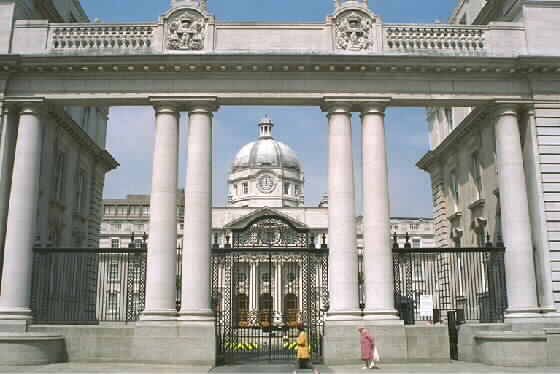
Merrion Street
Dept of An Taoiseach

When they came into office just eight months ago the Taoiseach started out well. He announced the withdrawal of ministerial cars and garda drivers from most Cabinet Ministers and was seen striding to work onfoot with no merc or beemer in sight.

He also said that he intended to take a similar approach to Special Advisers pay. The results there have been less impressive. Contrary to the declared intention to reduce the pay rates, it now emerges that almost 50% of them have been given exemptions and are now paid above the Principal Officer grade.

The Taoiseach defends this saying that Advisers are still paid less than previously.

Is that really so, Enda?

Back in October 2004 I was asked to become the Special Adviser to the newly appointed Defence Minister. It took me about five or six weeks to wind up my existing business and take on my duties as Special Adviser.

Within a few days of taking on the position I sat down with the Department’s HR manager. He talked me through the Departments requirements and regulations.

There were a number of forms to sign, covering a range of matters including security and related matters. I was required to produce the usual tax forms required of any new employee plus a Tax Clearance Certificate.

He then produced my contract of employment. We discussed some of the provisions while I leafed through the document. Then we both went quiet at the same time.

When it came to my pay rate the contract stated that I would be paid at the first point on the Assistant Principal (AP) grade. My understanding when I had accepted the post was that I would be paid at Principal Officer (PO) grade.

The difference between the first points on the AP and PO scales was in the region of €25k. The first point on the AP scale was in or around €57K as best as I can recall now.

I was a bit taken back by this and said as much to the HR manager. He explained that the default rate for my post in the department was AP grade unless I could show that my previous salary had been higher than that.

I relaxed as I knew I should clearly show that my annual income over the previous few years was in excess of the AP scale. It did take a few weeks to sort out but the paperwork was finalised as my first year’s pay was set at the first point on the PO scale.

I am not revealing anything new here. I am open about my salary as the then opposition used to ask parliamentary questions about my pay and expenses, and that of my colleagues across other Departments, at least twice a year. The replies were published regularly.

Indeed I recall opening an issue of the Sunday Independent as I was queuing to board a Ryanair flight to visit my parents in Spain and seeing one of those replies featuring my name, photo and pay rate there.  Worse still, I saw some people on the plane later holding copies of the Sindo and glaring at me.

Those replies usually pointed to the fact that there were fewer advisers in the post 1997 FF/PD Governments than there had been in the 94-97 FG/Lab/DL one. About 30% fewer: as far as I remember.

I make this point as the Taoiseach has sought to assert that paying 50% of their advisers at the first point on the PO scale is some big advance on the situation while I was there.

It is not.

The point on the scale is the same, though the scale has reduced. It was reduced by the last Government, not this one. As advisers we agreed to a 9% voluntary reduction in our pay in line with the voluntary cut in Ministerial pay, as well as the increased pension contributions and reductions in civil service pay rates across the board.

Like many things this Government is doing they may want people to think it is different – the reality is that it is the same.

Why current crisis is more political than economic

My latest Evening Herald column from August 8th 2011 – you can also see it online: here

——————————

Euro Parliament Committee Room - Bxl

Success has many fathers, but failure is an orphan. Clearly, no one has told the economists this.

In any other walk of life — architecture, dentistry, cake decorating — people run away when they see failure or disaster looming.

Not the economists. They embrace disaster. They revel in it.

As soon as a crisis looms they rush to the TV camera and the microphone to say how they predicted it.

They take a pride and pleasure in being associated with doom and failure that would do your heart good, if the consequences were not so dire for the rest of us.

In the wake of last week’s market turmoil, the weekend papers and discussion shows were full of economists doing what they do best.

Switching between the radio stations on Saturday and Sunday mornings was like playing some demented radio five-card stud — I see your dollar bond collapse and raise you an Italian bailout.

The Sunday newspapers were as bad with even more dire predictions of either the collapse of the euro or the dollar, or both.

We are living in uncertain economic times … and will be for some years to come. No one needs to tune into the radio to learn that.

This is a major culture shock for many, though not for those of us who lived through the Eighties … and no one wants to see another decade lost to despair and inactivity.

But I digress. So why have we seen renewed predictions of crisis this week? They do not seem to have been prompted by the publication of any eurozone statistics or hard figures.

Neither could they be reasonably explained away as just the result of a global slow news day.

While they may, in part, be due to the outworkings of the American debt ceiling compromise, the giveaway is in the word most often employed by economists in describing the crisis: confidence.

We have seen share values drop and bond costs increase over the past week because market analysts and investors do not have confidence in the capacity of eurozone countries to deal with all the debt in the system.

Could these possibly be the same investors who were protected from massive losses in banks and bad investments by those same governments?

Ironic, isn’t it? Eaten bread may be soon forgotten, but never with anything like the speed and hypocrisy with which socialised private losses are forgotten by the markets.

It is tough to make someone have confidence in you, particularly when you have not got much confidence or trust in them. But wringing our hands in anger on this won’t make the problem go away.

As I said earlier, the past week’s scare does not have its origin in a spreadsheet. It is fundamentally a political issue; not an economic one.

The real danger for us is that the dramatic actions and reforms the market is demanding in return for their “confidence” would be deeply unacceptable to people here and across the Eurozone.

This is the almost impossible balance that the eurozone leaders are trying to strike. To make the changes just about needed to gain market approval without totally alienating public opinion at home. The political spectre of Brian Cowen must stalk their deliberations.

Not that the eurozone leaders merit much sympathy. Merkel and Sarkozy’s slowness to act decisively in the early stages of this crisis has cost us all. Their dithering and loose talk threw Ireland to the market wolves in a futile attempt to stem the tide at no cost to themselves.

Their recent reforms to the European Financial Stability Fund have been more carefully judged, though these will take a while to work their way through.

Meanwhile, the next time you hear an economist demanding firmer and more determined actions, just remember that translates in higher taxes and higher charges for you and yours.

– Derek Mooney

How politicians helped redeem themselves by taking on the big guys

My Evening Herald article is online Here

Saturday July 23 2011

JUST by coincidence, I happened to be passing through Brussels this week.

From the window of my hotel room near the Schuman roundabout, I could both see the European Council building and hear the sirens roar as EU heads of government arrived for the emergency EU summit.

From the the TV in the background I could hear and see the continuing fallout on BBC World news from the hacking scandal, while on my laptop I read and listen to the deserved praise being heaped on the Taoiseach for his speech on the Cloyne scandal.

As these three separate news stories competed for my attention it began to dawn on me that these three very different events have a common thread: how politics can work and how politicians can make a difference when they reflect the public mood.

In the case of the News of the World hacking scandal we see the politicians finally recovering their sense of confidence and self worth and shedding their decades of deference to one media mogul.

In the European Council decision we see politicians taking bolder and coordinated actions to exert some meaningful control over Europe’s economic destiny and shunning the cautious advice of bankers or ratings agencies.

In the case of Enda Kenny’s Cloyne speech we see a political leader not just standing up to Rome, but finding his voice calmly and forcefully telling it some home truths and reminding it how much it has lost its way.

redeem

By their actions and words, across these three events, public representatives have helped redeem the profession of politics somewhat by taking on three of the most powerful interest groups: the Church, the banking sector and the media.

This is no renaissance for politics, but just a timely reminder that politics and politicians can rise above the cynical and do good.

While the common thread in the three events is the primacy of democratic politics, it is no harm to reflect on how much further Enda is along the road of telling the Church its role and place in modern society than David Cameron is in his attempt to break this news to Rupert Murdoch and News International.

Nonetheless, this should not stop us taking a leaf out of Westminster’s book and, just as the MPs did with the Murdochs, bringing senior churchmen before a public hearing of a Dail Committee to answer questions from the people’s chosen representatives.

Just over a year ago the Papal Nuncio refused to appear before a committee considering the report of the Murphy Commission.

Let us test the water now to see if the Vatican and the Nunciature think they can sustain this refusal to answer for their actions.

As Fergus Finlay said, the Taoiseach’s Cloyne speech has set the bar high.

It follows on from Brian Cowen’s hard hitting speech responding to the Ryan Report and Dermot Ahern’s declaration following the Report of the Murphy Commission that a “clerical collar will protect no criminal”.

To quote Brutus in Shakespeare’s Julius Caesar: “There is a tide in the affairs of men, Which taken at the flood, leads on to fortune.”

Enda has taken that tide and the Cloyne speech will help establish a political legacy.

However, while he is entitled to enjoy the coming few weeks as the speech continues to reverberate, he should make a quick call to a certain former Taoiseach in Drumcondra to discover how quickly the sheen on his real achievements in the Good Friday Agreement can be dulled by harsh economic realities.

opportunity

Enda needs to apply the same clarity of language and and certainty of approach to tackling the economy that he has found in tackling the Vatican and Catholic hierarchy.

The new measures agreed by euro leaders at the emergency EU Summit may just afford him such an opportunity — but he needs to take this particular tide soon and not squander the opportunities it affords.

My Herald Column: Man overboard as ‘Capt Birdseye’ Reilly caught in storm of his own making

See online here:

Man overboard. Just four months in office and the Government has lost its first back bencher. In fairness, they have a lot of them, so one could hardly matter that much.

The 2011 intake of new Fine Gael and Labour TDs are still so unfamiliar to us that, in all likelihood, it could take a while to notice that two or three of them had gone missing.

At this rate — losing one backbencher every four months — the Coalition could hold on to its 58-seat majority for another 10 years. That is if there wasn’t a general election due in just under five years’ time.

And that’s why this first defection might have slightly largely ramifications than originally thought.

Pressure

Denis Naughten defied the party whip by voting for a Dail motion calling for accident and emergency facilities in Roscommon Hospital to remain open.

In doing so, he has significantly raised the pressure on his former colleagues. The Roscommon Hospital Committee has got a scalp. Other hospital committees and pressure groups committees will be taking notes.

Minister of State John Perry, who promised before the election to return breast cancer services at Sligo General Hospital, will find the heat being turned on him. He won’t be alone in the simmering pot. Government backbenchers in Portlaoise and across the country will find more targeted and co-ordinated campaigns being whipped up over the summer.

Never mind a winter of discontent, this government faces an autumn of anguish. Correction: the Fine Gael TDs face an autumn of anguish on the hospitals issue thanks to the Health Ministers upping the ante just before the election. (He’s the one who looks like a cross between Brian Blessed and Captain Birdseye)

If only he had played it calmer and cooler. Everyone could see Fine Gael and Labour were coasting to victory, but that was not enough for Fine Gael’s health spokesperson and deputy leader. Captain Blessed Birdseye wrote an open letter to the voters of Roscommon saying: “Fine Gael undertakes to retain the emergency surgical, medical and other health services at Roscommon Hospital.”

Last week the Taoiseach sought to defend the good Captain with the argument that Dr Reilly said this when he ” … was contesting the general election (and) he was not in possession of the information about the difficulties surrounding the recruitment of non-consultant hospital doctors”.

This did not, however, explain Deputy Naughten’s announcement at the end of March that Fine Gael had firmly “put a halt to any plans by the HSE to withdraw services from smaller hospitals”, and that it would not only protect, but would also enhance and develop these services.

One presumes that his words had Captain Blessed Birdseye’s blessings. If not, the Roscommon Deputy has made a rod for his own back. If he had, then there is still some considerable mileage left in this story.

This is also about management of expectations. The last government reduced expectations enormously, though as often by accident as by design. This Government came in building up expectations beyond anything that was deliverable.

Enda may come to regret leaving ministers in the portfolios they held in opposition. Yes, they are familiar with the minutiae of the issues, but they are also left to face those promises they made. Fine Gael could well end up reaping a whirlwind it started by itself and for itself. To quote the Book of Proverbs: “He that troubleth his own house shall inherit the wind.” Put that in your sails, Captain.

Derek Mooney was political and policy adviser to a Cabinet Minister 2004-2010 and has worked as a public policy consultant since the mid-1990s

– Derek Mooney

Germany lectures us on debt — forgetting the lessons of its own history

Here is my column on Germany forgetting the lessons of its own history from the Herald (Tuesday June 28 2011)

—————————————————————

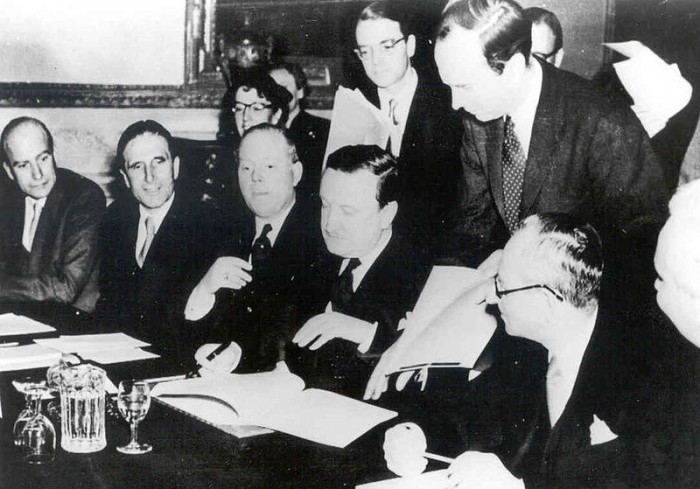
Signing the London Agreement on 27 Feb 1953 (Pic via: http://www.tlaxcala-int.org/article.asp?reference=8440)
Signing the London Agreement on 27 Feb 1953
(Pic via: http://www.tlaxcala-int.org/article.asp?reference=8440)

The media has been full of hourly reports of how the Greek debt crisis has the capacity to send the global economy back into the doldrums.

The Greeks, and by extension, the Portuguese, Irish and Spanish have had to endure tough lectures from France and Germany about the need for austerity.

The German government has been particularly forceful in delivering these lectures. Its leaders tell us their taxpayers do not want to subsidise bloated public sectors or unproductive workers across Europe.

And who could blame them? It is understandable that German workers do not want to pay extra taxes to send money across Europe, even if it is in the form of a loan with generous interest payments attached.

Understandable … but only if you have a short memory and disregard the history of the past century.

An economic historian at the LSE, Prof Albrecht Ritschl, has pointed out that the worst debtor nation of the past century is not Greece, it is Germany — and by a wide margin too. Worse still, Germany is denying to Greece, Portugal and Ireland the precise remedies it needed to rebuild itself. Twice in the last century, after WWI and WWII, Germany has ran up levels of debt that would make the Greek crisis look like a bad night at a mythical Tipperary Casino.

The cost of Germany’s 1930s debt default was as significant as the 2008 financial crisis. A default they were forced into as they could not repay the debts and war reparations set out in the Versailles Treaty following WWI.

This was the result of the rest of the world doing to Germany what Germany and others in the EU are now doing to us. Tons of new debt (in Germany’s case it was war reparations) were heaped on top of existing debt thereby draining the German economy of the ability to rebuild itself.

By the end of WWII, the rest of the world had learned a lesson. It recognised that lumbering a devastated and demoralised Germany with more debt was not a workable solution.

In the 1953 London Agreement on German External Debts, the Allied powers did the exact opposite of what the German and French governments are doing today. They wrote off half of Germany’s total mountain of debt and gave it additional time to repay the monies it owed.

It was thanks to the foresight and generosity of former enemies that West Germany was able to deliver the Wirtschaftswunder (economic miracle) of the 1950s.

This was a deal negotiated between leaders who had learned from the mistakes of the past and could see beyond the political demands of the next election, particularly Germany’s own Konrad Adenauer.

Remember, also, that one of the occupied countries owed money by Germany was Greece. Those protesting in Athens remember that their parents and grandparents had to forego the compensation owed to them.

How galling must it be for them to take lectures from the current German Chancellor on the virtues of paying your debts?

And, in case anyone thinks this is all reaching too far into the past, think again. According to Prof Ritschl, Germany defaulted on one of the conditions of the 1953 London Agreement as recently as 1990.

TOOLS

It is a sad indictment of the current German leadership that it cannot see that denying others the tools that it required to rebuild itself is only storing up trouble for the future.

It does not take a Konrad Adenauer or a Willy Brandt, however, to recognise that Germany’s economic fortunes are so closely intertwined with the other eurozone countries that if part of the eurozone falls, Germany could flounder.

So, even if heeding the lessons of history cannot bring Germany to realise the current policy is not working, self interest just might.

– Derek Mooney