Why lobbysits are so vital for all communities

My Evening Herald column from last Saturday (23rd June 2012)
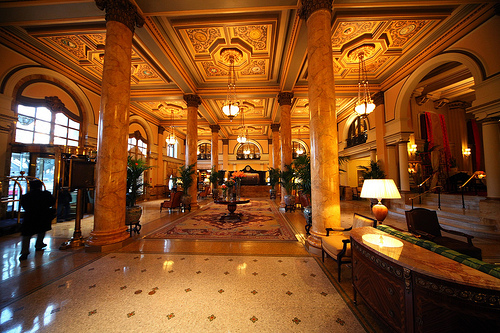
Lobby of The Willard Hotel in DC
Pic courtesy of biberfan on flickr

I have an aversion to the term: lobbyist. I resisted its use in describe myself when I worked with a range of national representative groups and I can’t recall ever using it to describe those whom I dealt with while I was a ministerial adviser.

The term “lobbyist” seems to have a pejorative tone to it. Lobbying is viewed with suspicion. Understandable enough after the Tribunal horror stories of men in well cut suits loitering outside Council chambers offering “incentives” to errant Councillors.

The reality is that lobbying is a practice as old as government itself. The origins of the term are often erroneously attributed to the post Civil War US President, Ulysses S. Grant.

Grant was fond of retiring to the bar of the old Willard Hotel across from the White House. News of his habit soon spread and he increasingly found himself besieged by promoters of this or that project as he passed through the lobby of the Hotel.

The term, in fact, well predates Grant and the Willard Hotel and most probably goes back to 17th century England and refers to the lobbies where constituents and petitioners could meet Members of Parliament.

Yet somehow the image of rail tycoons and land speculators in the lobby of the Willard smoking big cigars while stuffing cash into the pockets of pliable politicians seems to have stuck

This is a great pity as lobbying is an entirely legitimate and democratic activity. It is even protected by the First Amendment to the US Constitution which speaks of the right “…to petition the government for a redress of grievances.”

Substitute the words “advocacy” or “campaigning” for “lobbying” and you get a better sense of what it should be about: making the best case you can to the powers that be.

When it descends to kick backs and payola it is no longer lobbying, it is just corruption, plain and simple.

Yet this is the image that still persists: guys in the lobby of the Willard improperly influencing politicians, and their more modern day equivalents.

But it is a false image. Lobbyists today come in all shapes, sizes and types.

People can be advocates on their own behalf, or they can seek the services of others with experience and skills in presenting a case on behalf of others.

They can be from schools, universities, communities, companies, trade associations, trade unions, churches, charities, environmental groups or senior citizens groups

Not all lobbyists are paid. In my experience (from both sides of the divide) most are not. During my time in government I recall getting more calls and emails from volunteer lobbyists than paid ones.

Lobbying is not simply about getting access to a TD, Senator Councillor or Official. These meetings are just the final small step in a much more complex process.

Lobbying is about preparation. It is about research. It is about assembling the facts and honestly analyzing the implications of what you propose. It is a process – and one more about research, education and communication than it is just about persuasion.

I know, from being on the other side, that a dedicated individual pleading a case that they know and understand deeply can be infinity more persuasive than the most costly lawyer or public affairs consultant.

This was the case with those who campaigned for formal recognition of the bravery of those who fought at Jadotville in the Congo in 1961. Not only were they tireless and passionate, they had done their research. No one knew or understood the complexities of this tragic situation better than they. When presented, their case was undeniable.

Far from having something to fear from lobbying such as this, democracy needs it. Just as lobbyists and public affairs people will benefit from a transparent and fair system of regulation.

As Justice Brandeis observed, almost a century ago. “sunlight is the best of disinfectants”.

ENDS

Results of my online poll

Here are the results of my online poll. Over 360 visitors to the webpage in last two days – thanks for the 247 votes cast and for the comments posted.

I am not claiming this as scientific, just indicative…. maybe most indicative of just who follows me on Twitter and Facebook

You can print out the results in a PDF document fromhere: Impressed Most Poll

The question posed: Leaving aside whether you voted Yes or No who impressed you most during the Fiscal Treaty Campaign (Pick 3)


Total Votes 247

%


1

Micheál Martin

21.86%

2

Declan Ganley

14.17%

3

Michael McGrath

14.17%

4

Simon Coveney

13.77%

5

Mary Lou McDonald

13.77%

6

Joan Burton

5.67%

7

Gerry Adams

5.26%

8

Enda Kenny

4.45%

9

Shane Ross

2.83%

10

Eamon Gilmore

1.62%

11

Joe Higgins

1.21%

12

Richard Boyd Barrett

1.21%


Labour didn’t know magnitude of problems facing Ireland?

Irish Labour Party - Didn't Know

I have just been watching Labour’s Dominic Hannigan on The Week in Politics and was amazed to hear him claim that Labour didn’t know the magnitude of problems facing Ireland during the General Election campaign last year. He offered this as the reason why they have abandoned so many of the promises made in that campaign.

It is the same attitude you hear when Ministers trot out the glib little phrase “we inherited this from the last government”.

I am long enough around in politics to know that the Government will be using variations on this theme for a long time to come. When there is a change of government, particularly on the scale we saw last year, the incoming Government is naturally going to dump on the previous one.

It happens everywhere. In the UK, although he is well now two year ins office, David Cameron starts off almost every reply to Prime Minister’s questions saying how he is trying to tackle the problems left by Gordon Brown.

Doubtless he will continue to trot out the line for a while more, though polls there are suggesting the British electorate are starting to tire of it,

I understand that the Taoiseach and his assortment of Ministers are going to spend the next year or more prefacing every utterance with the “it wasn’t me, it was like this when I got here” line of attack.

I just wish they would drop the “inheriting” hook and find a line that does not make them sound as if they are some unwilling group plucked from obscurity and press-ganged into taking on the Ministerial offices, salaries and cars against their will.

Most people “inheriting” a situation have found themselves in that space despite their wishes, not because of them. As far as I know you cannot legally inherit from someone you have helped to do in, even when that someone was already doing a good job of doing themselves in.

This government came into office knowing the situation they faced full well. They set it out clearly in their election campaigns and went to the people asking them for their mandate to tackle the enormous problems we face. Labour’s Finance spokeperson said the economy was banjaxed:

The two parties now holding the levers of power have every right to talk about the size of the problems, the need for difficult decisions and to throw a few belts into the outgoing government for good measure.

They should not, however, be talking as if this all something that has taken them somehow by surprise. They also forfeit the right to lash their predecessors on every single issue by effectively taking the same policy approaches.

The health issue and the fate of local A&Es is a good case in point. There is no credibility in the Health Minister outbidding the outgoing Government by writing open letters to the voters in February saying “Fine Gael undertakes to retain the emergency surgical, medical and other health services at Roscommon Hospital”, only to reverse that commitment a few weeks later.

The Taoiseach only adds salt to the wound by offering the defence that when Dr Reilly “…was contesting the general election he was not in possession of the informati

on about the difficulties surrounding the recruitment of non-consultant hospital doctors.”

If they squabble this much over small stuff… what happens when the big probs arrive?

About a week ago I wrote a piece for the Herald defending the government giving politicians a three week break for the Easter.

Scousers
Calm down lads, calm down

This was, I argued, a welcome opportunity for Ministers, TDs and their advisers to do some of the other boring, but important, work and also to take some time to reflect and think about the issues of the day.
Talk about getting it wrong. No sooner has the ink hit the pages than almost everyone in Government was out in public tearing strips off each other.
The whole cast of characters were involved: Environment Minister: Big Phil Hogan, Health Minister: James “Capt Birsdeye O’Reilly, Finance Minister: Michael Noonan, Arts Minister: Jimmy Deenihan, Welfare Minister: Joan Burton, Communications Minister: Pat Rabbitte, Justice Minister Alan Shatter, FG Party Chair Charlie Flanagan plus a few Government backbenchers including Labour’s Colm Keaveney and Fine Gael’s Regina Doherty.

The week before had seen some on the Labour side saying that Big Phil could have handled the whole household charge thing a lot better. Just as it appeared that that particular row had run its course, news broke that Big Phil was meeting with Moriarty Tribunal favourite and Tipp North TD, Michael Lowry only a few days after the publication of that Tribunal’s final report.

Within hours other Ministers, namely Birdseye O’Reilly and Noonan, were confirming that they too had meetings with Lowry. This was all too much for Joan who questioned the wisdom of this. So too did Jimmy, but more subtly.

Joan’s words riled Charlie who went on Twitter to ask if Joan had a Government death wish. Regina subsequently went on Radio to say Charlie was right and that Joan was wrong. Others thought Joan was right, including Colm, who also went on to Twitter to call the judgment of senior figures in Fine Gael into question.

Meanwhile Pat spoke to the Sunday Independent to say that he was frustrated by the “interminable delay” in bringing prosecutions following Mahon and Moriarty. Within hours of the paper hitting the breakfast table Alan had issued a broadside that had Pat in mind when it stressed the importance of not making public comments that might prejudice proceedings.

By lunchtime the Taoiseach was doing a bad Harry Enfield scouser impression telling everyone to “calm done”. All that was missing was him donning a Kevin Keegan wig and finishing off the interview saying: “Dey do do dat dough don’t dey dough”

Not only did all of this happen in just one week, it happened in very quiet week at that. If this is how the members of the Government deal with minor matters, Lord help us when the big problems come. And come they will.

The Government has had a fairly charmed existence since coming to office. While things are clearly not improving, they have not had to face any genuine crises or policy dramas.

Both parties have endured some setbacks early into their term. but none that really tested them. For Fine Gael it was the losses in the presidential election and referendum, plus the Roscommon hospital fiasco. For Labour it was the loss of three TDS, including a Junior Minister and a by-election winner, though these were offset by their man winning the presidency.

The handling of the household charge suggests they lack a certain deftness of touch, yet it pales into significance against the problems they may yet face in the years ahead.

How will a government that descends into public squabbling and faction fighting at the mere mention of the names of Moriarty Lowry or O’Brien cope if Merkel Draghi or Barroso decide to turn the thumbscrews on Corporation tax or whatever?

Have they all forgotten that they will be asking the people to take their collective advice at the end of May and vote yes to the Fiscal Compact Treaty? Might it not help their case to give the appearance of knowing what they are doing and all pulling in one direction?

As to the internecine squabbling, there are several systems in place to stop such petty rows escalating and getting into the public arena. One is called common sense. Another is the special adviser/programme manger system. Isn’t it time to get working on both?

ENDS

BAI Report Does Not Close the File on that Bogus Tweet

Áras12 Candidates McGuinness and Gallagher

Besides our Fianna Fáil backgrounds, Sean Gallagher and I have something else in common: an errant tweet has contributed to us both losing out on a job.

In my case it partly caused me to lose a job I already held. I was Willie O’Dea’s adviser and programme manager when Dan Boyle sent his infamous tweet.

Its claim that there would: “Probably be a few chapters in this story yet” proved baseless, nonetheless 24 hours later the Minister had resigned and yours truly was clearing out his desk. C’est la vie. The tweet only brought the inevitable forward by twelve months.

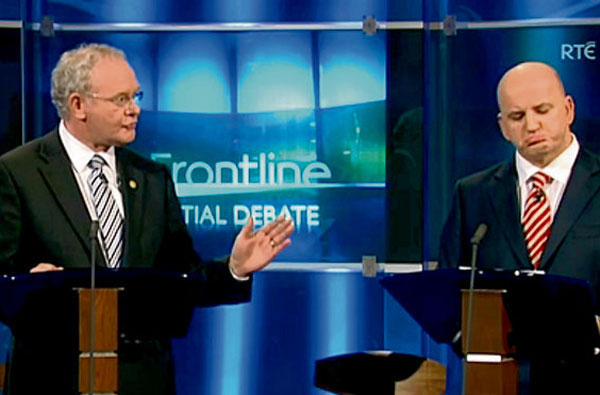
In Sean’s case the broadcast of a bogus tweet during the Frontline Presidential Debate played a major play in derailing his campaign and denying him the job he wanted.

Yesterday the Broadcasting Authority of Ireland gave its verdict on his complaint against RTE, The Frontline and The Pat Kenny Show.

It was a fairly damning judgement. The BAI found that Sean Gallagher had been treated “unfairly” on three counts.

One: by the broadcast of the initial bogus tweet from an account that purported to be from the official Martin McGuinness for President campaign.

Two: by the failure of the Frontline to tell the audience of the subsequent tweet from the official McGuinness campaign denying that it had issued the bogus one.

Three: by the continuing failure of the Today with Pat Kenny radio show the next morning to properly clarify the status and background of the two tweets.

Given that it found that a programme that was intended as a Presidential Debate was unfair to one particular candidate, it was amazing to see the BAI go on to say that no further investigation or inquiry is required as the complaint “was not of such a serious nature as to warrant an investigation or public hearings”.

It is not as if this might have affected the outcome of an election or anything….. oh, hang on a minute…. Yes, it might.

No one can definitively state whether the tweetgate affair altered the outcome, but we do know that Sean Gallagher was the poll leader before the debate and he wasn’t a few days later. We also know that tallies of the postal votes – ie those votes cast and returned to the presiding officers before the Frontline debate – showed Gallagher topping the poll.

On the other hand, it is entirely possible that viewers watching the Frontline debate might have switched from Gallagher to Michael D Higgins even if the tweet had never been mentioned.

All this is in the realms of speculation. What is not speculation however it that someone sent that tweet to undermine the front runner and affect the race.

So, yes, this matter does require further investigation.

The BAI has determined that Mr Gallagher was treated unfairly in how the tweet was handled. RTE’s Director General made a sincere and genuine apology and the RTE Authority is to examine the BAI’s finding.

This is all right and proper. But RTE’s actions are only part of the case.

Like others watching the campaign on the internet I was not aware of the difference between the real and fake McGuinness for President twitter accounts until the controversy broke that night.

The confusion was easy as, according to some Social Media watchers, both twitter accounts were created on the same day. Indeed, as part of its own defence, RTE argued that many other journalists were similarly confused and had taken the first bogus tweet as genuine. (A defence rejected by the BAI)

The question remains: who was responsible for sending out the tweet? Are we going to tolerate a situation where an election outcome can potentially be so easily influenced by one person or group of people acting in the shadows?

We have seen thousands of people protest on the streets of Moscow regarding accusations that Putin rigged their Presidential election, are we not to try and look a bit deeper into this case?

Isn’t the integrity of our democratic process worth a bit more effort?

I Don’t Like The Fiscal Compact Treaty, But I Will Still Vote Yes

My thoughts on why I am not impressed with this Fiscal Compact Treaty, but why I will vote for it and urge others to vote Yes too.  

A few nights ago I was on the cusp of penning a piece as to how it was possible to be a committed pro European and still urge a “No” vote at the forthcoming Fiscal Compact Referendum.

My reasoning broadly ran as follows.

  • While the Fiscal Compact does contain some important measures that would have addressed the fiscal problems that others, not Ireland, had experienced in the run up to the crisis – it effectively does nothing about the core issue facing the EU and the Euro: the dysfunctional European banking system.
  • The EU Council and Commission have wasted over two years taking pointless half measures that tinker about with the symptoms of the problem while studiously ignoring the core problem: the banking crisis.
  • This fiscal compact is just the latest in a series of well intentioned, but minimalist attempts to assure the markets that it ready to address the crisis. Like the others it will fail.
  • What the EU needs now is a short sharp shock to jolt it into effective and decisive action. By decisive action I mean tackling the banking and credit crisis head on and bolstering the role of the European Central Bank to become the lender of last resort.
  • Ireland can not only deliver that shock by rejecting the Fiscal Treaty as inadequate and lacking substance, but it can take the lead – particularly among the smaller, peripheral nations – in demanding that the Commission, particularly President Barroso stop acting as the servants of the French & German governments and get the EU back to being a Union of countries that work together, in partnership and in solidarity for our mutual benefit.

That was my broad theory.

It is not heresy or anti European to say that the Fiscal Compact Treaty does not address the biggest problem facing the economies in both the EU and the Euro.

The point is not that the Fiscal Compact goes too far – it is that it is too one sided. It addresses a secondary problem – not the primary one. It almost completely omits the measures required, specifically on the ECB, to tackle the real problems facing us all.

As I was writing the piece I realised that while I still fully believe in points 1 – 4 the reasoning underpinning Point 5 was fatally flawed.

Ireland rejecting the Fiscal Compact will not be seen as us rejecting it as a half measure. It will be seen as Irish petulance. We have thrown down the gauntlet before – on Nice 1 and Lisbon 1 for reasons that most in the EU failed to grasp.

The Taoiseach and his Ministers have shown not the slightest interest in showing Leadership at the EU Council or of building any consensus among the smaller peripheral countries.

Rather the Taoiseach has been content to roll over and have his belly tickled (metaphorically – I hope) by the big two, and hope that no one will ask him any difficult questions.

He has consistently underplayed his hand for the past year. Stories that talked tough and banged the table at his first Council meeting yielded nothing. Since then he has been content to keep his head below the parapet. The same applies to Eamon Gilmore.

There is nothing to suggest that either are capable of building a consensus across the EU. The reality is that neither have attempted it. Their antithesis to travelling to meet other leaders or hold bi-laterals here is mind boggling, especially when you consider how they howled in opposition that the last Government was allowing Ireland’s reputation to slip.

None of this augurs well for Ireland’s forthcoming EU Presidency, but that’s another story.

Those pointless rejections of Nice 1 and Lisbon 1, are now coming back to bite us. Those who urged us to say No then, are once again in the vanguard urging us to Vote No once more. Their reasoning has not changed. They are as Eurosceptic and anti European as they ever were.

Saying No now would be seen as biting the hand that feeds us – even when that hand has been making a few bob from what its been doing.

Worse still saying No would not gain anything by saying No – except to put ourselves in some undefined limbo beyond the revised European Stability Mechanism. Whereas our saying No in Nice 1 and Lisbon 1 held up the process of ratifying those treaties, saying No now will halt nothing.

We have no veto. We have no bargaining chips on this one. There is no point in threatening to pull the trigger when everyone else knows we have no ammo in the chamber.  UCD’s Dr Ben Tonra makes this point very clearly in an excellent post on the politicalreform.e page here.

The conclusion is that we must pass the Fiscal Compact treaty and then use that passing of the Treaty to build a coalition of smaller countries across the EU to tackle the real problem facing us.

I would love to think that saying No would urge the EU into actions that are long overdue. The sad reality is that it will not.

So, just like the French Socialists who were compelled to vote for Chirac in Round Two of the 2002 Presidential elections, rather than seeing Le Pen slip through, I may be taking a disinfectant mat with me to the polling station as I vote Yes.

I want a better treaty. I want a treaty that tackles the real problems. This treaty itself even acknowledges the need for a further treaty.

If passing this one is the price we must pay to get to that point – then let us do so – and quickly.

A tough year for Martin – and it will get tougher

My column in Saturday’s Evening Herald (Jan 28 2012) on Micheal Martin’s first year a leader of Fianna Fáil

—————

A year ago this week {or “today” if published on February 26} Michael Martin sought and won the toughest and possibly most thankless job in Irish politics today: leader of Fianna Fáil.

Looking back over the past year there must have been moments when he felt he hadn’t so much won the prize, as been landed with it. Yet he did win it.

The manner in which he took a stand and challenged for the leadership helped him throw off his previous reputation as an ultra cautious politician who preferred to kick problems to committees rather than taking tough decisions.

On becoming leader [this day one year ago] he found himself at the helm of a demoralised and dissolute party facing into an election for which it was woefully unprepared.

The once great election winning machine that had been Fianna Fáil limped and staggered its way over the line with its new leader’s energetic and impassioned debate performances as rare high points in an otherwise horrendous campaign.

The result was best described by a northern colleague of mine as the greatest political punishment beating ever. The public was not just disillusioned and angry with Fianna Fáil and its Ministers: it had no interest in its views or opinions.

While his first full year in the job has been tough, it could actually have been worse. At the outset many pundits thought the very best he could hope for was stemming the tide of Fianna Fáil’s decline.

Recent opinion polls and the unexpected second place showing in the Dublin West by-election point to the party not just halting the decline, but even reversing it a bit. But there will be no one around Martin popping the champagne corks for a long while yet.

While the party’s prospects may look a tad better now than a year ago: its future is still by no means assured. The party has a long way to go before the public will be ready to listen to what it has to say.

One of Martin’s successes, if this is the right word, has been to get the party’s membership to grasp the new political reality that Fianna Fáil can no longer take its continued existence or relevance as inevitable.

This was no easy lesson for the party to accept. In some ways it is still a work in progress. While there is much talk of reforming both how the party is run and how it develops policy, these have yet to be implemented.

Hopefully, the reconnection Martin has making between the leadership and the members through his constituency visits and personal engagement should enable him to drive through a meaningful reform package.

But it is not as if everything has gone his way. While the right decision was eventually made; the very public “will they/won’t they” row on running a candidate for theArastook its toll. Likewise, Martin’s sometimes over wordy and earnest contributions at Leader’s Questions in the Dáil have not helped convey the idea of a strong leader.

This latter criticism is often attributed to his need to attack on two fronts at once.  Martin is not just targeting the government; he is also targeting the other opposition alternative in Sinn Féin.

Another explanation is that Sinn Féin now has a much bigger back office and research resource than Fianna Fáil. Addams and Co may be reading from scripts, but they are well crafted and written ones

It is not as if his task will get any easier either.

In the coming weeks Martin faces the prospect of dealing with the fallout of the Mahon Tribunal’s report. While there is no confirmed date for its publication, there is much speculation that it may be released just before Fianna Fail’s Árd Fheis at the beginning of March.

Talk about bad timing.

Whatever happens, Martin’s own position is secure. He has from now until the Locals and Europeans in 2014, at least, to show that he can lead the party to recover some of the public trust and confidence it lost.

After one full year, the toughest job in Irish politics is going to get even tougher.

ENDS

To burn bondholders or not to burn them – is there a third option?

Is it any wonder there is so much confusion about what to do with the bank bondholders?

Less than twelve months ago (February 10th to be precise) Leo Varadkar was saying:

Any bank coming to us looking for more money is going to have to show how they are going to impose losses on their junior bondholders, on their senior bondholders, and on other creditors before they come looking to us for any more money. Not another cent.”

That was before the General Election. Eight months after the election; the now Minister Varadkar had changed tack and was saying:

What’s happening in relation to the Anglo bondholders is they’ll be paid from Anglo’s own resources, from the sale of its own property assets, for example.

By last weekend the line had developed further. On Sunday he was  says that the Government “had to weigh up the costs on the one side and the risks on the other.” and that not paying the €1.2billion of Anglo bonds due this Wednesday: “…would have implications for other State companies like ESB and Bord Gáis,”

It is probably a littler bit unfair to single out Minister Varadkar like this. He was saying pretty much what everyone else was saying in FG during this period. His skill and talent was that he said it more directly and concisely than almost any of his colleagues. It is what makes his quotes more memorable.

Whatever about the changes in the Fine Gael script, two bigger truths have not changed over the past year. The ironic part is that these truths are contradictory.

The first is that the ECB is still holding to its line that bond holders should not be ‘burned’. By that they mean that bond holders should not be forced to accept any reduction in the monies due to them.

The other is the reality that there is a very active market in bonds being sold off at a discount in return for hard cash. These discounts can be fairly hefty, particularly where those bonds have a tasty coupon included.

This trade in bonds was touched upon at a recent seminar on the issue of offset debt, hosted by Thomas Pringle TD and how it could ease the plight of those in negative equity.

Some bond holders are deciding, in their own business interests, to mitigate their losses and sell bonds at a discount. Their rationale is that a bird in the hand is better than two in the bush: a not uncommon business approach.

They sell the bonds on to vulture capitalists who buy the bonds at a 30, 40 or even 50% discount. They retain the bonds face value, and so, they stand to make a hefty profile when the bonds are paid off.

While bondholders may choose to do this, the ECB says they must not be made to do it – except in the case of Greece, but let’s put that to one side for the moment.

This leaves a classic Catch 22. Investors, speculators and traders are selling bonds between each other at varying hefty discounts, with the prospects of making even bigger profits.

It is one thing to say that bond holder’s rights should not be ridden over and allow the market to function, but telling European taxpayers that they should not enter the open market and offer to buy back those bonds, is another.

Its like signing an IOU and watching it being traded among your friends for less than its face value, but being told you cannot dare attempt to buy it back: even if the guy currently holding it would be willing to sell it to you.

Ireland cannot do a solo run and give two fingers to the ECB, but it needs to start canvassing opinion around the EU table to start looking at this issue again.

The noises coming from the new Belgian government, coupled with the prospect of a new occupant of the Élysée Palace come the summer suggests it may be a route worth exploring. Something, perhaps, for the Taoiseach to consider as he heads to Brussels?

Thus leaving Gay Mitchell as the last man standing…..

And then there was one. It is just over two and a half years since we elected Gay Mitchell, Proinsias de Rossa and Joe Higgins as our three MEPs.

Within eighteen months Joe had made his way back into the Dáil. He waved goodbye toBrusselshis seat was taken by Paul Murphy. (No, I don’t know much about him either).

Fast forward another twelve months to this week and veteranDublinMEP Proinsias de Rossa announces that he is to stand down and his seat will pass to Dublin City Councillor, Emer Costello.  As if to complete the row of falling dominoes, Cllr Costello’s vacancy on the City Council will in turn be filled by someone selected by her local labour organisation.

And so, two of the three people who asked us in June 2009 make them MEPs for a five year fixed term have decided to move on or move out. Thus… and who would have imagined we would ever again hear these words…leaving Gay Mitchell as the last man standing.

Everything that Joe and Proinsias have done is entirely and wholly within the rules. Casual vacancies arising from MEPs dying, resigning or otherwise being disqualified are filled this way. It applies across the EU.

It is arguable that this method of filling occasional vacancies is fairer and more democratic than the by-election route.  The people’s decision on the five year mandate of their MEPs made in 2009, by proportional representation, is allowed to stand for the duration.

Nonetheless, it is disappointing that some of those who contested the Euro Election so fiercely can so easily renege on their mandate mid way through the term. I won’t dwell on this point as I cannot claim to be an impartial observer on this aspect having worked on Eoin Ryan’s 2009 campaign.

The point I will comment upon is broader. It is the degree to which these seats are becoming the property of the political party in a manner that starts to resemble the introduction of the party list system.

This may look like a big extrapolation from just one or two co-option processes, but when taken together with recent commentary from Prof David Farrell and others on changing Dáil sitting times to drag TDs away from constituency work, then the leap may not seem so great.

One of the particular features of our multi-seat PR/STV system is the level of personal attachment and connection between Public Representative and voter. This can often transcend party affiliation and may even be said to be on the increase.

Yet there is a curious clamour for this personal connection to be broken. The accusation of the parish pump and cliental-ism is made TDs are said to be so obsessed with getting re-elected that they encourage constituents to think that entitlements they were due were only won thanks to the intervention of the TD.

They argue that TDs should be spending their entire working week legislating and debating. They miss the risk that such a system would just institutionalise the control of party hierarchies.

TDs based in Leinster House Monday to Friday, doing virtually no constituency work for almost five years would be dependent on the national party structure to get them re-elected. Bad news for mavericks.

Not to mention the loss of to our system of representative government. How else can you represent people if you do not spend a good proportion of your time meeting with them and really learning their concerns?

Like all things; there is a balance to be struck. You cannot have TDs who only see life through the prism of how it will affect their re-election chances. But going to the other end of the spectrum is not the answer either.

You don’t learn much by sending out glossy 8 page A3 newsletters every six months. You got to get out and knock on doors. There is no point speaking in the Dáil if all you are churning out is what you found on Google; read from a focus group or what popped into your head over night.

The personal connection between the elected and the elector is important. Anything that diminishes it, undermines the democratic process.

Though I never voted for him (not even a 3 or 4) I will be sad to see Proinsias quit the stage. I wish him well.

Twitter @dsmooney


Joan Burton’s Second Law of Inverse Stability

Hadn’t posted on here in a few weeks – catching up on missed items today. This is the most current of the three blogs posted today. It was originally intended for today’s Evening Herald

—————————————————

As far as I am aware the only eponymous Irish Rule of Politics was named for its creator, the much missed political journalist Gerald Barry.

The rule roughly states that “every leader of the opposition will, be at some point, be hailed as the worst ever leader of the opposition.”  Its strength lies not just in its inherent truth; but also to the fact that it applies in almost every jurisdiction.

Look at poor Ed Miliband. How he manages to drag himself into Parliament after reading reports of backbench murmuring and discontent in that morning’s papers is beyond me.

Yet he does, thus highlighting the fundamental truth that scorn and opprobrium goes with the job of being opposition leader. Maybe Enda Kenny could give Ed some pointers on this

But I digress. While the US has numerous rules and laws of politics, Gerald Barry’s is the only one I can think of in the Irish context, or at least it was until now.

Over the weekend the Social affairs Minister, Joan Burton reminded us that there is a second immutable rule of Irish politics, even if it hasn’t had a name up to now.

This Second law states that “large government majorities can lead to disaster and indiscipline”. It so might have been drafted with Minister Burton’s tactics in mind that it probably should be named for her: The Burton Second Law of Inverse Stability.

It’s most notable occurrence to date was during the 1977 – 1981 Fianna Fail majority Government. In 1997 Jack Lynch returned Fianna Fail to office with a twenty seat majority.

Two years later a variety of backbench insurrections on issues from the Farmer’s Levy to British Army border flyovers had so weakened and undermined his leadership that he lost two by-elections in his own back yard and would see his leadership ended by December of 1979.

While at first sight it would appear that big majorities would leave a government comfortably placed to win Dáil votes, the counter intuitive truth is otherwise.

Such big majorities allow backbenchers the scope to flex their muscles and run risks they would not dare try if they thought their actions might herald an election and the loss of their own seat.

Enter Minister Joan Burton. Almost since her appointment to government she has erred on the side of expressing her own strongly views rather than merely defer to the broader FG/Lab consensus.

She has some entitlement to feel aggrieved. She did the heavy lifting as the party’s Finance spokesperson in opposition. She carved out a separate position for the Labour party on the economy, differentiating itself from Fine Gael.

She played a vital part in securing the Labour swing, only to find herself having to standby while Labour effectively disavowed her policies, not in favour of Fine Gael’s but, in favour of those of the outgoing Government.

A hard pill to swallow, made harder by seeing front bench colleagues leap frog her into Cabinet.

It would seem her response has been to work the Labour back benches and strive to speak more for them than for her FG colleagues. A good strategy for positioning yourself within the party: not a great one when it comes to conveying the impression of strong and cohesive government.

While her comments on a second bailout may not send the markets into a spin or (regrettably) make President Sarkozy’s political headaches any worse, it will not endear her to her party leader or Cabinet colleagues.

It also sends a signal to others to feel free to do the same. Clearly, with three of them jettisoning the Labour Whip so far, labour backbenchers do not need much encouragement, but for how much longer can or will Fine Gael be prepared to tolerate this?

Which brings me back to the issue of rules and laws. Newton’s Third Law of Motion states: “To every action there is an equal and opposite reaction”. It is just as true in politics.

While they have been disciplined up to now, I suspect it won’t be too long until we see some Fine Gaelers feeling the same need to unburden themselves and say their piece.

Maybe we will then have our third law of politics: Varadkar’s Third Law of Political Momentum?

Twitter @dsmooney