
Here is my column on Germany forgetting the lessons of its own history from the Herald (Tuesday June 28 2011)
—————————————————————
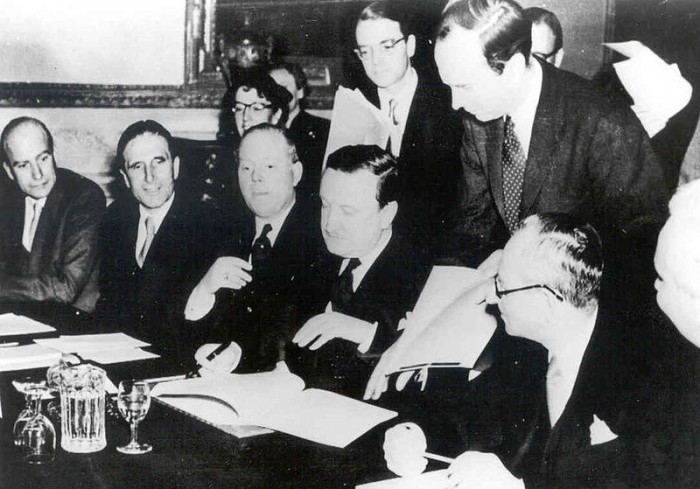
(Pic via: http://www.tlaxcala-int.org/article.asp?reference=8440)
The media has been full of hourly reports of how the Greek debt crisis has the capacity to send the global economy back into the doldrums.
The Greeks, and by extension, the Portuguese, Irish and Spanish have had to endure tough lectures from France and Germany about the need for austerity.
The German government has been particularly forceful in delivering these lectures. Its leaders tell us their taxpayers do not want to subsidise bloated public sectors or unproductive workers across Europe.
And who could blame them? It is understandable that German workers do not want to pay extra taxes to send money across Europe, even if it is in the form of a loan with generous interest payments attached.
Understandable … but only if you have a short memory and disregard the history of the past century.
An economic historian at the LSE, Prof Albrecht Ritschl, has pointed out that the worst debtor nation of the past century is not Greece, it is Germany — and by a wide margin too. Worse still, Germany is denying to Greece, Portugal and Ireland the precise remedies it needed to rebuild itself. Twice in the last century, after WWI and WWII, Germany has ran up levels of debt that would make the Greek crisis look like a bad night at a mythical Tipperary Casino.
The cost of Germany’s 1930s debt default was as significant as the 2008 financial crisis. A default they were forced into as they could not repay the debts and war reparations set out in the Versailles Treaty following WWI.
This was the result of the rest of the world doing to Germany what Germany and others in the EU are now doing to us. Tons of new debt (in Germany’s case it was war reparations) were heaped on top of existing debt thereby draining the German economy of the ability to rebuild itself.
By the end of WWII, the rest of the world had learned a lesson. It recognised that lumbering a devastated and demoralised Germany with more debt was not a workable solution.
In the 1953 London Agreement on German External Debts, the Allied powers did the exact opposite of what the German and French governments are doing today. They wrote off half of Germany’s total mountain of debt and gave it additional time to repay the monies it owed.
It was thanks to the foresight and generosity of former enemies that West Germany was able to deliver the Wirtschaftswunder (economic miracle) of the 1950s.
This was a deal negotiated between leaders who had learned from the mistakes of the past and could see beyond the political demands of the next election, particularly Germany’s own Konrad Adenauer.
Remember, also, that one of the occupied countries owed money by Germany was Greece. Those protesting in Athens remember that their parents and grandparents had to forego the compensation owed to them.
How galling must it be for them to take lectures from the current German Chancellor on the virtues of paying your debts?
And, in case anyone thinks this is all reaching too far into the past, think again. According to Prof Ritschl, Germany defaulted on one of the conditions of the 1953 London Agreement as recently as 1990.
TOOLS
It is a sad indictment of the current German leadership that it cannot see that denying others the tools that it required to rebuild itself is only storing up trouble for the future.
It does not take a Konrad Adenauer or a Willy Brandt, however, to recognise that Germany’s economic fortunes are so closely intertwined with the other eurozone countries that if part of the eurozone falls, Germany could flounder.
So, even if heeding the lessons of history cannot bring Germany to realise the current policy is not working, self interest just might.
– Derek Mooney

 derekmooney.ie