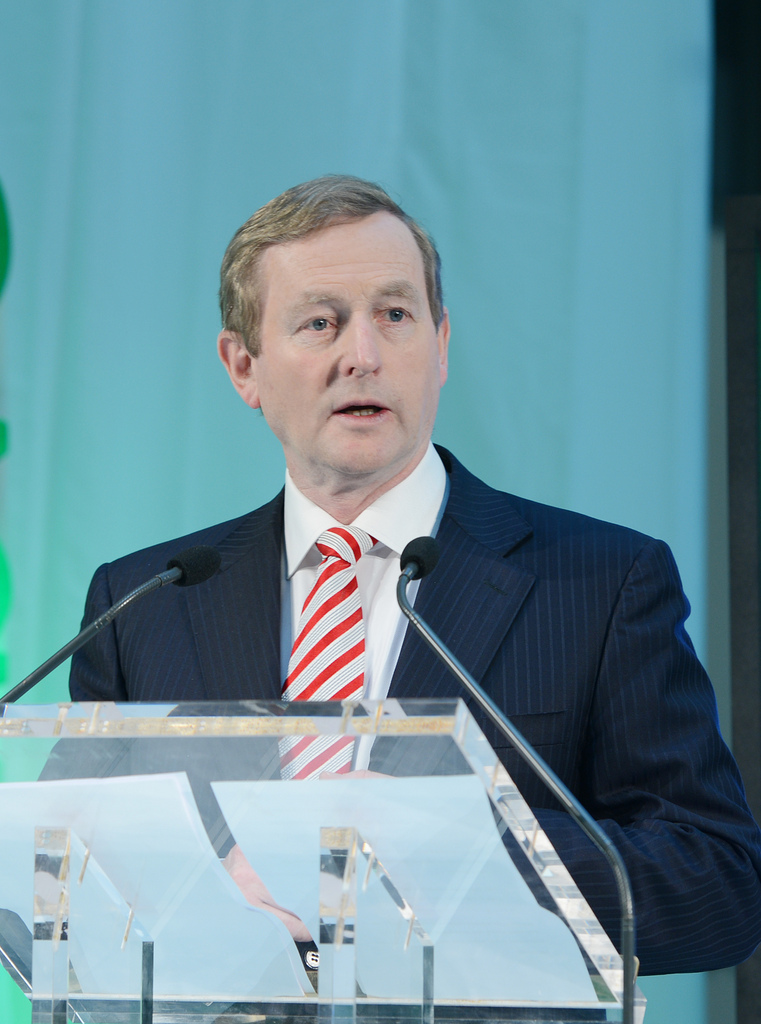
Enda Kenny has questions to answer after @Independent_ie reveals his #Anglo contacts

An Taoiseach Enda Kenny (pic taken from FG website)
An Taoiseach Enda Kenny, T.D.  (pic from FG website)

This morning’s Sunday Independent story that back in January 2009 when he was still leader of the opposition that Enda Kenny had been in informal contact with Anglo Irish Bank’s CFO, Matt Moran, raises several questions for Mr Kenny. Some of these questions have already been posed by Fianna Fáil’s Micheál Martin.

When the Anglo tapes first came into the public arena at the end of June, Mr Kenny moved quickly to politically insinuate that the tapes suggested an “axis of collusion” between Anglo Irish and Fianna Fáil, even though the tapes did not suggest any improper or informal contacts between any Fianna Fáil ministers and Anglo bosses.

During the course of Leaders Question on June 25th, Enda Kenny was quite strident and aggressive in his exchanges with the Fianna Fáil leader, Micheál Martin with the Taoiseach repeatedly mentioning Martin’s role in the Bank Guarantee (notwithstanding the fact that it was not Anglo who had sought the guarantee and that the bank was not even represented at the meeting in Government Buildings on the night of September 28th, 2008).

Typical of the exchanges is the following line from the Taoiseach:

“Deputy Micheál Martin was part of that environment. I am not suggesting he was involved directly in any of it—– (Interruptions) —-but he was a member of the Government and the people are entitled to know why the Government had incorporeal meetings at 3 a.m. They are entitled to know about the political environment in which all of these agents operated.”

Even after Martin had finished asking his two questions, the Taoiseach continued his political allegations of collusion during his subsequent exchanges with Deputy Gerry Adams and Deputy Mattie McGrath.

During his two questions McGrath asked the Taoiseach if the Minister for Justice and Equality had known about the tapes and if the government intended to set up a criminal inquiry and a robust investigation?

Towards the end of his replies to McGrath, indeed just as the time for Leader Questions was ending and Deputies were starting to prepare for the next business the Taoiseach volunteered the following curious little revelation. McGrath had not asked if he had any contact with the bosses in Anglo, indeed the topic had not been raised, yet the Taoiseach felt the need to put the following titbit on to the record:

“I had the doubtful privilege of calling into Anglo Irish Bank with Deputy Bruton, when he was the party’s spokesman on finance, a couple of weeks after the guarantee went through. We met all of the principals in the bank’s building on St. Stephen’s Green.

We were given a wonderful presentation by people who were very well remunerated in their positions and received very large bonuses. As has transpired, all of that presentation was a tissue of fabrication and untruths. The questions we asked on that occasion, from the Opposition benches, were very realistic in the context of the pressures people were under and the stories, rumours and allegations that were flying around about that bank. They were all utterly denied.

I make that point for the politicians who are interested in what happened here.”

http://oireachtasdebates.oireachtas.ie/debates%20authoring/debateswebpack.nsf/takes/dail2013062500028?opendocument

Is this just a case of Mr Kenny’ showing how unlike John Bruton, his predecessor as FG leader and Taoiseach, he is? Some years back Mr Bruton infamously defended his evasiveness in the Dáil with the line: “you didn’t ask me the right question”.  Are we to believe that where Bruton was cautiously meticulous in only answering the specifics of the question asked, Kenny is more effusive? To judge from other Leaders’ Questions sessions before and since, hardly so.

It now appears that Mr Kenny was endeavouring to get something on the record regarding his contacts with Anglo bosses just in case these precise revelations were to emerge.

This brings us to Minister Frances Fitzgerald’s protestations this morning on RTÉ’s The Week in Politics that it is ridiculous to suggest that the Taoiseach might have any questions to answer as he was only leader of the opposition back in January 2009. The presumption here is that Mr Kenny knew little or nothing about what was going on back in January 2009 so what could he have told or said to Anglo’s Mr Moran?

Two points here:

First, if the conversations with Moran, who it seems hails from the same part of the world as Kenny, were so inconsequential why did the Taoiseach not make even a passing reference to them in his June 25 dump out of unrequested information? Perhaps because these were one to one conversations without Richard Bruton present?

Second: the notion that Mr Kenny was completely clueless in January 2009 does not hold water. Unlike the current government, the last one – particularly the late Brian Lenihan was scrupulous in keeping the opposition informed and briefed. Lenihan knew the enormous scale of the issues with which he was grappling. He was not going to allow himself open to the charge of a lack of transparency or openness in dealing with decisions that would affect the economy for decades. It should not be forgotten that Fine Gael had, in the wake of the Sept 28 guarantee, been broadly constructive in its approach.

We get a glimpse into openness of the contacts between Lenihan and Kenny at the time from the following comment by Lenihan at the conclusion of the Second Stage debate on the Bank Guarantee legislation (Credit Institutions (Financial Support) Bill 2008).

“When I telephoned Deputy Kenny at 7 a.m. this morning and explained to him the circumstances in which the State found itself in regard to financial stability, he responded without hesitation that he would support any measure the Government brought forward.” 

http://oireachtasdebates.oireachtas.ie/debates%20authoring/debateswebpack.nsf/takes/dail2008093000018?opendocument

This contrasts with the paucity of the briefings offered by the current government to opposition spokespeople on February 6th when the government expected the Dáil to pass the legislation winding up Anglo Irish (by then called the Irish Bank Resolution Corporation) with only 10 minutes prior sight of the Bill itself.

Only after much cajoling from both Fianna Fáil and Sinn Féin did the Taoiseach eventually concede to giving the opposition an extra 30 minutes to read the legislation before debating it.

While Kenny’s informal contacts with Anglo Irish in 2008 and 2009 are clearly no where near the scale of Nixon’s pre 1968 back channel communications with the Vietnamese, they do raise some important question for the Taoiseach to answer now.

Rather than issuing bland blanket denials he needs to set out in tabular form all the contacts he and his colleagues had with Anglo Irish bank and its agents between early 2008 and before the 2011 election.

Will he heed Justice Minister Alan Shatter’s call elsewhere to tell us what he knows about “direct” contacts with Anglo? He also needs to say if he is willing to agree to co-operate with an independent Leveson style investigation into the banking crisis.
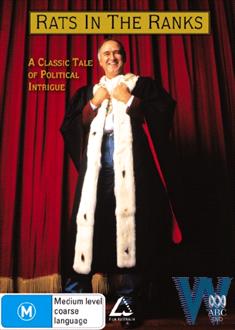
Lucinda Creighton and the “Rats in the Ranks”

Thanks to a lot of travelling with work it has been a few weeks since I last posted on here. Here are my belated thoughts on Lucinda Creighton’s departure from the ranks of the Fine Gael parliamentary party and how it connects with the “rats in the ranks”

——

Larry Hand in "Rats in the Ranks"
Larry Hand in “Rats in the Ranks”

If you enjoy political machinations and intrigue then you should definitely watch the excellent 1994 Australian documentary “Rats in the Ranks”   It chronicles the back stabbing and political manoeuvrings among the 12 local councillors electing a new mayor in a suburban Sydney district of Leichhardt. Watch the trailer here:  http://www.youtube.com/watch?v=huxbBH78nhg

It has become ritualistic viewing for me, I usually watch it a few times a year. The central character, Cllr Larry Hand, not only offers a quick primer in petty political power-play as he attempts to retain his post as Mayor, he also comes out with a few nice political aphorisms.

My particular favourite is his observation following yet another row with his Australian Labor Party (ALP) counterparts: “I’ve always felt you haven’t really joined the ALP until you’ve been expelled from it.” Hand had originally been an ALP member.

Perhaps the line has a particular resonance with me as around the same time (the mid 90s) I came perilously close to being expelled from Fianna Fáil. The reason was my going on RTÉ’s Morning Ireland in early November 1994 to call on Albert Reynolds to stand aside in the wake of the controversy surrounding the appointment of Harry Whelehan as President of the High Court.

My public comments on that Monday morning provoked a motion to discipline me (for conduct unbecoming a member) for the following Thursday’s Fianna Fáil Árd Comhairle, but it was never discussed as Reynolds resigned on Thursday morning.

Hand’s words came to mind again while watching Lucinda Creighton’s departure from the Fine Gael parliamentary party last week.

Though her fairly intensive milking of the situation in the days since her departure has not impressed me as much, it still does not take away from her steadfastness in sticking by her beliefs and pre-election commitments on X case legislation.

At this point it is worth pointing out that while I am a constituent of hers, I have never voted for her and that I don’t share her reservations and disagree with how she voted last week. Nonetheless, her actions stand in marked contrast to the capitulation of some of her colleagues. Notwithstanding the weeks of watching them publicly wrestling with their consciences, it was almost inevitable that they were going to beat their consciences into submission.

Step forward Deputy Michelle Mulherin. The paucity of her argument was exposed in the final line of her excruciatingly self pitying Dáil speech:  “I am now faced with either supporting the bill or being booted out of the party, my party, and I am not going to allow myself to be booted out so I am supporting this legislation.”

If her intention was to secure sympathy, she failed miserably. The only thing she succeeded in doing was making her constituency colleague John O’Mahony look less spineless than her.

His statement, at least, made some attempt at arguing a case for reneging on Fine Gael’s the pre-election commitments made in Phil Hogan’s infamous letter of comfort.

O’Mahony had to share his particular fig leaf of pretence with Deputy James Bannon. Bannon is  another one of the cadre of Fine Gael Deputies who once swore up and down that they would never ever support something like this and now happily marched into the Yes lobby hoping that the people to whom they given those solemn promises would ignore their volte-face.

While I would happily advise anyone wanting a peaceful and contented existence to resolutely ignore Deputy Bannon, I suspect they will not ignore his duplicity on this one.

Returning to Lucinda, the pundits and observers who were this week predicting her slow disappearance into obscurity on the back benches seriously underestimate the Deputy for Dublin Bay South.

Lucinda Creighton TD (pic taken from her website)

While political history does show that many TDs who have defied the whip manage do disappear, never to be heard from again: Alice Glenn springs to mind, there are several notable exceptions.

Charlie McCreevy’s expulsion from Fianna Fáil under Haughey was the making of his career, not the breaking of it. Similarly Mary Harney’s 1985 expulsion from the Fianna Fáil parliamentary party for voting for the Anglo Irish Agreement did not end her career.  This applies too to Des O’Malley, though I will concede that their routes back came via a new party.

While her stance on the Protection of Life During Pregnancy Bill would not reflect the views of most in her constituency, I suspect they will still admire her conviction and preparedness to walk the walk when necessary.

The same can be said for Wicklow TD, Billy Timmins. Billy was the Fine Gael opposition spokesperson for most of my time in the Department of Defence. He was an extremely effective opposition spokesman who showed more loyalty to Enda Kenny (via his attempted defence of Enda’s hare brained call for Army boot camps to deal with young offenders)  than Enda showed to him.

While the conduct of this week’s debate bordered on the farcical with serious doubts now raised over the Government’s ability to order the business of the Dáil, by contrast the Taoiseach emerged somewhat stronger in the short term thanks to his put down of most of the wavering or doubtful TDs.

But, as for the implications for Enda in the medium to longer term, these may not turn out to be quite as rose tinted as they now appear. While the likes of Mulherin and Bannon now have little or no credibility, those others who were forced through the lobbies without all the public hullabaloo will quietly seethe away, just waiting for the moment when Enda needs them.

Poll results: Worst Minister in Government

Last weekend I ran a poll under PR STV on the excellent www.opavote.org website to select/elect the worst Minister in Government. I closed polling a few minutes ago.

Many thanks to all those who took the time to vote. I ran this poll to see how well the site performed.

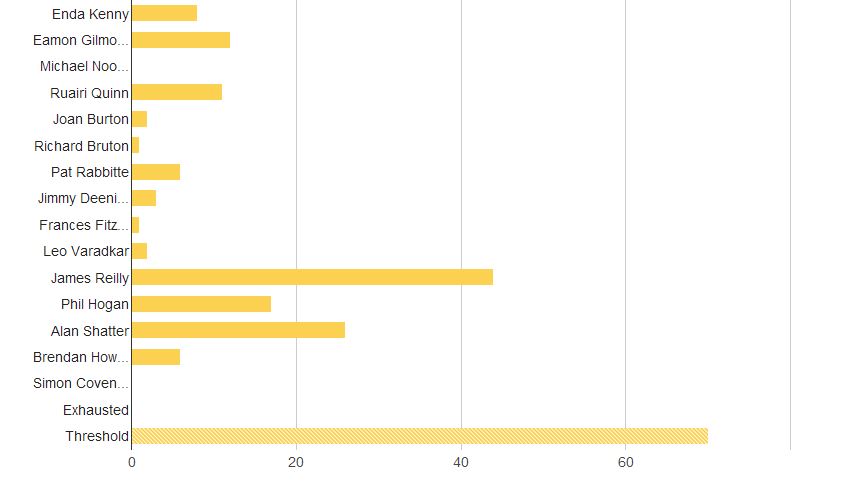
139 people voted and elected Dr James Reilly with 78 votes on the final count, beating Alan Shatter and Éamon Gilmore. http://www.opavote.org/results/1667002/0

Count
Results in Tabular format
1
First count as a bar chart

Where votes were tied (for an elimination) the one to be eliminated was picked by reference to their first count vote, where they were tied on first count is was by random selection

Interestingly both Michael Noonan and Simon Coveney received zero votes on the first count – which prompts me to shortly run a poll: Who is the best Minister in Cabinet (I may run that poll on a slightly different basis and seek the top three rather than just the one best)


Who is the worst Minister in Government – you decide

TAOISEACH-FIRST-CABINET-MEETING-ARAS-MX425
The first meeting of the cabinet

I recently discovered the opavote.org website and wanted to try it out, so I decided to create an online poll to see how the site works.

The poll is determine the worst member of Government – the poll is being run under PR STV – ie you vote for the worst minister in the order of your choice 1 being worst, 2 being second worst and so on… you can stop after 1, or continue on down until 15 (for least worst… or even best!)

There will just be one winner – i.e. one person who exceeds the 50% + 1 quota. You can view the results as the voting proceeds – ie it will run the election as if yours was the final vote to be cast.

You can vote via this link: www.opavote.org

I will publish the results in a few days.

#LE14 changes expose the big weakness in Government’s #Seanad Abolition case

Phil HoganOn Thursday last the hopes and political aspirations of many hundreds of aspiring and existing City and County Councillors were either dashed or revived with the publication of the new local government electoral boundaries.

Within seconds of being posted online the reports and maps containing the details of the new wards and local areas were being downloaded by political junkies and local election hopefuls across the country, looking to see how the new boundaries would impact on their community.

While these changes, reflecting shifts in population measured at the last Census, are always anxiously awaited, this review had a particular significance as it had been heralded by the Environment Minister as important next step in the Government’s programme for local government reform. Unlike previous reviews this one had a specific goal of improving balance and consistency in representational ratios in local government.

This has been an issue for many years with huge variations in the size of local council constituencies between Dublin and many rural areas. While someone running for election in Dublin City would need 2,500+ votes to secure a seat, someone else running in Leitrim or Roscommon might only require 900 or so votes.

In order to redress this imbalance the Government decided to set terms of reference that reduced the ratio in certain rural areas and reduced it in Dublin. The net effect was that Dublin and other major urban areas get more councillors and many rural areas get less.

The net effect of this rebalancing coupled with the Government’s already stated policy of scrapping Town Councils is a reduction in the number of council seats from 1,627 to 949 and in the number of local authorities from 114 to 31.

This is a significant reduction and it is not going down too well across the country.

While much of the analysis of the review and the changes has understandably focussed on this particular aspect, there is another area which is also worth considering, in the contexts of the Government’s plans to propose the abolition of the Seanad in a referendum later this year.

In scrapping the town councils and reducing the number of local elected representatives so dramatically; have they – to use a phrase from a bygone Fine Gael era – just shot their own fox?

Over the past few weeks and months Fine Gael has been claiming that Ireland does not need a Seanad or second parliamentary chamber based on its size. They have been particularly eager to draw comparisons with a number of the Nordic countries, pointing out that they only have one Chamber and that their average number of national parliamentarians is 160. They even put this claim on their Seanad Abolition posters saying that its time that we too had “fewer politicians”.

The problem with this assertion is that it is just plain wrong. The comparisons Fine Gael try to make don’t work because they compare apples with oranges. They compare bicameral (two chambered) parliaments with unicameral (single chambered) ones and shriek with terror that the bicameral ones have more members – well, of course they have. They are two chambered.

What Fine Gael don’t tell you though is that this is just half the picture. While countries like Norway, Sweden, Finland and Denmark do not have an upper house of parliament, i.e. no Senate, they have far more powerful, advanced and resourced systems of local government instead. That is how they maintain the checks and balances essential to a proper democracy – balances this Abolition proposal will eliminate.

The statistics country by country are quite impressive:

  • Denmark has 98 local authorities and 2,500 local Councillors.
  • Finland has 304 local authorities and just under 10,000 local Councillors.
  • Norway has 423 local authorities and 12,000 local Councillors.

The most impressive one by far is Sweden. It has a whopping 50,000 public office holders.  In other words 1% of the entire Swedish adult population (ie between 18 and 80) is a politician.

Over 3,500 of these public representatives serve on regional council governments. There are 20 of these councils based on Swedish counties. But these are not our Irish county councils – these councils control local schools, health services and have the power to raise their own taxes. Below this regional government tier there are about 46,000 local Councillors running their own local municipalities.

Sweden has approximately twice our population. So to match the Swedish level of public access and participation we would need to create an additional 20,000 + elected positions. Even before Fine Gael put up a single poster we already had fewer politicians per capita than Sweden or any of the Scandanavian countries.

But Fine Gael has such a cock eyed view of its own logic that after the changes introduced by this government:

  • Ireland will have 31 local authorities and 949 Councillors.
CIMG0509
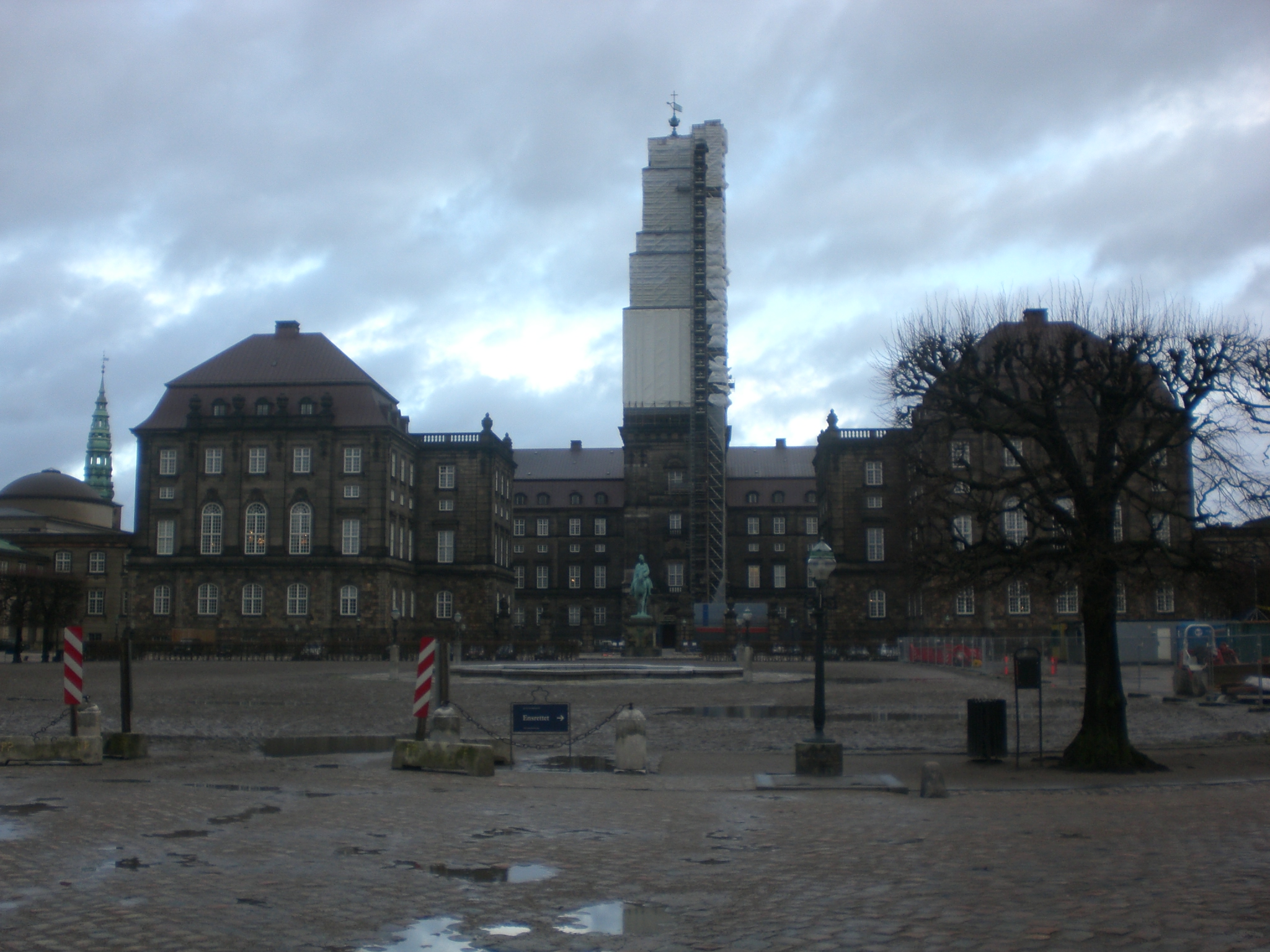
The courtyard of the Folketing (Danish Parliament)

Doesn’t this run counter to their argument? Surely the way to end elitism is to create more opportunities for access and participation – not less!

Doesn’t this expose and even widen a hole in the Government’s Abolition argument?

The Nordic countries may not have Senate, but they have a sound reason for not needing one. Their systems of government and administration are considerable more devolved than ours, with the Government and parliament retaining less centralised control over day to day services than we do.

In practice this means that the scrutiny and oversight we need to conduct in a Senate can be done by them at the local government level.

The Danish ambassador to Ireland, Niels Pultz, explained this approach in a recent column for the Irish Independent:“Another important fundamental in Danish politics is the division of labour between the national parliament and the local municipalities. The philosophy is basically that issues of importance to the daily life of citizens are best taken care of at the local level. That goes for primary and secondary education, social services, health, child care, local roads, water and waste management.”

If the government seriously believes that it can move our parliamentary system to resemble the Nordic model is it not going completely the wrong way about doing it?

ENDS

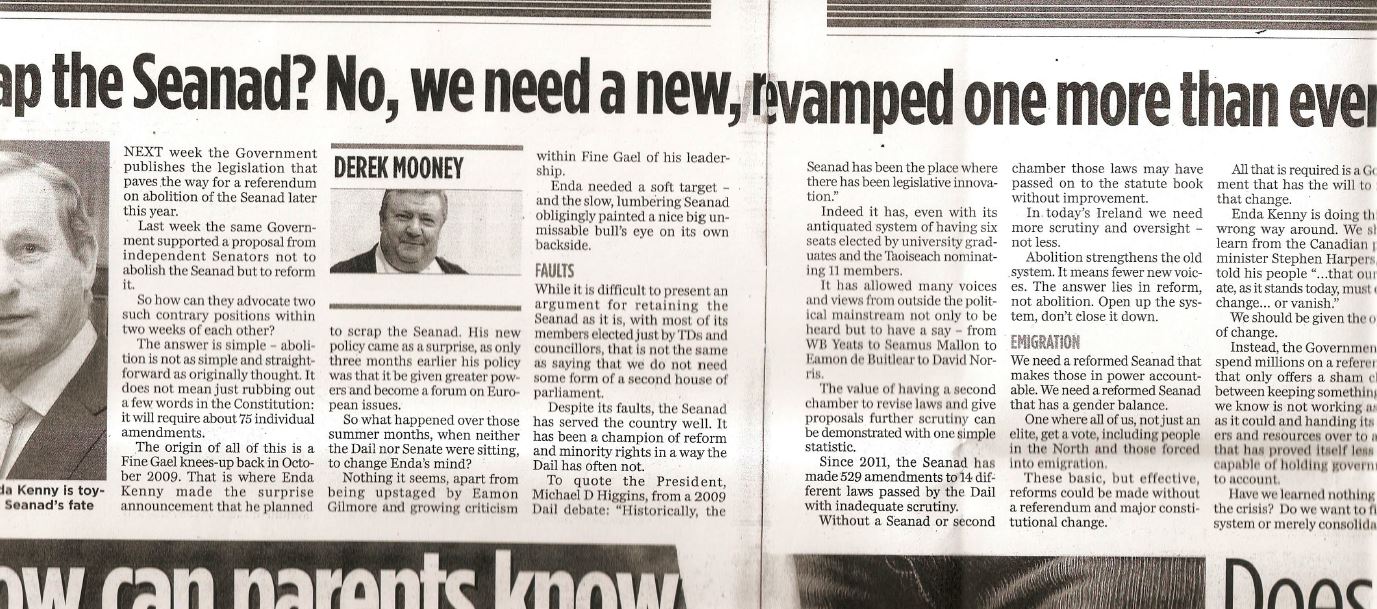
Scrap the #Seanad? No, we need a new, revamped one more than ever

Sorry for being late in posting this – it is my Herald column from last Friday, May 24th, on why the the Government’s plan to abolish the Seanad is as far from reform as it is almost humanly possible to get 

——————–

Democracy Matters! Campaign

Next week the Government publishes the legislation that paves the way for a referendum on abolition of the Seanad later this year.

Last week the same Government supported a proposal from independent Senators not to abolish the Seanad but to reform it.

So how can they advocate two such contrary positions within two weeks of each other?

The answer is simple – abolition is not as simple and straightforward as originally thought. It does not mean just rubbing out a few words in the Constitution: it will require about 75 individual amendments.

The origin of all of this is a Fine Gael knees up back in October 2009. That is where Enda Kenny made the surprise announcement that he planned to scrap the Seanad. His new policy came as a surprise as only three months earlier his policy was that it be given greater powers and become a forum on European issues.

So what happened over those summer months, when neither the Dáil nor Senate were sitting, to change Enda’s mind? Nothing it seems, apart from being upstaged by Éamon Gilmore and growing criticism within Fine Gael of his leadership.

Enda needed a soft target – and the slow, lumbering Seanad obligingly painted a nice big un-missable bull’s eye on its own backside.

While it is difficult to present an argument for retaining the Seanad as it is: with most of its members elected just by TD’s and Councillors, that is not the same as saying that we do not need some form of a Second House of Parliament.

Despite its faults, the Seanad has served the country well. It has been a champion of reform and minority rights in a way the Dáil has often not. To quote the President, Michael D Higgins from a 2009 Dáil debate: “historically, the Seanad has been the place where there has been legislative innovation.”

Indeed it has, even with its antiquated system of having 6 seats elected by University Graduates and the Taoiseach nominating 11 members. It has allowed many voices and views from outside the political mainstream not only to be heard but to have a say: from W B Yeats to Seamus Mallon to Éamon de Buitléar to David Norris.

The value of having a second chamber to revise laws and give proposals further scrutiny can be demonstrated with one simple statistic. Since 2011 the Seanad has made 529 amendments to 14 different laws passed by the Dáil with inadequate scrutiny.

Without a Seanad or Second chamber those defective laws would have passed on to the statute without correction.

In today’s Ireland we need more scrutiny and oversight – not less. Abolition strengthens the old system. It means fewer new voices. The answer lies in reform, not abolition: open up the system, don’t close it down.

We need a reformed Seanad that makes those in power accountable. We need a reformed Seanad that has a gender balance. One where all of us, not just an elite, get a vote, including people in the North and those forced into emigration.

These basic, but effective, reforms could be made without a referendum and major constitutional change. All that is required is a Government that has the will to make that change.
Enda Kenny is doing this the wrong way around. We should learn from the Canadian Prime Minister, Stephen Harpers who told his people “…that our Senate, as it stands today, must either change… or vanish.”

We should be given the option of change.

Instead, the government will spend millions on a referendum that only offers a sham choice between keeping something that we know is not working as well as it could and handing its powers and resources over to a Dáil that has proved itself less than capable of holding Government to account.

Have we learned nothing from the crisis?

Do we want to fix the system or merely consolidate it?

My latest column in Friday's Herald
My latest column in Friday’s Herald


Why waste time speculating about possible @FiannaFailparty and @FineGaeltoday link-ups?

This piece is also on www.TNT24.ie 

Surely I cannot be alone in realising that there is less chance of Fianna Fáil and Fine Gael linking up than there is of Luis Suarez having all his teeth pulled and turning vegetarian.

Yet, within hours of each new opinion poll you will see lots of speculation in print, on air, online and/or on all three that the next government will consist of Fianna Fáil and Fine Gael in some combination or other.

Such speculation seems to be based just on adding together the numbers that bring you to 50% and ignores the glaring Catch 22 that renders the chances of any such FG/FF or FF/FG alliance impossible: neither party would ever agree to go into a partnership government where it was not the biggest partner.

Kenny Martin
Photo via http://www.dailyedge.ie/

And as, by definition, a partnership government of just two groups cannot have two biggest partners, neither party would agree to be the junior partner in such a relationship. To do so would fly in the face of the fundamental rule of Irish governmental politics: junior coalition partners come off worst.

The strategists in both Fine Gael and Fianna Fáil know this. Whatever their weaknesses and deficiencies in policy formulation, these are still wily and experienced political operatives, they understand political realities. More critically they understand the laws of self preservation. They know that going into government as the junior partner while leaving Labour and Sinn Féin as the official opposition would be tantamount to writing their own party’s obituary.

Those who argue, on the basis of current opinion polls, that the Fine Gael / Fianna Fáil option may be the only viable one after the next election, do it on the basis that politics is a “numbers game”.

Well, to some degree it is, but numbers do not dictate everything. True, without the numbers you have no role and no say, but the converse is not true. Having the numbers does not mean that you must necessarily do A or B. Having the numbers does not restrict your options, quiet the opposite. Rather than being compelled to pursue some particular course, you have the opportunity to exercise judgement and think strategically.

This is not to discount the temptation and lure of ministerial office, especially to those who may not plan to face the electorate again. Saying no to power is no easy task, but the decision is made somewhat less troublesome if you know that saying yes to office today as a junior partner means that you are almost certainly ensuring that that option will be denied to you and your colleagues for many years thereafter.

Though majorly damaged after electoral pounding it took in the February 2011 General Election, Fianna Fáil is still hard wired for power – perhaps even more so that Fine Gael – so saying no to office would be difficult for some within the upper echelons of the organisation. Perhaps this is why the party leadership has recruited the membership of the party to ensure that any post election decision would be made by the broader party.

The situation is just as true for Fine Gael, though for other reasons. Having spent so long as the second party of Irish politics, it is now relishing its time in the top spot. It will be loathe to surrender that place – least of all to Fianna Fáil.

If the next election were to put Fianna Fáil ahead of Fine Gael, no matter by how small a margin, Fine Gael would do nothing to help Fianna Fáil back into power. Fine Gael would seek alliances with Labour, Sinn Féin, Independents, Socialists, Wallacites; McGrath-ites (of the Mattie or Fintan variety) Greens, People Before Profit, Profit Before People, Cart Before the Horse or whoever to keep Fianna Fáil out.

I know I risk appearing more than a little cynical in not mentioning policies and principles and just discussing the possible make up of a future government in terms of survival strategies but, I believe the chances of a Fine Gael/Fianna Fáil government are so remote and unrealistic that it is cynical not to dismiss it and to allow any more time and energy be wasted on discussing an option (and the associated policies) that does not exist.

#Merkel & #EU need to learn the lessons of Germany’s own economic renewal

adenauer
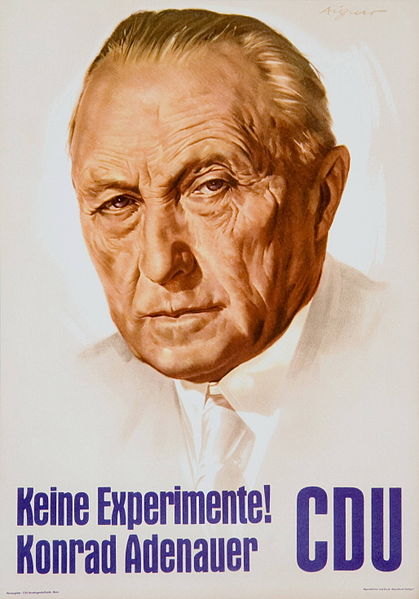
1957 Adenauer Election Poster: No Experiments

Yesterday (Thurs April 11th) the Irish Times ran a story saying that the German chancellor Angela Merkel is facing mounting political pressure at home to demand fiscal concessions from Ireland in exchange for granting extra time to repay crisis loans.

It seems that once again Germany is insisting that it not merely have an input into EU talks and discussion, but that it have a veto on the outcome. It is the ‘he who pays the piper calls the tune’ school of political thought.  While the approach is not unfamiliar in politics, it flies totally in the face of democratic process and accountability. But even more than that, in this instance, it contradicts the history of Germany’s own economic revival and the important role played by one of Ms Merkel’s most illustrious predecessors: Konrad Adenauer.

Germany’s Wirtschaftswunder – the economic miracle of the 1950s – was based in large measure on a generous programme of debt forgiveness given to Germany by its 33 debtor countries (including Ireland). The 1953 London Agreement on German External Debts, effectively wrote off half of Germany’s total mountain of debt and gave it additional time to repay the monies it owed. These debts included war reparations from both first and second world wars, plus the massive German 1930’s debt default, which was just as significant as the 2008 European financial crisis.

The West German CDU Chancellor, Konrad Adenauer realised that there would be no growth or revival of the West German economy for as long as it had to make huge annual payment to the Allied and other powers. These hefty payments, many of which Germany was even failing to make, were draining the West German economy of the ability to rebuild itself.  He recognised that the only way to achieve growth was to get some relief from this debt burden, hence the London conference on German external debts.

Adenauer managed to convince the others sitting around the table that the only way that Germany could recover and rebuild was for them to ease the burden on it – he managed to convince them to stop doing to Germany what Germany is now doing to Ireland, Spain, Portugal, Greece and Cyprus.

Easing the burden of West Germany’s debt did not make the country lazy and profligate, quite the opposite. The Agreement, along with the Marshall Plan very quickly enabled the West German government and industry to use the resources freed up by the easing of the debt burden to generate domestic economic activity and growth.

Not only did the London Agreement write off 50% of Germany’s debt it removed the requirement that interest be paid, though did say that this proviso would be revisited in the event of German reunification. The collapse of the Wall in late 1989 triggered that proviso but it was never implemented due to Chancellor’s Kohl’s protestations that demanding such interest payments would make it almost impossible for Germany to meet the considerable costs of re-unification. So, once again, Germany’s partners allowed it to walk away from its financial commitments in the greater good.

Kenny MerkelAs we know, both Enda Kenny and the Fine Gael party is deeply proud of its strong association with the CDU and Ms Merkel via their shared membership of the centre right European grouping: The European People’s Party EPP. Indeed, they regard the linkage as so important and significant that Mr Kenny manged to include a quick visit to Berlin and photocall with the Chancellor in the first week of the February 2011 general election campaign.

Perhaps the next time An Taoiseach meets up with the Chancellor in either Dublin, Brussels or Berlin he might gently remind her that her countries economic resurgence and dominance is due, in no small part, to the fact that 33 other countries, including Ireland, had allowede Germany to ease its burdens when it mattered and that it may now be time for Germany to allow others the facility they once extended to it.


POLL: Compare and Contrast Statements on #Thatcher

Thatcher FitzGeraldInteresting to note the different tones adopted by An Taoiseach and the Leader of the Opposition in their respective statements on the death of Margaret Thatcher.  While both probably reflect the broad view of public opinion, which best reflects that view?

Statement by Taoiseach Enda Kenny on the death of former British Prime Minister Margaret Thatcher

I was saddened to learn of the death this morning of former British Prime Minister Margaret Thatcher.

Mrs Thatcher was a formidable political leader who had a significant impact on British, European and world politics. During her eleven years as Prime Minister, she defined an era in British public life.

While her period of office came at a challenging time for British-Irish relations, when the violent conflict in Northern Ireland was at its peak, Mrs Thatcher signed the Anglo-Irish Agreement which laid the foundation for improved North-South cooperation and ultimately the Good Friday Agreement.

I extend my deepest sympathies to her family and the Prime Minister David Cameron.

Statement by FF Leader Micheál Martin on the death of former British Prime Minister Margaret Thatcher

“Today, on hearing of the death of Margaret Thatcher, our first thoughts are thoughts of condolence for her family. Our personal sympathy is also with her friends and colleagues within the Conservative Party and the British Government.

“In the coming days and weeks, there will inevitably be much discussion of Mrs Thatcher’s political legacy.

“It is important that such discussion take a balanced account of her approach to Irish affairs. While I or the Fianna Fáil party would have had little in common with the politics of Mrs Thatcher, it would be wrong not to acknowledge that the long journey towards the peace and respect that we enjoy between Britain and Ireland today, took its first faltering steps in the bilateral discussions between Mrs Thatcher and former Taoiseach Charles Haughey.

“However the British Prime Minister’s hard-line approach to an increasingly violent situation in the North was one of a number of factors which limited the potential of those early initiatives. Unfortunately her uncompromising approach to the escalating crisis in the early 1980s may actually have acted as a major boost for the recruitment efforts of the Provisional IRA at that time.

“There can be no doubt that the career of Margaret Thatcher had a significance and impact that is seen very rarely in modern European politics. The debate about the consequence of her impact will go on for many years to come.

“But today, our thoughts are with her family and close friends.”

Which statement more closely reflects your view?

Soldiers could lead the battle to reform public service

Irish troops serving the cause of peace internationally

My column from tonight’s Evening Herald on how the reform and modernisation of the Defence Forces over the past year could prove a model for public sector reform

—————————————————————————————————–

The first tentative step on the path to a possible Croke Park II deal was taken last week when Public Sector unions and management sat down together for preliminary talks.

While reaching any form of deal will pose difficulties for negotiators on both sides, the management side has a particularly difficult delicate balance to strike. Though their political masters in Cabinet may be signalling their support for a deal they also know that most Fine Gael back benchers would be just as happy if no deal was reached.

The public service is just one more issue that divides back-benchers from both parties, with many of FG’s newer intake of TD’s echoing the “small government” rhetoric heard from US Republicans and Tea-Partyers.

It is not an uncommon view in these difficult times. There are many siren voices around attacking the public service and portraying it as riding on the back of a shrinking private sector.

Sadly, the public service often leaves itself open to these onslaughts with daft examples of wasteful spending and bad work practises. But the danger lies when occasionally justified criticisms are distilled into a dogma.

Yes, the public service is in need of reform and modernisation, but the one dimensional demonizing of the entire public service we hear from some quarters will not help reform anything. Nor will the “everything is just fine as it is” defence we hear from various public sector unions.

Public service reform is possible without hyperbole or blood on the carpets. With the right management and leadership the public service is capable of reforming and modernising itself. I know, because I was there when it happened.

The reform and modernisation of the Defence Forces over the past decade and a half is a model of how it can be done right.

The 2009 Bórd Snip Nua report found that the Defence Forces were the only sector in the Public Service to reduce numbers during the Celtic Tiger.

While the numbers working in the Public Service had increased by 17% between 2001 and 2009, the numbers working in the defence organisation actually fell by 8%, going from 11,808 down to 10,895 a drop of 913.

The reduction in numbers in uniform was reflected in a reduction of numbers of civil servants in the Department. These payroll savings were invested in better equipment and improved training meaning that the Irish Defence Forces could do more with less.

The negotiations were tough, but both sides recognised that it was in their mutual interest. While soldiers and officers do not have Trade Unions, they do have strong representative organisations: PDFORRA and RACO and a parallel conciliation and arbitration process that conducts it business quietly and effectively,

Perhaps the absence of outside influences, speculation and running commentaries, helped create the conditions for agreement – but not nearly as strong leadership, both political and military.

We should now be finding ways of replicating this progressive model. Before coming into office the Taoiseach’s last big idea on the Defence Forces was that it should be running boot camps for young offenders.

Doubtless he has abandoned this nonsense having spent two years seeing them close up, but their handling of the last round of barrack closures suggests that he may not yet have realised just how the Defence Forces be a model for public service reform.

ENDS