Why @FineGael’s #GE16 pre-campaign campaign doesn’t augur well for real thing

This blog first appeared on the Slugger O’Toole website earlier today.
image
 

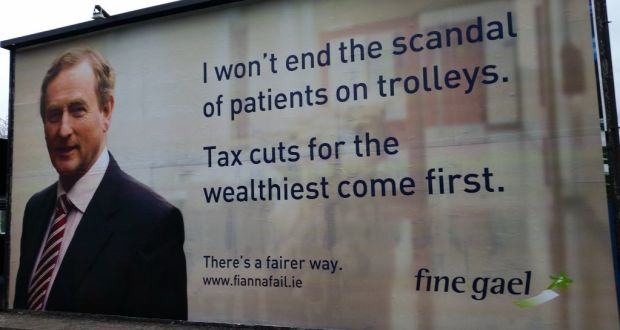
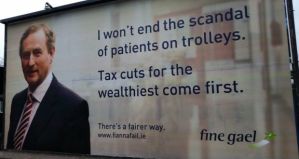
Fianna Fáil’s poster attacking Fine Gael’s broken promises


Whether polling day is on Feb 26th or March 4th, it is clear that we are only two or three weeks away from the start of the great 2016 corriboard shortage… sorry, the 2016 general election.

Over the coming two weekends we will have the Fianna Fáil and then the Fine Gael Ard Fheiseanna, followed by Labour at the end of January – presuming that Enda hasn’t already called the election and pulled the plug on Labour’s big day out.

While the corriboard campaign posters remain in their wrappings and the Vote for me leaflets stand ready, the electioneering has already as good as started.

One the most interesting aspects of Fine Gael’s pre-campaign campaigning so far is just how much time and energy a party determined to dismiss Fianna Fáil as irrelevant is devoting to attacking them. See Today FM’s Matt Cooper’s comment on the Taoiseach’s Wednesday afternoon press conference:

Could it be that Fine Gael’s own private polling is telling them something the national newspapers polls are missing?

It occurred to me recently that Enda has spent the last few years doing a very bad Bertie Ahern impression – making Enda the Bobby Davro of Irish politics you might say. Enda gets the minor gestures and mannerisms right – but he misses the core of the character.

Enda may be as accomplished and expert a glad handler as Bertie when it comes to wading into a crowd and shaking the hand and slapping the of everyone around him, but he his mimicry is one dimensional. He does not possess Bertie’s skill and ability to command the facts and figures when engaging with the media on door step interviews.

While Enda still possesses many skills and abilities, not least his steely determination and ruthless streak, he is not politically hard wired to endure or sustain a long election campaign – especially if he hopes to keep his media interactions down to a few tightly managed ones.

In this context Fine Gael’s attempts to transpose the most recent Tory election campaign strategy to Ireland seriously risking backfiring on them and only highlighting the weaknesses they hoped to obscure.

It is a mistake on two fronts. First as they seem to be copying the Tory playbook here with minimal changes and basic adaptions.

Do they so see themselves as Ireland’s Tories that they cannot be bothered to make even the most basic of changes to the strategy, the text and the slogans? A series of recent Fine Gael social media posts have used the Tory line: “long-term economic plan” word for word:

While the Tories undoubtedly mounted a superb social media campaign in the 2015 UK general election and used the platforms, particularly Facebook, more effectively than most of their rivals (apart from the SNP who are the master campaigners both online and on the ground) that does not mean you take their campaign slogans and approaches lock stock and barrel.

Second, in taking the Tory campaign playbook en masse Fine Gael seems to have forgetten that we have a PR STV system, not First-Past-The-Post – indeed Fine Gael used to pride itself as being the defender of PR STV (they had opposed the two attempts to change the voting system by referendum in the 50s and 60s)

What works in a FPTP system does not necessarily work in a PR-STV one. Depending on where you live in a FPTP system you can find yourself voting for someone you don’t like rather than the one you do like most just so you can make sure the one you dislike more is kept out.

The idea that a vote for Fianna Fáil or Independent alliance is a vote for Sinn Féin is not so easy to sell in an STV system where the voter can vote the entire panel right down the line and omit the local SF candidate.

That said is easy to see the attractiveness of the Tory playbook for Fine Gael. The Tories succeeded in keeping their leader out of head to head debates, Fine Gael want and need to do the same – though for different reasons. While Cameron was wary of elevating Milliband by sharing a head to head debate platform with him – there were no questions about the PM’s capacity to perform well in a head to head debate.

The other attraction was the Tories successful cannibalisation of their Lib Dems coalition partners. Cameron’s gains came mostly from Lib Dem losses (The Tories took 27 of the 49 Lib Dem seats lost as opposed to 12 lost to Labour and 10 to the SNP) – an option that Fine Gael is eyeing up here, using Labour losses to shore up their own numbers. Fine Gael are ready to fight this campaign to the last Labour TD.

Though Fine Gael’s polling numbers have recovered recently – at precisely the time they needed them to recover – they are still on course to lose seats, even if they do get 31/32% in the polls.

While these improving numbers are no mere coincidence and are a tribute to Fine Gael’s political strategists, the idea that seems to be floating about the commentariat that Fine Gael is now some invincible campaigning machine is more than a little bit short of the mark.

Fine Gael is having a few problems of its own right now, and they are problems entirely of its own making. Though they will doubtless address the issue between now and the Árd Fheis (and possibly drum up future local difficulties in the process) Fine Gael was still short of the 30% gender quota up to a few days ago – a system they introduced and championed.

Not only that but its head-quarters operation has just ended an unseemly, costly and ultimately unsuccessful fight in the Courts with one of their own candidates: John Perry TD.

And before I am accused me of dragging up these problems like a Fianna Fáil-er whistling past the graveyard, I do not think this is a zero sum game. I do not presume that any loss of ground by Fine Gael over the campaign will automatically translate into a Fianna Fáil gain.

Fianna Fáil will have to make its own ground in this one and will need to land some hefty punches on Enda, Leo, Michael and Simon, it cannot depend on Enda and Fine Gael to just lose it.
The Legend of #Enda of the wild Wesht…

The Legend of Enda of the Wild Whest…

Enda’s #armygate saga has had pundits of all hues falling over themselves to explain, or even excuse, how and why An Taoiseach went to a recent EPP gathering in Madrid and told a story about the Irish Defences Forces being on standby to protect ATMs back in 2012.

Some have seen this as just another example of the perils of letting Enda go off script. Others suggest it shows that his grip on the actualité is slipping, a bit like his story of the woman thanking him after the Budget.

In order to retain my punditry badge, let me weigh in with another possible explanation. I think Enda is suffering from Ransom Stoddard Syndrome.

Who is Ransom Stoddard, I hear you ask. He was the main character in the 1962 western: The Man Who Shot Liberty Valance. Stoddard, played by Jimmy Stewart, is the eponymous hero who shot the outlaw Liberty Valance – except, well…. he didn’t. (I hope this doesn’t spoil the plot for anyone hasn’t seen it.)

“No, sir. This is the West, sir. When the legend becomes fact, print the legend.”

Following a long political career, built in part on his reputation as the man who shot the criminal, Stoddard attempts to clarify events in an interview with a local newspaper. As the interview ends Stoddard asks the editor if the newspaper is going to use the real story, the editor replies: “No, sir. This is the West, sir. When the legend becomes fact, print the legend.”

For Enda the legend of Enda has become confused with fact. The Enda legend or, to use the political communications parlance, the Enda narrative, is that he and Fine Gael manfully pulled Ireland back from the brink. In Fine Gael’s mind they inherited a bankrupt and dysfunctional country and, with careful planning and skilful leadership, turned it around to become the fastest growing economy in Europe. Not only that, they also tell themselves (and others) that the recession would never have hit Ireland if only Fine Gael had been in office for the preceding decade.

It is this narrative Enda was sharing with his colleagues in the EPP. The problem is that the facts don’t back it up, so Fine Gael and Enda must construct its own facts, facts based on its legends.

As Noel Whelan points out in his column in the Irish Times: Kenny gaffe over army and ATMs part of pattern of deception this is not the first, second or third time Enda has uttered this story of Army, ATMs and the Central Bank. This story has been constructed not only to fit into a narrative of the past, it is structured so as to advance it.

Yes, as others have pointed out, it does highlight Enda’s recurring issues with going off script and ad-libbing, but it is about more than a Taoiseach who can’t be trusted out on his own and who can’t remember his lines. It is about a party in government that is all narrative and no facts.

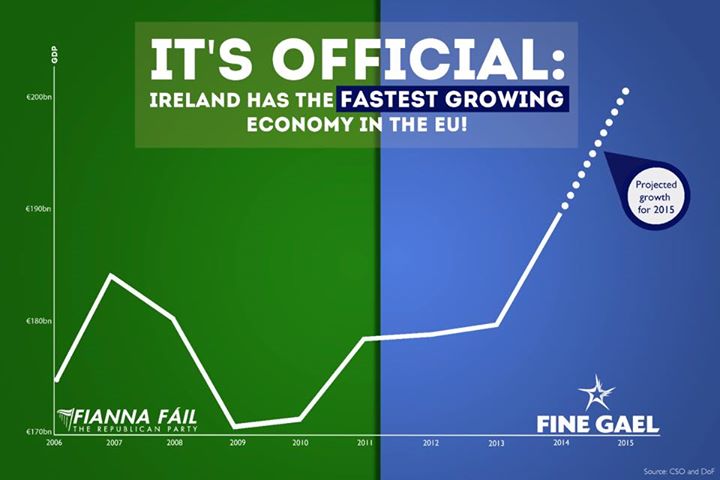
11225395_10153631887578211_4150166261132217846_nLast week the Fine Gael placed a graphic on its Facebook page which purported to show that it alone had secured Ireland’s recovery and made Ireland the fastest growing economy in the EU. To even the most casual of viewers the graphic, especially ones who ignore the dodgy Y axis increments, shows that the bulk of the recovery had been secured before the 2011 election and that the economy had effectively flat lined for the first two years of Fine Gael and Labour’s time in office.

Try searching for the 2002 and 2007 Fine Gael manifestos on the party’s website – you won’t find them. Neither will you find the many statements from Fine Gael spokespeople urging more spending after every Budget. The reality that both campaign platforms, plus the party statements promised to spend more and tax less than the Fianna Fáil alternatives does not sit well with the new Fine Gael legend.

Where Fine Gael is all narrative and no facts – Fianna Fáil has the opposite problem, it is all facts and precious little narrative. Up to the appearance of Brian Cowen and Bertie Ahern before the Banking Inquiry Fianna Fáil spokespeople seemed singularly unwilling to talk about the years leading up to the 2011 election. It seemed that they, like Fine Gael, thought that talking about the period 2002 – 2011 could only damage the party – but as Cowen and Ahern showed, setting the record straight and speaking candidly about what actually happened does not undermine Fianna Fáil.

Cowen and Ahern’s able and informed testimony at the Banking Inquiry showed that the Governments they led were neither reckless nor directionless. Yes, they made mistakes, but as they proved by their command of the facts and the details they did have a plan and were, in the teeth of a global financial crisis, making the best decisions they could on the basis of the facts and information before them. Their assured solo appearances contrasted with Enda’s assisted one, where he did the general patter and handed over to Richard Bruton when the questions become difficult.

The big fallout from the Banking Inquiry is not damaging Fianna Fáil the way Fine Gael’s strategists planned it would. They were full sure that parading the old familiar Fianna Fáil faces before the committee to be questioned and pilloried would re-ignite the public anger and ire of the 2011 election. Why else delay the hearings until the final run up to the election.

But they were wrong. While Fianna Fáil is hardly soaring in the polls, its support has been creeping up painfully slowly, just while the support levels for Fine Gael’s preferred enemy: Sinn Féin, have been slipping steadily downwards.

Hence the need for Fine Gael and for Enda is up the ante on the faux narrative and hype up the legend of Enda of the West complete, to return to the western movie motif, with the good guy white hats they have fabricated for themselves.

The problem is that life and politics today is much more questioning and techni-coloured now than it was in the days of the black and white western – no matter how exciting the story sounds.

I wrote this piece for the Slugger O’Toole website

The @finegael #LE14 meltdown is a repeat of @fiannafailparty’s #LE09 one #ep14

I have now updated my initial thoughts, musings, observations and mild rantings on the implications of the local election results, particularly Fianna Fáil’s stronger than expected showing.

This was first posted on Sunday morning – updated on Monday morning to reflect the revised party national totals in the Local Elections.


Local Election Results national overview


“If history repeats itself, and the unexpected always happens, how incapable must Man be of learning from experience.” – George Bernard Shaw.

Quite a lot, it seems.

Yesterday we saw history repeating itself, with the electorate visiting upon Fine Gael and Labour almost exactly the same devastating blow it had served up to Fianna Fáil and Labour five years earlier.

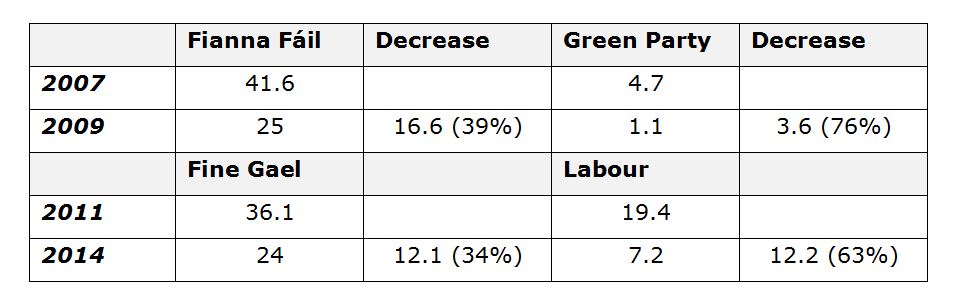
In 2009 Fianna Fáil lost around 39% of its support (when compared with 2007) while the Greens endured a massive reduction in its vote of 76%.

Yesterday, based on the Local Election results to hand, Fine Gael lost 34% of its support and Labour lost 63%.

le14 grid

While the story of the Local Elections is the rise in support for Sinn Féin and the Independents and the scale of the loss for Labour, the Fine Gael haemorrhaging of support should not be ignored.

Indeed, the case can be made that the real story of the election is this massive Fine Gael loss – a loss that should not be glossed over by what might appear to be its reasonable performance in the European Elections.

Losing 100 plus Councillors, on a day when you have increased the number of available council seats, is a political meltdown of Fianna Fáil in 2009 proportions. It will send a shiver around the Fine Gael backbenches that will match that currently coursing along the spines of their Labour colleagues.

Leo Varadkar’s line that the next election will be a battle between Fine Gael and Sinn Féin was a clever attempt to calm the troops with the notion that their lost support will come back when the Irish voters realise that Fine Gael is all that stands between them and the Shinners.

It’s clever line, but a flawed one.

For it to offer any comfort it would need to be underpinned by Fine Gael still remaining the largest party – but it hasn’t. By the time the dust settles it will become clear that the other big story of the locals is the return to frontline politics of Fianna Fáil, even if its European results are a bit rocky.

If the battle of the next election is, as Varadkar suggests, to be fought on the question of where you stand with regard to Sinn Féin then Fianna Fáil, with a few more weapons in its armoury, is standing on better – and now even firmer – ground than the depleted followers of Enda.

While Fine Gael may see itself as the antithesis of Sinn Féin, Fianna Fáil can challenge SF’s voodoo economics every bit as credibly as FG, but with the added bonus that that can better undermine and dismantle the Shinner’s fallacious claim to Republicanism, especially in its back yard.

The other story of the Fianna Fáil result is its incredible variety. Its national level of support at just over 25% belies some very good and incredibly bad local results, especially in urban centres.

They range from the sublime such as its 49% in Bailieborough-Coothall 39% in Castlecomer and 38.4% in Ballymote-Tobercurry to the ridiculous: such as its 4.9% in Dublin North Inner City, 6.8% in Tallaght South and 8.7% in Lucan.

While there are several other disappointing low teen results in urban centres across the country e.g 9.6% in Waterford City South, 10.5% in Bray and 13% in Limerick City North, it is no coincidence that the single digit performances are in Dublin.

That is not to say that the Capital is a wasteland for Fianna Fail. Contrast the single performance mentioned above with the parties stunning 27.3% in Castleknock, its 24.2% in Clontarf and its 22.3% in Stillorgan.

While the overall Dublin result of 16% points to a major problem for the party, the variety in results, highlighted above, shows Fianna Fáil’s further potential for growth and renewal in large swathes of Dublin.

It is the very patchiness of its result that points up where the party needs to work harder and better. Far too many candidates in Dublin were left to struggle on by themselves with no structured national campaign to underpin their efforts.

Having “Fianna Fáil” on your poster does not guarantee a good new candidate a certain base level of support in Dublin and other urban centres in the same way as having “Sinn Féin” on your poster did for their new first time candidates. Indeed it does not offer the prospect of that base level of support as it does in non-urban Ireland.

The candidates in Dublin raised the Fianna Fáil vote to their level, not the other way around. The vote in Dublin and other urban centres, is not the party vote plus the candidate’s unique personal support – it is just the latter. In certain parts of the city is it the unique personal support minus the residual antagonism to Fianna Fáil.

The “Fianna Fáil” identity is Dublin is not a coherent identity based on a core defining message from the party as a national political party: it is the collective identities of its various candidates.

This is not to underestimate the particular nature of Dublin voters, especially their looser party allegiances; it is just to point out that Dublin voters are just as likely to be receptive to a national message, just less continuously loyal to it.

Despite some clearly very good results in Dublin, most Fianna Fáil supporters still struggle to answer the questions: why should I vote Fianna Fáil and what does Fianna Fáil stand for. Most of the successful candidates I have encountered in Dublin answer it with the words: here is what I stand for…

It is not that there are not answers to these questions, but rather that the party has not sufficiently defined and substantiated them.

It is work that can and must be done. That work is not aided or encouraged by intemperate outbursts or Quixotic threatened heaves. The issues are policy and organisation – not personality.

The 24.3% of voters who abandoned Fine Gael and Labour saw their political alternatives this week. Some said independents, some said Sinn Féin – though not by a large margin as the swing to Sinn Féin since the 2011 election is in the 5.3%, but even more said Fianna Fáil with a swing of just over 8%, but the point should not be lost that the biggest single section of them said: none of the above.

The ones who stayed at home are the ones who were badly let down by Fianna Fáil and are now just as angry with Fine Gael and Labour for promising them a new politics and then delivering the old failed politics as usual.

Perhaps they concluded that they could afford to sit out these second order elections, as they do not see how the results will change their lives, they will not be as sanguine at the next election.

@sluggerotoole: Derek Mooney on @FiannaFáilparty’s long road to recovery #ep14ie #le14 #ee14 ##ep2014

This is an analysis piece I penned for the Slugger O’Toole website

———————————————————————————————–

Fianna Fáil

While there are worse jobs in the world: the worst job in politics is certainly leader of the opposition.

If he didn’t already know this, it is certain that Fianna Fáil’s leader Micheal Martin will know this in just over a week.

The 2014 European and Local Election campaigns for which he and his HQ team have prepared and planned for over 18 months are proving themselves to be a source of unalloyed joy. It is hard to believe that these are the campaigns they wanted.

The latest round of opinion poll findings only confirm this. They suggest that

  • His Dublin Euro candidate will fail to take the seat
  • His Midlands North West duo may struggle to win a seat
  • While his Ireland South candidates have the best part of two quotas between but are so imbalanced as to render a second seat impossible.

If the ballots cast on Friday confirm these poll findings, then it will be hard to make any of this sound like an achievement.

Continue reading “@sluggerotoole: Derek Mooney on @FiannaFáilparty’s long road to recovery #ep14ie #le14 #ee14 ##ep2014”

My #af14 analysis: @fiannafailparty’s future depends on delivering a coherent alternative

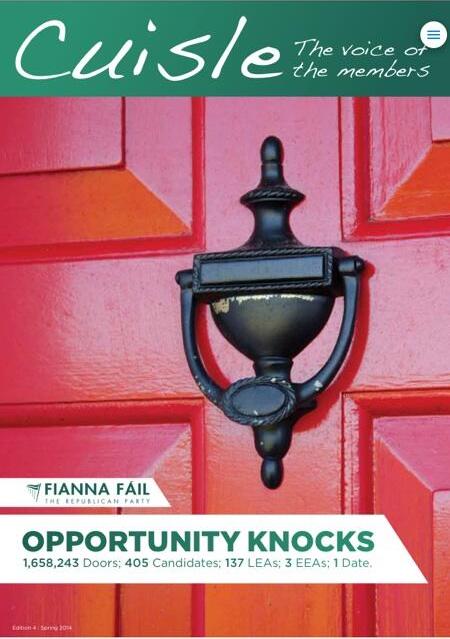
This is an article I have written for the March 2014 Árd Fheis issue of Fianna Fáil’s members’ magazine Cuisle

————————————————————————————————–

BjNAsq0IcAAMTFkA few months before the 2011 election, Michael Gallagher (the TCD Professor of Politics, not the Donegal postman and amateur weather forecaster) posted a blog where he asking how long Fianna Fáil could expect to spend in opposition. In it he wrote:

“Fianna Fáil is not a party accustomed to spending time there. Its longest spell on the opposition benches is still the nearly six years between its foundation in May 1926 and its entry into government in March 1932. Since then, the party has never spent more than one consecutive Dáil term in opposition and the longest spell it has been out of power remains the 4 years and 4 months of the Cosgrave coalition in the mid-1970s.”

Underpinning Gallagher’s 2010 comments is the idea that Fianna Fáil has never been that good at opposition. It is a fair point.

Not only have we not spent much time in opposition, as Gallagher points out, it is almost 30 years since we last spent a full Dáil term there.

Continue reading “My #af14 analysis: @fiannafailparty’s future depends on delivering a coherent alternative”

My @beerg article on recent #eudatap developments and important comments by @seankellymep


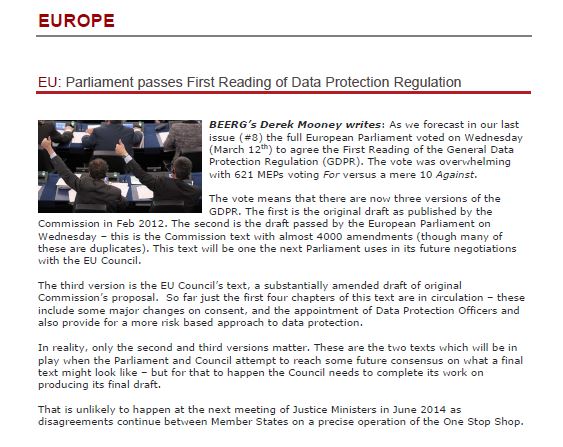
This is a piece I wrote for the March 14th issue of the BEERG global labour newsletter. It examines the consequences of the EU Parliament’s overwhelming vote on the General Data Protection Regulation and acknowledges the hard work and valid concerns raised by the Irish MEP Sean Kelly (EPP & Fine Gael)

BEERG Newsletter March 14th 2014

Though it is now accepted across the EU that the Data Protection Regulation is not likely to be approved until 2015 at the earliest, the European Parliament has scheduled a debate on the legislation on Tuesday (11 March) with a full First Reading vote on it on Wednesday.

The vote comes just 10 weeks before voters across Europe go to the polls to elect the next European Parliament.

The plenary vote on Wednesday is no mere gesture, however. It is the outgoing Parliament setting out its position so that the incoming one can start negotiations with the Council of Ministers, as soon as they have adopted their position, though the timetable for the Council’s part of the process remains uncertain

It is not the European Parliament’s only debate on Data Protection this week as it is also set to approve the final report of its own inquiry into alleged mass surveillance by the US National Security Agency.

That report not only demands that the US/EU trade talks not lead to a softening of data protection standards, it also calls for the suspension of a programme to share bank transfer data with the US, and calls on member states to strengthen oversight of their intelligence services.

As mentioned earlier, the ball now lies with the member states governments via the EU’s Council of Ministers. The Justice Ministers met last week and held a policy debate on outstanding issues relating to the data protection regulation framework.

ASs the communique issued after the meeting said: “Ministers broadly supported the draft provisions as regards the territorial scope of the regulation and confirmed the understanding that international transfers of personal data to third countries should take place on the basis of key principles contained in chapter V of the draft regulation.”

It then went on to diplomatically express the ongoing delays and problems saying:

“Ministers agreed that more technical work will need to be done on important aspects of this chapter and that the question of alternative models for international data transfer will need to be studied in depth.”

“The Council confirmed that the work will continue at a technical level on the basis of the progress achieved so far on: pseudonymisation as an element of the risk-based approach, portability of personal data for the private sector and obligations of controllers and processors.”

“Whilst a majority of delegations appeared to be of the opinion that the scope of the profiling provision in the future regulation should, like the current Directive 95/46/EC, limit itself to regulating automated decision-making that has legal effects or significantly affects individuals, some other delegations pleaded in favour of specific provisions on profiling. Work at a technical level should therefore continue on that basis.”

Others involved in the process expressed their frustrations with the Council’s difficulties in reaching a consensus less delicately. Ralf Bendrath, the Green Party’s data protection expert and an adviser to the German Green MEP who is the Rapporteur who has steered the Regulation through Parliament thus far said on Twitter: “Germany again – embarrassingly – less supportive than all other member states on progress”. He went on to dismiss Germany’s observations that the issue will “need more debate” and chided them for not specifically stating their objections.

While Ministers are still a long way off reaching agreement on their draft of the Regulation, that is not to say that a great deal of technical work and progress is going on behind the scenes.

The Greek EU Presidency has been working away very assiduously in recent months with a series of DAPIX and other Data Protection officials meerting. The Greeks have also been engaging with the Italian government (it is the the next country to hold the 6 month rotating Presidency of the EU) to work out a road map for agreeing on the data protection reform swiftly.

While their original objective of agreeing on a mandate for negotiation with the European Parliament before the end of the Greek Presidency looks unlikely to be achieved, they are busily dotting all the “i”s and crossing all the “t”s they reasonably can awaiting some direction from the member states.

Meanwhile in the UK, the Liberal Democrat Junior Minister at the Justice Ministry, Simon Hughes MP, has announced a review of the criminal sanctions available for breaches of the UK’s Data Protection Act. He said the review would help the UK government “decide whether to increase the penalties as the law permits”.

Feeding into this process Pinsent Masons’ specialist in data protection law Kathryn Wynn has suggested that the government should go further than reviewing the criminal sanctions and should also consider strengthening the civil monetary penalty regime too, arguing that a previous increase in the maximum level of fine in 2010 had prompted organisations to take the issue of data protection seriously.

Using the draft EU’s General Data Protection Regulation as an example she suggests that the review take the approach envisaged there, where the level of penalty for a data breach is calculated on the basis of a percentage of their annual turnover.

So, even before it is passed, we could see the draft EU’s General Data Protection Regulation is influencing domestic legislation across Europe.

Are @AlanShatterTD and @EndaKennyTD out-Nixoning Nixon on #gsoc ?

Nixon in Oval Office with Haldeman and Ehrlichman

In asking a High Court Judge to re-examine and review the documentation and material already available the Cabinet, and in particular the Taoiseach, Enda Kenny and the Minister for Justice and Defence, Alan Shatter are attempting to out-Nixon Nixon.

Back in early 1973, as the scandal of the Watergate Break In and Cover Up began to break, the then US President Richard M Nixon, in conjunction with his advisers John Ehrlichman and Bob Haldeman, devised a plan to get Nixon’s White House Counsel John Dean to write a report for the President on Watergate that “basically clears the President and White House staff of involvement”. Their plan was that they could cite Dean’s Report as what they had relied upon and that they could blame Dean for deceiving them.

While Dean did initially agree to go to Camp David at the President’s request to write such a report, but he soon came to realise that he was being lined up as the scapegoat and decided not to complete the report. Nixon sacked him shortly afterwards, on the same day as he announced the resignations of Ehrlichman and Haldeman.

While the Government is not asking a retired High Court Judge to become is scapegoat, it does seem to be looking to get a supposedly independent review that it determines will verify its own jaundiced version of events.

How else can we interpret the fact that while the Justice Minister was indicating how the review would operate he announced that he had decided on the review as he had received a review of the Verrimus report from RITS, a Dublin based IT security firm, that concluded that there was “no evidence at all”.

So, even as the Minister announces the review he sets out his view on what it should, if not must, conclude.

This, as with Nixon’s Dean Report, is all about attempting to draw a line under a growing political scandal rather than getting to the core of what caused it: allegations of bugging at GSOC’s premises?

Why opt for such a limited review, reporting to the Justice Minister and with Terms of Reference set by the Minister instead of an inquiry under the Commissions of Inquiry legislation?

Today’s Cabinet decision, albeit deeply flawed, runs counter to last week’s comments by both An Taoiseach and the Justice Minister and suggests either 1). A realization that the government’s spinning on the subject is not having the same impact now as it had at the start, and/or 2). Pressure from Labour members of the Cabinet growing tired of defending the Justice Minister.

—————

Background material on the Nixon/Dean Watergate Report

The timeline for Dean’s Watergate Report

March 20, 1973: In his conversation with chief of staff H. R. Haldeman about White House counsel John Dean’s phony “Dean Report,” which will say that no one in the White House was involved in the Watergate conspiracy, President Nixon says: “[The report] should lay a few things to rest. I didn’t do this, I didn’t do that, da-da, da-da, da-da, da-da, da-da, da-da, da-da. Haldeman didn’t do this. Ehrlichman didn’t do that. Colson didn’t do that. See?”

March 22, 1973:  President Nixon tells his aides to ensure that the nation never learns of the political and financial machinations that surround the Watergate burglary from his aides under investigation: “And, uh, for that reason, I am perfectly willing to—I don’t give a sh_t what happens, I want you all to stonewall it, let them plead the Fifth Amendment, cover-up or anything else.” But he wants something on paper that he can point to and say he knew nothing about the Watergate conspiracy, and that he had ordered an internal investigation of the matter. He sends counsel John Dean to Camp David for the weekend to write the document

March 27, 1973: President Nixon orders senior aide John Ehrlichman to conduct his own “independent investigation” of the conspiracy, since White House counsel John Dean has not yet produced the results of his own “investigation”

Download #seanref #seanad information booklet here…

Download the Seanad Information Booklet produced by Democracy Matters!

Seanad Reform Information Booklet


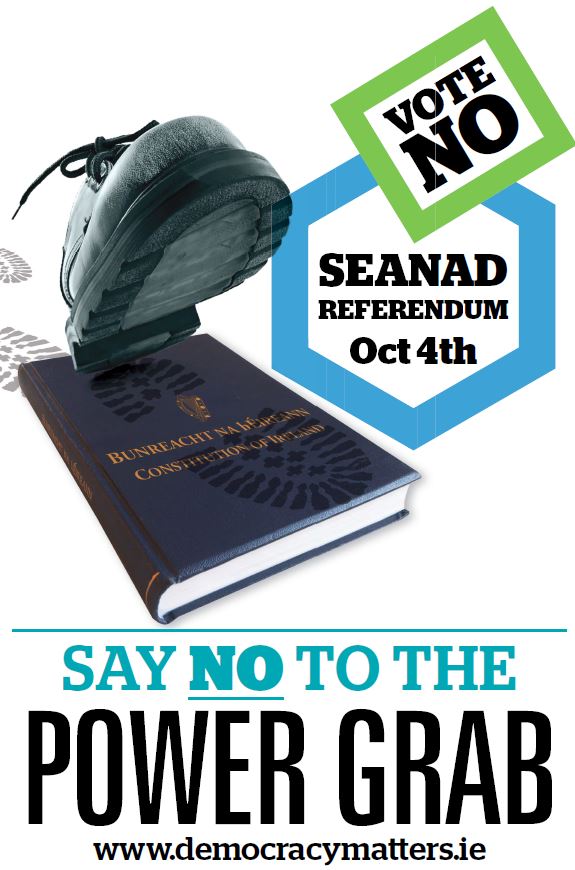
Powergrab

Why @simonharristd makes the case for a #seanref #No vote much stronger #Seanad

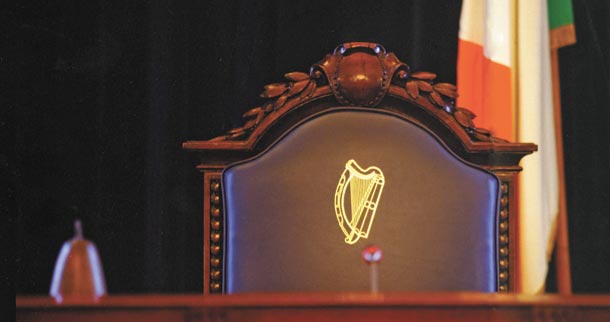
The Seanad Chair
The Seanad Chair

As a firm believer in Seanad reform – and consequently a trenchant opponent of Seanad abolition – the Sunday Independent’s Millward Brown poll showing the No to Abolition side gaining further momentum is gratifying.

The past few weeks have hardly been great for the No side. Fine Gael has been pretty active on the airwaves over the Summer break, while Sinn Féin’s opportunistic decision to campaign for a Yes, having vehemently opposed the Government’s proposal in both the Dáil and Seanad, hasn’t helped the No cause either.

All this makes the increase in the pro Seanad reform level of support all the more re-assuring. Not that the poll suggests that the campaign is done and dusted. Far from it.

More than almost any other, this Seanad abolition policy, is the lone brain child of Enda Kenny. Though there seem to be no research papers, discussion documents or policy positions he can produce to justify the origins of this initiative, he is the man behind it and he has more to lose by its defeat than anyone else.

While Labour nominally favours abolition, its TDs and Ministers can reasonably see their policy obligations as fulfilled by the holding of a referendum. Don’t expect to see many of them working too hard for a Yes to abolition vote. Indeed, as the Labour Chief Whip has indicated, at least half the Labour parliamentary party may actually work for a No vote seeing it as the best way to secure a popular mandate for Seanad reform.

One of the two authors of Labour’s 2009 position paper on Seanad reform, Junior Minister, Alex White has not commented on the issue much, while the other author, Joanna Tuffy TD has indicated that she will be campaigning for a No vote.

The worrying shift in the poll numbers make it necessary for Fine Gael to up the ante over the weeks ahead.
Given that the main shift has been in the group who describe themselves as favouring reform expect to see Fine Gael focus its attentions there and try to convince them that a Yes vote is a vote for reform.

We already had a glimpse of this approach last week via its neophyte Wicklow TD, Simon Harris’s speech at the Parnell Summer School.
Harris advanced the argument that abolishing the Seanad counts as reform and gives power back to the people as it means the single remaining chamber of the Oireachtas: the Dáil will be 100% elected by the public.

Harris’s reasoning seems to hinges on the statistic that the number of people registered to vote in Seanad elections, under current legislation, is around 156,000; about 5% of the approx 3.1 million entitled to vote at the February 2011 Dáil election.

What Harris misses, however, is that this 156,000 (Councillors, Oireachtas members and NUI and TCD graduates) is defined in legislation – not the Constitution. Everyone in the North and South could be given the right to vote with the passing of an Act by the Dáil and Seanad. Indeed the Seanad has already voted for such a piece of reform with the Second Stage vote on the Quinn/Zappone Seanad Reform Bill.
The extension of the Seanad franchise to all is now completely within the gift of Deputy Harris’s colleagues on the government benches.

The only real obstacle to such a real reform is the Taoiseach’s obduracy in insisting on Seanad abolition instead of reform.

Though not central to the argument it is worth noting that the 156,000 figure is probably an understatement as it just counts the NUI and Trinity graduates who have registered to vote. Many 100s of 1000s more are entitled to vote by virtue of their graduation.

The other problem with Harris’s reasoning is the idea that the answer to existing disenfranchisement is more disenfranchisement. It defies all democratic principles to propose removing someone’s voting rights when you have it in your power to extend them.

If you were to apply Deputy Harris’s quirky logic to the campaign for women’s suffrage a century back you would determine that the way to ensure equal voting rights for all was to remove the vote from men so that the two genders were equally disadvantaged.

The very legitimate criticism that not enough people are entitled to vote in Seanad elections is properly addressed by giving everyone the right, not by removing it.

I would hope that Deputy Harris’s espousal of a position that is the absolute antithesis of reform is informed by loyalty to his party leader and desire for advancement rather than by belief in the argument itself.

If it is the former then the case for reform is all the greater, if it is latter then it is time to worry.

Ends

Plan to give Dublin its own Boris Johnson is bonkers

Tonight's Herald Editorial Page
Tonight’s Herald Editorial Page

My column from today’s Herald on the current discussions to have directly elected mayors for Dublin in the future.

____________________ 

Should Dublin have its own version of Boris Johnson?

That is the question a Forum of 22 Dublin councillors will consider between now and September. But there is good news: Dubliners will get a say on it in May.

While the forum, drawn from the four Dublin Councils, started its deliberations at the end of July, the idea of Dublin having a directly elected Mayor goes back much further.

According to the Lord Mayor of Dublin website it goes back to Chapter 11 of Minister Phil Hogan’s June 2012 local government reform: Putting People First. It actually goes back to Noel Dempsey’s 2001 Local Government Act.

In case my Boris Johnson reference hasn’t given it away, I am not a fan of the idea. I wasn’t a fan of it in 2000, nor when John Gormley resurrected it in 2008.

Like most Dubliners, I want to see decisions made about Dublin being made by people who are answerable to Dubliners, but I am not persuaded that directly electing a mayor is the way.

My biggest worry is that an office supposedly created to give leadership to Dublin would descend into de-facto focus of attention for opposition to the government of the day.

A directly elected Mayor of Dublin would, after the President, have the biggest electoral mandate in the State, but without the constitutional prohibitions on politicking.

Boris Johnson’s mayoralty has become a focus for those unhappy with David Cameron’s leadership. Given the scale here: a mayor of the greater Dublin area would potentially be elected by up to a third of the total electorate, imagine how much more pronounced those clashes would be, particularly when the Taoiseach and Mayor were from opposing parties?

The potential for political gridlock is huge, especially where the Mayor has no real powers or responsibilities, just what Teddy Roosevelt called “a bully pulpit”. Instead of leadership we would just be getting a personality with a shiny office and access to a microphone.

The use of the London Mayor template only adds to this concern. Chapter 11 of Putting People First, which the Forum is using as its starting point, makes no fewer that six references to London.

It does not mention the directly elected mayors in Berlin, Budapest or Paris, or the strong systems of city governance in Helsinki, or Copenhagen.

This Ministerial and Departmental infatuation with London is hard to understand. I can only imagine that it is because they have never seen the legislation establishing the London Mayoralty and Authority: The Greater London Authority Act 1999.

At almost 500 pages it is the longest piece of legislation passed at Westminster since the Government of India Act. More importantly it does something almost unheard of in Irish public administration: it takes power away from central government.

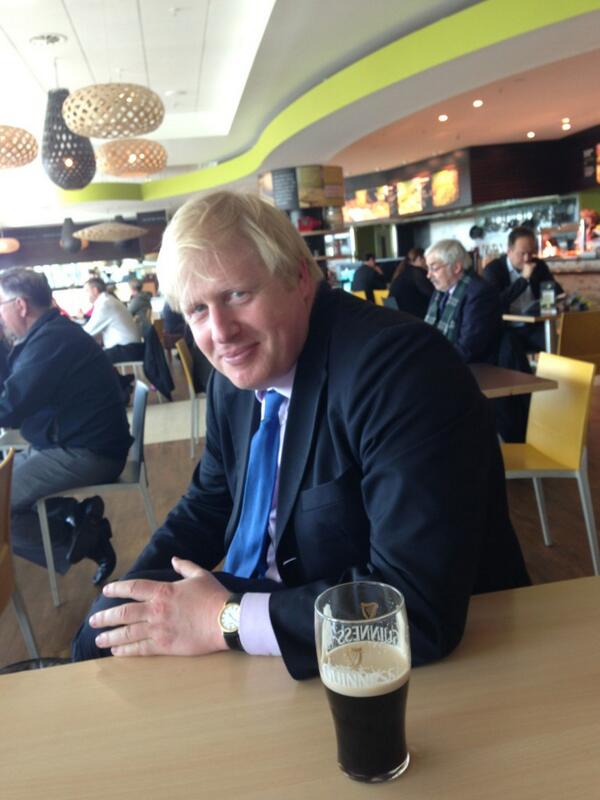
Boris Johnson pic from @mayoroflondon twitter a/c

Not that it took enough powers. Earlier this year Johnson was again calling for London to have the power to raise property and new tourism taxes. In May last year 8 out of the 10 UK cities asked if they wanted a directly elected Mayor said: no.

Do we really see the Phil Hogan’s Department of Environment ceding power and controls to anyone?

This is the Minister who, in the same Putting People First document, has slashed the number of local authorities from 114 to 31 and the total number of City, County and Town councillors from 1,627 to 949.

Do we really think he is ready to chop off a large section of his Budget and power to keep us happy?

With most decisions regarding Dublin’s present and future being made by unaccountable and disconnected State bodies and departments, the case for giving more power to Dublin is clear.

What is almost just as clear is that instead of being given viable city government with a budget and authority the most that will really be on offer is a city personality with a big desk, a press officer and an electric car.

ENDS