@campaignforleo poll nos – not so much a Leo bounce as just an Enda recoil

This is my Broadsheet.ie column from last week, published before today’s Sunday Times/B&A poll showing FG on 29% and FF on 30%. This joint level of support of 59% is a positive, particularly for FF and suggests it has scope to get its average showing back into the low 30s. 

The original article is online here: www.broadsheet.ie/a-bounce-or-a-recoil

______________________________________________
sbp.redc_-1024x502
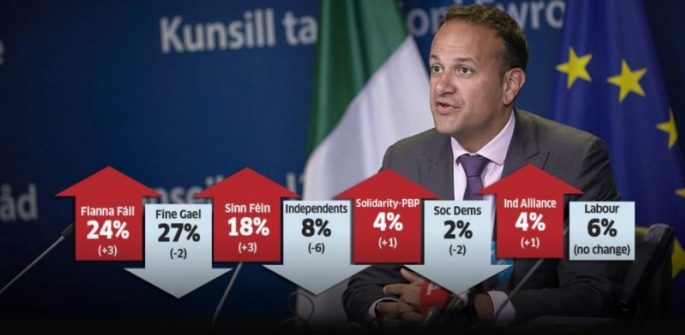
From the Sunday Business Post/RedC

Well, that didn’t seem to last too long.

Yesterday’s Sunday Business Post/RedC poll showed Fine Gael’s lead over Fianna Fáil closing by 5pts: from 8% in late May to down to just 3% now) This suggests an abrupt end to the Varadkar honeymoon.

I stress the word “suggest”. While the RedC poll puts Fine Gael on 27% and Fianna Fáil on 24%, another poll, taken exactly two weeks earlier by the Irish Daily Mail/Ireland Thinks put Fine Gael on 31% and Fianna Fáil on 26%. While it is possible that Leo’s less than adroit handling of events over the last two weeks may have shaved 4pts off his halo, it would be folly to try to conclude that from the results of two separate polls conducted by two different companies and taken at two different time periods.

What you can do, though, is track and compare the results from one individual polling company over a period of time. Fortunately, Red C does that for you via its handy online live-polling-tracker. Here you can find the results from the 10 polls conducted by Red C over the past year.

Continue reading “@campaignforleo poll nos – not so much a Leo bounce as just an Enda recoil”

Who would want to be a TD?

This column is from two weeks back (July 3rd, 2017) and is both a guarded defence of the political party system and a warning of the dangers of the constant desire of the hard left fringe parties to take politics out on to the street.  

It is said that France has the only “tricameral system” in the world – the National Assembly, the Senate and the Street – but history and experience shows that the Street has always been the biggest hindrance to reform. Origianl column online here: www.broadsheet.ie/who-would-want-to-be-a-td/

____________________________________

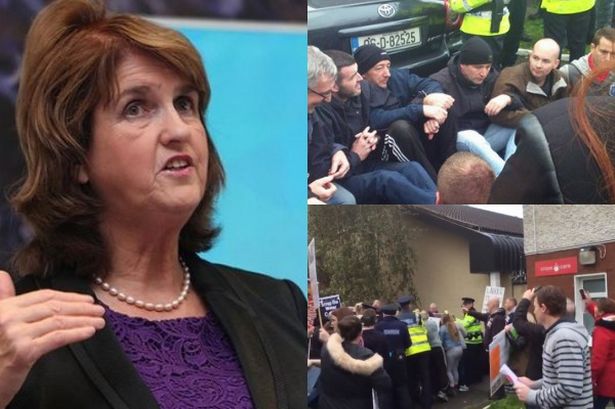
Joan-Burton-Collage
Collage pic from Irish Mirror


Who in their right mind would want to become a T.D.?

The pay is good, the perks are decent and the scope for promotion (career and ‘self’) is none too bad either, but can these incentives really outweigh the forfeiture of a private life, never mind the ongoing press, public and social media opprobrium whenever you express an opinion?

Shouldn’t politics be a vocation, not a career path?

The problem with that view is not just that it is naïve, it is that it simply won’t work. Try it and we end up with a Dáil full of only those who can only afford to be there by virtue of their profession, their families’ money or simple “pull” – by the way not all of them would be on the right, a fair few would also come from the comfortable left, but that’s just an aside.

Continue reading “Who would want to be a TD?”

The honeymoon for Leo was over… even before it started? @campaignforleo @FineGael

This column is from last month, June 19th 2017. In it, I looked at Taoiseach Varadkar’s first few faltering days in office and conclude that things have not been going according to his masterplan.

Even the more ardent blueshirt cannot call a cabinet that contains FG ministers who entered the Oireachtas in 1981 (Bruton), 1987 (Flanagan) and 1989 (Creed), 1992 (Fitzgerald) and 1994 (Ring) new or fresh.

Meanwhile, the Marie Whelan saga, which was not of Varadkar’s making, but his ownership of a move that looked suspiciously like a vintage political stroke, is now 100%

Original article here: www.broadsheet.ie/the-honeymoon-is-over/

____________________________________________________

Silage

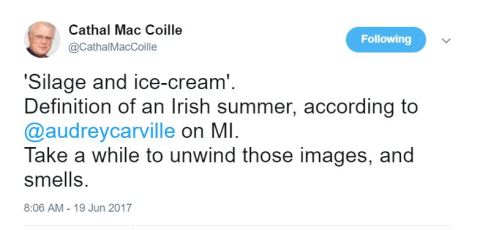
“Silage and Ice-cream”.   This is how Audrey Carville defined the classic Irish Summer on RTÉ Radio One’s Morning Ireland earlier today.

And though silage was not exactly plentiful in the Liberties, Rathmines or even Yellowbatter in Drogheda during my childhood years, I think I know what she means.

Indeed, up to this morning I hadn’t realised that silage is spelled with just one “l”. Though I cannot recall using the word in many speeches, reports or articles I am virtually certain that I used two “l”s anytime I have written it.

I know for sure that I used two “l”s when I went searching for the phrase just before writing this piece, only to discover that the two “l”-ed version of silage, i.e. sillage (pronounced as if there were no “l”s at all in the word) is the word used to describe the lingering fragrance that someone’s perfume leaves in the air.

Silage and ice-cream may also be an apt phrase to describe Leo Varadkar’s first few days as Taoiseach.

The ice-cream has come in the form of the positive coverage his elevation to high office has generated, both at home and abroad, though that may be starting to melt a bit after two solid weeks of learning what a wonderfully precocious child he was and how he wrote his first letter to the Irish Times aged three, or whatever.

His first TV interview with Tommy Gorman was good. He was clear, concise and on top of his brief. The fact that he opted to do his first one-to-one TV encounter as Taoiseach with RTÉ’s northern editor was clearly intended to signal that the North would be a priority with this Taoiseach in a way that it had not been for his predecessor.

It was also interesting that he opted to set out his government’s policy approach to the North and re-unification himself having just appointed his rival, Simon Coveney, as the line minister dealing with the brief, a signal perhaps of things to come.

But, and not for the first time, a gap emerged between what he says and what he does. His decision to just meet with the leaders of two of the North’s five major political parties was not a good first move. In using his first actions on the North to meet with just Arlene Foster of the DUP and Sinn Féin’s Michelle O’Neill, and not to meet with the leaders of the other three centre ground parties: the SDLP, UUP and Alliance, the new Taoiseach was perpetuating the mistake made by recent Irish governments.

Yes, a deal on the return of Stormont and the Executive is not possible without the two big beasts of the DUP and Sinn Féin agreeing to again work together, but the smaller parties should not be taken for granted. Even the British government realised that when it invited all the parties to Downing Street last Thursday, not just the big two.

Taoiseach Varadkar made a silly unforced error in appearing to relegate the smaller parties to the second division of negotiation. Their participation in the institutions is as important and crucial as that of the DUP and SF. If anything, the events of the second half of last year suggest that it is even more important, as the two main parties seem unable to reach accommodations in office without the smaller parties there to give them cover.

Varadkar should know this. He sits at a Cabinet which could not continue in office if it were not for the involvement of smaller parties and Independents though, as we see from today’s latest development in the Marie Whelan appointment saga, he may know it, but he doesn’t show it.

Perhaps this is the point. Perhaps his near disdainful attitude to the smaller parties in the North just echoes his disdainful attitude to its own partners in government?

The incredible, some would say grubby, rush to get Marie Whelan quickly sworn in as a judge of the appeal court this morning so that the sorry saga is all over and down before tomorrow’s Cabinet meeting is a brazen throw down to Ministers Ross and Naughten and – by extension to Fianna Fáil.

Is this just Varadkar bravado, showing early on that he is now the boss and what he says goes? Or, is the nomination a difficult, but essential, element of the succession’s realpolitik that he must see through to the end, no matter how the stench adheres to him? I suspect this is more the latter.

Those who say that Leo has wiped Fianna Fáil’s eye by pushing this through seem to miss the point that this appointment, coupled with the fiasco of the cabinet reshuffle that wasn’t, has just shortened what could have been an extensive Varadkar honeymoon.

As every job interviewee had been told: you only get one chance to make a first impression and Leo has wasted his. Meanwhile, Fianna Fáil will wait for its moment to exact some political revenge and that will be a moment of its choosing, not Leo’s. If Fianna Fáil is to bring down this government let be on an issue of policy that affects people’s lives, not “beltway” process.

The Marie Whelan saga was not of Varadkar’s making, but his ownership of a move that looks suspiciously like a vintage political stroke, is now 100%. The appointment was brought to Cabinet as the last act of the outgoing Taoiseach and outgoing Justice Minister, but by defending it so fiercely the new Taoiseach has made it his own… alone… and, unless I am missing something, I have not seen the new, sorry… the incoming… Minister for Justice, Charlie Flanagan, (it hardly seems right calling someone who has been in the Dáil since 1987 “new”) rushing to the barricades to help.

If Varadkar has been preparing all his political life for this moment, then it is hard to believe that this is what he had planned. You cannot call a cabinet that contains FG ministers who entered the Oireachtas in 1981 (Bruton), 1987 (Flanagan) and 1989 (Creed), 1992 (Fitzgerald) and 1994 (Ring) new or fresh.

We shall see tomorrow how he handles the even trickier issue of appointing Junior Ministers. Will he be bold and courageous in these hardly earth-shattering selections, or will he just do what he did with the cabinet?

Are these first faltering steps a case of the promises made to secure election restricting the ability to operate, or is the problem more fundamental? Can Varadkar be the thrusting and dynamic Taoiseach his Fine Gael parliamentary colleagues longed for, or will he just become the commentator-in-chief?

Is that the sillage of silage or of raspberry ripple ice-cream. Excuse me, I must be off to Teddys in Sandycove!

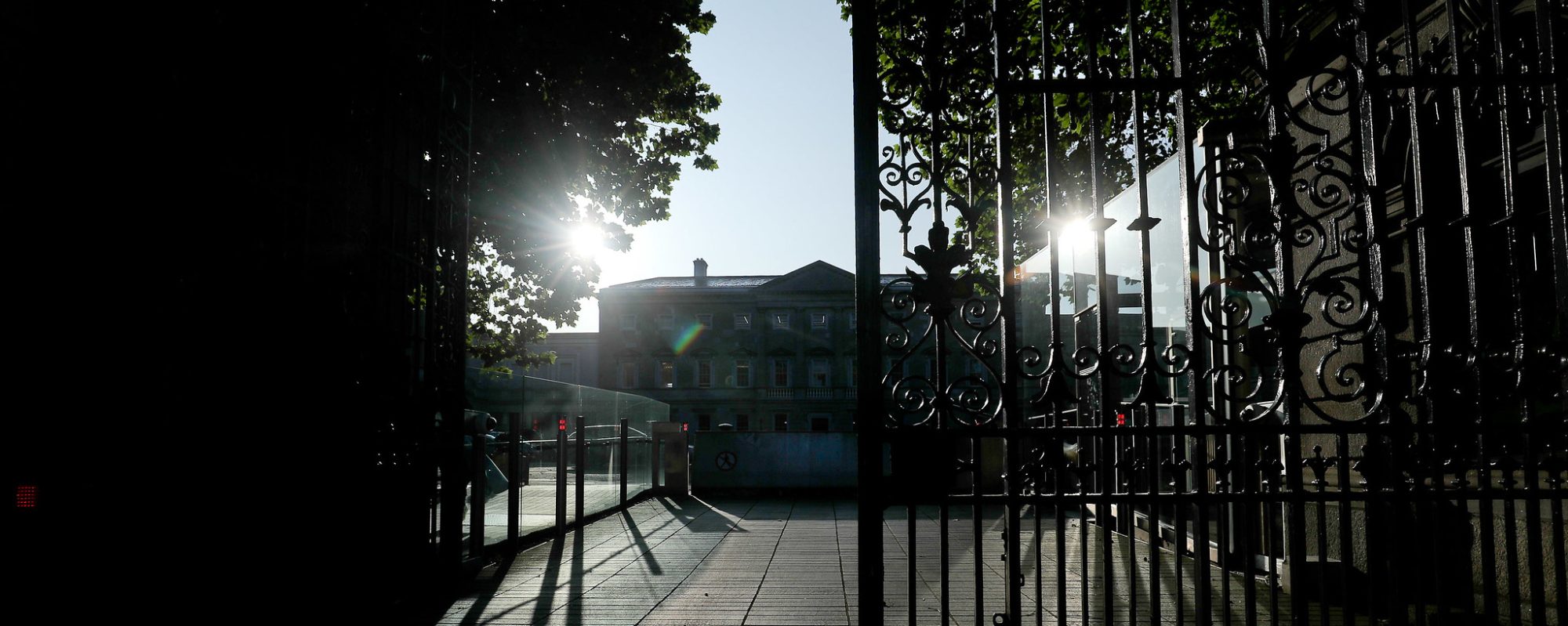
 

The perks of abstinence…?

This Broadsheet column first appeared online on June 12th 2017. In it, I explore the ramifications of the 2017 Westminster election result on politics in Northern Ireland, and suggest – borrowing heavily from an Irish Times article by Denis Bradley – that politics on the nationalist/republican side may be set for a major change over the coming year… www.broadsheet.ie/the-perks-of-abstinence/

_____________________________________________

BBC NI

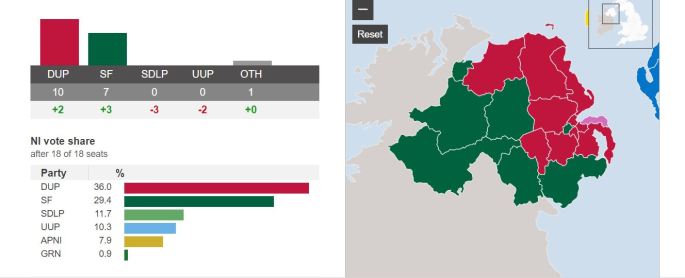
The results page from the BBC NI website – www.bbc.com/results/northern_ireland

While the outcome of the Westminster election was far from conclusive in England and Wales, the same cannot be said for Scotland and Northern Ireland.

Only for the resurgence of the Scottish Tories under Ruth Davidson, Theresa May would be moving furniture rather than clinging to office by her fingertips. While the same Scottish result has, sadly, delayed the prospect of an Indy2 referendum, as the SNP Westminster representation collapsed from 56 seats to just 35 thanks to a 13% drop in support.

Continue reading “The perks of abstinence…?”

#Macron – Le Pen and Now

This column appeared on Broadsheet.ie on April 24th, 2017 – just after the first round of voting in the French Presidential election when Macron and Le Pen emerged as the two front runners in Round Two: www.broadsheet.ie/le-pen-and-now

________________________

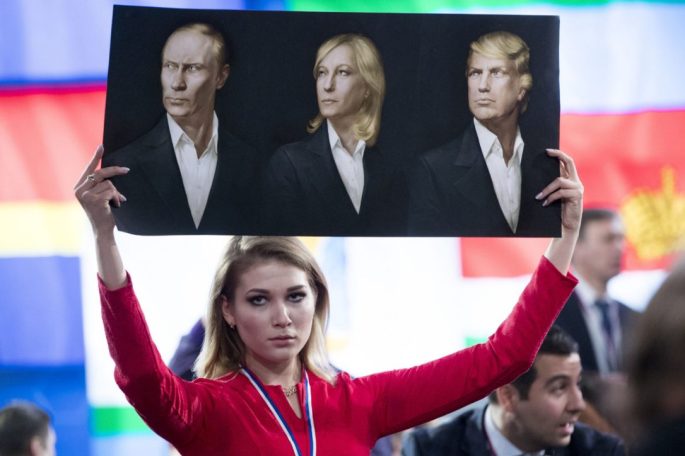
protester.jpg.size.custom.crop.1086x724
The new would-be divine trinity: Putin, Le Pen, Trump?

You could almost hear the collective sigh of relief last night as the first exit poll results from the French presidential election emerged showing Emmanuel Macron as the front runner. Macron, the former Economy Minister under Socialist President Francois Hollande and now independent centrist candidate now faces off against the second placed right-winger, Marine Le Pen in round two of the election in two weeks’ time.

It wasn’t just EU officials and other EU heads of government who were relieved, but also the heads of the polling companies whose predictions turned out to be extraordinary accurate, in many cases within just 1% of the result.

That sense of relief continued into this morning with European stock markets rallying and the Euro rising to a five-month peak with the news that France is likely to have a more centrist pro-EU President Emmanuel Macron.

Only a month ago the polls suggested that Le Pen might emerge as the lead candidate in the first round followed by Macron, with some showing Le Pen as high as 27% and Macron around 25%.  However; the collapse in recent weeks of the socialist party candidate Hamon saw the far left’s Melechon rally and join the leading pack, consisting of Le Pen, Macron and the conservative candidate Fillon, all within 3-4% of each other.

Continue reading “#Macron – Le Pen and Now”

Enda Kenny: we’ll miss him (eventually)

This column originally appeared on Broadsheet.ie on May 8th 2017 and suggests that Fine Gael will come to regret dumping Enda Kenny as Taoiseach and leader as speedily as they have…  www.broadsheet.ie/well-miss-him-eventually/

enda

“But as I leave you I want you to know – just think how much you’re going to be missing. You won’t have Nixon to kick around anymore”

With these words, Richard Nixon departed the political scene, well almost. It was November 7th, 1962. He was concluding what he assumed would be his last ever political press conference after losing the race to become Governor of California. Two years earlier he had narrowly lost the Presidency to John F Kennedy.

While Enda Kenny’s departure, when it comes – possibly over the next week or two – will not be as bitter and waspish as Tricky Dicky’s, there may just be the slightest hint of the same sentiment: just think what we will potentially be missing.

Love him or loathe him, during his time as Taoiseach Enda has been anything but colourless or bland. For all his faults and failings, he showed quickly that he realised that one of the main roles of any Taoiseach is re-assuring the public that there is someone with a plan in charge.

He also grasped that this role as the nation’s re-assurer-in-chief requires you to get out and about and meet people as much as possible. In some ways, Enda has spent the past six years doing a passable Bertie Ahern impression.

Continue reading “Enda Kenny: we’ll miss him (eventually)”

I have my doubts about Enda Kenny’s emigrants’ votes plans

Enda Kenny’s fascination with his predecessor John A. Costello continues. Not only is Enda determined to beat Costello’s record for time served as Taoiseach, he now seems to want to eclipse Costello’s penchant from making major constitutional announcements outside the country.

Costello announced his intention for Ireland to abandon the External Relations Act (and effectively quit the British Commonwealth and declare itself Republic) during a visit to Canada in 1948, while Kenny announces in Philadelphia that he intends to hold a referendum to give the Irish diaspora votes in future Irish presidential elections – but only in elections after the next one.

There are many legends about Costello’s Ottawa announcement, including one version that claims he made it when was “tired and emotional” and another that asserts he did it after being offended by the placing of a replica of the Roaring Meg canon used in the Siege of Derry in front of him on the dining table at a formal dinner at the Governor General’s residence. But they are only legends.

Continue reading “I have my doubts about Enda Kenny’s emigrants’ votes plans”

A brief history of the Fine Gael Heave #FGheave

cosgrave
Cosgrave at a Fine Gael Árd Fheis

No one does heaves like Fine Gael does heaves. None of your subtle behind the scenes manoeuvrings for them. When it comes to getting political blood on the plush axminster the good folks at Fine Gael are major exhibitionists.

They have had plenty of heaves over the past forty years or so: most of them ill-judged, poorly timed and glaringly unsuccessful. The December 1972 heave against Liam Cosgrave is a good example of all three.

Fine Gael’s liberal wing wanted rid of the conservative, law and order Cosgrave. They complained that the party had failed under his leadership to capitalise on Fianna Fáil’s post Arms Crisis trials and tribulations, but the final straw was Cosgrave’s efforts to get FG TDs to back the government’s controversial Offences Against the State Bill – something they implacably opposed.

Cosgrave was effectively saved from the plotters by a loyalist bomb on Sackville Place that tragically killed two CIE busmen. The explosion took place just hours before the Dáil vote on the Bill. The Dáil adjourned to allow discussion between the parties. When it resumed, Fine Gael withdrew its opposition and abstained as Bill was voted through in an all-night sitting. Three months later Cosgrave became Taoiseach leading Fine Gael into government with the Labour Party.

Fast forward to 1980s and 1990s and we enter the golden age of the Fine Gael heave. The drama and intrigue within the Fine Gael parliamentary party was so intense that RTÉ ran a TV documentary series in 2003 about the period entitled: Fine Gael: A Family at War.

For about two decades the folks in blue were regularly sharpening their knives as they awaited the opportunity to dispatch their leaders. While Dr Garret Fitzgerald managed to escape their clutches his successor, Alan Dukes, had a less happy fate.

Dukes took over from Fitzgerald after the 1987 defeat. While he started out well, Duke’s Tallaght Strategy – a less formalised precursor of the current Confidence and Supply Agreement, which facilitated Haughey’s minority government – was not too popular with FG TDs.

One TD, Austin Deasy, was so incensed that he at first resigned in protest from the party only to return in 1989 and try, unsuccessfully, to oust Dukes. Deasy was a serial heaver, launching his first one first against Garret in 1982 and finishing up with his failed November 2000 one against John Bruton.

Dukes survived, but not for long. In a snap election in June 1989, Fine Gael regained only 5 of the 19 seats they lost two years earlier. The whispering campaign against Dukes was back with a vengeance with one back bencher remarking that if it was raining soup Dukes would be out there with a fork. Things came to a head in late 1990 when the party’s candidate in the presidential election came a very poor third behind Mary Robinson and Brian Lenihan Snr.

The result had hardly been declared when Fergus O’Brien, who had been demoted by Dukes, tabled a motion of no confidence. This was followed by a flurry of Fine Gael TDs rushing to the nearest journalist to unburden themselves. Dukes could not withstand the onslaught. Within days he resigned and was succeeded by John Bruton.

Now the Fine Gael heavers shifted into top gear. It seemed as if there was a heave brewing every few months. Bruton survived five leadership contests during his eleven years at the top. The sixth one, in January 2001, led by two political heavy weights Jim Mitchell and Michael Noonan succeeded in toppling him. Noonan took the top job, beating Enda Kenny, but his reign was short lived. FG’s defeat in the May 2002 election was so calamitous that Noonan resigned on the night of the count. He was succeeded by Enda Kenny.

As you can see from these examples and the June 2010 heave against Enda outlined in my Enda’s 3am question is still unanswered Broadsheet column: most of them fail. The ones that do succeed have the oblique backing of the person who hopes to succeed and are usually attempted when the party is in opposition – not in government.

This later point is perhaps not so relevant today. Fine Gael spent most of the 80s and 90s in opposition and were not in office long enough to have the time to consider it. It was these long periods of opposition – and powerlessness – that led to the heaves. The breaking point, in most cases, being a bad election result or a series of poor opinion poll results.

This heave is different or at least it appears different. Unlike heaves of the past it has been occasioned by an actual political event, namely the chronic mishandling of the Sgt McCabe debacle and the confusion about who told who said what and when and if they told the Taoiseach or just one of his Advisers.

But it would be foolish to think that electoral considerations are not also a major factor.
While Enda Kenny has made it clear that he does not intend to lead his party into the next election, the abiding fear among Fine Gael TDs was that events would overtake them and that Fianna Fáil would pull down the house of cards before Enda quits and they find themselves facing an election with Enda still in place.

Up to a few weeks ago, they assumed that Fianna Fáil was neither ready nor willing to trigger an election until 2018 – but a series of good polls for Micheál Martin’s soldiers of destiny has convinced already rattled Fine Gael TDs that Fianna Fáil was preparing itself to call time on the government.

The problem with this scenario is that it shows Fine Gaelers thinking like Fine Gaelers, not like Fianna Fáilers. Fianna Fáil knows well that voters tend not to reward parties who trigger unnecessary elections for partisan gain. Martin’s FF eschews the “cute hoor” tag that once bedevilled the party. When it eventually moves against the government it will be seen clearly do so on an issue of policy, not personality or partisan gain.

On a more practical front, 20 of Fianna Fáil’s 45 TDs are first timers. They are just starting to settle in after two or three years of intense campaigning to win those seats. They are not ready or prepared for an election yet. Most are now watching the turmoil in the FG ranks and trying to work out whether the election of Simon or Leo – or neither – means the election will be in May, June, September or later.

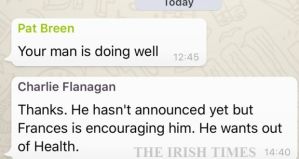
Meanwhile the rest should reach for the popcorn, scan our WhatApp to see if Charlie Flanagan is messaging us and just enjoy it all.
flanagan

I hate to admit it, but @JuliaHB1 and other #brexiteers may have a point, just not the one they think

Here is my Broadsheet article from Sept 28th regarding the calls for a second #Brexit referendum vote. I would love to be able to support the call, but I cannot. Experience of re-runs of Irish EU referendums tells me that this is not an option in the UK given the high voter turnout.

————– 

questiontimeI have to confess that my heart sinks a little whenever I hear English Tories or English nationalists, like Nigel Farage, mention Ireland during their rants about the EU. The reference is usually patronising or condescending or – even worse – is given in the form of advice that would have us join them in their march back to a glorious era that never existed.
This is why my heart sank when Julia Hartley Brewer, a British Talk Radio host, Leave campaigner and former political editor, stated on last Thursday’s BBC Question Time that the EU had forced Ireland, and other countries, to vote again on EU referendums.

Her comments came during the course of a discussion on whether Britain might have another referendum on Brexit – a proposal put forward by the failed Corbyn challenger, Owen Smith MP or that the UK might have a separate vote on the final deal hammered out on the conclusion of the Art 50 negotiations, an idea put forward by Tim Farron’s Liberal Democrats.

Though hearing Hartley-Brewer getting it badly wrong on the notion of the EU ‘forcing’ us to vote again made my heart sink a little, it sank even further when I realised that she and her fellow panellist that night Jacob Rees-Mogg MP (who looks like he is being portrayed by Joyce Grenfell) may actually have a point, just not the one they think.

Though I and other Remainers may wish it to be otherwise, the hard fact is that Ireland’s voting again on the Nice and Lisbon treaties is not relevant to the UK’s situation for one simple reason: turnout.

In the first referendum on the Nice Treaty (Nice I) in 2001 the turnout was just under 35% – the result then was 54% No: 46% Yes. At second referendum on the Nice Treaty (Nice II) in Oct 2002 the turnout shot up to just under 50% with Yes getting 63% and No dropping to 37%.

It was a broadly similar situation in the case of the two Lisbon Treaty referendums. In Lisbon I in June 2008 the turnout was 53%. No won by 53%:47%. At Lisbon II the turnout had again increased, this time to 59% with Yes now winning by 63%:37%

In both cases the turnout in the first referendum was low to start with, in the case of Nice I it was exceptionally low, just in the mid-30s, so there was a convincing argument to be made for a second vote, particularly when you felt that a second referendum would have a higher turnout.

This was not the case in the UK’s Brexit referendum. The turnout there was a whopping 72%. This is a substantial turnout. It is much higher that recent UK General Election turnouts, indeed you have to go back to Tony Blair’s 1997 election victory to find a UK general election turnout of over 70%.

The huge political risk you take by having a re-run second Brexit referendum in these circumstances is that you get a lower turnout. It is politically saleable to try to reverse one mandate with a smaller one?

To be clear, turnout alone was not the reason why there were re-runs of the Nice and Lisbon referendums. In both cases post referendum polling and analysis found that the main reason for voting “No” or abstaining was a lack of knowledge of either treaty. Both “Yes” and “No” voters were highly critical of what they viewed as a dearth of clear, accessible information on the treaty’s merits.

While the Remainers can clearly point to a lot of misinformation from the Leave side, not least the claims that leaving would mean £350 million extra per week for the NHS, they cannot yet point to any substantive research or analysis suggesting any changes in opinion.

Noted UK pollster, Prof John Curtice, reckons that there is little evidence of a “significant rethink” three months on from the result with those who voted Remain still convinced that they were right and likewise for the Leavers. Very few minds have been changed, though let us see if that remains the case as the details of the Brexit deal on offer emerge during the course of the next year or so.

The problem with all this abstract discussion on a second referendum is that it takes the focus away from the very real and tangible issues with the first result: most crucially that the Hartley Brewer, Farage and others do not want to honour the clear Remain majorities in Northern Ireland and Scotland. Instead they want to use the votes of English and Welsh people to forcibly drag Northern Ireland and Scotland out of the EU against their declared will.

This is no small issue, yet it is receiving scant attention in the UK and, sadly, here.

Voters in both Northern Ireland and Scotland voted convincingly to stay in the EU, by much bigger margins that the people across the UK voted to leave. Many of those voters in Northern Ireland hold Irish passports and are thus also EU citizens, even if the UK leaves. Can that citizenship – and the guarantees and privileges it offers – simply be snatched away from them on the say so of 50%+ of voters in the south of England?

As people like Michéal Martin and Colum Eastwood have repeatedly said over the past few weeks and months; trying to drag the North out of the EU against its will ignores the layered complexities of the Irish political process.

It is a refutation of the basic principles of the accommodation achieved in the Good Friday Agreement and that is something that concerns all of us on this island.

We should be debating and discussing this now. We should be looking at the significant consequences of Brexit for our economy, for our trade – both North/South and East/West, our education system, out health service.

We should not allow the foot dragging by the British Government on outlining its terms of exit to stop us from forcefully setting out our concerns and our alternatives. We need the speedy establishment of the all-island political/civic forum I called for here at the end of June. I know the Taoiseach and his team messed up their first attempt to get the idea up and running, but they need to go again and get it right this time.

Some understanding, but no grá for the GRA #Gardastrike.

This is my Broadsheet article from Monday, October 3rd, 2016

gardai-in-uniform-1878112If the Luas and Dublin Bus pay disputes are anything to go by then the choreography of future pay rows, particularly public sector ones, is likely to run as follows:

Step 1. Both sides negotiate for months without success.
Step 2. Employees go on a limited strike, inconveniencing the public
Step 3. The strike action continues for 3 – 4 weeks while both sides posture on TV and radio news shows
Step 4. Both sides then ‘suddenly’ return, without preconditions, to the negotiating table
Step 5. Employers find extra cash for pay increases they previously said was not there

Would it not be better for everyone, most particularly the public who these public services are meant to… well… serve…, if the unions and management could just skip steps 2 and 3 and jump straight to step 4?

Continue reading “Some understanding, but no grá for the GRA #Gardastrike.”