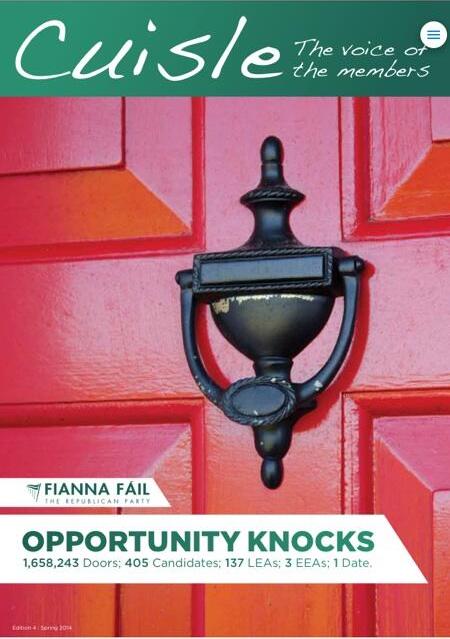
This is an article I have written for the March 2014 Árd Fheis issue of Fianna Fáil’s members’ magazine Cuisle.
————————————————————————————————–
A few months before the 2011 election, Michael Gallagher (the TCD Professor of Politics, not the Donegal postman and amateur weather forecaster) posted a blog where he asking how long Fianna Fáil could expect to spend in opposition. In it he wrote:
“Fianna Fáil is not a party accustomed to spending time there. Its longest spell on the opposition benches is still the nearly six years between its foundation in May 1926 and its entry into government in March 1932. Since then, the party has never spent more than one consecutive Dáil term in opposition and the longest spell it has been out of power remains the 4 years and 4 months of the Cosgrave coalition in the mid-1970s.”
Underpinning Gallagher’s 2010 comments is the idea that Fianna Fáil has never been that good at opposition. It is a fair point.
Not only have we not spent much time in opposition, as Gallagher points out, it is almost 30 years since we last spent a full Dáil term there.
Today’s RedC poll for Paddy Power brings very little good news unless you are an independent or a don’t know. The unadjusted core figures rank the parties in descending order as:
Fine Gael 23%
Fianna Fáil 18%
Don’t Knows 18%
Independents 17%
Sinn Féin 13%
Labour 9%
After adjusting the figures by excluding 50% of the don’t know and adjusting the other 50% back to how they voted in 2011 the ranking positions stay the same. Only the relative gaps between Fine Gael and Fianna Fáil and between Fianna Fáil and the Independents widen.
Fine Gael 29%
Fianna Fáil 22%
Independents 21%
Sinn Féin 15%
Labour 11%
Sinn Fein’s lead over Labour remains at a steady 4%. While this may, at first glance, suggest some good news for Sinn Féin, the party has been in this territory before only for its good polling numbers to fail to translate into votes.
Back in December 2010, on the eve of a general election, three polls showed the party in the mid teens. A Red C Poll for The Sun on 03/12/2010 gave the party 16%. The MRBI/Irish Times poll on Dec 16th put it on 15% while a third, the Red C/Sunday Business Post poll of December 18th put its support at 14%. On polling day, two months later, the voters gave it 9.9%.
This is not to discount its advance since. Sinn Féin has been consistently polling in the mid teens since September 2011. That said, though an Irish Times poll in early October 2011 put party support at a hefty 18% its Presidential candidate and possibly most charismatic figure, Martin McGuinness still could not get the party’s actual vote past the 13.7% mark in the ballot boxes a few weeks later.
Despite its considerable and well resourcing organisation it seems to still have a problem translating favourable poll numbers into actual votes.
Though of cold comfort to Fianna Fáil it does not, at least, have this particular problem. The MRBI/Irish Times and Red C/Sunday Business Post polls conducted on the eve of the 2009 Local elections put Fianna Fáil’s support at 20% and 21% respectively. On polling day, the party managed to scrape its way up to 25.4%.
Fianna Fáil problems are more significant. While it has won back some of its lost “soft” support and pulled itself up from the 2011 hammering it has yet to say or do anything substantive to win back many of those who had voted for it in 2002 and 2007 but rejected it in 2011. There is nothing to suggest it is doing any better with potential first time voters either.
Despite the speculation of last weekend, Fianna Fáil’s problem is not its leader. The notion that Fianna Fáil picking a new leader whose only virtue is that they were not a member of the previous government is almost laughable. Surely no one in the party or the commentariat is delusional enough to think that the electorate is so naïve that it will flock to Fianna Fáil’s cause just because it has a leadership team devoid of anyone who served under Ahern or Cowen?
Despite its apology and acknowledgement of past mistakes, Fianna Fáil has yet to present a researched and substantive alternative policy programme. It has come up with some good micro-policies, not least its family home protection and debt resolution Bills, but many have been light on substance and appear to have been produced as well intentioned responses to specific representative groups, e.g. the Mobile Phone Radiation Warning Bill
Try finding the party’s April 2013 Policy Guide on its website. It is there, but you have to know what you are looking for to find it. Click on the “issues” button on the homepage and you get the Spring 2012 version, to locate the latest version you need to do a search for it by name.
The April 19th 2013 document shows the party has been doing some serious work on policy, but you would be hard pushed to know it from the statements coming from its spokespeople. These still read as knee jerk responses to government statements rather than as co-ordinated parts of a coherent alternative. Fine Gael may have gotten away with tactic this during its time in opposition, but Fianna Fáil does not have the luxury they had: a Government unwilling and unable to communicate with its own supporters.
Perhaps the criticisms of a small and possibly over stretched clique around the leadership have some basis in reality, but as someone who has spent a long time around the party, on both the inside and outside tracks, I think the problem lies elsewhere.
Michéal Martin has shown a remarkable capacity for getting out and about and engaging with members and voters alike, it is curious, therefore, to read of him being less engaged and accessible to members of his own very diminished parliamentary party.
Might I suggest that the fault lies on both sides. Yes, he should be having regular one to one meetings with his 33 parliamentary colleagues – God knows there are not that many of them to make such regular meetings impractical – but they too should be engaging with him.
The traditional deference to the leader needs to change. Gone are the days when you had to wait ages to have an audience with the great leader as he busied himself with the great affairs of state in the Taoiseach’s office. Parliamentary party members have the opportunity for unique access, let them use it. A minority can only exercise sole access when allowed by the majority indifference or reticence.
Despite the job losses and the massive reduction in resources, there still appears to be a sense that the party structures are operating and running as if the party is still as big as it once was. Worse still many of those working those structures have no sense memory of how the party should operate in opposition.
A small number of paid officials are being expected to do the party’s policy research and formulation with minimal input from a vast array of experts across the volunteer membership. Too much power and control is being retained around the centre and around Leinster House: not by the leadership and his supposed clique, but also by members of the parliamentary party who are criticising him for just that.
I am old enough to remember what was put in place between 1982 and 1987, the last time the party was truly in opposition. Back then a series of policy committees were established by the leadership and mandated, working with the various spokespeople, to produce credible and researched policies for submission to the party for adoption.
These committees worked with the TDs and Senators but were not run by them. Outside experts were brought in to assist and work with them.
To borrow a phrase from Fianna Fáil’s past – the phase of its recovery will be dependent on policies and substance – not personality. The party already has the potential to bring itself back into the upper 20s in terms of actual voter support – the question now for the leadership and the party as a whole is if it has the energy, expertise and inclination to innovate the policy approaches that could bring support up into the 30% plus range.
Surely I cannot be alone in realising that there is less chance of Fianna Fáil and Fine Gael linking up than there is of Luis Suarez having all his teeth pulled and turning vegetarian.
Yet, within hours of each new opinion poll you will see lots of speculation in print, on air, online and/or on all three that the next government will consist of Fianna Fáil and Fine Gael in some combination or other.
Such speculation seems to be based just on adding together the numbers that bring you to 50% and ignores the glaring Catch 22 that renders the chances of any such FG/FF or FF/FG alliance impossible: neither party would ever agree to go into a partnership government where it was not the biggest partner.
And as, by definition, a partnership government of just two groups cannot have two biggest partners, neither party would agree to be the junior partner in such a relationship. To do so would fly in the face of the fundamental rule of Irish governmental politics: junior coalition partners come off worst.
The strategists in both Fine Gael and Fianna Fáil know this. Whatever their weaknesses and deficiencies in policy formulation, these are still wily and experienced political operatives, they understand political realities. More critically they understand the laws of self preservation. They know that going into government as the junior partner while leaving Labour and Sinn Féin as the official opposition would be tantamount to writing their own party’s obituary.
Those who argue, on the basis of current opinion polls, that the Fine Gael / Fianna Fáil option may be the only viable one after the next election, do it on the basis that politics is a “numbers game”.
Well, to some degree it is, but numbers do not dictate everything. True, without the numbers you have no role and no say, but the converse is not true. Having the numbers does not mean that you must necessarily do A or B. Having the numbers does not restrict your options, quiet the opposite. Rather than being compelled to pursue some particular course, you have the opportunity to exercise judgement and think strategically.
This is not to discount the temptation and lure of ministerial office, especially to those who may not plan to face the electorate again. Saying no to power is no easy task, but the decision is made somewhat less troublesome if you know that saying yes to office today as a junior partner means that you are almost certainly ensuring that that option will be denied to you and your colleagues for many years thereafter.
Though majorly damaged after electoral pounding it took in the February 2011 General Election, Fianna Fáil is still hard wired for power – perhaps even more so that Fine Gael – so saying no to office would be difficult for some within the upper echelons of the organisation. Perhaps this is why the party leadership has recruited the membership of the party to ensure that any post election decision would be made by the broader party.
The situation is just as true for Fine Gael, though for other reasons. Having spent so long as the second party of Irish politics, it is now relishing its time in the top spot. It will be loathe to surrender that place – least of all to Fianna Fáil.
If the next election were to put Fianna Fáil ahead of Fine Gael, no matter by how small a margin, Fine Gael would do nothing to help Fianna Fáil back into power. Fine Gael would seek alliances with Labour, Sinn Féin, Independents, Socialists, Wallacites; McGrath-ites (of the Mattie or Fintan variety) Greens, People Before Profit, Profit Before People, Cart Before the Horse or whoever to keep Fianna Fáil out.
I know I risk appearing more than a little cynical in not mentioning policies and principles and just discussing the possible make up of a future government in terms of survival strategies but, I believe the chances of a Fine Gael/Fianna Fáil government are so remote and unrealistic that it is cynical not to dismiss it and to allow any more time and energy be wasted on discussing an option (and the associated policies) that does not exist.
The late Séamus Brennan: “You are playing senior hurling now lads…”
“You are playing senior hurling now lads – but you are playing with lads with All Ireland medals”.
This, according to Eamon Ryan, is how the late Séamus Brennan greeted the Green Party team as it arrived in Government buildings for the 2007 talks on forming a government with Fianna Fáil.
It is a phrase that every Labour Party TD calling for a renegotiation of the Programme for Government (PfG) should print out and place at the top of their PC screen.
God be with the days when Labour recruited its Dáil candidates from the old ITGWU or FWUI. Those guys knew the first principles of negotiating; they particularly knew that you did not go into negotiations unless you had 1. A strong hand and 2. A fair idea of the outcome. Yet some in Labour are advocating that they enter talks with neither.
They want to enter a renegotiation of the government’s fundamental policy programme at precisely the moment when their party has hardly ever been weaker. Do they seriously expect that their senior partners in Fine Gael will take pity on them and offer them major policy concessions just because they are having a bad hair day?
Do they really underestimate their government partners that much?
Politics is a tough world guys. Wake up.
You do not get your way in politics just because you mean well, you get your way and get policies implemented by getting a mandate and pursuing your goals assiduously.
You certainly do not enter talks with partners from whom you wish to extract concessions with the message: we are in a weakened state and desperately need to give the impression that we can beat you into submission, so please, please, please let us.
It is the equivalent in nature of a lone deer asking a lion to not to devour them as they have a leg injury and cannot run properly today. Indeed it goes further and suggests that the lion should agree to allow the injured deer to bitch slap them around for a while so that any other deer who may be watching from a distance will think more highly of them.
There is no compulsion on Fine Gael to enter meaning renegotiation talks with Labour. They know Labour cannot cut and run now and risk facing the electorate, so they know it is strapped into this arrangement until the bitter end. The very most Labour could hope to get is a sham negotiation where we see TV clips of the pairs of Ministers from each side entering Government buildings for late night talks and the last minute “leak” from a source “close to the Labour leadership” saying the talks are at a crucial point right now and may go well into the night. The optics will look good, they may even fool a few activists, but most others (including the public) will see it as just a gesture. If the guys want to go down this road there is doubtless a battered old playbook for such an exercise laying around Government building somewhere.
The current cohort of Fine Gael TDs is possibly the most right of centre since the late 1950s. They are already getting flack from supporters and voters for the appearance that Labour is dictating too much of the government’s agenda, particularly on social issues, so they are neither motivated nor minded to give any more policy ground to them on the back of what was a bad day for Labour and, conversely, a good day for Fine Gael.
The idea of renegotiating the PfG is at best: naïve, and at worst: dumb.
That so many TDs would advocate it after only two years in office suggests that we are probably beyond the mid point of the life of this government and that the chances of there being a general election in early 2015 just got stronger.
Not surprisingly, most of the commentary on the Meath East by-election result has focussed on the electoral drubbing meted out to the Irish Labour Party, but as Fergus Finlay pointed out in the Irish Examiner, Labour has been here before. Back in 1983, at the Dublin Central By-Election occasioned by the death of George Colley, Labour’s then candidate Jimmy Somers was beaten not only by the Workers’ Party (ironic) but by Sinn Fein in an area where Labour had until recently held a seat.
This nice analysis piece penned by the late Mary Raftery for MaGill at the time is worth reading and contains some phrases we have seen used a few times over the past week, including: “The by-election result was one of the most disastrous in Labour’s history” and “…a humiliation from which it will be difficult to recover.”
While Labour’s poor showing and Fianna Fáil’s continuing electoral recovery are the two main national lessons to be taken from the Ashbourne count centre, I want to briefly reflect on another less obvious one.
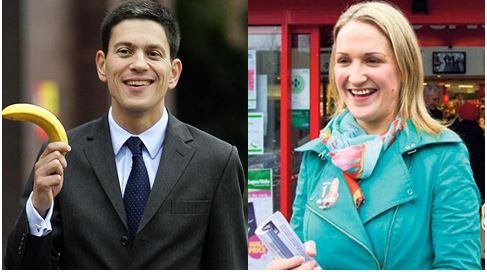
On almost precisely the same day as Fine Gael’s Helen McEntee entered full time national politics on this island, another politician was leaving it on the neighbouring island: David Miliband.
So what could these two events have in common? Well, not a lot really – but it did occur to me that Miliband, aged 48, was quitting politics at an age when politicians used to once enter politics.
In that regard Ms McEntee and Mr Miliband do have something in common, two things actually. First they both entered their respective parliaments at a relatively young age – Ms McEntee at 26 and Mr Miliband, slightly later, at 36 and second, neither had much real world experience outside of politics before entering parliament.
Essentially both were products of the political system, albeit at differing levels and grades. After completing her masters in 2010 Ms McEntee worked as a parliamentary assistant in her late father’s constituency office, while David progressed from Oxford and M.I.T to becoming Tony Blair’s head of policy via a stint at the Institute for Public Policy Research.
Neither had, to use the American phrase, “ever made a payroll”. While in America that is taken to mean running a business and being responsible for paying and employing people, in this context we can use it to mean experience of the real world, getting a job, getting promoted, running a household, paying a mortgage, providing childcare and then education for your kids.
Not that experiencing some or all of these necessarily qualify you to become a full time public representative, but wouldn’t some understanding of these help? Not that I am disregarding the pressures and difficulties faced by students these days. Frankly, as bad as the 70s and 80s were, I daily thank heavens that I am not a student in today’s environment.
Neither is this a plea for the Oireachtas to be full of 50 and 60-somethings or an attack on anyone under 25 running for the Dáil.
Rather I am just sounding a small note of caution against what I perceive as an emerging phenomenon here of people going almost straight from college into full time politics. Over the past two decades the number of jobs and opportunities in full time politics have increased. Since the early 90s the world of politics has become more professionalised with TDs and Senators now being able to employ parliamentary researchers and assistants paid for from the public purse. Not that I am one to complain having been a beneficiary of this development.
But with the creation of these additional opportunities it now seems the most successful path into the Dáil runs as follows:
University → elected as party officer – Job in Leinster House → Special Adviser → TD.
We risk having cohort of potential TDs (and Senators, if it survives) who have almost all followed the same real-life free path. Look at the UK and see how many of the men and women on the Tory and Labour benches fall into this category. While they may represent different political parties and support competing policies they essentially come from the same political background – all university educated, essentially middle class and all from within the political process.
Already we see the parties here looking out for new, young, vibrant candidates – and that’s a good thing. But what we also see is these candidates being identified earlier and earlier and based on criteria that are hard to understand.
Perhaps it is their newness and inexperience that is the attraction: a fresh clean slate for the party leadership to control and etch its views, coupled with a personal history that is free of controversy because its brevity presented damn all opportunity for it.
Turning back to Meath East, maybe it was just campaign hyperbole, or his penchant for the grandiloquent, that prompted Enda Kenny to describe Helen McEntee as “one of the most brilliant young candidates I have seen in any election” during an exchange in the Dáil on the day before polling. But what was there in her achievements or utterances that justified this high praise?
Is she a smart, confident and well educated woman, yes, without a doubt… but one of the most brilliant… in any election? Did we see anything in either the Vincent Brown or Primetime debates to support this claim?
Yes, there is a place in full time politics for young people and yes they deserve a major say in how their future is shaped, but we need to ensure that the search for the ideally packaged and presented candidate is not done at the cost of selecting those with more experience of life.
My column from yesterday’s Evening Herald (21/Feb/13) taking a very personal look at where Fianna Fáil is today; almost exactly two years on from the political meltdown of Election 2011
Sums up the the response in many places in 2011
——————————————————————————————————————
Though I don’t share his politics I like John O’Farrell. O’Farrell, whose father hailed from Galway, is a comedy writer and British Labour Party supporter who is now their candidate in the Eastleigh by-election.
My reasons for liking him stem not just from his days as a script writer on Spitting Image but from his hilarious 1998 memoir: Things Can Only Get Better: Eighteen Miserable Years in the Life of a Labour Supporter.
In it he details the disappointments, frustrations and the heartache he endured at all levels of the Labour Party until he came to realise that “Michael Foot would never be Prime Minister… and that the nuclear arms race was never going to be stopped by face painting alone.”
A few months after the punishment beating that was Fianna Fáil’s 2011 General Election result I started to wonder if I should start work on my own homespun version.
I toyed around with several possible titles, including: I Thought That Things Could Only Get Better: Boy, Was I Wrong or Fianna Fáil: the view from the edge.
The idea never got beyond a few lines on the PC screen, however. This was partly due to my not seeing anything even vaguely humorous in my situation, but also to me not knowing any publisher sufficiently cracked to commission it. Back in 2011 it was hard to imagine a market for such a work.
I also had a slight suspicion that the party was not yet ready for the scrapheap, nor for 18 years in the wilderness.
Yes, it was in bad shape – very bad shape. Not just the organisation, but the people too. Friends and colleagues who had worked in politics were shell shocked by the result. Not just elected reps, but people on more modest salaries working behind the scenes. Researchers, press officers, organisers and administrators. Losing 51 seats meant HQ shedding staff over half its staff.
But along with this loss, a loss that many hundreds of thousands of other people have had to face, was the realisation that people of my vintage were the ones who had allowed the decline to happen: we could be the generation that not only wrecked Fianna Fáil, but damaged the values on which it was founded.
This is not to underestimate or disregard the mistakes we made and the anger we caused to those people whose support we had sought and won over the decades. Nor is it a plea for pity. It is just to acknowledge that the 2011 defeat had real consequences for many of us.
While there were reports of some particularly heated and fraught exchanges during the campaign, what I experienced at the doors was a harsh coldness. The voters had long since made up their minds on Fianna Fáil – we had let them down badly and we would pay the price.
I suspect many voters even surprised themselves with the scale and magnitude of the Tsunami that engulfed Fianna Fáil two years ago.
Two years is not a long time in the life of an established political party. While the coldness and mistrust may have thawed somewhat, there is still a lot of real anger out there that will take a long time to address.
This should not be confused, however, with the contrived disdain that characterises some people’s attitudes to Fianna Fáil. As Sean Gallagher discovered during his presidential bid, it is now almost McCarthey-esque. You can talk about us in a way that you could not about almost any other group.
It ranges from the scorn that perceives FF as unprincipled, gauche, maybe even a bit NOCD (not our class dahling) to the more visceral anti Fianna Fail-ism that sees us all as chancers and strokers.
But for as long as I know that I am in a party that works to give people the means and opportunities to succeed, I reckon I can live with that.
My take on the US Presidential election results from tonight’s Evening Herald
My Evening Herald column on the Obama victory night
“Half the money I spend on advertising is wasted; the trouble is I don’t know which half!” If this is how Henry Ford felt about his cash you can only imagine how the campaign treasurers in both American parties feel about 90% of theirs.
Last January polls showed Obama and Romney in a statistical dead heat within a point or two of each other. Ten months and some €4.7billion of campaign spending later and the two parties appeared to have hardly budged an inch.
Watching the early results in the Presidential and Congressional come in this morning you had to wonder did either candidate or party get value for its money.
On Monday I said that I though Obama would win and that he would win the majority of the so called battleground States. While I was fully confident of that view when I penned it last Monday, I did have one brief moment of doubt last night.
It came by way of a stern but firm Facebook message from an old friend in New York. He said he thought that Romney might just shade it. His comments came as a bit of a shock as my mate is no political novice and is usually a good judge of these things.
The first key result I was waiting for was Virginia. While Obama could win the election without winning in Virginia it would be a good early indicator of how the election was going.
According to the US TV networks they would be ready to make a prediction, based on exit polls, about 30 minutes after midnight Irish time.
The final pre election polls had Obama set to win it by around 2%, but that was inside the margin of error. The exit polls would tell all. My heart sank a little when the Networks declared Virginia too close to call at the appointed time.
Could my mate be right? Could it be that Romney had managed to claw back enough to reverse Obama’s small lead? Virginia was not essential or critical to an Obama win, but it might be an indication of other problems.
The uncertainty lasted about thirty minutes. Soon reports started to emerge that Florida was too close to call. On Monday I had predicted it would go to Romney. Almost every polling company had been calling it for Romney for weeks, yet the reports coming out from precincts and districts across the State were saying that it was neck and neck.
Latino, women and young voters were coming out for Obama in bigger numbers and by wider margin than predicted. Obama had been expected to get about 66% of the latino voter, but the exit polls were not putting it at 71%..
Florida was the third easiest State for Romney to win from Obama, yet it was going to Obama, though only just. Of the swing sates only two: Indiana and North Carolina went to Romney, the rest stuck with the President.
In each case the margin was tight, but in America’s first past the post system, the winner takes it all.
By a little after 3.00am is was virtually all over. While there were several races still too close to call, all were favouring the President. Obama had not won the magic 270 electoral college votes but it looks now that there was almost no mathematical possibility of Romney reaching it.
While he was not losing them by large margins the States were being stacked up against Romney. By 4am it was all over once Ohio was called for Obama. With that Romney’s last remaining hope was quashed. While a few diehard Republicans refused to accept the prediction it was over and so Election 2012 ended with a stronger Electoral College victory for Obama, 332 to 206, than even I dared imagine a few days ago.
My column predicting an Obama victory from today’s Evening Herald
My Herald Column Calling The Election For Obama
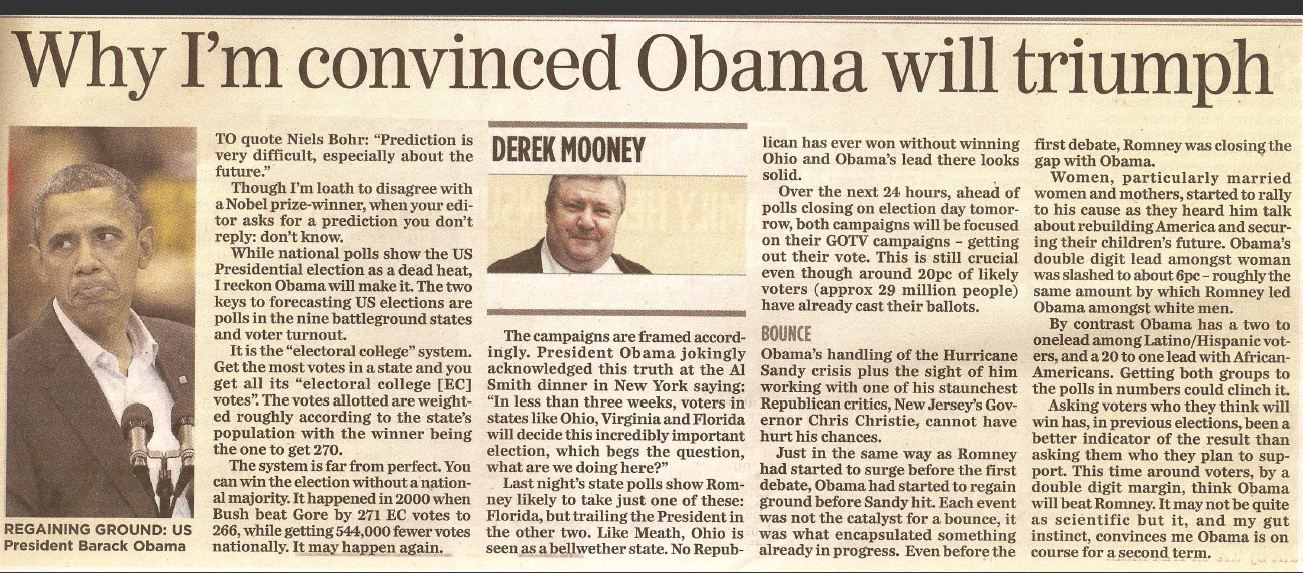
To quote Niels Bohr: “Prediction is very difficult, especially about the future.” Though I’m loathe to disagree with a Nobel prize-winner, when your editor asks for a prediction you don’t reply: don’t know.
While national polls show the US Presidential election as a dead heat, I reckon Obama will make it. The two keys to forecasting US elections are polls in the nine battleground states and voter turnout.
It is the “electoral college” system. Get the most votes in a State and you get all its “electoral college [EC] votes”. The votes allotted are weighted roughly according to the States population with the winner being the one to get 270.
The system is far from perfect. You can win the election without a national majority. It happened in 2000 when Bush beat Gore by 271 EC votes to 266, while getting 544,000 fewer votes nationally. It may happen again this time.
The campaigns are framed accordingly. President Obama jokingly acknowledged this truth at the Al Smith dinner in New York saying: “In less than three weeks, voters in states like Ohio, Virginia and Florida will decide this incredibly important election, which begs the question, what are we doing here?”
Last night’s State polls show Romney likely to take just one of these: Florida, but trailing the President in the other two. Like Meath, Ohio is seen as a bellwether state. No Republican has ever won without winning Ohio and Obama’s lead there looks solid.
Over the next 24 hours, ahead of polls closing on election day tomorrow, both campaigns will be focussed on their GOTV campaigns – getting out their vote. This is still crucial even though around 20% of likely voters (approx 29 million people) have already cast their ballots.
Obama’s handling of the Hurricane Sandy crisis plus the sight of him working with one of his staunchest Republican critics: New Jersey’s Gov Chris Christie cannot have hurt his chances.
Just in the same way as Romney had started to surge before the first debate, Obama had started to regain ground before Sandy hit. Each event was not the catalyst for a bounce it was what encapsulated something already in progress.
Even before the first debate Romney was closing the gap with Obama, particularly with women voters. The Obama campaign had spent millions over the Summer on TV ads portraying Romney as an aloof, remote right winger, using his own words from the primaries to indict him. The Republican convention and Romney’s selection of arch fiscal conservative, Paul Ryan, as his running mate did not help dispel the image.
But as soon as he hit the campaign trail proper Romney eased his message. Gone was the tea-party rhetoric that won him the nomination: in its place the more emollient, stern but fair tone that had made him a moderate Governor.
Women, particularly married women and mothers, started to rally to his cause as they heard him talk about rebuilding America and securing their children’s future. Obama’s double digit lead amongst woman was slashed to about 6%. This is roughly the same amount by which Romney led Obama amongst white men.
By contrast Obama has a 2 to 1 lead among Latino/Hispanic voters, an increasingly important constituency, and a 20 to 1 lead with African-Americans. Getting both groups to the polls in numbers could clinch it for him.
I could go on quoting polls of other groups. Under 35s, veterans, middle class etc, but let me close with a slightly more bit quirky one. Asking voters who they think will win has, in previous elections, been seen to be a better indicator of an election result than asking them who they plan to support.
This time around voters, by a double digit margin, think Obama will beat Romney. It may not be quite as scientific but it, and my gut instinct, convinces me Obama is on course for a second term.
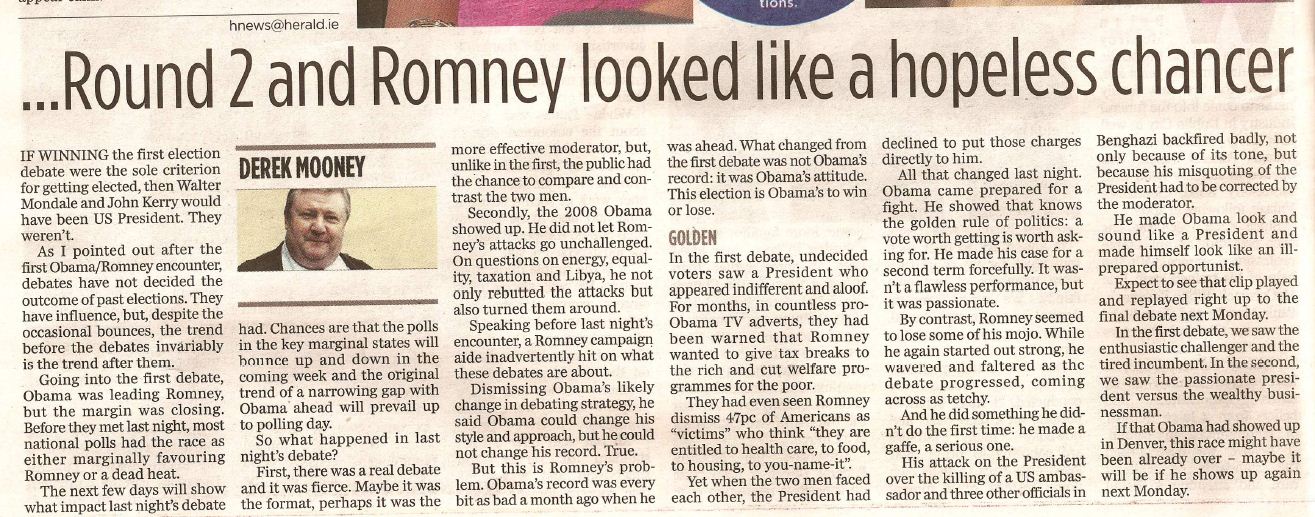
If winning the first election debate were the sole criteria for getting elected then Walter Mondale and John Kerry would have been President. They were not.
As I pointed out after the first Obama/ Romney encounter, debates have not decided the outcome of past elections. They are influencers but, despite the occasional bounces, the trend before the debates invariably is the trend after them.
Going into the first debate Obama was leading Romney but the margin was closing. Before they met last night most national polls had the race as either marginally favouring Romney or a dead heat.
The next few days will show what impact last night’s debate had. Chances are that the polls in the key marginal States will bounce up and down in the coming week and the original trend of a narrowing gap with Obama ahead will prevail up to polling day.
So, what happened in last night’s debate?
Firstly, there was a real debate and it was fierce. Maybe it was the format, perhaps it the more effective moderator, but unlike the first the public had the chance to compare and contrast the two men, especially when they clashed directly – and they certainly did that.
Secondly, the 2008 Obama showed up. He did not let Romney’s attacks go unchallenged. On questions on energy, equality, taxation and Libya he not only rebutted the attacks he turned them back on him.
Speaking before last night’s encounter one of Romney’s own campaign aides inadvertently hit on what these debates are about. Pre-emptively dismissing Obama’s likely change in debating strategy, he said Obama could change his style and approach, but he cannot change his record. True.
But this is the Romney campaign’s problem. Obama’s record was every bit as bad a month ago when he was ahead. What changed at the first debate was not Obama’s record: it was Obama’s attitude. This election is Obama’s to win or lose.
At the previous debate undecided voters saw a President who appeared indifferent and aloof. For months, in countless pro-Obama TV adverts, they had been warned that Romney wanted to give tax breaks to the rich and cut welfare programs for the poor.
They had even seen Romney dismiss 47% of Americans as “victims” who think “they are entitled to health care, to food, to housing, to you-name-it.”
Yet, when the two men faced each other the President had refused to put those charges directly to him. Worse still, Obama came across as being every bit as ineffectual as the pro Romney ads had claimed.
All that changed last night
Obama came prepared for a fight. He showed that knows the golden rule of politics: a vote is worth getting is worth asking for. He made his case for a second forcefully. It was not a flawless performance, but it was passionate.
By contrast, Romney seemed to lose some of his mojo. While he again started out strong, he did waiver and falter as the debate progressed, coming across as tetchy as he argued with the moderator over the rules and time allowed.
But he did something he didn’t do the first time: he made a gaffe, a serious one. His attack on the President over the killing of the American Ambassador and three other officials in Benghazi backfired badly, not only because of its tone but because his misquoting of the President had to be corrected by the moderator.
He made Obama look and sound like a President and made himself look like an ill prepared political opportunist.
Expect to see that clip played and replayed on TV and the internet right up to the final debate on foreign policy next Monday.
In the first debate we saw the enthusiastic challenger and the tired incumbent. In the second we saw the passionate President versus the wealthy businessman.
If that Obama had showed up in Denver, this race might have been over already – maybe it will be if he shows up gain next Monday.
My analysis of Wednesday night’s US Presidential Debate from tonight’s Evening Herald (Oct 4th 2012) .
—————————————————————————————————————-
Before last night’s Obama/Romney debate the American political rulebook said that debates do not swing elections. While the debates can give a candidate a short term bounce, the trend after the debates tends to be the same as the trend before them.
Obama never mentioned Romney’s infamous 47%, though it seems Big Bird and pals are part of it.
Without a doubt Romney had a good night. But nothing happened in Denver to change the political rulebook. While commentators, especially the network TV ones, like to think that TV debates swing elections, the reality is that they haven’t.
Yes, there have been some incidents like President Bush Sr’s constant looking at his watch at the 1992 debate or President Ford’s assertion in the 1976 debate against Jimmy Carter that eastern Europe was not dominated by the USSR, but none of these reversed the course of the elections.
Bush Sr had started to lose ground to Clinton before the debate. Ford was trailing Carter badly by the time they debated. Indeed Ford only agreed to the debate because he was behind. Though we think these TV debates have been the norm in the US since the famous Nixon/Kennedy debates of 1960, the 1976 Carter/ Ford one was the first in 16 years.
Presidential debates by their nature tend to favour the challenger. The format raises the challenger’s status presenting the two candidates as equals. The challenger can put the President on the back foot by going on the attack and picking apart the incumbent’s record.
That is what Romney did last night, and he did it effectively.
While the current race is relatively tight, the polls have favoured Obama since before the summer. As with Carter in 1980 the Democrats should be in trouble. Polling suggests that Americans believe their country is on the wrong track by a margin of almost 20%. Optimism is on the decline. Only 43% of middle class Americans expect that their children’s standard of living will be better than their own. This compares to 51% four years ago.
These numbers should be poison for Obama and the Democrats and make the election a slam dunk for the Republicans, except the same Americans either do not understand or do not believe the alternative vision offered by Romney.
Romney’s people know this. He went into last night’s debate with a mission to change American’s views of him. He did himself some good in that regard. He not only went on the attack on Obama’s record he also scored several points in denying the Democrats portrayal of him as a tax cutter for the rich. The issue for him is that he did this at the expense of discussing the details of his alternative.
Perhaps his position behind Obama convinced him that he had nothing to lose with this approach, but the other risk for Romney is that his lurch to the centre may mean leaving some right wing voters at home?
In contrast, Obama seemed aloof and remote. He was reluctant to attack and take Romney on directly. This may have been a deliberate tactic. His people may have felt that scrapping and politicking with Romney wouldn’t look Presidential – he never mentioned Romney’s 47% remarks even once – however, it also meant that he allowed several very answerable attacks on his record go unchallenged.
While Romney didn’t land a knock out blow, he did win in terms of punches landed. He also did well in terms of appearance and body language, he dominated the debate. These things matter. This is television after all. We get as much information from what we see as what we hear.
Arguably the real impact these debates will have will be down to the clips the TV news shows choose to use in the coming days, though neither man gave a hostage to fortune. The late night comics will have fun with Romney’s threat to cut public funding for PBS and Big Bird, but I don’t see last night’s rather boring exchanges as switching anyone’s vote.
Romney may have won the debate – but I reckon he will still lose the election

 A few months before the 2011 election, Michael Gallagher (the TCD Professor of Politics, not the Donegal postman and amateur weather forecaster) posted a blog where he asking how long Fianna Fáil could expect to spend in opposition. In it he wrote:




 derekmooney.ie