Obama lost first TV battle – but he’s still on course to win the war

My analysis of Wednesday night’s US Presidential Debate from tonight’s Evening Herald (Oct 4th 2012) .

—————————————————————————————————————-

Before last night’s Obama/Romney debate the American political rulebook said that debates do not swing elections. While the debates can give a candidate a short term bounce, the trend after the debates tends to be the same as the trend before them.

Sesame Street
Obama never mentioned Romney’s infamous 47%, though it seems Big Bird and pals are part of it.

Without a doubt Romney had a good night. But nothing happened in Denver to change the political rulebook. While commentators, especially the network TV ones, like to think that TV debates swing elections, the reality is that they haven’t.

Yes, there have been some incidents like President Bush Sr’s constant looking at his watch at the 1992 debate or President Ford’s assertion in the 1976 debate against Jimmy Carter that eastern Europe was not dominated by the USSR, but none of these reversed the course of the elections.

Bush Sr had started to lose ground to Clinton before the debate. Ford was trailing Carter badly by the time they debated. Indeed Ford only agreed to the debate because he was behind. Though we think these TV debates have been the norm in the US since the famous Nixon/Kennedy debates of 1960, the 1976 Carter/ Ford one was the first in 16 years.

Presidential debates by their nature tend to favour the challenger. The format raises the challenger’s status presenting the two candidates as equals. The challenger can put the President on the back foot by going on the attack and picking apart the incumbent’s record.

That is what Romney did last night, and he did it effectively.

While the current race is relatively tight, the polls have favoured Obama since before the summer. As with Carter in 1980 the Democrats should be in trouble. Polling suggests that Americans believe their country is on the wrong track by a margin of almost 20%. Optimism is on the decline. Only 43% of middle class Americans expect that their children’s standard of living will be better than their own. This compares to 51% four years ago.

These numbers should be poison for Obama and the Democrats and make the election a slam dunk for the Republicans, except the same Americans either do not understand or do not believe the alternative vision offered by Romney.

Romney’s people know this. He went into last night’s debate with a mission to change American’s views of him. He did himself some good in that regard. He not only went on the attack on Obama’s record he also scored several points in denying the Democrats portrayal of him as a tax cutter for the rich. The issue for him is that he did this at the expense of discussing the details of his alternative.

Perhaps his position behind Obama convinced him that he had nothing to lose with this approach, but the other risk for Romney is that his lurch to the centre may mean leaving some right wing voters at home?

In contrast, Obama seemed aloof and remote. He was reluctant to attack and take Romney on directly. This may have been a deliberate tactic. His people may have felt that scrapping and politicking with Romney wouldn’t look Presidential – he never mentioned Romney’s 47% remarks even once – however, it also meant that he allowed several very answerable attacks on his record go unchallenged.

While Romney didn’t land a knock out blow, he did win in terms of punches landed. He also did well in terms of appearance and body language, he dominated the debate. These things matter. This is television after all. We get as much information from what we see as what we hear.

Arguably the real impact these debates will have will be down to the clips the TV news shows choose to use in the coming days, though neither man gave a hostage to fortune.  The late night comics will have fun with Romney’s threat to cut public funding for PBS and Big Bird, but I don’t see last night’s rather boring exchanges as switching anyone’s vote.

Romney may have won the debate – but I reckon he will still lose the election

ENDS

Who impressed you most during referendum campaign?

Referendum is as much about Left vs Right as it is about the €

What will we be voting about on May 31st? It is one of the toughest Treaty referendum questions to answer.

European Central Bank
The ECB on Frankfurt’s Way?

If you are to believe the thousands of posters that adorn our street lamps we are either voting yes to stability and jobs or voting no to austerity. A simple enough choice… or so you’d think? Unfortunately, as the campaign progresses, it is becoming clear that neither the Yes nor the No poster claims stands up to much scrutiny.

Do we really think we will suddenly achieve stability and more jobs if we vote yes? I suspect that even the most ardent of yes voters believes that to be case.

On the other hand does the most convinced no voter think that the austerity measures, including household and septic tank charges will disappear if 50% plus one of us votes no? I doubt it.

So what are we voting about?

The best answer I have heard so far has not come from a member of government, the ULA or Sinn Féin. It came, peculiarly enough, from a Euro bureaucrat, a former member of the board of the European Central Bank member. Not the type of person you would expect to speak with simplicity and clarity, yet he did.

Speaking on RTE Radio One’s This Week programme, Lorenzo Bini Smaghi described the decision before us with a cheque book analogy. After years of having separate current accounts, he explained, the Eurozone countries have decided to have one current account and one single chequebook between them for certain purposes.

The risk with this is that any individual country could abuse their access and stick others with the bill, so it is important to agree a set of strict and enforceable rules beforehand. These rules are set out in the Fiscal Treaty. If you want to be able to use the joint account, you need to agree the rules. Refuse to agree the rules and you won’t be allowed near the chequebook.

It is a simple and effective explanation.

What we are voting about is our relationship with the Eurozone countries. Do we want to continue and strengthen that relationship or do we want to weaken it. This does not mean that voting No is the same as being against the Europe, but the choice we are facing has become starker than we would like it to be.

Ok. So now that I have attempted to make the issue a little clearer and get behind the hype and hysteria printed on the posters let me now reverse the process and confuse it again.

While much of the debate has been about the EU and the Euro let me point to another level in the debate. Though it does not get mentioned so much, this referendum has become a proxy battle on the future of left versus right politics in Ireland.

Before The Declan Ganley entered the fray the battle lines had been drawn up along clear Left/Right lines.

On the Yes side you had the right/centre right parties (FG, FF and even Lab), the employers’ and business organisations, the farmer’s groups and the more conservative trade unions.

On the No side you had the radical and left parties, People Before Profit, Joe Higgins Socialists, Sinn Féin, the more radical trade unions.

A Yes result would recalibrate the centre of the Irish political spectrum several degrees to the right. While this would not vanquish the left, it would limit their scope and hem them in.

This could help explain why Sinn Féin has been so fierce in urging a No. A Yes vote would place a definite ceiling on their ambitions and make the centre/centre right economic approach the norm for at least the next decade.

This would leave the hard left /socialist factions with no influence, just sitting on the sideline spouting rhetoric – so, no change there.

The main casualty could be Irish Labour Party, no matter what the result. “Frankfurt’s Way or Labour’s Way” may turn out to be the most devastating political slogan of recent times – devastating to its authors, that is.

Is Government the Biggest Threat to a Yes Vote?

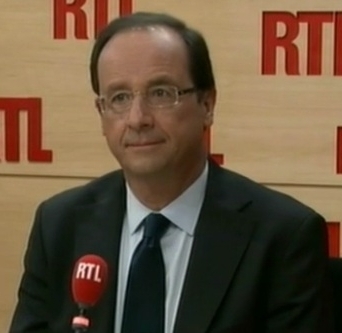
The next French President? François Hollande
(Photo taken from the Hollande Campaign site)

Though the early polls have been positive I am getting a sense that the No side may picking up some momentum as we near the May 31st polling date for the Fiscal Stability Treaty Referendum.

One of the main grounds for this sense of foreboding may indeed be the May polling date itself. I fear having the poll this early may prove the biggest threat to a Yes outcome for three reasons:

1. It allows no side to raise the prospect of a second referendum later in the year. The more astute and sophisticated side of the No campaign is starting to run an argument that goes as follows: We have voted twice on the last two EU treaties.In each case we have come back with a better deal the second time. This Treaty does not come into force until January 2013. We have the time to Vote No now and use the following months to go back and get a better deal and then Vote Yes later in the year. A late September polling date would have denied this argument to them

2. This Sunday see’s the first round of the French Presidential Elections, The Second roubnd of voting will be two weeks later at the beginning of May. While Sarkozy has had a good campaign to date and has closed the gap in the first round the polls there still suggest that Francois Hollande will win the Second Round by approx 55:45.Hollande is standing on recovery platform that rejects Sarkozy’s austerity plan and talks of renegotiating the Fiscal Compact,

While this position may be dismissed as a Gallic version of Gilmore’s “Frankfurt’s Way or Labour’s Way” – ie a promise that sounds good in the campaign but doesn’t survive past polling day – it does look like Hollande is serious. His determination to imeddiately set out a renegotiation the Fiscal Compact to include a growth programme, Euro Bonds etc has probably been strengthened by the attempts of Merkel and other Centre Right EU leaders to snub him.

We will be going to vote during the first days of a Hollande presidency, the background noise to ouyr vote to pass the existing threaty will be his moves to renegotiate that very treaty – almost making a farce of that vote. The politically astute move for our Government would have been to hold off until September and see if Hollande will make a difference.

3. The one great lesson learned from previous referenda, particularly NIce I & II and Lisbon I & II is that the public needs a longer run up/lead in period to tease out the issues. The traditional three or four week campaign has been found to be insufficient, particularly in the absence of “on the ground” campaigns.

Though polling day is about six weeks away there is little sign of that debate is starting yet. Will the Refendum Commission have the time to do the job? Based on the last referendums, it would certainly appear not.  The Tanaiste and Minister for Foreign Affairs had a thirty minute slot on RTE 1 last Saturday where he could have used 5/6 miinutes to explain why voting Yes is important. He didn’t. He chose instead to just give the poll a passing reference, 125 words in a script over 3100 words long. “referendum” featured only once in his script.

While the timing of the polling day is just one factor, it may prove a crucial one. The Treaty should stand or fall on its own contents alone. I am on record here as having my own qualms about the Treaty (see my post here on why I will be a reluctant Yes voter). The debate will be essential. This vote is not like others, we do not have a veto, we cannot delay or deny the progress of this Treaty by our vote alone. The EU has been horrendously slow to act to save itself from the start of this crisis. It has chosen the path of half measures over swift decisive action – usually at the behest of a Franco-German leadership that put domestic political considerations ahead of pan european ones. But we should not be blind to the developing EU real politik.

The appointment of Simon Coveney and Joan Burton as the Fine Gael and Labour campaign directors somehow does not imbue one with a sense of confidence. Coveney’s nomination does echo Charlie Haughey’s appointment of Paddy Lalor as Fianna Fáil national director of elections – a move that spurred the late Frank Cluskey to comment: “There’s confidence for ya”

BAI Report Does Not Close the File on that Bogus Tweet

Áras12 Candidates McGuinness and Gallagher

Besides our Fianna Fáil backgrounds, Sean Gallagher and I have something else in common: an errant tweet has contributed to us both losing out on a job.

In my case it partly caused me to lose a job I already held. I was Willie O’Dea’s adviser and programme manager when Dan Boyle sent his infamous tweet.

Its claim that there would: “Probably be a few chapters in this story yet” proved baseless, nonetheless 24 hours later the Minister had resigned and yours truly was clearing out his desk. C’est la vie. The tweet only brought the inevitable forward by twelve months.

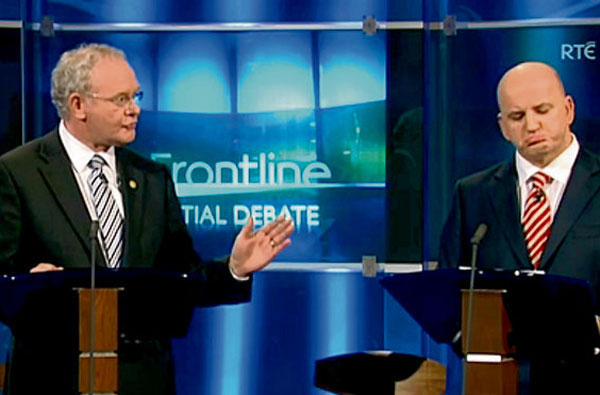
In Sean’s case the broadcast of a bogus tweet during the Frontline Presidential Debate played a major play in derailing his campaign and denying him the job he wanted.

Yesterday the Broadcasting Authority of Ireland gave its verdict on his complaint against RTE, The Frontline and The Pat Kenny Show.

It was a fairly damning judgement. The BAI found that Sean Gallagher had been treated “unfairly” on three counts.

One: by the broadcast of the initial bogus tweet from an account that purported to be from the official Martin McGuinness for President campaign.

Two: by the failure of the Frontline to tell the audience of the subsequent tweet from the official McGuinness campaign denying that it had issued the bogus one.

Three: by the continuing failure of the Today with Pat Kenny radio show the next morning to properly clarify the status and background of the two tweets.

Given that it found that a programme that was intended as a Presidential Debate was unfair to one particular candidate, it was amazing to see the BAI go on to say that no further investigation or inquiry is required as the complaint “was not of such a serious nature as to warrant an investigation or public hearings”.

It is not as if this might have affected the outcome of an election or anything….. oh, hang on a minute…. Yes, it might.

No one can definitively state whether the tweetgate affair altered the outcome, but we do know that Sean Gallagher was the poll leader before the debate and he wasn’t a few days later. We also know that tallies of the postal votes – ie those votes cast and returned to the presiding officers before the Frontline debate – showed Gallagher topping the poll.

On the other hand, it is entirely possible that viewers watching the Frontline debate might have switched from Gallagher to Michael D Higgins even if the tweet had never been mentioned.

All this is in the realms of speculation. What is not speculation however it that someone sent that tweet to undermine the front runner and affect the race.

So, yes, this matter does require further investigation.

The BAI has determined that Mr Gallagher was treated unfairly in how the tweet was handled. RTE’s Director General made a sincere and genuine apology and the RTE Authority is to examine the BAI’s finding.

This is all right and proper. But RTE’s actions are only part of the case.

Like others watching the campaign on the internet I was not aware of the difference between the real and fake McGuinness for President twitter accounts until the controversy broke that night.

The confusion was easy as, according to some Social Media watchers, both twitter accounts were created on the same day. Indeed, as part of its own defence, RTE argued that many other journalists were similarly confused and had taken the first bogus tweet as genuine. (A defence rejected by the BAI)

The question remains: who was responsible for sending out the tweet? Are we going to tolerate a situation where an election outcome can potentially be so easily influenced by one person or group of people acting in the shadows?

We have seen thousands of people protest on the streets of Moscow regarding accusations that Putin rigged their Presidential election, are we not to try and look a bit deeper into this case?

Isn’t the integrity of our democratic process worth a bit more effort?

The Party May be Down, But it is Certainly Not Finished

Fianna Fáil

My take on Fianna Fáil’s 73ú Ard Fheis which is taking place in the RDS this weekend (March 2 & 3). This piece was written for the Evening Herald of March 3rd

———————————-

For as long as I can recall Fianna Fáil Árd Fheiseana were the party conferences where the emphasis was more on the “partying” than the “conferencing”.

They were great social and political occasions where activists from all strands of society, right across the country, gathered to celebrate their membership of the party.

There they rallied; networked; socialised and renewed friendships with colleagues from other constituencies.

To be brutally honest, for many – myself included – the formal debates and motions were incidental to the core objective: discussing politics with old friends and hearing the leader’s speech.

While tonight’s address, the first by Michael Martin as leader, will remain the highpoint of this weekend’s Árd Fheis, it will come at the end of two days of serious and intense debate about the party’s future.

The issue before the Árd Fheis is that stark: the very survival of what was once the greatest modern political movement in Western Europe.

Over these two days – yesterday and today – at the RDS, members are deciding a slate of major reforms on how the party is organised and run.

Key to these is the move away from the representative/delegate model for candidate selection in favour of the One Member One Vote system (OMOV). In other words; to allow every active member in every cumann to have an equal say in selecting candidates and officers.

It is resonant of the crucial debate the British Labour Party had at their 1993 Conference. That was the year they ended the Trade Union block vote and adopted OMOV.

It was not an easy battle for them. The move to reform and modernise had been delayed for almost 14 years as they tore themselves apart with internal wrangling and infighting.

The result was three stunning defeats and three terms of powerless opposition.

Only by reforming their internal structures and systems did Labour allow itself to reconnect with its membership and, more importantly, with the people. After 14 years of irrelevance “New” Labour began to get in touch with the cares and concerns of the British people and respond effectively to them.

That is what Michael Martin hopes to achieve with this Árd Fheis. While the events of the past few days may have moved the focus slightly away from that goal, he was determined to shift it back as soon as the members start to gather in the RDS last night.

And a fair few of them gathered; with over 4000 members registered to attend by the middle of the week.

It is an indication of how serious the party’s grassroot members are about renewing their party. The number of people running for positions is another. Contest for the 20 nationally elected places on the Fianna Fáil Árd Comhairle has never been keener, with many bright, young first time candidates.

The same applies to several of the other senior positions, though the contest for the positions of Party Vice President was made marginally less intense with the withdrawals of two former party big hitters: Mary Hanafin and Éamon Ó Cuiv.

The weekend’s debates are not confined to organisational matters. The Clár contains some motions which, if passed, would herald interesting shifts in policy, including ones on gay marriage, gay adoption ending the regime of TDs’ and Senators expenses’ and reducing the voting age to 16.

There is also a slew of the more traditional Árd Fheis motions, including some Dublin centred resolutions calling for the reinstatement of the Ballymun Regeneration, Grangegorman DIT Campus and Metro North projects.

So, a great deal of serious work will be done by those gathering in Ballsbridge, but be certain too that there some socialising and banter as the faithful show that while they may be down, the party is by no means finished.

Derek Mooney was a Ministerial Adviser 2004 – 2010 and a Public Affairs Consultant and Speechwriter since the 90s

Is Sinn Fein’s living on the average wage claim all that it seems?

My Evening Herald column from today’s paper. Friday 17th February 2012

Sinn Féin

There are few topics more guaranteed to raise the hackles than politicians’ pay. I recently overheard a conversation on the topic in a pub in Cork. It was hard not to hear it given the volume of the exchange. This was curious as they were agreeing with each other – their argument was as to which of them detested politicians more.

The late Brian Lenihan kick started the process of trying to bring down the levels of politicians’ pay and expenses back in October 2008. There have been a few rounds since. Enda Kenny started out ok reducing the number of garda drivers and cutting staff levels in ministerial offices, but recently lost the plot with the €17k pay hikes for Super Juniors.

The issue of reducing politicians’ pay and re-allocating that money elsewhere even raised its head during the Presidential election. Several candidates said they favoured a cut, including Martin McGuinness who promised to only take home the average industrial wage if elected.

In doing this he was repeating what Sinn Féin elected reps say they do in the Oireachtas and the Northern Ireland Assembly. While TDs earn about €92K a year, Sinn Fein’s TDs say they take the average industrial wage: around €32,000 per year. Speaking to the Donegal Daily a few weeks ago SF TD Pearse Doherty put his weekly take home pay at around €540.

They frequently remind us of their largesse. Without a doubt anyone foregoing 60% of their salary is entitled to praise and kudos, but only when that is what they are really doing. So, this begs the question: are they truly foregoing the money?

Martin McGuinness partly answered this question in the Guardian newspaper in April 2009. This was in the aftermath of a report that he and Gerry Adams jointly claimed expenses of £3,600 a month (under the House of Commons second home allowance scheme) for rent on a shared two-bedroom flat in north London.

Speaking at the time Mr McGuinness said: “I get roughly over £300 per week from Sinn Féin, the exact same money as the person who drives me to my work”.

“I have no difficulty or problem with that, knowing that the rest of the money is being put into developing Sinn Féin and developing constituency offices all over the island of Ireland for the people of Ireland.”_

There are two things wrong with this statement. First, he regards Sinn Féin as his paymaster; not the taxpayer. Second, the sense of pride that the “rest of the money”, in his case in the region of £75k before tax, does not go back in to central funds to pay for hospital beds or SNAs: but rather goes to funding and advancing Sinn Féin’s political enterprise.

The money surrendered by Sinn Féin’s TDs and Senators does not benefit the taxpayer or the person on welfare: it benefits their own local party organisations. It goes to running constituency offices and funding local activists. In Pearse Doherty’s case it pays for two part time workers in his constituency

So, Sinn Féin takes money from the public coffers and puts it into running political operations dedicated to helping them keep their seats. This is not so much a sacrifice: it is more of an investment in their own political future.

Though on the average industrial wage, they get to be local employers with extra paid staff. I am fairly sure there are not many others on the industrial wage out there who can similarly hire someone in to help them keep their job.

Yet the rules state that a political party may not accept a donation from the same person in the same calendar year which exceeds €6,348.69 in value. So is what they are doing a donation or not?

It is an issue which freelance journalist Gerard Cunningham aka faduda.ie has attempted to raise with both Sinn Féin and SIPO, though without much success.

Is there a distinction between donations depending on whether they are allocated locally or nationally – if so, then it is a big loophole. If not, then shouldn’t all TDs and all Senators be placed on a level playing field when it comes to funding their local political activities?

Most important, if taxpayers money is being handed back – shouldn’t it be handed back to the taxpayer?

ENDS

FF’s Sean Fleming quickly adds up the damage

My review of Minister Brendan Howlin’s day 1 budget speech. http://www.herald.ie/news/ffs-fleming-quickly-adds-up-the-damage-2954736.html

This is the first budget since Ruairi Quinn’s 1996 one where Fianna Fail have been in the position of having to respond as an opposition.

Only a handful of the remaining Fianna Fail TDs have any experience of replying to a budget statement on the hoof, like this.

Back then they had both the numbers in the chamber and in their research office to be able to respond robustly. Back then, they were also not hampered by seeng their economic strategy being implemented by the government.

In these circumstances, the party’s spokesperson, Sean Fleming, did reasonably well. His accountancy background enabled him to focus in on some of the finer and more damaging points that appeared in the tables, but somehow managed not to make it into the Minister’s script.

Sinn Fein’s Mary Lou McDonald gave one of her best Dail performances to date. Whereas Fleming stuck with the detail, she concentrated on the politics, excoriating and needling Fine Gael and Labour backbenchers for reneging on their election promises.

Over recent years we have been moving from the traditional westminster model of budgets where the finance minister goes into a self imposed silence or purdah in advance of the statement, to a european one where large elements emerge into the public arena in advance.

While recent budgets have seen their share of advance kite flying, this one brought the craft to new and dizzying heights. 

It is all about the management of expectations. It’s an old trick. Get your people spinning that medical cards might be hit, and then hope the public will break out the champagne, or possibly the Babycham given our straightened times, when they are not.
So the theory goes. In this case the audience was not so much the people at home, but the massed ranks of backbench government TDs who would like to be two term Deputies not one termers.
This may account for the very muted applause after Minister Howlin resumed his seat. Though this may just as much been due to how inappropriate and ill judged the loud cheers and fulsome applause the Fianna Fail deputies gave to their recent budgets seems now.

Enda’s State of the Nation fails to Inspire

An Taoiseach’s national address was well intentioned but badly executed. 

To his credit; from the moment he became Taoiseach, Enda Kenny has shown that he realises the importance of talking to people. He has demonstrated regularly that he knows the job of Taoiseach is not just the traditional one of government Chairman or Chief.

He understands that it is also that of the “confidence giver in chief”, particularly at times of crisis like this. The person who tells the rest of us what is happening and how he and his team have a plan to get us through the difficulties.

Television has not been his friend. Neither have the formal set pieces: Ard Fheis speeches etc. He has been more comfortable in informal situations, particularly those where his words and message are delivered unmediated: live to a flesh and blood audience.

For all these reasons, last night’s TV “Address to the Nation” was going to be a big ask. The fact that it was billed as the most important address he would ever give, the “speech of his life”, did not help.

In the event, the speech did not succeed in achieving its desired result.

A speech is not about offering a litany of facts and figures, it is about putting across a clear message. The Taoiseach acknowledged this truth in his address saying that he was “outlining the Government’s strategy.”

The pity is that while this may have been the aim, the content and delivery failed to convey any sense of strategy or coherent plan.

The address should not just have been another element of the package of budget speeches: but an opportunity to set out a vision of where we are going and how we can get there together.

It could have been a vision of the kind of Ireland the Taoiseach wants to see in place by 2016, the centenary of the Easter Rising and an exposition of how he sees us achieving that.

Instead of the expected “state of the nation” we got a curiously cold and passionless presentation that omitted both vision and purpose. A bland party political broadcast that seemed, in part, to be an attempt to explain both why The government was now implementing policies it had opposed and why it had abandoned promises made only nine months ago.

It was less an “address to the nation” and more an apology from the leader of Fine Gael.
As the Taoiseach and his advisers are now starting to realise there are some very obvious risks with such addresses.

The expectations were high.

People expect to be better informed and maybe even more confident after the broadcast than they were before. Looking at the online commentary as I write this, I do not see this being the emerging consensus. Most politically unaligned posters appear to be seeing the address as a “wasted opportunity”.

But there are other risks too. The leader comes on TV to say that things will get better… but, they don’t. As a consequence we lose faith in them.

The other worry is that the Leader comes on TV to say that things are even worse that he had suggested they were… the opposition have a field day using his own words to attack him and his popularity plummets

Though I have no firm evidence for thinking this, I believe that these were the two of the key factors behind Brian Cowen’s reluctance to make a similar address in 2008/2009. The one issue Cowen would not have had to address if he had chosen to make such a speech then is the crisis facing the EU and the Euro.

In my view the Taoiseach made a mistake in not devoting more of his script to this crucial issue. Not only did the EU section amount to less than 10% of the total text, the section was bland and failed to seriously address any of the issues facing us.

In other EU countries they are talking of having “less than a week” to save the Euro. Within the coming days we will learn more of the Merkel/Sarkozy plan to fundamentally change how the EU and the Euro function, but here our Taoiseach reduces the matter to almost an afterthought in his keynote address to the nation.

It kind of sums up the whole exercise, well intentioned, but poorly done.

Twitter:  @dsmooney

Barrack Closures a Mistake on All Fronts

This article appeared in the Irish Examiner on Thursday November 17th 2011

Resigning as a Minister is not something to be done lightly. You must weigh up the influence and input you are surrendering from having a seat at the table against the public acclamation you will receive. The applause and cheers will soon die down and you will be left standing on the outside while decisions get made without you.

Though he is not a household name, Willie Penrose is a smart man. While he may have the bearing and manner of a classic rural parish pump TD, he is a smart guy. An experienced and successful Barrister, Penrose knows what he is doing.

Gilmore knew that that the future of Columb Barracks in Mullingar was a red line issue for Penrose when he nominated him as a Super Junior – so why did he proceed with the appointment?

This government was only a few days in office when speculation started that they may close some more barracks. Further barrack closures have been a fixation with some senior civil servants and military figures in Defence.

Shortly after I entered the Department of Defence in October 2004 a senior official popped into my office to discuss the issue of “barrack consolidation”. This I came to learn was the euphemism for barrack closures.

There is a school of thought, among some in the Defence organisation, that we should have a much smaller number of super barracks – say three or four – located in the major cities, rather than the existing network of smaller posts across the State.

While this would potentially be a little more economic and efficient, this has to be weighed with the popular support and positive PR generated from having more locally organised and based units. It is a demonstrable fact that recruitment is strongest in those areas where there is a military post.

Even at the height of the Celtic Tiger for every general service recruit post advertised there were at least 5 applicants, while the Cadet competitions often saw 25 or 30 well qualified applicants for each vacancy.

Local barracks and locally based army units form strong bonds with local communities. Use of barracks facilities, especially sports grounds, is usually offered to local community groups, particularly youth groups. The local army unit is always on hand to help out in the classic “aid to the civil power” type exercises – flooding, ice clearance, bad weather etc.

While they are hard to measure on a civil servants excel spreadsheet, these strong local bonds are vitally important and should not be thrown away lightly.

The previous Minister, Michael Smith has closed six barracks back in 1998, though some of these properties had still not been disposed of almost six years later. Indeed it would take a further five or so years to deal with these.

The estimated year on year savings from these 1998 closures was estimated to be in the region of €3.5 – 4.5m. These were “economies of scale” saving from reduced security, heating, lighting and other savings.

If the current row over closing three or four barracks was just about that, I might be tempted to agree with it. But this is a mistake on all fronts.

Alan Shatter says that given the choice between saving buildings and retaining personnel, he opts for the latter. A noble intention: if only that was the choice before him.

It is not.

If the planned closures go ahead the Defence Forces can kiss good bye to seeing their numbers ever rise back above 10,500 again.

There are a number of reasons not to close these barracks.

Their closure will hurt the local economies in Mullingar, Clonmel and Cavan just as much as any factory closure. There is no point the Taoiseach giving out to Talk-Talk management for the inconsiderate handling of that closure while his own Minister is planning to do the same thing.

Where does the Minister propose to transfer the troops stationed in Mullingar, Clonmel and Cavan? Where is the spare capacity in the remaining barracks?

We are already aware from the last round of barrack closures that the remaining barracks were full and operating close to capacity.

To close these other barracks and to permanently move around 500 – 600 troops would require a considerable capital investment in additional facilities in Athlone, Finner andLimerick. This is not something that will appear overnight. Where does the Minister propose to get the cash to provide this additional capacity?

Colm McCarthy’s famous Bord Snip Nua report found that the Defence Forces were the only sector of the Public Service to reduce numbers during the height of the Celtic Tiger. His report suggested a number of further small reforms, including a reduction in the size of the force by a further 500 to 10,000. He recommended this be implemented over a two year period. It was achieved within a year, well ahead of the target date.

So what kind of signal do these further cuts – cuts that go beyond An Bord Snip Nua – send to others in the Public Service? This was a point that Brian Lenihan and Brian Cowen instinctively understood.

Here is a part of the public service that has downsized, modernised and reformed itself beyond expectations and yet it gets singled out again for cuts that neither make sense nor add up. These barrack closures appear, on the face of it, to be gratuitous.

The Defence Forces now do more with less. When it comes to real public sector reform the Defence Forces are a model of how it can be done right. These closures put that model at risk.

The investment in the Defence Forces made between 1997 and 2007 was a text book example of how to invest wisely and productively. Surplus property was sold and the proceeds invested in better training and equipment.

While the numbers working in the Public Service increased by 17% over the decade of the Celtic Tiger, the numbers working in the defence organisation actually fell by 8%.

This applied across all levels. The number of troops fell and so did the number of civil servants. Indeed Defence has a remarkably small civil service

The fact that the Minister does not get this point is compounded by the fact that he did not address the annual PDFORRA conference. That was a bad decision. It was his first opportunity to address the soldier’s representative organisation and he opted to send his Junior Minister while he and his Secretary General heading off to an international conference instead.

Willie Penrose’s resignation is about a lot more than just Mullingar Barracks; it is about a part time Defence Minister who fails to appreciate what he is doing, or is simply not bothered.