This is an article I have written for the March 2014 Árd Fheis issue of Fianna Fáil’s members’ magazine Cuisle.
————————————————————————————————–
A few months before the 2011 election, Michael Gallagher (the TCD Professor of Politics, not the Donegal postman and amateur weather forecaster) posted a blog where he asking how long Fianna Fáil could expect to spend in opposition. In it he wrote:
“Fianna Fáil is not a party accustomed to spending time there. Its longest spell on the opposition benches is still the nearly six years between its foundation in May 1926 and its entry into government in March 1932. Since then, the party has never spent more than one consecutive Dáil term in opposition and the longest spell it has been out of power remains the 4 years and 4 months of the Cosgrave coalition in the mid-1970s.”
Underpinning Gallagher’s 2010 comments is the idea that Fianna Fáil has never been that good at opposition. It is a fair point.
Not only have we not spent much time in opposition, as Gallagher points out, it is almost 30 years since we last spent a full Dáil term there.
My column from today’s Herald on Chris Andrew’s joining Sinn Féin
My column in today’s Herald
————————————————————————
Cui Bono, who gains? That is the question political analysts normally ask when someone does something unusual or out of the ordinary.
It was the question that came to mind when I heard that my former party and constituency colleague Chris Andrews was joining Sinn Féin.
While Chris may hope he will be the main beneficiary of his defection, he will soon learn that nothing is for nothing in Sinn Féin.
Recent local election boundary changes had made Chris very likely to take a seat as an independent in the new eight seat Pembroke South Docks Ward, even with such tough opposition as local Councillor Mannix Flynn.
While running under the Sinn Féin banner would bring Chris extra votes, it would also drive away a big chunk of his previous support. Either way, as an independent or Sinn Féin he was likely to get elected.
Maybe Chris has his eye on a bigger prize than Dublin City Council and fancies his chances in the European elections? This would mean Sinn Féin bumping a loyal servant like Éoin Ó Broin in favour of a newcomer.
This would doubtless cause dismay among SF activists across Dublin, particularly as the party is already well placed to take the European seat formerly held by Mary Lou McDonald (another former Fianna Fáil-er) and currently occupied by the co-opted Socialist MEP Paul Murphy.
Running Chris for Europe would be an uncharacteristically generous act by them, but politics, especially Sinn Féin politics, does not work like that. It has not grown and developed by charitably adopting waifs and strays.
The Shinner’s acceptance of Chris has meant them closing their eyes to a lot.
Around this time last year we had the saga of Chris’s anonymous “sock puppet” Twitter attacks on Fianna Fáil colleagues both at leadership and local level. But his ire was not aimed solely at them.
Having blasted people who had worked on his campaigns, he then swung his sawn off twitter shotgun at Sinn Féin. Using his “brianformerff” identity he spoke of: “…the amount of people Sinn Féin reps killed over the years. #jeanmcconville” and “…still trying to make his SF gun men party coomrades [sic] trendy and likeable!!”
Perhaps Sinn Féin can find it in itself to pardon anonymous comments made from behind an internet balaclava, but it must be less easy to ignore the fact that Chris spent almost all of his time in the Dáil in the opposite lobby to them?
When Sinn Féin was voting against that Government’s actions – aside from the Bank Guarantee – Chris was resolutely voting for them. Looking back, I can’t remember anyone raising serious questions about Chris’s loyalty during my time in government.
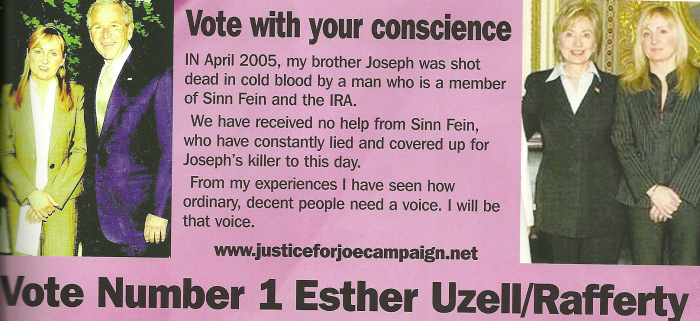
Chris was just as assiduous when it came to attacking Sinn Féin locally. In a Dáil debate on May 27 2009 he spoke out about the local intimidation of Esther Uzell, labelling those responsible as “thugs” and “scum”. Esther’s brother Joseph Rafferty had been killed by the IRA in April 2005. Despite her repeated calls, Sinn Féin had done nothing to help identify her brother’s killer. They had been so unhelpful that she accused them of covering up for her brother’s killer.
Perhaps Chris can assist her again in his new role?
Anyone else making such attacks would not be given the time of day, so what has Chris got that they want so badly? His name. His pedigree.
As an Andrews he potentially allows them claim the linkage, no matter how tenuous, back to the foundations of the State that they so desperately lack and need. The statement welcoming Chris into the fold talks of his grandfather’s “ideals and values” with the added sideswipe that Chris felt Fianna Fáil no longer represented them.
Chris is entitled to that view, just as he’s entitled to decide his future and just as others are at liberty to remind him of his past.
Today’s RedC poll for Paddy Power brings very little good news unless you are an independent or a don’t know. The unadjusted core figures rank the parties in descending order as:
Fine Gael 23%
Fianna Fáil 18%
Don’t Knows 18%
Independents 17%
Sinn Féin 13%
Labour 9%
After adjusting the figures by excluding 50% of the don’t know and adjusting the other 50% back to how they voted in 2011 the ranking positions stay the same. Only the relative gaps between Fine Gael and Fianna Fáil and between Fianna Fáil and the Independents widen.
Fine Gael 29%
Fianna Fáil 22%
Independents 21%
Sinn Féin 15%
Labour 11%
Sinn Fein’s lead over Labour remains at a steady 4%. While this may, at first glance, suggest some good news for Sinn Féin, the party has been in this territory before only for its good polling numbers to fail to translate into votes.
Back in December 2010, on the eve of a general election, three polls showed the party in the mid teens. A Red C Poll for The Sun on 03/12/2010 gave the party 16%. The MRBI/Irish Times poll on Dec 16th put it on 15% while a third, the Red C/Sunday Business Post poll of December 18th put its support at 14%. On polling day, two months later, the voters gave it 9.9%.
This is not to discount its advance since. Sinn Féin has been consistently polling in the mid teens since September 2011. That said, though an Irish Times poll in early October 2011 put party support at a hefty 18% its Presidential candidate and possibly most charismatic figure, Martin McGuinness still could not get the party’s actual vote past the 13.7% mark in the ballot boxes a few weeks later.
Despite its considerable and well resourcing organisation it seems to still have a problem translating favourable poll numbers into actual votes.
Though of cold comfort to Fianna Fáil it does not, at least, have this particular problem. The MRBI/Irish Times and Red C/Sunday Business Post polls conducted on the eve of the 2009 Local elections put Fianna Fáil’s support at 20% and 21% respectively. On polling day, the party managed to scrape its way up to 25.4%.
Fianna Fáil problems are more significant. While it has won back some of its lost “soft” support and pulled itself up from the 2011 hammering it has yet to say or do anything substantive to win back many of those who had voted for it in 2002 and 2007 but rejected it in 2011. There is nothing to suggest it is doing any better with potential first time voters either.
Despite the speculation of last weekend, Fianna Fáil’s problem is not its leader. The notion that Fianna Fáil picking a new leader whose only virtue is that they were not a member of the previous government is almost laughable. Surely no one in the party or the commentariat is delusional enough to think that the electorate is so naïve that it will flock to Fianna Fáil’s cause just because it has a leadership team devoid of anyone who served under Ahern or Cowen?
Despite its apology and acknowledgement of past mistakes, Fianna Fáil has yet to present a researched and substantive alternative policy programme. It has come up with some good micro-policies, not least its family home protection and debt resolution Bills, but many have been light on substance and appear to have been produced as well intentioned responses to specific representative groups, e.g. the Mobile Phone Radiation Warning Bill
Try finding the party’s April 2013 Policy Guide on its website. It is there, but you have to know what you are looking for to find it. Click on the “issues” button on the homepage and you get the Spring 2012 version, to locate the latest version you need to do a search for it by name.
The April 19th 2013 document shows the party has been doing some serious work on policy, but you would be hard pushed to know it from the statements coming from its spokespeople. These still read as knee jerk responses to government statements rather than as co-ordinated parts of a coherent alternative. Fine Gael may have gotten away with tactic this during its time in opposition, but Fianna Fáil does not have the luxury they had: a Government unwilling and unable to communicate with its own supporters.
Perhaps the criticisms of a small and possibly over stretched clique around the leadership have some basis in reality, but as someone who has spent a long time around the party, on both the inside and outside tracks, I think the problem lies elsewhere.
Michéal Martin has shown a remarkable capacity for getting out and about and engaging with members and voters alike, it is curious, therefore, to read of him being less engaged and accessible to members of his own very diminished parliamentary party.
Might I suggest that the fault lies on both sides. Yes, he should be having regular one to one meetings with his 33 parliamentary colleagues – God knows there are not that many of them to make such regular meetings impractical – but they too should be engaging with him.
The traditional deference to the leader needs to change. Gone are the days when you had to wait ages to have an audience with the great leader as he busied himself with the great affairs of state in the Taoiseach’s office. Parliamentary party members have the opportunity for unique access, let them use it. A minority can only exercise sole access when allowed by the majority indifference or reticence.
Despite the job losses and the massive reduction in resources, there still appears to be a sense that the party structures are operating and running as if the party is still as big as it once was. Worse still many of those working those structures have no sense memory of how the party should operate in opposition.
A small number of paid officials are being expected to do the party’s policy research and formulation with minimal input from a vast array of experts across the volunteer membership. Too much power and control is being retained around the centre and around Leinster House: not by the leadership and his supposed clique, but also by members of the parliamentary party who are criticising him for just that.
I am old enough to remember what was put in place between 1982 and 1987, the last time the party was truly in opposition. Back then a series of policy committees were established by the leadership and mandated, working with the various spokespeople, to produce credible and researched policies for submission to the party for adoption.
These committees worked with the TDs and Senators but were not run by them. Outside experts were brought in to assist and work with them.
To borrow a phrase from Fianna Fáil’s past – the phase of its recovery will be dependent on policies and substance – not personality. The party already has the potential to bring itself back into the upper 20s in terms of actual voter support – the question now for the leadership and the party as a whole is if it has the energy, expertise and inclination to innovate the policy approaches that could bring support up into the 30% plus range.
An Taoiseach Enda Kenny, T.D. (pic from FG website)
This morning’s Sunday Independent story that back in January 2009 when he was still leader of the opposition that Enda Kenny had been in informal contact with Anglo Irish Bank’s CFO, Matt Moran, raises several questions for Mr Kenny. Some of these questions have already been posed by Fianna Fáil’s Micheál Martin.
When the Anglo tapes first came into the public arena at the end of June, Mr Kenny moved quickly to politically insinuate that the tapes suggested an “axis of collusion” between Anglo Irish and Fianna Fáil, even though the tapes did not suggest any improper or informal contacts between any Fianna Fáil ministers and Anglo bosses.
During the course of Leaders Question on June 25th, Enda Kenny was quite strident and aggressive in his exchanges with the Fianna Fáil leader, Micheál Martin with the Taoiseach repeatedly mentioning Martin’s role in the Bank Guarantee (notwithstanding the fact that it was not Anglo who had sought the guarantee and that the bank was not even represented at the meeting in Government Buildings on the night of September 28th, 2008).
Typical of the exchanges is the following line from the Taoiseach:
“Deputy Micheál Martin was part of that environment. I am not suggesting he was involved directly in any of it—– (Interruptions) —-but he was a member of the Government and the people are entitled to know why the Government had incorporeal meetings at 3 a.m. They are entitled to know about the political environment in which all of these agents operated.”
Even after Martin had finished asking his two questions, the Taoiseach continued his political allegations of collusion during his subsequent exchanges with Deputy Gerry Adams and Deputy Mattie McGrath.
During his two questions McGrath asked the Taoiseach if the Minister for Justice and Equality had known about the tapes and if the government intended to set up a criminal inquiry and a robust investigation?
Towards the end of his replies to McGrath, indeed just as the time for Leader Questions was ending and Deputies were starting to prepare for the next business the Taoiseach volunteered the following curious little revelation. McGrath had not asked if he had any contact with the bosses in Anglo, indeed the topic had not been raised, yet the Taoiseach felt the need to put the following titbit on to the record:
“I had the doubtful privilege of calling into Anglo Irish Bank with Deputy Bruton, when he was the party’s spokesman on finance, a couple of weeks after the guarantee went through. We met all of the principals in the bank’s building on St. Stephen’s Green.
We were given a wonderful presentation by people who were very well remunerated in their positions and received very large bonuses. As has transpired, all of that presentation was a tissue of fabrication and untruths. The questions we asked on that occasion, from the Opposition benches, were very realistic in the context of the pressures people were under and the stories, rumours and allegations that were flying around about that bank. They were all utterly denied.
I make that point for the politicians who are interested in what happened here.”
Is this just a case of Mr Kenny’ showing how unlike John Bruton, his predecessor as FG leader and Taoiseach, he is? Some years back Mr Bruton infamously defended his evasiveness in the Dáil with the line: “you didn’t ask me the right question”. Are we to believe that where Bruton was cautiously meticulous in only answering the specifics of the question asked, Kenny is more effusive? To judge from other Leaders’ Questions sessions before and since, hardly so.
It now appears that Mr Kenny was endeavouring to get something on the record regarding his contacts with Anglo bosses just in case these precise revelations were to emerge.
This brings us to Minister Frances Fitzgerald’s protestations this morning on RTÉ’s The Week in Politics that it is ridiculous to suggest that the Taoiseach might have any questions to answer as he was only leader of the opposition back in January 2009. The presumption here is that Mr Kenny knew little or nothing about what was going on back in January 2009 so what could he have told or said to Anglo’s Mr Moran?
Two points here:
First, if the conversations with Moran, who it seems hails from the same part of the world as Kenny, were so inconsequential why did the Taoiseach not make even a passing reference to them in his June 25 dump out of unrequested information? Perhaps because these were one to one conversations without Richard Bruton present?
Second: the notion that Mr Kenny was completely clueless in January 2009 does not hold water. Unlike the current government, the last one – particularly the late Brian Lenihan was scrupulous in keeping the opposition informed and briefed. Lenihan knew the enormous scale of the issues with which he was grappling. He was not going to allow himself open to the charge of a lack of transparency or openness in dealing with decisions that would affect the economy for decades. It should not be forgotten that Fine Gael had, in the wake of the Sept 28 guarantee, been broadly constructive in its approach.
We get a glimpse into openness of the contacts between Lenihan and Kenny at the time from the following comment by Lenihan at the conclusion of the Second Stage debate on the Bank Guarantee legislation (Credit Institutions (Financial Support) Bill 2008).
“When I telephoned Deputy Kenny at 7 a.m. this morning and explained to him the circumstances in which the State found itself in regard to financial stability, he responded without hesitation that he would support any measure the Government brought forward.”
This contrasts with the paucity of the briefings offered by the current government to opposition spokespeople on February 6th when the government expected the Dáil to pass the legislation winding up Anglo Irish (by then called the Irish Bank Resolution Corporation) with only 10 minutes prior sight of the Bill itself.
Only after much cajoling from both Fianna Fáil and Sinn Féin did the Taoiseach eventually concede to giving the opposition an extra 30 minutes to read the legislation before debating it.
Rather than issuing bland blanket denials he needs to set out in tabular form all the contacts he and his colleagues had with Anglo Irish bank and its agents between early 2008 and before the 2011 election.
Will he heed Justice Minister Alan Shatter’s call elsewhere to tell us what he knows about “direct” contacts with Anglo? He also needs to say if he is willing to agree to co-operate with an independent Leveson style investigation into the banking crisis.
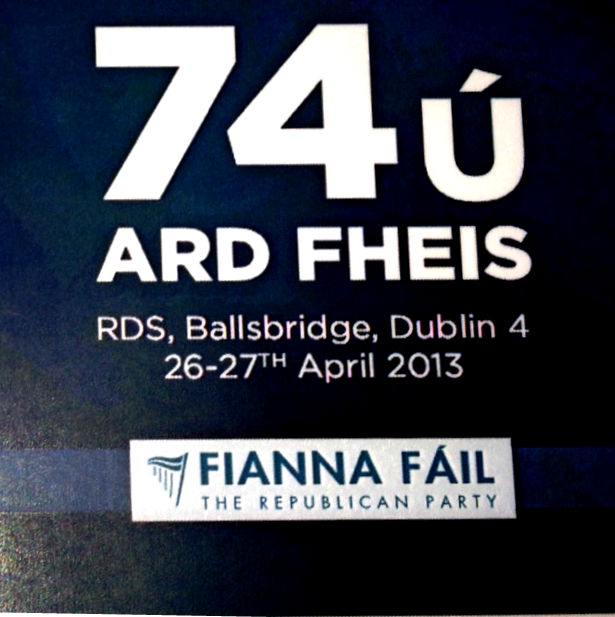
My column on this weekend’s Fianna Fáil Árd Fheis from today’s Herald
If you are planning to head to Ballsbridge for a quiet pint or a cup of coffee this Friday or Saturday – think again. From about 5pm this Friday until well past mid-night on Saturday the area around the RDS will be saturated with about five thousand exuberant and excitable Fianna Fáil-ers gathered for the party’s Árd Fheis – including yours truly.
If you decide to follow the Árd Fheis proceedings online or on air you can expect to hear the Good Friday Agreement (GFA), whose fifteenth anniversary passed two weeks ago with little acknowledgement from the Government, mentioned several times.
Many in Fianna Fáil fear that its greatest recent political achievement is being slowly air brushed out of official history.
The impression is being given that the GFA was merely the logical and inevitable consequence of the 1985 Anglo Irish Agreement, about which we have heard a lot following the deaths of both Garret Fitzgerald and Margaret Thatcher.
As one of many people who spent countless hours travelling up and down to Belfast on pre M1 roads that stopped for lollipop ladies in Balbriggan and Julianstown, I can assure you there was nothing inevitable about it.
But the Good Friday Agreement is also something of a metaphor for Fianna Fáil itself.
We now see that that getting agreement was the easier piece of work when compared with the effort and energy required to get it implemented and working – well, almost working.
The same is true of Fianna Fáil. The work required to get the party to this point has been huge, but it as nothing to the work ahead.
While last year’s Árd Fheis focused mainly on important internal reforms, such as One Member One Vote, the truly difficult work starts now.
This Árd Fheis is more about facing outwards and talking to an electorate who now shows signs of being ready to listen to what the party has to say. But the party’s improving opinion poll figures should not delude pundits, or even party members, to thinking its resurgence is assured.
To be brutally frank, what has Fianna Fail said or done in recent months to justify such increases? While it has produced some very fine policy proposals such as the Family Home Bill and Regulation of Debt Management Advisors Bill, they hardly account for bounce.
Nor does the performance of the party’s spokespeople.
Without doubt the party has scored significant hits on the government in recent months, particularly via its Health Spokesman Billy Kelliher, its Finance Spokesman Michael McGrath and its Justice Spokesman Niall Collins and, of course, the party leader Michéal Martin, but it is finding it difficult to mark all bases with such few Oireachtas personnel.
While he has several new people inside the Oireachtas who he can use effectively: such as Senators Averil Power and Marc McSharry, perhaps the leader also needs to look outside the ranks of the parliamentary party for other new faces and voices to put on Radio and TV in senior roles – Dublin Bay South’s Cllr Jim O’Callaghan for instance.
The hard truth is that the increases are as much down to Fine Gael and Labour’s travails as they are to any softening of attitude to Fianna Fáil. Besides, as the poll analysts would tell you, it is dangerous to read too much into opinion polls where over 30% of the respondents are answering: don’t know.
This is not to underestimate the size of what the party has achieved. At this time last year it was a tough job convincing others that while the party may be down, it was not finished. The big achievement has not been the increases in the polls, but rather the halt in the party’s decline.
At last year’s Árd Fheis the party helped reverse that decline by re-introducing itself to its own members, this weekend it starts the even great task of re-introducing itself to its former supporters. Let’s hope it has more success in doing that than the GFA has had in getting its institutions working.
Surely I cannot be alone in realising that there is less chance of Fianna Fáil and Fine Gael linking up than there is of Luis Suarez having all his teeth pulled and turning vegetarian.
Yet, within hours of each new opinion poll you will see lots of speculation in print, on air, online and/or on all three that the next government will consist of Fianna Fáil and Fine Gael in some combination or other.
Such speculation seems to be based just on adding together the numbers that bring you to 50% and ignores the glaring Catch 22 that renders the chances of any such FG/FF or FF/FG alliance impossible: neither party would ever agree to go into a partnership government where it was not the biggest partner.
And as, by definition, a partnership government of just two groups cannot have two biggest partners, neither party would agree to be the junior partner in such a relationship. To do so would fly in the face of the fundamental rule of Irish governmental politics: junior coalition partners come off worst.
The strategists in both Fine Gael and Fianna Fáil know this. Whatever their weaknesses and deficiencies in policy formulation, these are still wily and experienced political operatives, they understand political realities. More critically they understand the laws of self preservation. They know that going into government as the junior partner while leaving Labour and Sinn Féin as the official opposition would be tantamount to writing their own party’s obituary.
Those who argue, on the basis of current opinion polls, that the Fine Gael / Fianna Fáil option may be the only viable one after the next election, do it on the basis that politics is a “numbers game”.
Well, to some degree it is, but numbers do not dictate everything. True, without the numbers you have no role and no say, but the converse is not true. Having the numbers does not mean that you must necessarily do A or B. Having the numbers does not restrict your options, quiet the opposite. Rather than being compelled to pursue some particular course, you have the opportunity to exercise judgement and think strategically.
This is not to discount the temptation and lure of ministerial office, especially to those who may not plan to face the electorate again. Saying no to power is no easy task, but the decision is made somewhat less troublesome if you know that saying yes to office today as a junior partner means that you are almost certainly ensuring that that option will be denied to you and your colleagues for many years thereafter.
Though majorly damaged after electoral pounding it took in the February 2011 General Election, Fianna Fáil is still hard wired for power – perhaps even more so that Fine Gael – so saying no to office would be difficult for some within the upper echelons of the organisation. Perhaps this is why the party leadership has recruited the membership of the party to ensure that any post election decision would be made by the broader party.
The situation is just as true for Fine Gael, though for other reasons. Having spent so long as the second party of Irish politics, it is now relishing its time in the top spot. It will be loathe to surrender that place – least of all to Fianna Fáil.
If the next election were to put Fianna Fáil ahead of Fine Gael, no matter by how small a margin, Fine Gael would do nothing to help Fianna Fáil back into power. Fine Gael would seek alliances with Labour, Sinn Féin, Independents, Socialists, Wallacites; McGrath-ites (of the Mattie or Fintan variety) Greens, People Before Profit, Profit Before People, Cart Before the Horse or whoever to keep Fianna Fáil out.
I know I risk appearing more than a little cynical in not mentioning policies and principles and just discussing the possible make up of a future government in terms of survival strategies but, I believe the chances of a Fine Gael/Fianna Fáil government are so remote and unrealistic that it is cynical not to dismiss it and to allow any more time and energy be wasted on discussing an option (and the associated policies) that does not exist.
The late Séamus Brennan: “You are playing senior hurling now lads…”
“You are playing senior hurling now lads – but you are playing with lads with All Ireland medals”.
This, according to Eamon Ryan, is how the late Séamus Brennan greeted the Green Party team as it arrived in Government buildings for the 2007 talks on forming a government with Fianna Fáil.
It is a phrase that every Labour Party TD calling for a renegotiation of the Programme for Government (PfG) should print out and place at the top of their PC screen.
God be with the days when Labour recruited its Dáil candidates from the old ITGWU or FWUI. Those guys knew the first principles of negotiating; they particularly knew that you did not go into negotiations unless you had 1. A strong hand and 2. A fair idea of the outcome. Yet some in Labour are advocating that they enter talks with neither.
They want to enter a renegotiation of the government’s fundamental policy programme at precisely the moment when their party has hardly ever been weaker. Do they seriously expect that their senior partners in Fine Gael will take pity on them and offer them major policy concessions just because they are having a bad hair day?
Do they really underestimate their government partners that much?
Politics is a tough world guys. Wake up.
You do not get your way in politics just because you mean well, you get your way and get policies implemented by getting a mandate and pursuing your goals assiduously.
You certainly do not enter talks with partners from whom you wish to extract concessions with the message: we are in a weakened state and desperately need to give the impression that we can beat you into submission, so please, please, please let us.
It is the equivalent in nature of a lone deer asking a lion to not to devour them as they have a leg injury and cannot run properly today. Indeed it goes further and suggests that the lion should agree to allow the injured deer to bitch slap them around for a while so that any other deer who may be watching from a distance will think more highly of them.
There is no compulsion on Fine Gael to enter meaning renegotiation talks with Labour. They know Labour cannot cut and run now and risk facing the electorate, so they know it is strapped into this arrangement until the bitter end. The very most Labour could hope to get is a sham negotiation where we see TV clips of the pairs of Ministers from each side entering Government buildings for late night talks and the last minute “leak” from a source “close to the Labour leadership” saying the talks are at a crucial point right now and may go well into the night. The optics will look good, they may even fool a few activists, but most others (including the public) will see it as just a gesture. If the guys want to go down this road there is doubtless a battered old playbook for such an exercise laying around Government building somewhere.
The current cohort of Fine Gael TDs is possibly the most right of centre since the late 1950s. They are already getting flack from supporters and voters for the appearance that Labour is dictating too much of the government’s agenda, particularly on social issues, so they are neither motivated nor minded to give any more policy ground to them on the back of what was a bad day for Labour and, conversely, a good day for Fine Gael.
The idea of renegotiating the PfG is at best: naïve, and at worst: dumb.
That so many TDs would advocate it after only two years in office suggests that we are probably beyond the mid point of the life of this government and that the chances of there being a general election in early 2015 just got stronger.
My column from yesterday’s Evening Herald (21/Feb/13) taking a very personal look at where Fianna Fáil is today; almost exactly two years on from the political meltdown of Election 2011
Sums up the the response in many places in 2011
——————————————————————————————————————
Though I don’t share his politics I like John O’Farrell. O’Farrell, whose father hailed from Galway, is a comedy writer and British Labour Party supporter who is now their candidate in the Eastleigh by-election.
My reasons for liking him stem not just from his days as a script writer on Spitting Image but from his hilarious 1998 memoir: Things Can Only Get Better: Eighteen Miserable Years in the Life of a Labour Supporter.
In it he details the disappointments, frustrations and the heartache he endured at all levels of the Labour Party until he came to realise that “Michael Foot would never be Prime Minister… and that the nuclear arms race was never going to be stopped by face painting alone.”
A few months after the punishment beating that was Fianna Fáil’s 2011 General Election result I started to wonder if I should start work on my own homespun version.
I toyed around with several possible titles, including: I Thought That Things Could Only Get Better: Boy, Was I Wrong or Fianna Fáil: the view from the edge.
The idea never got beyond a few lines on the PC screen, however. This was partly due to my not seeing anything even vaguely humorous in my situation, but also to me not knowing any publisher sufficiently cracked to commission it. Back in 2011 it was hard to imagine a market for such a work.
I also had a slight suspicion that the party was not yet ready for the scrapheap, nor for 18 years in the wilderness.
Yes, it was in bad shape – very bad shape. Not just the organisation, but the people too. Friends and colleagues who had worked in politics were shell shocked by the result. Not just elected reps, but people on more modest salaries working behind the scenes. Researchers, press officers, organisers and administrators. Losing 51 seats meant HQ shedding staff over half its staff.
But along with this loss, a loss that many hundreds of thousands of other people have had to face, was the realisation that people of my vintage were the ones who had allowed the decline to happen: we could be the generation that not only wrecked Fianna Fáil, but damaged the values on which it was founded.
This is not to underestimate or disregard the mistakes we made and the anger we caused to those people whose support we had sought and won over the decades. Nor is it a plea for pity. It is just to acknowledge that the 2011 defeat had real consequences for many of us.
While there were reports of some particularly heated and fraught exchanges during the campaign, what I experienced at the doors was a harsh coldness. The voters had long since made up their minds on Fianna Fáil – we had let them down badly and we would pay the price.
I suspect many voters even surprised themselves with the scale and magnitude of the Tsunami that engulfed Fianna Fáil two years ago.
Two years is not a long time in the life of an established political party. While the coldness and mistrust may have thawed somewhat, there is still a lot of real anger out there that will take a long time to address.
This should not be confused, however, with the contrived disdain that characterises some people’s attitudes to Fianna Fáil. As Sean Gallagher discovered during his presidential bid, it is now almost McCarthey-esque. You can talk about us in a way that you could not about almost any other group.
It ranges from the scorn that perceives FF as unprincipled, gauche, maybe even a bit NOCD (not our class dahling) to the more visceral anti Fianna Fail-ism that sees us all as chancers and strokers.
But for as long as I know that I am in a party that works to give people the means and opportunities to succeed, I reckon I can live with that.
Today, December 29th 2012, marks the 75th anniversary of the Irish Constitution, Búnreacht na hÉireann coming into effect. This is my Evening Herald column on it continuing importance and relevance to Irish life.
Dev – Architect of our Constitution
On this day seventy five years ago the Irish Constitution came into operation. As we have seen in recent and current controversies, almost four decades on, the Constitution is still central to much of our political debate.
Within the past year we have seen it successfully amend it three times: Judges Pay, Fiscal Compact and Children’s Rights. But, we have also seen the public resoundingly reject the governments request that they amend it on the issue of Oireachtas enquiries.
It is not the first time the public has done this. Not only did they defeat the Nice I and Lisbon I votes, as early as 1959 they rejected the then attempt to change the voting system. Indeed in 1968 the voters rejected the next two amendments put to them, both related to elections.
It was not until the 1972 vote on joining the then EEC that the people passed the first amendment to the Constitution. (Technically this is the Third Amendment as the first two were made in 1939 and 1941 without referendums as part of transitional arrangements.)
Over the past 75 years the public have approved some twenty five changes to the Constitution. While some were technical in nature, others – such as the five votes relating to abortion – were highly controversial and emotionally charged.
What this shows is that the Constitution makes the people sovereign. They alone decide what changes may be made to the fundamental law of the land.
This important aspect of De Valera’s 1937 Constitution has been much praised over the years. While it is easy to look at the language and some of the secondary provisions as being a product of their time and maybe a little outdated now, most legal experts view the principles set out in the Constitution of 1937 as being ahead of their time.
Five of the fifty articles are devoted to Fundamental Rights. Decades before international instruments, such as the United Nations Charter and the Universal Declaration of Human Rights proclaimed fundamental rights and fair procedures, the Irish Constitution had done so.
Indeed, while the Constitution does not declare Ireland as militarily neutral, it does contain in Article 29.2 a commitment to “the pacific settlement of international disputes” and the adherence to International law. This is just something else that marks the document out as being ahead of its time.
But while it may have been well ahead of its time 75 years ago, it is still so?
I would argue that, essentially, it is. The fundamental principles it espouses are just that – fundamental. The commitment to democracy, rule of law, fair procedures etc do not change with the seasons of the prevailing political fashion.
But it is also a living document, particularly in the provisions relating to how government and the judiciary should work. Back in 1937 it seemed natural that only those over 21 should be entitled to vote, by 1972 that was changed to 18 by a margin of over 5 to 1 of those voting.
Events of recent years have thrown up some more significant issues. Are our governmental structures sufficiently responsive – or even fit for purpose – in the context of the IMF/EU bailout and an evolving European Union/Eurozone? Is the 1930’s post independence concept of property ownership appropriate in 21st century Ireland?
But where is reform on these issues being discussed? Not at the Government’s Constitutional Convention, it seems. Its initial priorities, as set out by the Government, are to discuss the President’s term of office and the voting age. This is the equivalent of setting up a dance committee after the Titanic has hit the ice. The one substantive constitutional issue on which the government, particularly the Taoiseach, is committed is abolition of the Seanad.
Just when we require more meaningful scrutiny of government policy, it proposes less and sells it under the guise of “reform”. Fortunately, it is the people who will be sovereign on this.
The text of my column from tonight’s Evening Herald (Mon Sept 17th)
—————————————-
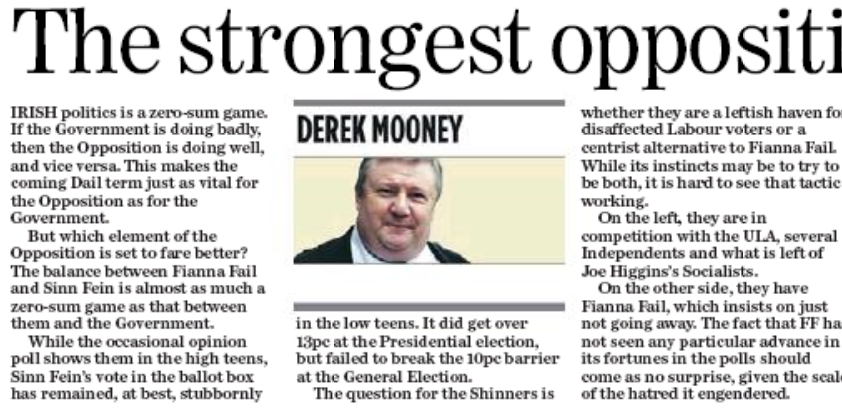
Irish politics is a zero sum game. If the government is doing badly; then the opposition is doing well, and vice versa.
Derek Mooney’s Column in tonight’s Evening Herald
This makes the coming Dáil term just as vital for the opposition as for the government.
But which element of the opposition is set to fare better? The balance between Fianna Fáil and Sinn Féin is almost as much a zero sum game as that between them and the government.
While the occasional opinion poll shows them in the high teens, Sinn Féin’s vote in the ballot box has remained, at best, stubbornly in the low teens. It did get over 13% at the Presidential election, but failed to break the 10% barrier at the General Election.
The question for the Shinners is whether they are a leftish haven for disaffected Labour voters or a centrist alternative to Fianna Fáil. While its instincts may be to try to do both, it is hard to see that tactic working.
On the left they are in competition with the ULA, several Independents and what is left of Joe Higgin’s Socialists.
On the other side they have Fianna Fáil, which insists on just not going away. The fact that FF has not seen any particular advance in its fortunes in the polls should come as no surprise given the scale of the hatred it engendered.
The past 18 months has been about Fianna Fáil stabilising its position. It has put a floor under its decline, which was no small task. The issue now is if it can recover former ground.
While FF may skirmish with SF over ex FF voters who went to Labour, the main battle will be fought elsewhere and with another enemy. Surveys suggest that up to 40% of those who said they voted FF in 2007 switched to FG in 2011.
This sizeable group are still angry and hurt. They have not been ready to listen to Fianna Fáil so far. Will they become disenchanted over the coming months with Enda Kenny and Fine Gael as it struggles to deliver on its election promises?
Will this be sufficient? Will the disenchantment be enough to allow them to listen to anything the party has to say, never mind be convinced by it? These are questions taxing Fianna Fail reps at their think in today and tomorrow.
The opposition parties and independents will also need to consider the competition they face from the emerging, and varied, opposition within government.
It ranges from Brian Hayes and Joan Burton’s fighting over pensioners to FG backbenchers bemoaning its failure to take on the public sector.
The greatest challenge, though, may come from within the Labour Party. There seems to be something about becoming chairman of the smaller party in government that makes the holder think they are the deputy leader of the opposition. I call it “Dan Boyle Syndrome”.
As a first time Deputy; sitting on the government backbenches; the new Labour Chairman may gaze longingly at the other side of the Dáil wishing he were there opposing and criticising the current Government, but he isn’t.
The public gets the difference between government and opposition. They understand the fundamental truth of Mario Cuomo’s famous maxim: “you campaign in poetry but you govern in prose”.
If he thinks doing solo runs will firewall him from the approaching barrage of criticism and unpopularity, then he is in for a nasty surprise. All he needs to do is Google “Dan Boyle” and “election results” to see how these tactics failed.
FG and Lab TDs would do well to heed the words of Mary Harney: “Even the worst day in government is better than the best day in opposition”. This may seem unlikely, but it is the case, especially if you believe politics is about improving things.
If they doubt it, then they only need call the Marine Hotel and ask any Fianna Fáil TD.

 A few months before the 2011 election, Michael Gallagher (the TCD Professor of Politics, not the Donegal postman and amateur weather forecaster) posted a blog where he asking how long Fianna Fáil could expect to spend in opposition. In it he wrote: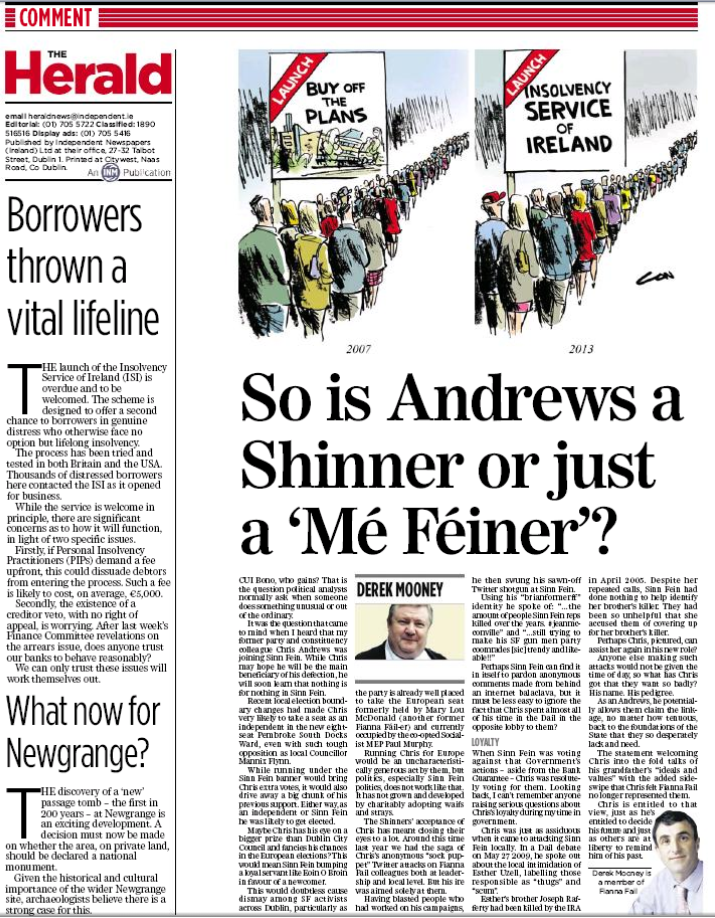




 derekmooney.ie