This column appeared on Broadsheet.ie on November 24th as the Frances Fitzgerald saga was coming to a peak:
How did we get to this situation? Well, as with any crisis, we got to it one step at a time.
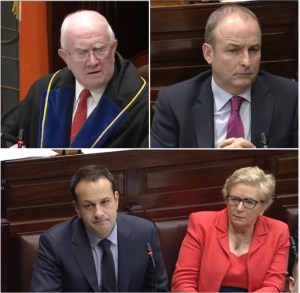
Leo Varadkar did not start this week with a plan to trigger a snap election, no more than Micheál Martin did, but with a series of serious missteps Leo Varadkar walked this government to the brink and last night whipped things up to a point that the country is now on a course that means a general election either before Christmas or early in 2018.
Misstep number one came with the Taoiseach’s opening comments on Leader’s Question in the Dáil last Tuesday. when he attempted to address the issue
“The House will appreciate, once again, that I do not have first-hand knowledge of any of these matters.”
With those words it was clear that an Taoiseach was approaching the issue of Minister Fitzgerald’s level of knowledge on the campaign against Sgt McCabe satisfied that it had nothing personally to do with him and, so it was not something for him to be worried about.
This week’s Broadsheet column was a defence of the oft criticisied Summer School season and an argument for more policy Irish think tanks, for for a Fianna Fáil aligned one in particular. Original column online here: Broadsheet.ie
At around 4.20pm on Friday last Dáil Éireann adjourned for the Summer recess. It is due to return at 2pm on Wednesday September 20th.
If this Dáil was actually processing legislation, especially the range of halfway decent Private Members Bills coming from backbenchers across the House, then there may be a basis for complaint. But, it isn’t.
To be fair, it is not as if TDs and Senators are about to head off to the Maldives or Marrakech. The Seanad is sitting this week, as are several Oireachtas committees, and they will take a shorter break than the Dáil and return earlier – and before you sigh that the committees don’t count, bear in mind that Sean Fleming’s Public Accounts Committee will be launching its report into the financial procedures at Garda College, Templemore at 2.00pm tomorrow.
This is my Broadsheet.ie column from last week, published before today’s Sunday Times/B&A poll showing FG on 29% and FF on 30%. This joint level of support of 59% is a positive, particularly for FF and suggests it has scope to get its average showing back into the low 30s.
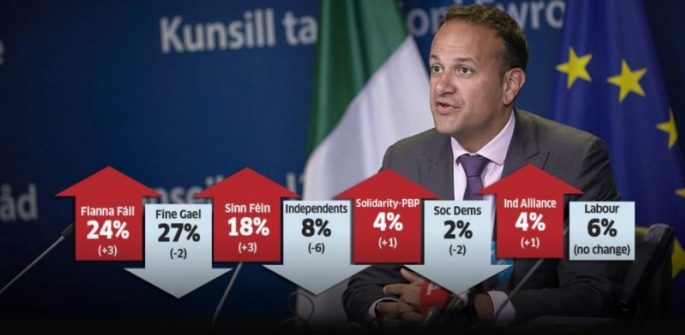
Yesterday’s Sunday Business Post/RedC poll showed Fine Gael’s lead over Fianna Fáil closing by 5pts: from 8% in late May to down to just 3% now) This suggests an abrupt end to the Varadkar honeymoon.
I stress the word “suggest”. While the RedC poll puts Fine Gael on 27% and Fianna Fáil on 24%, another poll, taken exactly two weeks earlier by the Irish Daily Mail/Ireland Thinks put Fine Gael on 31% and Fianna Fáil on 26%. While it is possible that Leo’s less than adroit handling of events over the last two weeks may have shaved 4pts off his halo, it would be folly to try to conclude that from the results of two separate polls conducted by two different companies and taken at two different time periods.
What you can do, though, is track and compare the results from one individual polling company over a period of time. Fortunately, Red C does that for you via its handy online live-polling-tracker. Here you can find the results from the 10 polls conducted by Red C over the past year.
This column is from two weeks back (July 3rd, 2017) and is both a guarded defence of the political party system and a warning of the dangers of the constant desire of the hard left fringe parties to take politics out on to the street.
It is said that France has the only “tricameral system” in the world – the National Assembly, the Senate and the Street – but history and experience shows that the Street has always been the biggest hindrance to reform. Origianl column online here: www.broadsheet.ie/who-would-want-to-be-a-td/
Who in their right mind would want to become a T.D.?
The pay is good, the perks are decent and the scope for promotion (career and ‘self’) is none too bad either, but can these incentives really outweigh the forfeiture of a private life, never mind the ongoing press, public and social media opprobrium whenever you express an opinion?
Shouldn’t politics be a vocation, not a career path?
The problem with that view is not just that it is naïve, it is that it simply won’t work. Try it and we end up with a Dáil full of only those who can only afford to be there by virtue of their profession, their families’ money or simple “pull” – by the way not all of them would be on the right, a fair few would also come from the comfortable left, but that’s just an aside.
This Broadsheet column first appeared online on June 12th 2017. In it, I explore the ramifications of the 2017 Westminster election result on politics in Northern Ireland, and suggest – borrowing heavily from an Irish Times article by Denis Bradley – that politics on the nationalist/republican side may be set for a major change over the coming year…www.broadsheet.ie/the-perks-of-abstinence/
While the outcome of the Westminster election was far from conclusive in England and Wales, the same cannot be said for Scotland and Northern Ireland.
Only for the resurgence of the Scottish Tories under Ruth Davidson, Theresa May would be moving furniture rather than clinging to office by her fingertips. While the same Scottish result has, sadly, delayed the prospect of an Indy2 referendum, as the SNP Westminster representation collapsed from 56 seats to just 35 thanks to a 13% drop in support.
Enda Kenny’s fascination with his predecessor John A. Costello continues. Not only is Enda determined to beat Costello’s record for time served as Taoiseach, he now seems to want to eclipse Costello’s penchant from making major constitutional announcements outside the country.
Costello announced his intention for Ireland to abandon the External Relations Act (and effectively quit the British Commonwealth and declare itself Republic) during a visit to Canada in 1948, while Kenny announces in Philadelphia that he intends to hold a referendum to give the Irish diaspora votes in future Irish presidential elections – but only in elections after the next one.
There are many legends about Costello’s Ottawa announcement, including one version that claims he made it when was “tired and emotional” and another that asserts he did it after being offended by the placing of a replica of the Roaring Meg canon used in the Siege of Derry in front of him on the dining table at a formal dinner at the Governor General’s residence. But they are only legends.
This is my latest article for Broadsheet.ie – available online here: New Politics Explained
What exactly is this “New Politics” we have been reading and hearing about so much lately?
It was the question that should have occurred to me as soon as the Public Relations Institute asked me to participate in a panel discussion they held last Thursday as part of a half day seminar entitled: Public Affairs in the era of ‘New Politics’.
But it didn’t. Like many others, I have been throwing about the phrase “new politics” in the two and a half weeks since the Dáil elected a Taoiseach as if everyone understands what it means.
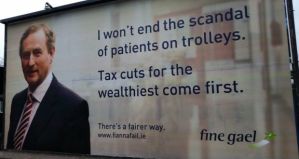
Fianna Fáil’s poster attacking Fine Gael’s broken promises
Whether polling day is on Feb 26th or March 4th, it is clear that we are only two or three weeks away from the start of the great 2016 corriboard shortage… sorry, the 2016 general election.
Over the coming two weekends we will have the Fianna Fáil and then the Fine Gael Ard Fheiseanna, followed by Labour at the end of January – presuming that Enda hasn’t already called the election and pulled the plug on Labour’s big day out.
While the corriboard campaign posters remain in their wrappings and the Vote for me leaflets stand ready, the electioneering has already as good as started.
One the most interesting aspects of Fine Gael’s pre-campaign campaigning so far is just how much time and energy a party determined to dismiss Fianna Fáil as irrelevant is devoting to attacking them. See Today FM’s Matt Cooper’s comment on the Taoiseach’s Wednesday afternoon press conference:
Could it be that Fine Gael’s own private polling is telling them something the national newspapers polls are missing?
It occurred to me recently that Enda has spent the last few years doing a very bad Bertie Ahern impression – making Enda the Bobby Davro of Irish politics you might say. Enda gets the minor gestures and mannerisms right – but he misses the core of the character.
Enda may be as accomplished and expert a glad handler as Bertie when it comes to wading into a crowd and shaking the hand and slapping the of everyone around him, but he his mimicry is one dimensional. He does not possess Bertie’s skill and ability to command the facts and figures when engaging with the media on door step interviews.
While Enda still possesses many skills and abilities, not least his steely determination and ruthless streak, he is not politically hard wired to endure or sustain a long election campaign – especially if he hopes to keep his media interactions down to a few tightly managed ones.
It is a mistake on two fronts. First as they seem to be copying the Tory playbook here with minimal changes and basic adaptions.
Do they so see themselves as Ireland’s Tories that they cannot be bothered to make even the most basic of changes to the strategy, the text and the slogans? A series of recent Fine Gael social media posts have used the Tory line: “long-term economic plan” word for word:
While the Tories undoubtedly mounted a superb social media campaign in the 2015 UK general election and used the platforms, particularly Facebook, more effectively than most of their rivals (apart from the SNP who are the master campaigners both online and on the ground) that does not mean you take their campaign slogans and approaches lock stock and barrel.
Second, in taking the Tory campaign playbook en masse Fine Gael seems to have forgetten that we have a PR STV system, not First-Past-The-Post – indeed Fine Gael used to pride itself as being the defender of PR STV (they had opposed the two attempts to change the voting system by referendum in the 50s and 60s)
What works in a FPTP system does not necessarily work in a PR-STV one. Depending on where you live in a FPTP system you can find yourself voting for someone you don’t like rather than the one you do like most just so you can make sure the one you dislike more is kept out.
The idea that a vote for Fianna Fáil or Independent alliance is a vote for Sinn Féin is not so easy to sell in an STV system where the voter can vote the entire panel right down the line and omit the local SF candidate.
That said is easy to see the attractiveness of the Tory playbook for Fine Gael. The Tories succeeded in keeping their leader out of head to head debates, Fine Gael want and need to do the same – though for different reasons. While Cameron was wary of elevating Milliband by sharing a head to head debate platform with him – there were no questions about the PM’s capacity to perform well in a head to head debate.
The other attraction was the Tories successful cannibalisation of their Lib Dems coalition partners. Cameron’s gains came mostly from Lib Dem losses (The Tories took 27 of the 49 Lib Dem seats lost as opposed to 12 lost to Labour and 10 to the SNP) – an option that Fine Gael is eyeing up here, using Labour losses to shore up their own numbers. Fine Gael are ready to fight this campaign to the last Labour TD.
Though Fine Gael’s polling numbers have recovered recently – at precisely the time they needed them to recover – they are still on course to lose seats, even if they do get 31/32% in the polls.
While these improving numbers are no mere coincidence and are a tribute to Fine Gael’s political strategists, the idea that seems to be floating about the commentariat that Fine Gael is now some invincible campaigning machine is more than a little bit short of the mark.
Fine Gael is having a few problems of its own right now, and they are problems entirely of its own making. Though they will doubtless address the issue between now and the Árd Fheis (and possibly drum up future local difficulties in the process) Fine Gael was still short of the 30% gender quota up to a few days ago – a system they introduced and championed.
Not only that but its head-quarters operation has just ended an unseemly, costly and ultimately unsuccessful fight in the Courts with one of their own candidates: John Perry TD.
And before I am accused me of dragging up these problems like a Fianna Fáil-er whistling past the graveyard, I do not think this is a zero sum game. I do not presume that any loss of ground by Fine Gael over the campaign will automatically translate into a Fianna Fáil gain.
Fianna Fáil will have to make its own ground in this one and will need to land some hefty punches on Enda, Leo, Michael and Simon, it cannot depend on Enda and Fine Gael to just lose it.
I have now updated my initial thoughts, musings, observations and mild rantings on the implications of the local election results, particularly Fianna Fáil’s stronger than expected showing.
This was first posted on Sunday morning – updated on Monday morning to reflect the revised party national totals in the Local Elections.
Local Election Results national overview
“If history repeats itself, and the unexpected always happens, how incapable must Man be of learning from experience.” – George Bernard Shaw.
Quite a lot, it seems.
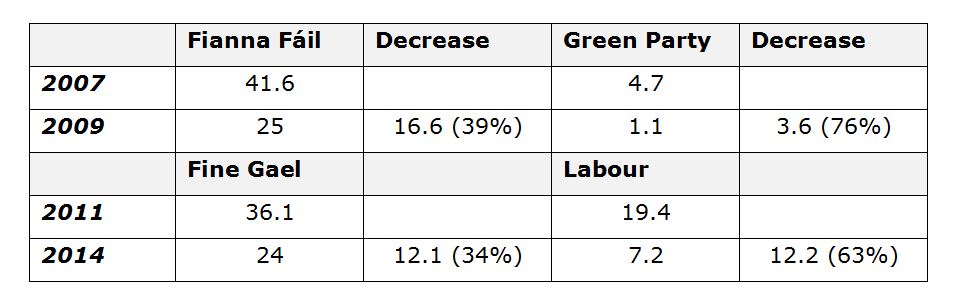
Yesterday we saw history repeating itself, with the electorate visiting upon Fine Gael and Labour almost exactly the same devastating blow it had served up to Fianna Fáil and Labour five years earlier.
In 2009 Fianna Fáil lost around 39% of its support (when compared with 2007) while the Greens endured a massive reduction in its vote of 76%.
Yesterday, based on the Local Election results to hand, Fine Gael lost 34% of its support and Labour lost 63%.
While the story of the Local Elections is the rise in support for Sinn Féin and the Independents and the scale of the loss for Labour, the Fine Gael haemorrhaging of support should not be ignored.
Indeed, the case can be made that the real story of the election is this massive Fine Gael loss – a loss that should not be glossed over by what might appear to be its reasonable performance in the European Elections.
Losing 100 plus Councillors, on a day when you have increased the number of available council seats, is a political meltdown of Fianna Fáil in 2009 proportions. It will send a shiver around the Fine Gael backbenches that will match that currently coursing along the spines of their Labour colleagues.
Leo Varadkar’s line that the next election will be a battle between Fine Gael and Sinn Féin was a clever attempt to calm the troops with the notion that their lost support will come back when the Irish voters realise that Fine Gael is all that stands between them and the Shinners.
It’s clever line, but a flawed one.
For it to offer any comfort it would need to be underpinned by Fine Gael still remaining the largest party – but it hasn’t. By the time the dust settles it will become clear that the other big story of the locals is the return to frontline politics of Fianna Fáil, even if its European results are a bit rocky.
If the battle of the next election is, as Varadkar suggests, to be fought on the question of where you stand with regard to Sinn Féin then Fianna Fáil, with a few more weapons in its armoury, is standing on better – and now even firmer – ground than the depleted followers of Enda.
While Fine Gael may see itself as the antithesis of Sinn Féin, Fianna Fáil can challenge SF’s voodoo economics every bit as credibly as FG, but with the added bonus that that can better undermine and dismantle the Shinner’s fallacious claim to Republicanism, especially in its back yard.
The other story of the Fianna Fáil result is its incredible variety. Its national level of support at just over 25% belies some very good and incredibly bad local results, especially in urban centres.
They range from the sublime such as its 49% in Bailieborough-Coothall 39% in Castlecomer and 38.4% in Ballymote-Tobercurry to the ridiculous: such as its 4.9% in Dublin North Inner City, 6.8% in Tallaght South and 8.7% in Lucan.
While there are several other disappointing low teen results in urban centres across the country e.g 9.6% in Waterford City South, 10.5% in Bray and 13% in Limerick City North, it is no coincidence that the single digit performances are in Dublin.
That is not to say that the Capital is a wasteland for Fianna Fail. Contrast the single performance mentioned above with the parties stunning 27.3% in Castleknock, its 24.2% in Clontarf and its 22.3% in Stillorgan.
While the overall Dublin result of 16% points to a major problem for the party, the variety in results, highlighted above, shows Fianna Fáil’s further potential for growth and renewal in large swathes of Dublin.
It is the very patchiness of its result that points up where the party needs to work harder and better. Far too many candidates in Dublin were left to struggle on by themselves with no structured national campaign to underpin their efforts.
Having “Fianna Fáil” on your poster does not guarantee a good new candidate a certain base level of support in Dublin and other urban centres in the same way as having “Sinn Féin” on your poster did for their new first time candidates. Indeed it does not offer the prospect of that base level of support as it does in non-urban Ireland.
The candidates in Dublin raised the Fianna Fáil vote to their level, not the other way around. The vote in Dublin and other urban centres, is not the party vote plus the candidate’s unique personal support – it is just the latter. In certain parts of the city is it the unique personal support minus the residual antagonism to Fianna Fáil.
The “Fianna Fáil” identity is Dublin is not a coherent identity based on a core defining message from the party as a national political party: it is the collective identities of its various candidates.
This is not to underestimate the particular nature of Dublin voters, especially their looser party allegiances; it is just to point out that Dublin voters are just as likely to be receptive to a national message, just less continuously loyal to it.
Despite some clearly very good results in Dublin, most Fianna Fáil supporters still struggle to answer the questions: why should I vote Fianna Fáil and what does Fianna Fáil stand for. Most of the successful candidates I have encountered in Dublin answer it with the words: here is what I stand for…
It is not that there are not answers to these questions, but rather that the party has not sufficiently defined and substantiated them.
It is work that can and must be done. That work is not aided or encouraged by intemperate outbursts or Quixotic threatened heaves. The issues are policy and organisation – not personality.
The 24.3% of voters who abandoned Fine Gael and Labour saw their political alternatives this week. Some said independents, some said Sinn Féin – though not by a large margin as the swing to Sinn Féin since the 2011 election is in the 5.3%, but even more said Fianna Fáil with a swing of just over 8%, but the point should not be lost that the biggest single section of them said: none of the above.
The ones who stayed at home are the ones who were badly let down by Fianna Fáil and are now just as angry with Fine Gael and Labour for promising them a new politics and then delivering the old failed politics as usual.
Perhaps they concluded that they could afford to sit out these second order elections, as they do not see how the results will change their lives, they will not be as sanguine at the next election.
While there are worse jobs in the world: the worst job in politics is certainly leader of the opposition.
If he didn’t already know this, it is certain that Fianna Fáil’s leader Micheal Martin will know this in just over a week.
The 2014 European and Local Election campaigns for which he and his HQ team have prepared and planned for over 18 months are proving themselves to be a source of unalloyed joy. It is hard to believe that these are the campaigns they wanted.
The latest round of opinion poll findings only confirm this. They suggest that
His Dublin Euro candidate will fail to take the seat
His Midlands North West duo may struggle to win a seat
While his Ireland South candidates have the best part of two quotas between but are so imbalanced as to render a second seat impossible.
If the ballots cast on Friday confirm these poll findings, then it will be hard to make any of this sound like an achievement.

 How did we get to this situation? Well, as with any crisis, we got to it one step at a time.
 This is my latest article for Broadsheet.ie – available online here: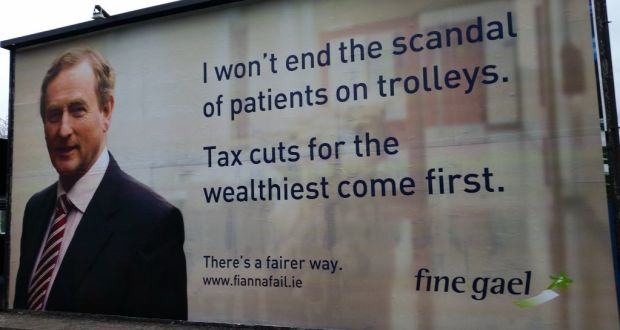


 derekmooney.ie