Sinn Féin is not so much a “party in transition” as it is “transitioning into a party”

This is my Broadsheet column from last Monday (Sept 19th) and appeared online here: www.broadsheet.ie/still-behind-you/

——————-
fu

Yesterday was a busy media day for Sinn Féin’s Deputy Leader, Mary Lou MacDonald. Within the space of an hour she had appeared on RTÉ’s The Week in Politics and BBC 1’s Sunday Politics.

Mary Lou was doing what she does better than anyone else in Sinn Féin: taking no prisoners, firmly holding the party line and all without seeming unduly hostile or aggressive.

During the course of her one-on-one interview with BBC Northern Ireland’s Mark Carruthers; Mary Lou described Sinn Féin as being a party “in transition”.  Given the context this was a reference to either: the potential for generational change in the Sinn Féin leadership or, to Sinn Féin’s ambition to be more seen as a potential party of government.

Perhaps it was a reference to both – either way, I am sure Mary Lou meant the phrase to convey the sense of a political party undergoing change and development.

I happen to agree that Sinn Féin is “in transition”, except that the transition I believe it is undergoing is into becoming a normal political party. It is a transition that it has been undergoing for some time, with varying degrees of success, but it is still an ongoing process.

Sinn Féin is not so much a “party in transition” as it is “transitioning into a party”.

The party leadership is an obvious example. It is not the only example. Normal political parties do not have T.D.s collecting convicted Garda killers from prison upon their release, nor do they hail convicted tax evaders as “good republicans”, but for the purposes of this piece, let’s just focus on the autocratic nature of Sinn Fein’s leadership.

Though he is over thirty-three years in the role, we are expected to believe that no one over that time in Sinn Féin has ever been unhappy with Gerry Adams’ leadership or ever willing to challenge openly it.

For most of those 33 years obedience to the leadership of Adams and McGuinness has been a core principle – one that seemed to trump everything else. But as the fictitious Chief Whip, Francis Urquhart, observes in the opening sequence of House of Cards: “Nothing lasts forever. Even the longest, the most glittering reign must come to an end someday.”

The blind obedience has started to slip over recent years. From the resignations of various Councillors North and South in the years after the 2007 election to more recent murmurings, including the resignations of 18 SF members in North Antrim in protest at the manner in which a replacement MLA was appointed and the Chair of Sinn Fein’s Virginia-Mullagh Cumann writing to the Irish News to say it was time for Adams to step down.

Even the most disciplined and united of political parties have various groups or factions not entirely happy with the leader. Our post popular and electorally successful party leaders like Jack Lynch, Garret Fitzgerald or Bertie Ahern have had their internal party critics, even at times when their leadership seemed at its most secure and assured.

They either feel the leader is too progressive or too conservative, too weak or too strong, or they believe that their personal talents and skills may be better recognised if there was a new leader in place.

These stresses and pressures are customary in a normal political party. They are the forces that keep a political party democratic. They are also forces that grow over time, particularly after a leader has been in place for a decade or more. They

Now, after over three decades of Gerry Adams’ leadership, it seems that Sinn Féin has a plan to do what other political parties do routinely and relatively seamlessly: change leader.

Except in Sinn Féin’s case it is a “secret” plan. Even the current Sinn Féin Deputy Leader concedes that she does not know what precisely is in this plan.

In most political parties the process for electing a new leader is transparent. People can see how potential leadership candidates are nominated and who has a vote in electing the new leader.

In some cases, this is done by an electoral college such as in Fine Gael where members of the parliamentary party have 65% of the votes; party members 25% and county councillors 10% or, as in the case of the Labour Party, it is done via a one member one vote system with all valid party members having a vote – though as we saw in the recent contest only the parliamentary party can nominate the candidates.

How will it happen in Sinn Féin? The stock answer from Adams and others is that the Sinn Féin Árd Fheis will decide, but how will that play out? Will it really decide? Will there be a real contest with rival candidates travelling to constituencies to meet those voting in the leadership election and set out their competing visions.

Or, will a new leader ‘emerge’, as the British Tory party leaders once did, following the intervention of a group of shadowy figures in Belfast with that decision gaining the semblance of democratic authority with a set-piece ratification at an Árd Fheis.

While I won’t hold my breath waiting for that change of leadership to actually happen, I am also a political realist and recognise that asking any leader to be specific as to when they plan to stand aside is to ask them to surrender their leadership at that moment.

How Sinn Féin conducts the change of leadership, whenever it happens, will be a major test of its transition. It will determine if the transition is merely an illusion or it is a sincere and genuine attempt to become a real political party.

Though I am clearly no fan of Sinn Féin, I believe that it is more the latter than the former, particularly as the organisation takes on new members and is compelled to allow more internal debate. Time will tell if I am right to be so optimistic.


The decline of public language in politics is coming to Ireland

This is my Broadsheet column from just over a week ago – September 12th 2016 – it concerns the then MoS John Halligan will he/won’t he resign saga. Though he didn’t resign, keep this one on file for the next time this political soap opera comes around. The original column can be viewed here: www.broadsheet.ie/in-a-field-of-his-own/ 

——————–

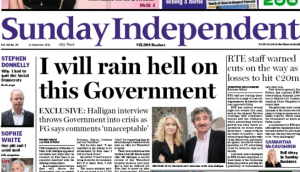
rain-hellThough he may not realise it: John Halligan’s pronouncements over the weekend (such as the headline [left] in the Sindo) may just be a very small part of a world-wide phenomenon.
No, I am not claiming there is global movement to secure a second catheterisation (cath) lab for Waterford. What I am saying however, is that his statements, particularly his most recent ones, contain many of the elements of the decline of public language in politics that we have heard elsewhere.

I accept that Halligan and the local consultants in Waterford hospital are sincere in desperately wanting a second cath lab, but wanting something is not the same as needing it – especially when resources are not unlimited.

Continue reading “The decline of public language in politics is coming to Ireland”

Special Advisers #Spads can play an important and positive role in government

Here is my Broadsheet column from September 5th 2016. This looks at the important and positive role Special Advisers (Spads) can play in government, particularly a partnership one. www.broadsheet.ie/treated-like-interlopers/

——————-

sycamore-room
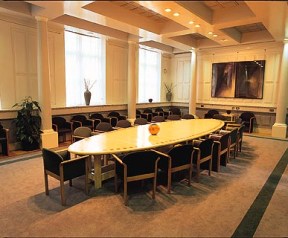
The Sycamore Room in Dept of an Taoiseach where the Advisers meet

“To provide spurious intellectual justifications for the Secretary of State’s prejudices”

This is how the late Maurice Peston (father of ITV’s political editor Robert Peston) responded in the early 1970s when a senior UK civil servant asked him to explain how he saw his role as Roy Hattersley’s newly appointed Special Adviser (Spad).

It was more than just a casual witty remark from the Professor of Economics: it specifically referenced the fears the Department of Prices and Consumer Protection had about having an acknowledged policy expert in their midst and gainsaying their more generalist advice.

Continue reading “Special Advisers #Spads can play an important and positive role in government”

A simple primer on Irish #Defence Policy

Here is another of my weekly Broadsheet columns. I am slowly catching up on reposting these columns here, I hope to have my site up to date over the coming week.

This one is from August 29th and offers a quick primer on understanding Irish Defence policy: www.broadsheet.ie/mission-creep-2/ 

————————————

army

Though you may not have noticed it – there was, over the last few weeks, an attempt to start a public debate on Irish Defence policy. While the Irish Examiner, in particular, did its level best to get it going, the discussion soon fizzled out.

The reason why the debate never really got going may be due to the fact that we tend to only discuss defence policy in public in response to some significant event or, more frequently, to some outlandish and unfounded claim.

On the rare occasions that we have any debate on defence in Ireland, they tend to be either end of the extreme ranging from claims that we are abandoning neutrality, a claim made continuously since the 1970s, to questions as to why we even have a Defence Force.

Though there is a real and clear public pride in our Defence Forces, both at home and abroad, there is also a surprising paucity of knowledge about Defence policy.

With this in mind, I want to use this week’s Broadsheet.ie offering to put some basic facts about Irish Defence policy out there, in the vain hope that the next public debate on Defence may be based on fact and reality, not myth and assertion.

Let’s start with a few basics.

The Irish Defence Forces comprise the Army, Air Corps and Naval Service and should total 9,500 men and women. The current manpower figure as set out in a parliamentary reply to Fianna Fáil’s Lisa Chambers, is just under 9100.

There are approximately 460 Irish troops currently serving overseas on a range of UN led and mandated peace-keeping and humanitarian missions. These include: 60 naval service personnel on the humanitarian search and rescue operations in the Mediterranean; about 210 troops on the UNIFIL mission in Lebanon and approx 140 troops serving in the UNDOF mission on the Golan Heights in Syria.

Though these numbers are way down from the average of 800 plus personnel serving overseas less than a decade ago, it still represents a sizeable Irish contribution to international peace and security, which in turn contributes to our own national security.

We spend about €900 million per year on Defence, though the vast bulk (over 70%) is accounted for by wages and pensions. When it comes to value for money the Defence Forces lead the way. The reform and modernisation programme undertaken between 2001 and 2010 make it a model of how public sector reform can be done right. Productivity was increased, numbers were reduced and the savings were invested in vastly improved equipment and training.

Now let’s turn to the policy side. First and foremost, Ireland is militarily neutral. While this is usually defined as not being a member of a military alliance, it also means that we decide for ourselves how much we spend on defence and – most importantly – how, where and when we deploy our troops overseas on humanitarian and peace-keeping/peace enforcement operations.

This is done via the “Triple-Lock” mechanism of UN mandate, Cabinet and Dáil approval. Triggering this triple lock is required before 12 or more Defence Force personnel are deployed overseas under arms. This enshrines not only our military neutrality but our commitment to multilateralism and the UN.

We use the phrase UN mandated, which means that a UN resolution is required. Nowadays many UN mandated missions are not UN led, i.e. “blue helmet”, but rather led by regional organisations – such as the EU, The African Union, NATO etc – on behalf of the UN. This was the case in the 2008 EUFor Chad  mission, which was commanded by an Irishman, Gen. Pat Nash.

I was in the Dept. of Defence during the Chad/Central African Republic mission, which was established to deal with the crisis created in the region on foot of the Darfur famine. I saw how the Triple Lock was implemented smoothly and speedily. UN resolution 1778 was passed at the end of Sept 2007, Cabinet Approval was given in October, unanimous Dáil approval by the end of November and by December an initial deployment of Army Rangers and support elements were on the ground in Eastern Chad establishing the Irish Camp.

Any difficulties in deployment were not due to the Irish or the Triple Lock but rather to the frustrating slowness of other EU countries, particularly the non-neutral ones, to respond especially when it came to offering air and medical support to the mission.

Nothing I saw at those defence meetings in Brussels led me to think that an EU Army was a realistic possibility, leaving aside the fact that we have a veto (EU requires unanimity on common defence) on it and that the Irish Constitution (Art 29.4.9) precludes Irish membership of a common defence.

Speaking of air support brings me back to the Irish Examiner article mentioned at the outset. From my perspective this appears to be based on the inaccurate, if not sensationalised misreading, of an already inaccurate report.

I say inaccurate as the original material suggests that is not Ireland which has asked the RAF to protect our airspace from terrorist threats, but rather that it is the British who have asked for Irish permission to fly into our air space in the event of terrorist air attacks heading for Britain.

When viewed this way the story is not quite as sensational, nor is it the slam dunk argument for Ireland rushing out and purchasing a fleet of F-16s.

I am not absolutely opposed to our buying a few F-16s – though if we are going to go into the fighter aircraft market why not opt for some newer F-35s?

I am sure the Air Corps would be overjoyed to have them, though I suspect the Departments of Finance and Public Expenditure might baulk at the tripling or quadrupling of annual defence expenditure necessary to keep these fighters in the air 24/7, especially when we consider the real and actual threat assessments.

So, let us have a full debate on defence (and foreign) policy by all means, but let us ground it in fact and reality.

ENDS

Sinn Féin’s Martial Docility – my Broadsheet column from Aug 22

Here is my “Mooney on Monday” Broadsheet.ie column from August 22nd  www.broadsheet.ie/sinn-feins-martial-docility/ Here I discuss the resignation of a Sinn Féin MLA and how it serves as an indication of the level of strict and unfaltering discipline that still operates within Sinn Féin.


Sinn Féin’s Martial Docility

2016-08-19_new_23906427_i1If there is one thing the Provos do well, it is commemorations. Give them the slightest reason and out come the banners, wreathes, black polo-necks, replica uniforms and the gang is ready to march anywhere.

So zealous are they to remember and memorialise that the objects of their commemoration do not even require any direct connection. All that is needed is a rallying cry, a route map, a bit of media attention and they are all set to go.

It is therefore curious, given this penchant for marking the contribution and sacrifice of others, that neither former Sinn Féin M.L.A. Daithí McKay nor Sinn Féin activist Thomas O’Hara can expect to find their colleagues publicly commemorating them anytime soon.

Last week, McKay resigned his Stormont seat and O’Hara was suspended as a Sinn Féin member after the Irish News accused McKay, then chair of Stormont’s Finance committee, of arranging for O’Hara to coach a witness due to appear at McKay’s committee in September 2015.

The witness, loyalist blogger Jamie Bryson, was there to give evidence about allegations of political corruption linked to Nama’s £1.3 billion “Project Eagle” sale of Northern Ireland property. At the Committee hearing Bryson made allegations of kickbacks to a senior politician and, at the conclusion of his evidence, accused then Northern Ireland Peter Robinson of being that politician.

This is in line with the advice Bryson received from O’Hara on Sept 19th in their Twitter direct message exchanges:

O’Hara: When talking about Robinson refer to him as ‘Person A’. So say all you have to say about him referring to him as Person A. Then in your final line say: Person A is Peter Robinson MLA.

Means that the committee cannot interrupt you and means that you don’t have to say robbos name until the very last second. So then it’s job done!

Shortly after the Bryson evidence, McKay was at the Dáil’s Public Accounts Committee on October 1st to discuss his committee’s investigations into the Project Eagle deal. Responding to a specific question from Deputy Shane Ross on Bryson’s evidence and why the NI Finance Committee had decided to call him, McKay replied:

Mr. Daithí McKay: It is well known that he [Bryson] has blogged at some length on this. It is also well known that he appears to have a lot of material which some believe may have been fed to him from another source. It was an issue of debate for the committee. What the committee agreed to do was to set a bar. The bar that has been set for him and future witnesses is that they have to prove that they have some connection to the terms of reference of the inquiry.

Oh the irony of McKay talking about Bryson being “fed” and his setting the bar high.

So, why does any of this matter?

Well, there is more to this episode than just dodgy goings on by Sinn Féin at Stormont. Nama’s Project Eagle was the single biggest property sale in Irish history. The investigation by Stormont’s Finance Committee was supposed to establish the truth behind the accusations of wrong doing.

Perhaps that Stormont Committee was never going to be able to uncover the truth behind the deal and expose whose fingers were in the till, but as the SDLP Leader, Colum Eastwood, has pointed out: “Sinn Féin’s interference in that democratic investigation has only served the purposes of those who are alleged to have corruptly benefited from the Project Eagle deal in the first place”.

It is hard to imagine that was Sinn Féin’s primary intention, yet it is the likely outcome of it. So why, after months of posturing and calling for a full public investigation of this massive property deal, would Sinn Féin undermine an element of that investigation?

Were they just eager to get Robinson’s name on the record or could they have had other pressing political considerations at the time? At around this this time last year senior PSNI officers were linking a murder in east Belfast with the Provisional IRA. That killing was thought to have been in revenge for a killing in May.

We are now expected to believe that undermining of what is a very legitimate public concern was all done by two lone wolves: McKay and O’Hara without any input, sanction or direction from others? Really?

The current N.I. Finance Minister, Sinn Féin’s Máirtín Ó Muilleoir has described the contacts between Bryson and the Sinn Féin officials as “inappropriate”. He denies any involvement with or knowledge of their communications, though he was a member of the McKay committee when Bryson gave his evidence and was even mentioned twice in the O’Hara/Bryson exchanges.

If the positions were reversed down here and it was a Fine Gael or Fianna Fáil Minister facing such questions, it is hard to imagine Messrs McDonald, Doherty or Ó Broin being quiet as phlegmatic and dismissive as Ó Muilleoir appears in his statement this morning.

The fact that both McKay and O’Hara have so readily been thrown under the bus without even a whimper from either is not only a testament to their loyalty and commitment but an indication of the level of strict and unfaltering discipline that still operates within Sinn Féin.

Can you imagine a T.D., Senator or Councillor in any other party being so ready to walk away so silently? No, me neither.

While it is tempting to speculate that Michéal, Enda or Brendan might yearn to have such command and mastery over their flocks, I suspect they are content to forego such control as they see the bigger picture and know that democratic accountability is not well served by such martial docility.


Three cheers for the system. Hip hip…. No? Nothing…?

Here is my “Mooney on Monday” Broadsheet column from August 8th 2016 last:  www.broadsheet.ie/three-cheers-for-the-system/

blog_tag1This comes as no surprise. After the tumult and turmoil of the past few years it would require a hopefulness that bordered on the foolhardy to expect to hear anything even vaguely complimentary said about the system.
At so many levels, it failed us. The institutional accountability and oversight that we thought would prevent bank and financial crashes proved inadequate at best, and downright mendacious at worst.

It is a failure that reaches beyond the crash and extends right up to the present day with so many people seeing the present recovery as something that is happening in communities and areas other than theirs.

This feeling that is not unique to Ireland. We see echoes of it in the Brexit result in the U.K. with the high numbers of people in the former industrial heartlands of the midlands and the north of England voting to leave the EU.

Continue reading “Three cheers for the system. Hip hip…. No? Nothing…?”

Pro-EU sentiment across #Ireland should be fostered via all island Forum #brexitresult

puckoonThis is my Broadsheet “Mooney on Monday” from Monday piece from June 27th on how the Irish Government (and politicians) must act in response to the UK’s Brexit vote.  

There is a new (though not uncritical) pro-EU majority across the island that should be encouraged and fostered via a re-establishment of the Forum on Europe. There must not any a return of form of border across the island.

The original online version appears here: www.broadsheet.ie/return-of-the-hard-border/

———————————

For as long as I can recall it has been a central tenet of Unionism that the status of Northern Ireland should not change without the political consent of the majority of the people living there.

Yet, that it precisely what is set to happen over the coming years, with senior members of the DUP cheering it on

Despite the fact that a clear majority – some 56% – of the people of Northern Ireland who voted, including large numbers from both traditions, stated that they wanted to remain in the EU, their wishes are about to be ignored. It seems that a majority in the North is only a majority when the DUP is a part of it.

Continue reading “Pro-EU sentiment across #Ireland should be fostered via all island Forum #brexitresult”

Irish ‘New Politics’ explained…. kind of… #Dail

DSMooney_Bio_PicThis is my latest article for Broadsheet.ie – available online here: New Politics Explained
What exactly is this “New Politics” we have been reading and hearing about so much lately?

It was the question that should have occurred to me as soon as the Public Relations Institute asked me to participate in a panel discussion they held last Thursday as part of a half day seminar entitled: Public Affairs in the era of ‘New Politics’.

But it didn’t. Like many others, I have been throwing about the phrase “new politics” in the two and a half weeks since the Dáil elected a Taoiseach as if everyone understands what it means.

Continue reading “Irish ‘New Politics’ explained…. kind of… #Dail”

Alan Kelly: @labour’s unpopular populist? (From @broadsheet_ie)

DSMooney_Bio_PicThis was my first column for Broadsheet.ie

“There’s no Labour problem that Ken (Livingstone) can’t make worse.”

This was Alan Johnson’s response to the former London Mayor’s latest unwelcome intervention in a UK Labour row.

Substitute the name “Alan Kelly” for “Ken Livingstone” and Johnson’s axiom could just be as applicable here.

Perhaps it’s his pugnacious ‘I tell it like it is’ style, but Alan Kelly has come to be personally identified with two of the last government’s biggest political failures: Irish Water to the housing crisis, not to mention his “power is a drug… it suits me” interview or his penchant for adding to his own party’s travails.

Continue reading “Alan Kelly: @labour’s unpopular populist? (From @broadsheet_ie)”

Why @FineGael’s #GE16 pre-campaign campaign doesn’t augur well for real thing

This blog first appeared on the Slugger O’Toole website earlier today.

image
 

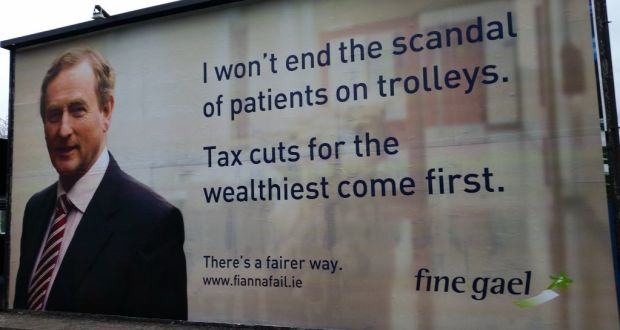
Fianna Fáil’s poster attacking Fine Gael’s broken promises


Whether polling day is on Feb 26th or March 4th, it is clear that we are only two or three weeks away from the start of the great 2016 corriboard shortage… sorry, the 2016 general election.

Over the coming two weekends we will have the Fianna Fáil and then the Fine Gael Ard Fheiseanna, followed by Labour at the end of January – presuming that Enda hasn’t already called the election and pulled the plug on Labour’s big day out.

While the corriboard campaign posters remain in their wrappings and the Vote for me leaflets stand ready, the electioneering has already as good as started.

One the most interesting aspects of Fine Gael’s pre-campaign campaigning so far is just how much time and energy a party determined to dismiss Fianna Fáil as irrelevant is devoting to attacking them. See Today FM’s Matt Cooper’s comment on the Taoiseach’s Wednesday afternoon press conference:

Could it be that Fine Gael’s own private polling is telling them something the national newspapers polls are missing?

It occurred to me recently that Enda has spent the last few years doing a very bad Bertie Ahern impression – making Enda the Bobby Davro of Irish politics you might say. Enda gets the minor gestures and mannerisms right – but he misses the core of the character.

Enda may be as accomplished and expert a glad handler as Bertie when it comes to wading into a crowd and shaking the hand and slapping the of everyone around him, but he his mimicry is one dimensional. He does not possess Bertie’s skill and ability to command the facts and figures when engaging with the media on door step interviews.

While Enda still possesses many skills and abilities, not least his steely determination and ruthless streak, he is not politically hard wired to endure or sustain a long election campaign – especially if he hopes to keep his media interactions down to a few tightly managed ones.

In this context Fine Gael’s attempts to transpose the most recent Tory election campaign strategy to Ireland seriously risking backfiring on them and only highlighting the weaknesses they hoped to obscure.

It is a mistake on two fronts. First as they seem to be copying the Tory playbook here with minimal changes and basic adaptions.

Do they so see themselves as Ireland’s Tories that they cannot be bothered to make even the most basic of changes to the strategy, the text and the slogans? A series of recent Fine Gael social media posts have used the Tory line: “long-term economic plan” word for word:

While the Tories undoubtedly mounted a superb social media campaign in the 2015 UK general election and used the platforms, particularly Facebook, more effectively than most of their rivals (apart from the SNP who are the master campaigners both online and on the ground) that does not mean you take their campaign slogans and approaches lock stock and barrel.

Second, in taking the Tory campaign playbook en masse Fine Gael seems to have forgetten that we have a PR STV system, not First-Past-The-Post – indeed Fine Gael used to pride itself as being the defender of PR STV (they had opposed the two attempts to change the voting system by referendum in the 50s and 60s)

What works in a FPTP system does not necessarily work in a PR-STV one. Depending on where you live in a FPTP system you can find yourself voting for someone you don’t like rather than the one you do like most just so you can make sure the one you dislike more is kept out.

The idea that a vote for Fianna Fáil or Independent alliance is a vote for Sinn Féin is not so easy to sell in an STV system where the voter can vote the entire panel right down the line and omit the local SF candidate.

That said is easy to see the attractiveness of the Tory playbook for Fine Gael. The Tories succeeded in keeping their leader out of head to head debates, Fine Gael want and need to do the same – though for different reasons. While Cameron was wary of elevating Milliband by sharing a head to head debate platform with him – there were no questions about the PM’s capacity to perform well in a head to head debate.

The other attraction was the Tories successful cannibalisation of their Lib Dems coalition partners. Cameron’s gains came mostly from Lib Dem losses (The Tories took 27 of the 49 Lib Dem seats lost as opposed to 12 lost to Labour and 10 to the SNP) – an option that Fine Gael is eyeing up here, using Labour losses to shore up their own numbers. Fine Gael are ready to fight this campaign to the last Labour TD.

Though Fine Gael’s polling numbers have recovered recently – at precisely the time they needed them to recover – they are still on course to lose seats, even if they do get 31/32% in the polls.

While these improving numbers are no mere coincidence and are a tribute to Fine Gael’s political strategists, the idea that seems to be floating about the commentariat that Fine Gael is now some invincible campaigning machine is more than a little bit short of the mark.

Fine Gael is having a few problems of its own right now, and they are problems entirely of its own making. Though they will doubtless address the issue between now and the Árd Fheis (and possibly drum up future local difficulties in the process) Fine Gael was still short of the 30% gender quota up to a few days ago – a system they introduced and championed.

Not only that but its head-quarters operation has just ended an unseemly, costly and ultimately unsuccessful fight in the Courts with one of their own candidates: John Perry TD.

And before I am accused me of dragging up these problems like a Fianna Fáil-er whistling past the graveyard, I do not think this is a zero sum game. I do not presume that any loss of ground by Fine Gael over the campaign will automatically translate into a Fianna Fáil gain.

Fianna Fáil will have to make its own ground in this one and will need to land some hefty punches on Enda, Leo, Michael and Simon, it cannot depend on Enda and Fine Gael to just lose it.