#Merkel & #EU need to learn the lessons of Germany’s own economic renewal

adenauer
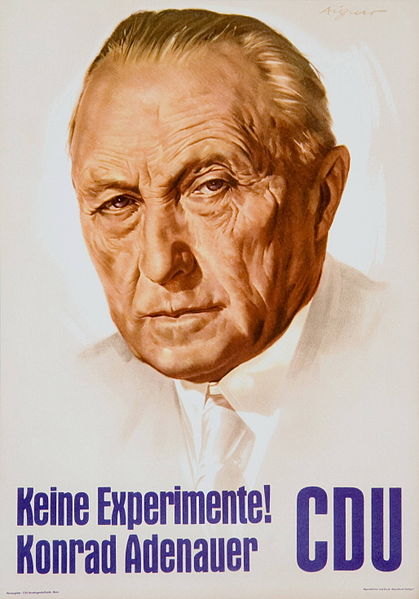
1957 Adenauer Election Poster: No Experiments

Yesterday (Thurs April 11th) the Irish Times ran a story saying that the German chancellor Angela Merkel is facing mounting political pressure at home to demand fiscal concessions from Ireland in exchange for granting extra time to repay crisis loans.

It seems that once again Germany is insisting that it not merely have an input into EU talks and discussion, but that it have a veto on the outcome. It is the ‘he who pays the piper calls the tune’ school of political thought.  While the approach is not unfamiliar in politics, it flies totally in the face of democratic process and accountability. But even more than that, in this instance, it contradicts the history of Germany’s own economic revival and the important role played by one of Ms Merkel’s most illustrious predecessors: Konrad Adenauer.

Germany’s Wirtschaftswunder – the economic miracle of the 1950s – was based in large measure on a generous programme of debt forgiveness given to Germany by its 33 debtor countries (including Ireland). The 1953 London Agreement on German External Debts, effectively wrote off half of Germany’s total mountain of debt and gave it additional time to repay the monies it owed. These debts included war reparations from both first and second world wars, plus the massive German 1930’s debt default, which was just as significant as the 2008 European financial crisis.

The West German CDU Chancellor, Konrad Adenauer realised that there would be no growth or revival of the West German economy for as long as it had to make huge annual payment to the Allied and other powers. These hefty payments, many of which Germany was even failing to make, were draining the West German economy of the ability to rebuild itself.  He recognised that the only way to achieve growth was to get some relief from this debt burden, hence the London conference on German external debts.

Adenauer managed to convince the others sitting around the table that the only way that Germany could recover and rebuild was for them to ease the burden on it – he managed to convince them to stop doing to Germany what Germany is now doing to Ireland, Spain, Portugal, Greece and Cyprus.

Easing the burden of West Germany’s debt did not make the country lazy and profligate, quite the opposite. The Agreement, along with the Marshall Plan very quickly enabled the West German government and industry to use the resources freed up by the easing of the debt burden to generate domestic economic activity and growth.

Not only did the London Agreement write off 50% of Germany’s debt it removed the requirement that interest be paid, though did say that this proviso would be revisited in the event of German reunification. The collapse of the Wall in late 1989 triggered that proviso but it was never implemented due to Chancellor’s Kohl’s protestations that demanding such interest payments would make it almost impossible for Germany to meet the considerable costs of re-unification. So, once again, Germany’s partners allowed it to walk away from its financial commitments in the greater good.

Kenny MerkelAs we know, both Enda Kenny and the Fine Gael party is deeply proud of its strong association with the CDU and Ms Merkel via their shared membership of the centre right European grouping: The European People’s Party EPP. Indeed, they regard the linkage as so important and significant that Mr Kenny manged to include a quick visit to Berlin and photocall with the Chancellor in the first week of the February 2011 general election campaign.

Perhaps the next time An Taoiseach meets up with the Chancellor in either Dublin, Brussels or Berlin he might gently remind her that her countries economic resurgence and dominance is due, in no small part, to the fact that 33 other countries, including Ireland, had allowede Germany to ease its burdens when it mattered and that it may now be time for Germany to allow others the facility they once extended to it.
 

You are playing senior hurling now lads: why renegotiating the PfG won’t work for @Labour

seamusbrennan
The late Séamus Brennan: “You are playing senior hurling now lads…”

“You are playing senior hurling now lads – but you are playing with lads with All Ireland medals”.

This, according to Eamon Ryan, is how the late Séamus Brennan greeted the Green Party team as it arrived in Government buildings for the 2007 talks on forming a government with Fianna Fáil.

It is a phrase that every Labour Party TD calling for a renegotiation of the Programme for Government (PfG) should print out and place at the top of their PC screen.

God be with the days when Labour recruited its Dáil candidates from the old ITGWU or FWUI. Those guys knew the first principles of negotiating; they particularly knew that you did not go into negotiations unless you had 1. A strong hand and 2. A fair idea of the outcome. Yet some in Labour are advocating that they enter talks with neither.

They want to enter a renegotiation of the government’s fundamental policy programme at precisely the moment when their party has hardly ever been weaker. Do they seriously expect that their senior partners in Fine Gael will take pity on them and offer them major policy concessions just because they are having a bad hair day?

Do they really underestimate their government partners that much?

Politics is a tough world guys. Wake up.

You do not get your way in politics just because you mean well, you get your way and get policies implemented by getting a mandate and pursuing your goals assiduously.

You certainly do not enter talks with partners from whom you wish to extract concessions with the message: we are in a weakened state and desperately need to give the impression that we can beat you into submission, so please, please, please let us.

It is the equivalent in nature of a lone deer asking a lion to not to devour them as they have a leg injury and cannot run properly today. Indeed it goes further and suggests that the lion should agree to allow the injured deer to bitch slap them around for a while so that any other deer who may be watching from a distance will think more highly of them.

There is no compulsion on Fine Gael to enter meaning renegotiation talks with Labour. They know Labour cannot cut and run now and risk facing the electorate, so they know it is strapped into this arrangement until the bitter end. The very most Labour could hope to get is a sham negotiation where we see TV clips of the pairs of Ministers from each side entering Government buildings for late night talks and the last minute “leak” from a source “close to the Labour leadership” saying the talks are at a crucial point right now and may go well into the night. The optics will look good, they may even fool a few activists, but most others (including the public) will see it as just a gesture. If the guys want to go down this road there is doubtless a battered old playbook for such an exercise laying around Government building somewhere.

The current cohort of Fine Gael TDs is possibly the most right of centre since the late 1950s. They are already getting flack from supporters and voters for the appearance that Labour is dictating too much of the government’s agenda, particularly on social issues, so they are neither motivated nor minded to give any more policy ground to them on the back of what was a bad day for Labour and, conversely, a good day for Fine Gael.

The idea of renegotiating the PfG is at best: naïve, and at worst: dumb.

That so many TDs would advocate it after only two years in office suggests that we are probably beyond the mid point of the life of this government and that the chances of there being a general election in early 2015 just got stronger.

Have we in Fianna Fáil survived our election punishment beating?

My column from yesterday’s Evening Herald (21/Feb/13) taking a very personal look at where Fianna Fáil is today; almost exactly two years on from the political meltdown of Election 2011 

Sums up the the response in many places in 2011

——————————————————————————————————————

Though I don’t share his politics I like John O’Farrell. O’Farrell, whose father hailed from Galway, is a comedy writer and British Labour Party supporter who is now their candidate in the Eastleigh by-election.

My reasons for liking him stem not just from his days as a script writer on Spitting Image but from his hilarious 1998 memoir: Things Can Only Get Better: Eighteen Miserable Years in the Life of a Labour Supporter.

In it he details the disappointments, frustrations and the heartache he endured at all levels of the Labour Party until he came to realise that “Michael Foot would never be Prime Minister… and that the nuclear arms race was never going to be stopped by face painting alone.”

A few months after the punishment beating that was Fianna Fáil’s 2011 General Election result I started to wonder if I should start work on my own homespun version.

I toyed around with several possible titles, including: I Thought That Things Could Only Get Better: Boy, Was I Wrong or Fianna Fáil: the view from the edge.

The idea never got beyond a few lines on the PC screen, however. This was partly due to my not seeing anything even vaguely humorous in my situation, but also to me not knowing any publisher sufficiently cracked to commission it. Back in 2011 it was hard to imagine a market for such a work.

I also had a slight suspicion that the party was not yet ready for the scrapheap, nor for 18 years in the wilderness.

Yes, it was in bad shape – very bad shape. Not just the organisation, but the people too. Friends and colleagues who had worked in politics were shell shocked by the result. Not just elected reps, but people on more modest salaries working behind the scenes. Researchers, press officers, organisers and administrators. Losing 51 seats meant HQ shedding staff over half its staff.

But along with this loss, a loss that many hundreds of thousands of other people have had to face, was the realisation that people of my vintage were the ones who had allowed the decline to happen: we could be the generation that not only wrecked Fianna Fáil, but damaged the values on which it was founded.

This is not to underestimate or disregard the mistakes we made and the anger we caused to those people whose support we had sought and won over the decades. Nor is it a plea for pity. It is just to acknowledge that the 2011 defeat had real consequences for many of us.

While there were reports of some particularly heated and fraught exchanges during the campaign, what I experienced at the doors was a harsh coldness. The voters had long since made up their minds on Fianna Fáil – we had let them down badly and we would pay the price.

I suspect many voters even surprised themselves with the scale and magnitude of the Tsunami that engulfed Fianna Fáil two years ago.

Two years is not a long time in the life of an established political party. While the coldness and mistrust may have thawed somewhat, there is still a lot of real anger out there that will take a long time to address.

This should not be confused, however, with the contrived disdain that characterises some people’s attitudes to Fianna Fáil. As Sean Gallagher discovered during his presidential bid, it is now almost McCarthey-esque. You can talk about us in a way that you could not about almost any other group.

It ranges from the scorn that perceives FF as unprincipled, gauche, maybe even a bit NOCD (not our class dahling) to the more visceral anti Fianna Fail-ism that sees us all as chancers and strokers.

But for as long as I know that I am in a party that works to give people the means and opportunities to succeed, I reckon I can live with that.

ENDS

Soldiers could lead the battle to reform public service

Irish troops serving the cause of peace internationally

My column from tonight’s Evening Herald on how the reform and modernisation of the Defence Forces over the past year could prove a model for public sector reform

—————————————————————————————————–

The first tentative step on the path to a possible Croke Park II deal was taken last week when Public Sector unions and management sat down together for preliminary talks.

While reaching any form of deal will pose difficulties for negotiators on both sides, the management side has a particularly difficult delicate balance to strike. Though their political masters in Cabinet may be signalling their support for a deal they also know that most Fine Gael back benchers would be just as happy if no deal was reached.

The public service is just one more issue that divides back-benchers from both parties, with many of FG’s newer intake of TD’s echoing the “small government” rhetoric heard from US Republicans and Tea-Partyers.

It is not an uncommon view in these difficult times. There are many siren voices around attacking the public service and portraying it as riding on the back of a shrinking private sector.

Sadly, the public service often leaves itself open to these onslaughts with daft examples of wasteful spending and bad work practises. But the danger lies when occasionally justified criticisms are distilled into a dogma.

Yes, the public service is in need of reform and modernisation, but the one dimensional demonizing of the entire public service we hear from some quarters will not help reform anything. Nor will the “everything is just fine as it is” defence we hear from various public sector unions.

Public service reform is possible without hyperbole or blood on the carpets. With the right management and leadership the public service is capable of reforming and modernising itself. I know, because I was there when it happened.

The reform and modernisation of the Defence Forces over the past decade and a half is a model of how it can be done right.

The 2009 Bórd Snip Nua report found that the Defence Forces were the only sector in the Public Service to reduce numbers during the Celtic Tiger.

While the numbers working in the Public Service had increased by 17% between 2001 and 2009, the numbers working in the defence organisation actually fell by 8%, going from 11,808 down to 10,895 a drop of 913.

The reduction in numbers in uniform was reflected in a reduction of numbers of civil servants in the Department. These payroll savings were invested in better equipment and improved training meaning that the Irish Defence Forces could do more with less.

The negotiations were tough, but both sides recognised that it was in their mutual interest. While soldiers and officers do not have Trade Unions, they do have strong representative organisations: PDFORRA and RACO and a parallel conciliation and arbitration process that conducts it business quietly and effectively,

Perhaps the absence of outside influences, speculation and running commentaries, helped create the conditions for agreement – but not nearly as strong leadership, both political and military.

We should now be finding ways of replicating this progressive model. Before coming into office the Taoiseach’s last big idea on the Defence Forces was that it should be running boot camps for young offenders.

Doubtless he has abandoned this nonsense having spent two years seeing them close up, but their handling of the last round of barrack closures suggests that he may not yet have realised just how the Defence Forces be a model for public service reform.

ENDS

Our Constitution gives people the power, thankfully

Today, December 29th 2012, marks the 75th anniversary of the Irish Constitution, Búnreacht na hÉireann coming into effect. This is my Evening Herald column on it continuing importance and relevance to Irish life.

eamon de valera
Dev – Architect of our Constitution

On this day seventy five years ago the Irish Constitution came into operation. As we have seen in recent and current controversies, almost four decades on, the Constitution is still central to much of our political debate.

Within the past year we have seen it successfully amend it three times: Judges Pay, Fiscal Compact and Children’s Rights. But, we have also seen the public resoundingly reject the governments request that they amend it on the issue of  Oireachtas enquiries.

It is not the first time the public has done this. Not only did they defeat the Nice I and Lisbon I votes, as early as 1959 they rejected the then attempt to change the voting system. Indeed in 1968 the voters rejected the next two amendments put to them, both related to elections.

It was not until the 1972 vote on joining the then EEC that the people passed the first amendment to the Constitution. (Technically this is the Third Amendment as the first two were made in 1939 and 1941 without referendums as part of transitional arrangements.)

Over the past 75 years the public have approved some twenty five changes to the Constitution. While some were technical in nature, others – such as the five votes relating to abortion – were highly controversial and emotionally charged.

What this shows is that the Constitution makes the people sovereign. They alone decide what changes may be made to the fundamental law of the land.

This important aspect of De Valera’s 1937 Constitution has been much praised over the years. While it is easy to look at the language and some of the secondary provisions as being a product of their time and maybe a little outdated now, most legal experts view the principles set out in the Constitution of 1937 as being ahead of their time.

Five of the fifty articles are devoted to Fundamental Rights. Decades before international instruments, such as the United Nations Charter and the Universal Declaration of Human Rights proclaimed fundamental rights and fair procedures, the Irish Constitution had done so.

Indeed, while the Constitution does not declare Ireland as militarily neutral, it does contain in Article 29.2 a commitment to “the pacific settlement of international disputes” and the adherence to International law. This is just something else that marks the document out as being ahead of its time.

But while it may have been well ahead of its time 75 years ago, it is still so?

I would argue that, essentially, it is. The fundamental principles it espouses are just that – fundamental. The commitment to democracy, rule of law, fair procedures etc do not change with the seasons of the prevailing political fashion.

But it is also a living document, particularly in the provisions relating to how government and the judiciary should work. Back in 1937 it seemed natural that only those over 21 should be entitled to vote, by 1972 that was changed to 18 by a margin of over 5 to 1 of those voting.

Events of recent years have thrown up some more significant issues. Are our governmental structures sufficiently responsive – or even fit for purpose – in the context of the IMF/EU bailout and an evolving European Union/Eurozone? Is the 1930’s post independence concept of property ownership appropriate in 21st century Ireland?

But where is reform on these issues being discussed? Not at the Government’s Constitutional Convention, it seems. Its initial priorities, as set out by the Government, are to discuss the President’s term of office and the voting age. This is the equivalent of setting up a dance committee after the Titanic has hit the ice. The one substantive constitutional issue on which the government, particularly the Taoiseach, is committed is abolition of the Seanad.

Just when we require more meaningful scrutiny of government policy, it proposes less and sells it under the guise of “reform”. Fortunately, it is the people who will be sovereign on this.

ENDS

As soon as Florida became too close to call, it was all over

My take on the US Presidential election results from tonight’s Evening Herald

My Evening Herald column on the Obama victory night

“Half the money I spend on advertising is wasted; the trouble is I don’t know which half!” If this is how Henry Ford felt about his cash you can only imagine how the campaign treasurers in both American parties feel about 90% of theirs.

Last January polls showed Obama and Romney in a statistical dead heat within a point or two of each other. Ten months and some €4.7billion of campaign spending later and the two parties appeared to have hardly budged an inch.

Watching the early results in the Presidential and Congressional come in this morning you had to wonder did either candidate or party get value for its money.

On Monday I said that I though Obama would win and that he would win the majority of the so called battleground States. While I was fully confident of that view when I penned it last Monday, I did have one brief  moment of doubt last night.

It came by way of a stern but firm Facebook message from an old friend in New York. He said he thought that Romney might just shade it. His comments came as a bit of a shock as my mate is no political novice and is usually a good judge of these things.

The first key result I was waiting for was Virginia. While Obama could win the election without winning in Virginia it would be a good early indicator of how the election was going.

According to the US TV networks they would be ready to make a prediction, based on exit polls, about 30 minutes after midnight Irish time.

The final pre election polls had Obama set to win it by around 2%, but that was inside the margin of error.  The exit polls would tell all. My heart sank a little when the Networks declared Virginia too close to call at the appointed time.

Could my mate be right? Could it be that Romney had managed to claw back enough to reverse Obama’s small lead? Virginia was not essential or critical to an Obama win, but it might be an indication of other problems.

The uncertainty lasted about thirty minutes. Soon reports started to emerge that Florida was too close to call. On Monday I had predicted it would go to Romney. Almost every polling company had been calling it for Romney for weeks, yet the reports coming out from precincts and districts across the State were saying that it was neck and neck.

Latino, women and young voters were coming out for Obama in bigger numbers and by wider margin than predicted. Obama had been expected to get about 66% of the latino voter, but the exit polls were not putting it at 71%..

Florida was the third easiest State for Romney to win from Obama, yet it was going to Obama, though only just. Of the swing sates only two: Indiana and North Carolina went to Romney, the rest stuck with the President.

In each case the margin was tight, but in America’s first past the post system, the winner takes it all.

By a little after 3.00am is was virtually all over. While there were several races still too close to call, all were favouring the President. Obama had not won the magic 270 electoral college votes but it looks now that there was almost no mathematical possibility of Romney reaching it.

While he was not losing them by large margins the States were being stacked up against Romney.  By 4am it was all over once Ohio was called for Obama. With that Romney’s last remaining hope was quashed. While a few diehard Republicans refused to accept the prediction it was over and so Election 2012 ended with a stronger Electoral College victory for Obama, 332 to 206, than even I dared imagine a few days ago.

Coalition Junior Partners Come Off Worse Eventually

My column from Thursday’s Evening Herald (27/Sept/2012)  on Eamon Gilmore’s travails following Dep Roisín Shortall’s resignation.

________________________________________________________________________________________________________________

Who would want to be the leader of the Labour party today? No doubt Éamon Gilmore still does, though perhaps with a little less relish than he exuded last Monday when he was sitting cheerfully behind me on the early morning flight to Brussels.

Former Labour Party Leader
The late Frank Cluskey – took a principled stand on Dublin Gas

While the dip in Labour’s fortunes revealed in the previous day’s RedC poll may not have demonstrably dampened his ardour, last night’s dramatic resignation by Roisín Shortall will.

Eighteen months in office and he is looking like the Mr Worthing character in the “Importance of Being Earnest:”: losing  one Junior Minister, may be regarded as a misfortune; to lose two looks like carelessness.

But isn’t this what happens to the smaller party in Government? When they get into battles with the larger party, don’t they usually come out the worst?

A quick glance at the history of coalitions and it would appear otherwise.

The electoral reality is that going into office costs the smaller party seats at the next election. It takes the bigger risk and, in return, gets a say in policy above its Dáil strength.

That’s the deal. Both partners they know they need the other. It is not for eternity, maybe not even for the full five years of the term, but each knows that without the other neither would in power. unless one sees an alternative, in which case the balance is disturbed.

I served in two Fianna Fáil led coalitions featuring feisty junior partners: the Greens and the Progressive Democrats. While there were the occasional stand-offs, indeed one partly led to my departure, these were the exception to the rule.

Coalition work and last where there is a well negotiated and defined programme for government around which they can agree.

Naturally, where there are two distinct parties with their own hinterlands and approaches, there will be tensions. In my experience these were confined to issues not specifically covered in the Programme for Government or those thrown up by unexpected events.

The other main source of disruptions were the interventions from senior figures, just outside of government, in the smaller party who saw themselves as the conscience of their party, Dan Boyle was particular master of this dark art. While the major partner was usually the main target of these outbursts they were just as often designed to embarrass, irk and provoke their own ministers.

While deeply frustrating, these things came with the territory.  The larger party in a coalition knows it needs the smaller one to stay in office. While it can never allow itself to be seen as a pushover, it also knew that the smaller party could not stay long in office if their members felt there were being used as a mudguard.

This is what makes Roisin Shortall’s resignation so significant. Unlike most ministerial resignations this was about policy. Yes, there are personality and political dimensions too, but essentially this is about adherence to the programme for government.

Her departure is reminiscent of the late Frank Cluskey’s 1983 resignation from Cabinet not only because it too was about policy, but also thanks to the increasing number of comparisons been drawn between both administrations’ handling of the economic problems facing them.

But, as with most parallels, it is not a perfect one. While his departure was a protest against Fine Gael’s stance on Dublin Gas, Shortall’s resignation is just as much about her own parties role in government as it is about Minister Reilly’s capacity to run a department.

When Frank Cluskey quit he made it clear that he did not expect other labour ministers to follow him out and bring down that government. There was no hint that he had lost any confidence in his colleagues. The feeling was mutual. At the meeting following his resignation he reportedly received a lengthy standing ovation from his parliamentary colleagues. Can Deputy Shortall expect to be cheered to the rafters by messers Quinn, Howlin, Gilmore and Rabbitte when they next week? I doubt it.

The Strongest Opposition may be within the coalition itself

The text of my column from tonight’s Evening Herald (Mon Sept 17th)

—————————————-

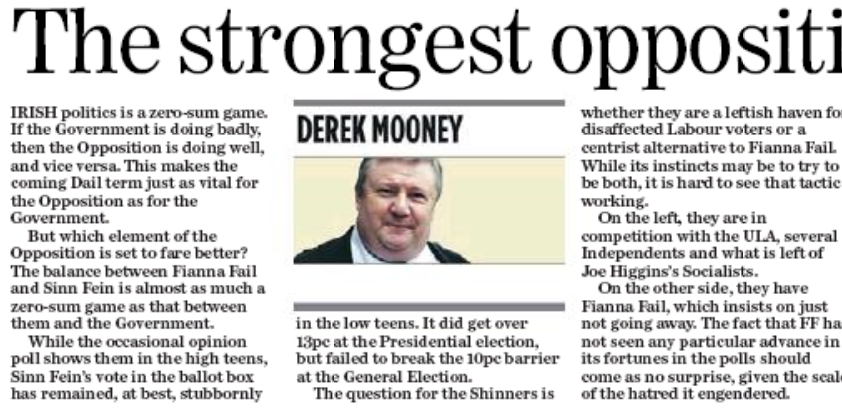
Irish politics is a zero sum game. If the government is doing badly; then the opposition is doing well, and vice versa.

Derek Mooney’s Column in tonight’s Evening Herald

This makes the coming Dáil term just as vital for the opposition as for the government.

But which element of the opposition is set to fare better? The balance between Fianna Fáil and Sinn Féin is almost as much a zero sum game as that between them and the government.

While the occasional opinion poll shows them in the high teens, Sinn Féin’s vote in the ballot box has remained, at best, stubbornly in the low teens. It did get over 13% at the Presidential election, but failed to break the 10% barrier at the General Election.

The question for the Shinners is whether they are a leftish haven for disaffected Labour voters or a centrist alternative to Fianna Fáil. While its instincts may be to try to do both, it is hard to see that tactic working.

On the left they are in competition with the ULA, several Independents and what is left of Joe Higgin’s Socialists.

On the other side they have Fianna Fáil, which insists on just not going away. The fact that FF has not seen any particular advance in its fortunes in the polls should come as no surprise given the scale of the hatred it engendered.

The past 18 months has been about Fianna Fáil stabilising its position. It has put a floor under its decline, which was no small task. The issue now is if it can recover former ground.

While FF may skirmish with SF over ex FF voters who went to Labour, the main battle will be fought elsewhere and with another enemy. Surveys suggest that up to 40% of those who said they voted FF in 2007 switched to FG in 2011.

This sizeable group are still angry and hurt. They have not been ready to listen to Fianna Fáil so far. Will they become disenchanted over the coming months with Enda Kenny and Fine Gael as it struggles to deliver on its election promises?

Will this be sufficient? Will the disenchantment be enough to allow them to listen to anything the party has to say, never mind be convinced by it? These are questions taxing Fianna Fail reps at their think in today and tomorrow.

The opposition parties and independents will also need to consider the competition they face from the emerging, and varied, opposition within government.

It ranges from Brian Hayes and Joan Burton’s fighting over pensioners to FG backbenchers bemoaning its failure to take on the public sector.

The greatest challenge, though, may come from within the Labour Party. There seems to be something about becoming chairman of the smaller party in government that makes the holder think they are the deputy leader of the opposition. I call it “Dan Boyle Syndrome”.

As a first time Deputy; sitting on the government backbenches; the new Labour Chairman may gaze longingly at the other side of the Dáil wishing he were there opposing and criticising the current Government, but he isn’t.

The public gets the difference between government and opposition. They understand the fundamental truth of Mario Cuomo’s famous maxim: “you campaign in poetry but you govern in prose”.

If he thinks doing solo runs will firewall him from the approaching barrage of criticism and unpopularity, then he is in for a nasty surprise. All he needs to do is Google “Dan Boyle” and “election results” to see how these tactics failed.

FG and Lab TDs would do well to heed the words of Mary Harney: “Even the worst day in government is better than the best day in opposition”. This may seem unlikely, but it is the case, especially if you believe politics is about improving things.

If they doubt it, then they only need call the Marine Hotel and ask any Fianna Fáil TD.

ENDS

Dan Boyle Syndrome

What is it about the position of chairman of the smaller party in government that makes them think they are the deputy leader of the opposition?

Labour’s parliamentary party chairman, Colm Keaveney is not a wet day in the job and already he is showing signs of the delusion.

Labour: In government or opposition?

He disowns government actions and policies like a member of the opposition while enjoying the privileges perks and access that being in office bring.

I call it “Dan Boyle Syndrome”. While the avuncular Cork man was not the first to exhibit the symptom, the condition reached such a virulent pitch during his time as the Green party chairman that he came to define the condition.

The most noted previous sufferer of the condition, one Michael McDowell, did occasionally present with chronic symptoms, including a slight political tourettes, but seemed to affect a recovery.

It is like a form of “Stockholm Syndrome”. In that; the subject comes to identify and sympathise with their captor, In “Dan Boyle Syndrome” the person loses any sympathy or attachment to their partners and projects themselves into the role of in-house opposition.

Deputy Keaveney’s angry reaction to the

latest round of health cuts, suggesting that it could precipitate an early election may have uttered with the intention of convincing the public that he was still on their side, but it only served to suggest that he still does not understand how government works.

Rather than convincing his voters that he is still on their side, they want him to convince his senior colleagues in government to start taking measures

The public is not impressed by politicians repeating their own concerns back to them. They want their representatives to reflect their views to those in authority, not reflect them back to those who hold them like a possessed hall of mirrors.

The public get the difference between government and opposition. They understand the fundamental truth of Mario Cuomo’s famous maxim: “you campaign in poetry but you govern in prose”.

Doubtless Deputy Keaveney is getting a lot of hassle and criticism from people he meets on the street. As a first time Deputy; sitting on the government backbenches; he may gaze longingly at the Fianna Fáil benches wishing he were there opposing and criticising the tough and unpopular choices that government brings, but he would do well to remember the words of Mary Harney: “Even the worst day in government was better than the best day in opposition”.

Though it may not seem like it to Deputy Keaveney now, Harney’s counsel is right, but only if you believe politics is about changing things and improving society.

Having worked in government and opposition, I know and understand the strains and pressures of both. I am not totally unsympathetic to Deputy Keaveny’s plight, but being sympathetic is not the same as supportive.

If he seriously believes that he will firewall himself and his party colleagues from the approaching barrage of criticism and unpopularity, then he is in for a bad surprise.

Just google “Dan Boyle” and “election results” and he will see how his tactics failed. While other Greens, like Trevor Sargent and Eamon Ryan saw their vote collapse by between 40% and 50% last year, Boyle’s already low vote (he had lost his Dáil seat in 2007) dropped by almost 70%.

If Deputy Keaveney truly finds it impossible to reconcile the platform he was elected upon with the policies his party is pursuing in office then he can follow the example of his three former colleagues: Willie Penrose, Tommy Broughan and Patrick Nulty and resign the Labour whip in the Dáil.

They were not the only three Oireachtas members elected on a labour ticket missing from the five star Carton House think in. as reported here last Wednesday, three Labour senators also stayed away.

A sign to Deputy Keaveney, perhaps, that if he still around next year he may be chairing an even smaller gathering.

ENDS

Intriguing insight into the worklife of Minister Quinn

My column from today’s Evening Herald on Monday night’s RTE 1 #backtoschool documentary “Inside the Department” – a fly on the wall look at life in Education Minister, Ruairi Quinn’s office. 

——————————————————————————

There are times when you despair at how little choice of TV viewing there appears to be on the domestic channels.

Wesht Wing?
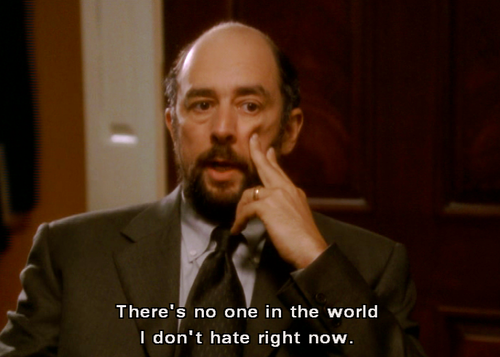
The West Wing’s Toby Ziegler….. not a young Ruairi Quinn TD

Last night was not one of those nights.

You could watch the fly on the wall documentary “Inside the Department” on RTE1 or the latest incarnation of Dallas on TV3.

What a choice. A programme about power, jealousy, feuding, lust, carnality, sumptuous offices, driving ambition, back stabbing, expense accounts and flash cars….. or you could watch JR and Bobby stare it out on Dallas.

As an ex ministerial adviser, I opted for the former and watched “Inside the Department”. Indeed, I not only watched it, I recorded it and watched it a second time.

This was not due to my not believing what I had seen the first time, but rather as a means of catching on the second viewing any gems or nuggets of information I missed on the first viewing.  I needn’t have bothered.

As a PR colleague from the North observed on Twitter last night: like all bad ideas making this documentary probably looked like a good one at the time.

That is not to say it was a bad idea for the producers, far from it. It was interesting programme. The problem is that it did not achieve its goal. It was less a look “inside the department” and more a look at Ruairi Quinn and his kitchen cabinet.

And what a kitchen cabinet it is. I think I counted five of them around a table at one point. When I was a special adviser at the Department of Defence there was just the two of us: me and the Minister’s press adviser. Even so, the then Fine Gael and Labour opposition told us we were over staffed

But even they, notwithstanding their numbers, failed to note that the title of the programme was “Inside the Department” and not “Inside the West Wing”.

They also forgot that they are there as servants of the Minister, not as players. Their role is to aid and assist the minister in implementing government policy. This is work you can best do silently and discreetly.

What possessed them to agree to do interviews to camera and offer what were, in my opinion, smug and ill-considered running commentaries on the events of the day?

Worse still, how did they allow themselves and their Minister to talk so loosely on camera about “summoning” Minister Rabbitte over to the northside and being “wary” of  the planned “off the record” meeting with Rabbitte and a delegation of Labour TDs?

As Minister Quinn said during the programme itself, we all make mistakes, I know that only too well myself, but having such a discussion on camera shows naivety at best.

On the broader front, I got the sense that the neither Minister nor the advisers were ever arguing the public’s side during any discussions: either on the Déis schools or reductions in teacher numbers.

It is called “going native”. It was the accusation that stuck to the last administration after 14 years in office. It is the impression that Ministers and advisers are there to represent and present the policy of the bureaucracy, not the voters.

While it took us the guts of 14 years to that that way, these guys seems to have achieved it in as many weeks.

Listening to them talk and interact with the officials it is almost impossible to believe that they had ever been in opposition. It was if they had no problems with the existing policy and saw it merely as their role to guarantee its seamless and uncritical transmission to the public, with the odd kick at Fianna Fáil thrown in to remind them that this lot is different.

Yes, there were the clips of Ruairi calling the Department “malevolently dysfunction” back in 2010, but where did we see it reflected in his discussion with his officials?

Rather than coming across as our representatives in Government, they came across as the system’s front men to us, more concerned with presentation than substance.

Perhaps the documentary caught the mood of the place accurately, but as someone who believes in the benefits of the adviser system, I sincerely hope it didn’t.

ENDS