EU Justice Ministers “Move Backwards” on Data Protection Regulation? #EUDatap

BEERG coverBEERG’s Director of Public Affairs Derek Mooney writes: The ongoing problems in reaching agreement on the content and detail of the General Data Protection Regulation were highlighted yesterday (Friday Dec 6th) at the EU Council’s meeting of Justice & Home Affairs Ministers.

Despite months of discussions among officials and experts from the member states; Ministers were still unable to reach a consensus on the detailed operation of the “one stop shop” principle central to the Regulation. The issue, just one of several still to be resolved, is now pushed back into the forthcoming Greek EU Presidency, due to run for the first six months of 2014.

After the meeting Commission Vice President and Justice Commissioner, Viviane Reding seemed unable to hide her frustration at this further delay, saying

“…we have moved backwards… Instead of seeing the wood for the trees Ministers got bogged down in details with the solution that even after three months of discussions on the one-stop-shop principle there is still no workable solution on the table.”

Her comments contrast with those of the current Chair of the Council of Justice Ministers, Lithuanian Minister of Justice, Juozas Bernatonis who said:

We prefer a strong agreement to a fast one, and must work to ensure a proper balance between business interests and fundamental rights of citizens.”

The EUObserver.com website later cited an EU diplomat as saying that Germany, with the support of Sweden and Belgium, was partly responsible for the delay adding that Berlin does not want the EU law to be any weaker than its domestic one. Other countries are said to have problems with the actual operation of the systems, believing it to be overcomplicated.

As currently drafted the “one stop shop” principle means that when activities of the undertaking in the EU takes place in more than one Member State, the obligation for cooperation with national data protection authority would be limited to the authority of the main establishment of that undertaking.

As we have previously reported here, Commissioner Reding has spent most of 2013 attempting to railroad the Data Protection Regulation through the EU with a minimum of discussion on the detail, particularly the unnecessary burdens and costs it will create for businesses, large and small, across the EU. Reding’s target was to get the Regulation passed before the current EU parliament and Commission mandates finish in mid-2014 – just in time to further her ambitions to become the next Commission President

While she had some success in speeding up its passage through the Justice & Civil Liberties Committee (LIBE) in the European Parliament, her tactic has not worked with the member state governments. Both the Irish (Jan – June 2013) and Lithuanian (July – Dec 2103) Presidencies have focussed on the detailed operations of her proposal as worded.

Their insistence on fleshing out the implications of the draft Regulations many complex provisions have not only stymied her April 2014 timetable, but perhaps also her own personal ambitions? Could this account for her attack on those Ministers yesterday:

“I wonder how Ministers will face citizens back home, who are calling for stronger and uniform data protection rules in Europe? But fortunately this is not a question that I have to answer.”

With her Commissionership looking certain to end in 2014, it is likely a question she will soon not be around to answer.


ENDS 
 

Obama – one year on from his second victory

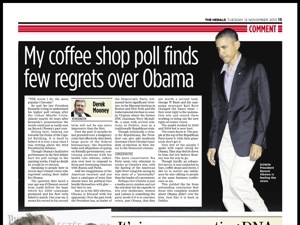
My column for The Herald from Washington DC on my “coffee shop” poll one year on from President Barack Obama’s second term win.

My "in Washington" Herald column
My “in Washington” Herald column

“The worse I do, the more popular I become”. So said the late President Kennedy trying to understand his higher poll ratings after the Cuban Missile Crisis.

Almost exactly 50 years after Kennedy’s assasssination the words could just as easily sum up Barack Obama’s past year. Sitting here, looking out from my Washington DC hotel bedroom towards the Dome of the Capitol building; it is hard to believe it is over a year since I was writing about the 2012 Presidential debates. Though his lack lustre performancein the first debate hurt his poll ratings in the opening weeks, I had no doubt he would be re-elected.

The real question one year ago was if Obama’s second term could deliver the hope and promise which his 2008 campaign promised and his first term failed to match. One year on, it seems that his record in his second term will not be any more impressive than his record in the first.

Over the past 12 months he has presided over a budgetary crisis that effectively shut down large parts of the federal bureaucracy; the Snowden leaks and allegations of spying on friendly governments; continuing problems with his health care reforms, indecision over how to respond to the Syrian crisis and worsening relations with Russia and Putin. Add the sluggishness of the American recovery and you have a catalogue of woes that should have his political foes beside themselves with glee – but they’re not.

Just as in the 2012 election: Obama is blessed with his opponents. Over the past week the President has, as leader of the Democratic Party, witnessed three significant victories: in the Mayoral elections in Boston and New York and the Gubernatorial election in nearby Virginia where the former DNC Chairman Terry McAuliffe, a man with several relations in Dublin, won in a traditionally Republican State.

Though techically a victory for the Republic Party, the President can also add moderate Governor Chris Christie’s landslide re-election in New Jersey to the Democrat column. The more conservative “tea party” republicans seem very reluctant to rejoice in Christie’s win, with the darling of the American right Newt Gingrich saying that he was more of a “personality” leader rather than the leader of a movement.

Maybe he is right. Perhaps Gov Christie is just media savvy creation and not the real deal, but his capacity to win over moderates, women and Latinos is something the Republican Party needs if it is to convince voters, post Obama, that they are worth a second look.

For decades before George W Bush presidential elections were fought on the basis of the Democrat lurching to the left to win the nomination but steering back to the centre to win the election itself and the Republican doing likewise, only to the right first,then back to the centre. Bush and his campaign stratagust Karl Rove changed that – they went right towin the nomination and then stayed there working on bring out new right of centre voters. The model worked in 2000 and 2004, but is now bust. The voters know it. The people at the top of the Republican Party know it. Only their grassroots don’t get it. Very few of the people I spoke with over the past few days here in Washington DC and in neighbouring Virginia, regret voting for Obama. They may feel let down by the President, but almost none believe that Romney was the way to go. Though hardly an exhaustive or scientic survey. To be frank it was conducted mainly in bars, coffee shops and stores. I did try to correct any imbalance in the sample due to my social habits by also talking to people attending the same business conference as me. Those interviews yielded the far from astounding conclusion that those who complain most loudly about Obama, never voted for him. Just like it is back in Dublin.

Abolition of #Seanad is an insult to the proclamation guarantees – Tom Kelly

Here is the text of a column by Tom Kelly in today’s Irish News  You can download the text of the column from here:   Tom Kelly Seanad


Abolition of the Senate is an insult to the proclamation guarantees – Tom Kelly

Tom Kelly
Tom Kelly

As a rule I am in favour of less politicians as they have long since abandoned their representative roles in exchange for a cosy coalition of partisan elites. It’s clear too that in all walks of life we are grossly over governed. Here in Northern Ireland we have one hundred and eight representatives for approximately 1.7 million people. To put that in context Greater Manchester has 2.68 million people.

Soon our grand Norn Iron council will debate the reform of local government which is less about reform and more about a sectarian carve up, but such a debate in a place so small, that only focuses on one aspect of government reform is unlikely to see any direct improvement in the provision of local services or indeed local accountability and transparency.

At the moment we have to drag public information on public expenditure from very unwilling and uncooperative public bodies and public representatives via the cumbersome and costly freedom of information process. Politicians who pay family members from the public purse somehow feel immune to public scrutiny. At each election a simple leaflet should be dropped through the door of every constituency telling us exactly what political nepotism costs us.

Yet there is a fashion for arrogance in Irish politics at the moment that transcends the border. Gifting a large majority to any single party is fraught with danger. The Irish electorate wisely avoided doing so for over thirty years. Ministers in such governments can become magisterial in their pronouncements and Prime Ministers become almost monarchical.

Such is the nature of the government currently blighting the Republic of Ireland. The Taoiseach Enda Kenny has learned much from his one time nemesis, Bertie Ahern. He assiduously avoids media interface unless its at a jobs announcement, rubbing shoulders with a foreign dignitary or climbing Croagh Patrick with Trappatoni. He is a copious student of the sound byte over substance. In the run up to the last General election he got a spur of the moment ‘big idea’ -something not always greeted with enthusiasm by political handlers trying to win an election. Enda’s spurt of ill defined genius was that his incoming government would abolish Seanad Eireann.

Now it’s true that the Irish Senate thanks to the actions of successive Fianna Fáil and Fine Gael governments has long since lost its mojo. Indeed both main parties and the Labour Party stuffed the place with aspirant political wannabes and electoral rejects. It’s also true that to have a second chamber with long outdated panels of election and a significant number of appointees at the partisan whim of a ‘dear’ leader is embarrassing and antiquated; yet for all its faults it is still better than no second chamber at all.

It’s amazing, even bizarre that as we approach the hundred anniversary of the Irish Proclamation with its high minded guarantees of ‘religious and civil liberty for all’- that an Irish government led by people who are torch- bearers to signatories of that Proclamation and political successors to the every creators of the first pluralist Irish senate; would dismantle an important part of a bicameral political system in a multi-cultural and diverse nation, that protects minority rights and those marginalised.

Activist and past member of the Seanad, Kathleen Clarke, wife of Thomas Clarke, first signatory to the Irish Proclamation must be turning in her grave. The Seanad for all its shortcomings gave Ireland two outstanding and unifying Presidents- Douglas Hyde and Mary Robinson. It possibly also gave the current incumbent, a life line that had he lost could have meant he only got to the Aras as a visitor.

Whether its been WB Yeats, David Norris, Feargal Quinn, Ivana Bacik, or even Pearse Doherty, the Seanad has given diverse and unrepresentative audiences an voice. In an all island context too, Ireland would have been a poorer place without the critical voices of senators Seamus Mallon, Maurice Hayes, Gordon Wilson, Sam Mcaughtery, Brid Rodgers and John Robb. A country is truly enriched when it can harness the independent minds and talents of all its people.

Perhaps more importantly we need checks and balances in a democracy. Imagine Charles Haughey’s Fianna Fáil with unbridled authority in Leinster House or what if there were no dissenting voices to the rise of a would be Mussolini such as Fine Gael’s own spectre – Eoin O’ Duffy? The Seanad needs to be reformed not abolished; because once its gone who will be left to apply the brakes to the threat of absolute majoritarian rule ?


TOM KELLY Bio

From Democratic National Conventions in Atlanta and New York to the international Progressive Governance Conference involving 30 heads of state in London, and from President Clinton’s historic Belfast visit to the Dalai Lama’s recent press conferences in Ireland, Stakeholder CEO Tom Kelly has played various roles in making these major global events happen. Amongst the citations of commendations he has received for his work include endorsements from former US President, Bill Clinton, former British Prime Minister, Tony Blair, former Irish Taoiseach, Bertie Ahern, and His Holiness, the Dalai Lama. Each international figure acknowledged not only the work Tom did, but also the professionalism with which he carried out his assignments.

It is widely recognised that few in the communications industry would have the breadth, scope and scale of Tom’s public relations and public affairs experience. He has consulted on many complex and difficult matters for organisations, businesses and individuals, from providing strategic advice to the bakery industry on its pricing policy and referral to the Competition Commission to carrying out media relations for Irish Catholic hierarchy on the handling of allegations of child sexual abuse against clergy. He has contributed to the community consultation programme of change management as the RUC transformed into the PSNI, provided lobbying advice to the Trustees of the Presbyterian Church working on the fall-out of the collapse of the Presbyterian Mutual Society and co-ordinated a public affairs strategy on behalf of the major Northern Ireland newspaper industry groups.

Tom has also demonstrated his capability in the financial sector by co-ordinating a hearts and minds campaign which underpinned the Irish League of Credit Unions’ successful ‘Dirt’ exemption bid, as well as working with the Irish Bank Officials Association on its successful opposition to employment and benefit changes for members.

#Seanref #Seanad debate via @mickfealty #digital lunch

Streamed live on Sep 27, 2013
DigitalLunch coversation chaired by Mick, between Fine Gael TD Joe McHugh and Democracy Matters rep Derek Mooney on whether Seanad Eireann should be abolished?

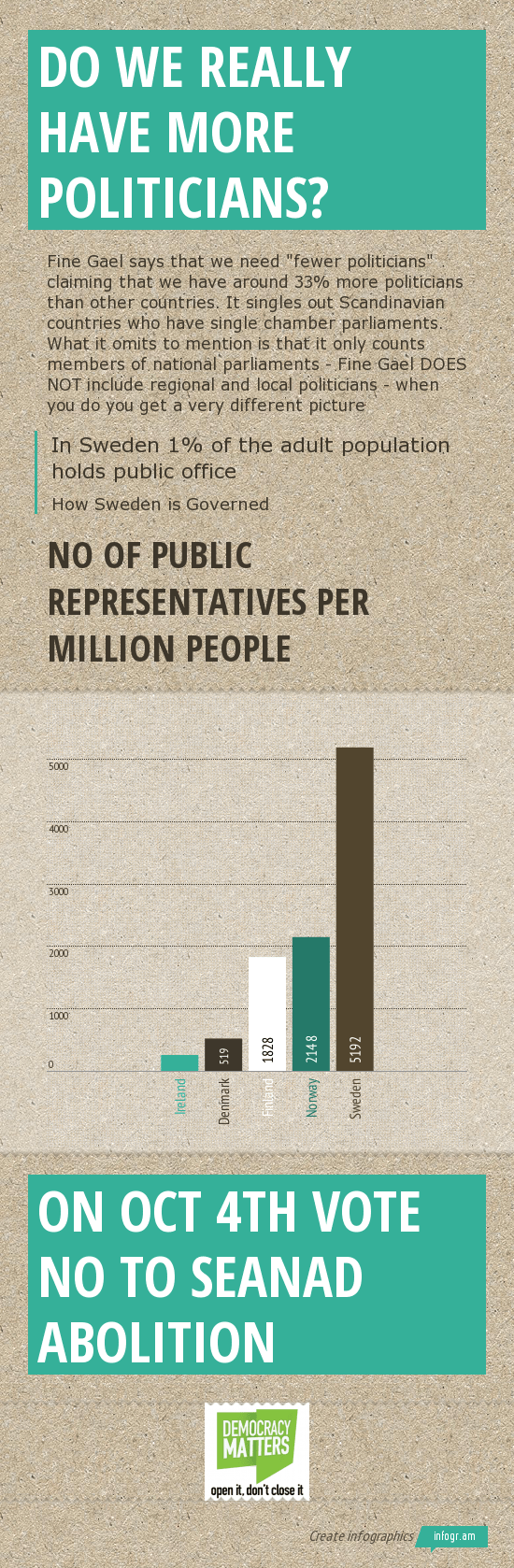
FG’s “fewer politicians” claim is bogus #Seanref

Download #seanref #seanad information booklet here…

Download the Seanad Information Booklet produced by Democracy Matters!

Seanad Reform Information Booklet


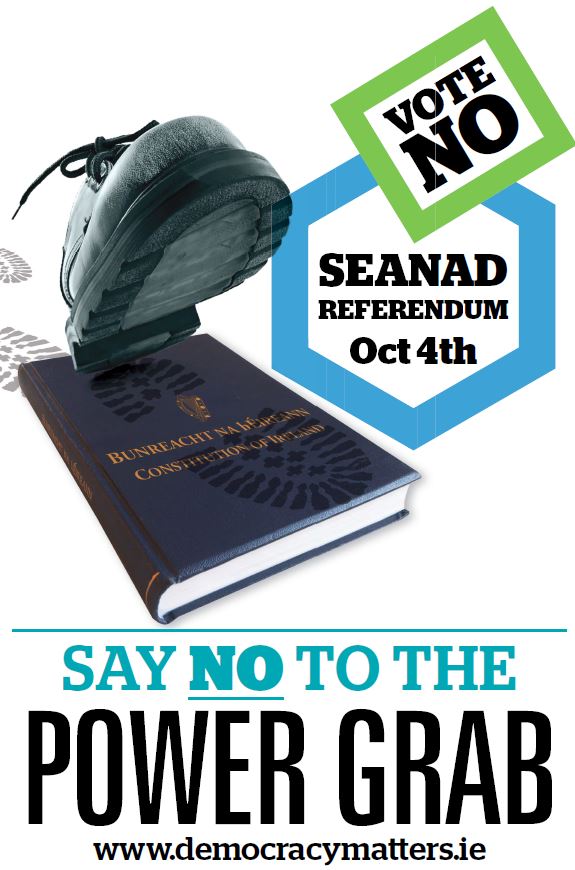
Powergrab

“Is Chris Andrews a Shinner or Just a Mé-Féiner”

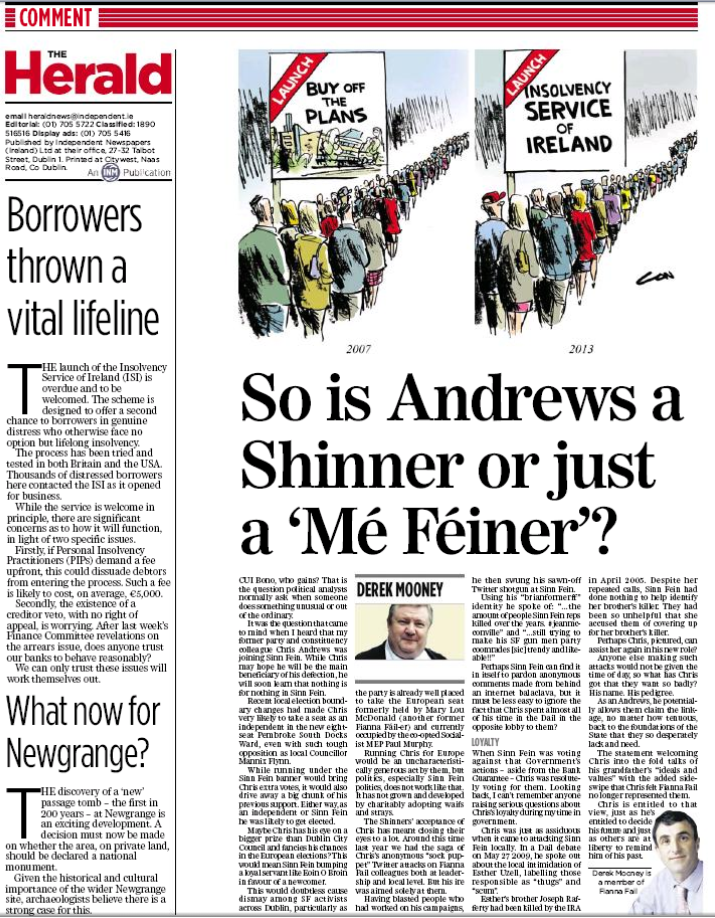
My column from today’s Herald  on Chris Andrew’s joining Sinn Féin 

My column in today's Herald
My column in today’s Herald

————————————————————————

Cui Bono, who gains? That is the question political analysts normally ask when someone does something unusual or out of the ordinary.

It was the question that came to mind when I heard that my former party and constituency colleague Chris Andrews was joining Sinn Féin.

While Chris may hope he will be the main beneficiary of his defection, he will soon learn that nothing is for nothing in Sinn Féin.

Recent local election boundary changes had made Chris very likely to take a seat as an independent in the new eight seat Pembroke South Docks Ward, even with such tough opposition as local Councillor Mannix Flynn.

While running under the Sinn Féin banner would bring Chris extra votes, it would also drive away a big chunk of his previous support. Either way, as an independent or Sinn Féin he was likely to get elected.

Maybe Chris has his eye on a bigger prize than Dublin City Council and fancies his chances in the European elections? This would mean Sinn Féin bumping a loyal servant like Éoin Ó Broin in favour of a newcomer.

This would doubtless cause dismay among SF activists across Dublin, particularly as the party is already well placed to take the European seat formerly held by Mary Lou McDonald (another former Fianna Fáil-er) and currently occupied by the co-opted Socialist MEP Paul Murphy.

Running Chris for Europe would be an uncharacteristically generous act by them, but politics, especially Sinn Féin politics, does not work like that. It has not grown and developed by charitably adopting waifs and strays.

The Shinner’s acceptance of Chris has meant them closing their eyes to a lot.

Around this time last year we had the saga of Chris’s anonymous “sock puppet” Twitter attacks on Fianna Fáil colleagues both at leadership and local level. But his ire was not aimed solely at them.

Having blasted people who had worked on his campaigns, he then swung his sawn off twitter shotgun at Sinn Féin. Using his “brianformerff” identity he spoke of: “…the amount of people Sinn Féin reps killed over the years. #jeanmcconville” and “…still trying to make his SF gun men party coomrades [sic] trendy and likeable!!”

Perhaps Sinn Féin can find it in itself to pardon anonymous comments made from behind an internet balaclava, but it must be less easy to ignore the fact that Chris spent almost all of his time in the Dáil in the opposite lobby to them?

When Sinn Féin was voting against that Government’s actions – aside from the Bank Guarantee – Chris was resolutely voting for them. Looking back, I can’t remember anyone raising serious questions about Chris’s loyalty during my time in government.

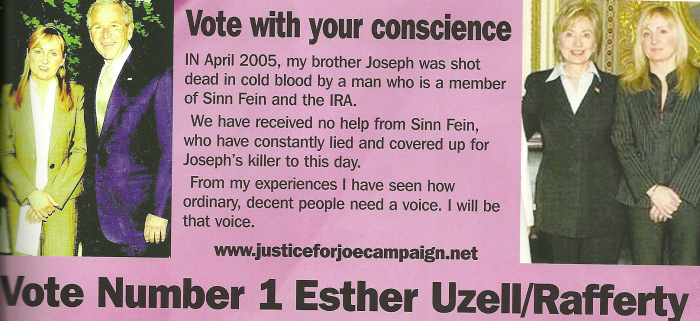
Chris was just as assiduous when it came to attacking Sinn Féin locally. In a Dáil debate on May 27 2009 he spoke out about the local intimidation of Esther Uzell, labelling those responsible as “thugs” and “scum”. Esther’s brother Joseph Rafferty had been killed by the IRA in April 2005. Despite her repeated calls, Sinn Féin had done nothing to help identify her brother’s killer. They had been so unhelpful that she accused them of covering up for her brother’s killer.

Perhaps Chris can assist her again in his new role?

Anyone else making such attacks would not be given the time of day, so what has Chris got that they want so badly? His name. His pedigree.

As an Andrews he potentially allows them claim the linkage, no matter how tenuous, back to the foundations of the State that they so desperately lack and need. The statement welcoming Chris into the fold talks of his grandfather’s “ideals and values” with the added sideswipe that Chris felt Fianna Fáil no longer represented them.

Chris is entitled to that view, just as he’s entitled to decide his future and just as others are at liberty to remind him of his past.

ENDS

uzzellraff2
Esther Uzell leaflet – image from http://irishelectionliterature.wordpress.com/

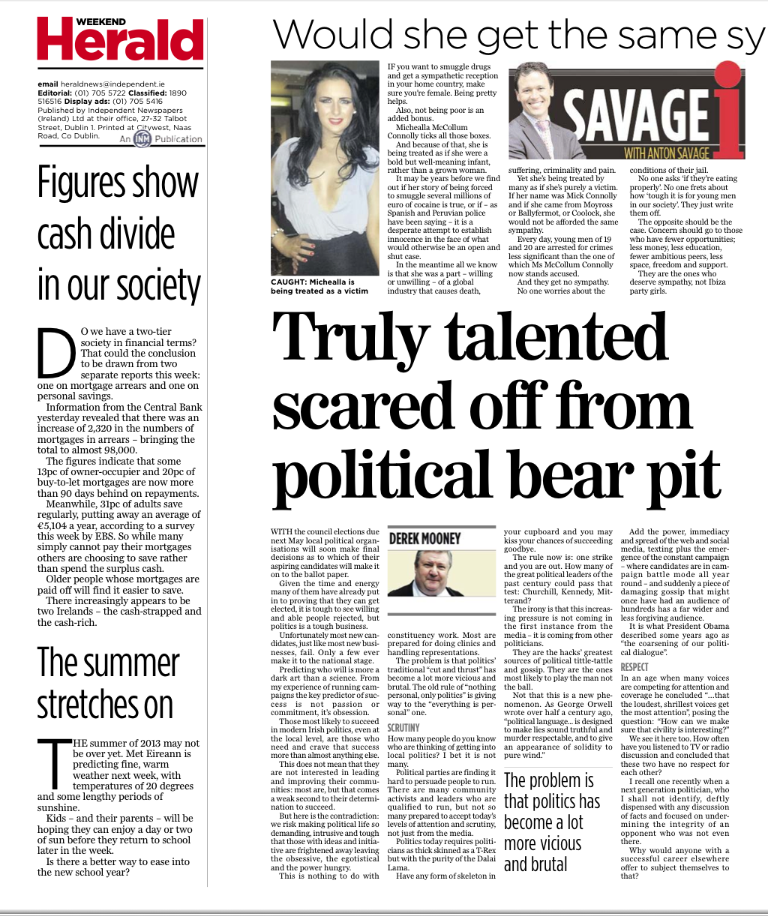
Truly talented scared off from political bearpit

This is my latest column on how “playing the man, not the ball” is hurting Irish politics. It appeared in today’s Herald (August 24th 2013):

Evening Herald Aug 24, 2013

With the council elections due next May local political organisations will soon make final decisions as to which of their aspiring candidates will make it on to the ballot paper.

Given the time and energy many of them have already put in to proving that they can get elected, it is tough to see willing and able people rejected, but politics is a tough business.

Unfortunately most new candidates, just like most new businesses, fail. Only a few ever make it to the national stage.

Predicting who will is more a dark art than a science. From my experience of running campaigns the key predictor of success is not passion or commitment, its obsession… and I don’t mean the fragrance.

Those most likely to succeed in modern Irish politics, even at the local level, are those who need and crave that success more than almost anything else.

This does not mean that they are not interested in leading and improving their communities: most are, but that comes a weak second to their determination to succeed.

But here is the contradiction: we risk making political life so demanding, intrusive and tough that those with ideas and initiative are frightened away leaving the obsessive, the egotistical and the power hungry.

This is nothing to do with constituency work. Most are prepared for doing clinics and handling representations. The problem is that politics’ traditional “cut and thrust” has become a lot more vicious and brutal. The old rule of “nothing personal, only politics” is giving way to the “everything is personal” one.

How many people do you know who are thinking of getting into local politics? I bet it is not many.

Political parties are finding it hard to persuade people to run. There are many community activists and leaders who are qualified to run, but not so many prepared to accept today’s levels of attention and scrutiny, not just from the media.

Politics today requires politicians as thick skinned as a T-Rex but with the purity of the Dalai Lama. Have any form of skeleton in your cupboard and you may kiss your chances of succeeding goodbye. The rule now is: one strike and you are out. How many of the great political leaders of the past century could pass that test: Churchill, Kennedy, Mitterand?

The irony is that this increasing pressure is not coming in the first instance from the media – it is coming from other politicians.

They are the hacks greatest sources of political tittle-tattle and gossip. They are the ones most likely to play the man not the ball.

Not that this is a new phenomenon. As George Orwell wrote over half a century ago, “political language… is designed to make lies sound truthful and murder respectable, and to give an appearance of solidity to pure wind.”

Add the power, immediacy and spread of the web and social media, texting plus the emergence of the constant campaign – where candidates are in campaign battle mode all year round – and suddenly a piece of damaging gossip that might once have had an audience of hundreds has a far wider and less forgiving audience.

It is what President Obama described some years ago as “the coarsening of our political dialogue” In an age when many voices are competing for attention and coverage he concluded “…that the loudest, shrillest voices get the most attention”, posing the question: “How can we make sure that civility is interesting?”

We see it here too. How often have you listened to TV or radio discussion and concluded that these two have no respect for each other? I recall one recently when a next generation politician, who I shall not identify, deftly dispensed with any discussion of facts or and focused on undermining the integrity of an opponent who was not even there.

Why would anyone who either with a successful career elsewhere offer to subject themselves to that?

Why @simonharristd makes the case for a #seanref #No vote much stronger #Seanad

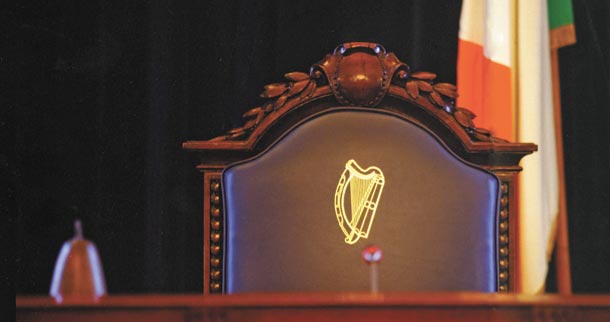
The Seanad Chair
The Seanad Chair

As a firm believer in Seanad reform – and consequently a trenchant opponent of Seanad abolition – the Sunday Independent’s Millward Brown poll showing the No to Abolition side gaining further momentum is gratifying.

The past few weeks have hardly been great for the No side. Fine Gael has been pretty active on the airwaves over the Summer break, while Sinn Féin’s opportunistic decision to campaign for a Yes, having vehemently opposed the Government’s proposal in both the Dáil and Seanad, hasn’t helped the No cause either.

All this makes the increase in the pro Seanad reform level of support all the more re-assuring. Not that the poll suggests that the campaign is done and dusted. Far from it.

More than almost any other, this Seanad abolition policy, is the lone brain child of Enda Kenny. Though there seem to be no research papers, discussion documents or policy positions he can produce to justify the origins of this initiative, he is the man behind it and he has more to lose by its defeat than anyone else.

While Labour nominally favours abolition, its TDs and Ministers can reasonably see their policy obligations as fulfilled by the holding of a referendum. Don’t expect to see many of them working too hard for a Yes to abolition vote. Indeed, as the Labour Chief Whip has indicated, at least half the Labour parliamentary party may actually work for a No vote seeing it as the best way to secure a popular mandate for Seanad reform.

One of the two authors of Labour’s 2009 position paper on Seanad reform, Junior Minister, Alex White has not commented on the issue much, while the other author, Joanna Tuffy TD has indicated that she will be campaigning for a No vote.

The worrying shift in the poll numbers make it necessary for Fine Gael to up the ante over the weeks ahead.
Given that the main shift has been in the group who describe themselves as favouring reform expect to see Fine Gael focus its attentions there and try to convince them that a Yes vote is a vote for reform.

We already had a glimpse of this approach last week via its neophyte Wicklow TD, Simon Harris’s speech at the Parnell Summer School.
Harris advanced the argument that abolishing the Seanad counts as reform and gives power back to the people as it means the single remaining chamber of the Oireachtas: the Dáil will be 100% elected by the public.

Harris’s reasoning seems to hinges on the statistic that the number of people registered to vote in Seanad elections, under current legislation, is around 156,000; about 5% of the approx 3.1 million entitled to vote at the February 2011 Dáil election.

What Harris misses, however, is that this 156,000 (Councillors, Oireachtas members and NUI and TCD graduates) is defined in legislation – not the Constitution. Everyone in the North and South could be given the right to vote with the passing of an Act by the Dáil and Seanad. Indeed the Seanad has already voted for such a piece of reform with the Second Stage vote on the Quinn/Zappone Seanad Reform Bill.
The extension of the Seanad franchise to all is now completely within the gift of Deputy Harris’s colleagues on the government benches.

The only real obstacle to such a real reform is the Taoiseach’s obduracy in insisting on Seanad abolition instead of reform.

Though not central to the argument it is worth noting that the 156,000 figure is probably an understatement as it just counts the NUI and Trinity graduates who have registered to vote. Many 100s of 1000s more are entitled to vote by virtue of their graduation.

The other problem with Harris’s reasoning is the idea that the answer to existing disenfranchisement is more disenfranchisement. It defies all democratic principles to propose removing someone’s voting rights when you have it in your power to extend them.

If you were to apply Deputy Harris’s quirky logic to the campaign for women’s suffrage a century back you would determine that the way to ensure equal voting rights for all was to remove the vote from men so that the two genders were equally disadvantaged.

The very legitimate criticism that not enough people are entitled to vote in Seanad elections is properly addressed by giving everyone the right, not by removing it.

I would hope that Deputy Harris’s espousal of a position that is the absolute antithesis of reform is informed by loyalty to his party leader and desire for advancement rather than by belief in the argument itself.

If it is the former then the case for reform is all the greater, if it is latter then it is time to worry.

Ends

Plan to give Dublin its own Boris Johnson is bonkers

Tonight's Herald Editorial Page
Tonight’s Herald Editorial Page

My column from today’s Herald on the current discussions to have directly elected mayors for Dublin in the future.

____________________ 

Should Dublin have its own version of Boris Johnson?

That is the question a Forum of 22 Dublin councillors will consider between now and September. But there is good news: Dubliners will get a say on it in May.

While the forum, drawn from the four Dublin Councils, started its deliberations at the end of July, the idea of Dublin having a directly elected Mayor goes back much further.

According to the Lord Mayor of Dublin website it goes back to Chapter 11 of Minister Phil Hogan’s June 2012 local government reform: Putting People First. It actually goes back to Noel Dempsey’s 2001 Local Government Act.

In case my Boris Johnson reference hasn’t given it away, I am not a fan of the idea. I wasn’t a fan of it in 2000, nor when John Gormley resurrected it in 2008.

Like most Dubliners, I want to see decisions made about Dublin being made by people who are answerable to Dubliners, but I am not persuaded that directly electing a mayor is the way.

My biggest worry is that an office supposedly created to give leadership to Dublin would descend into de-facto focus of attention for opposition to the government of the day.

A directly elected Mayor of Dublin would, after the President, have the biggest electoral mandate in the State, but without the constitutional prohibitions on politicking.

Boris Johnson’s mayoralty has become a focus for those unhappy with David Cameron’s leadership. Given the scale here: a mayor of the greater Dublin area would potentially be elected by up to a third of the total electorate, imagine how much more pronounced those clashes would be, particularly when the Taoiseach and Mayor were from opposing parties?

The potential for political gridlock is huge, especially where the Mayor has no real powers or responsibilities, just what Teddy Roosevelt called “a bully pulpit”. Instead of leadership we would just be getting a personality with a shiny office and access to a microphone.

The use of the London Mayor template only adds to this concern. Chapter 11 of Putting People First, which the Forum is using as its starting point, makes no fewer that six references to London.

It does not mention the directly elected mayors in Berlin, Budapest or Paris, or the strong systems of city governance in Helsinki, or Copenhagen.

This Ministerial and Departmental infatuation with London is hard to understand. I can only imagine that it is because they have never seen the legislation establishing the London Mayoralty and Authority: The Greater London Authority Act 1999.

At almost 500 pages it is the longest piece of legislation passed at Westminster since the Government of India Act. More importantly it does something almost unheard of in Irish public administration: it takes power away from central government.

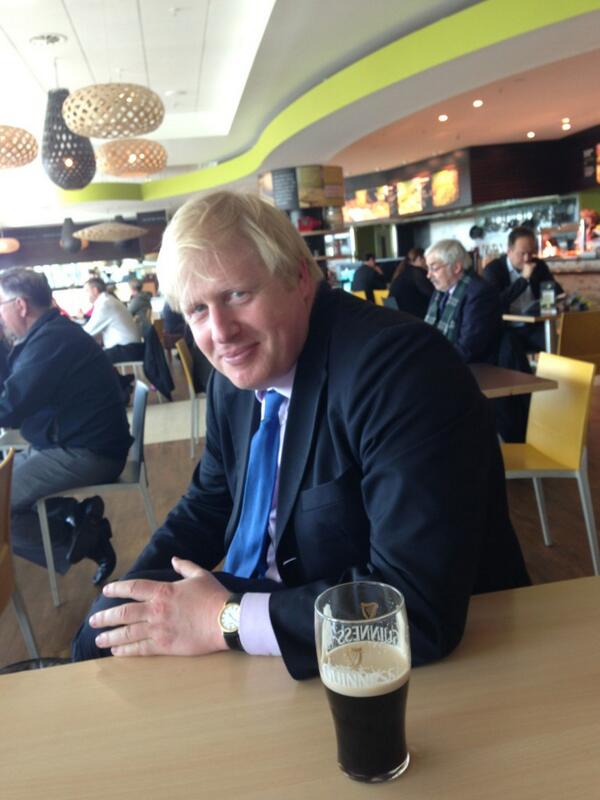
Boris Johnson pic from @mayoroflondon twitter a/c

Not that it took enough powers. Earlier this year Johnson was again calling for London to have the power to raise property and new tourism taxes. In May last year 8 out of the 10 UK cities asked if they wanted a directly elected Mayor said: no.

Do we really see the Phil Hogan’s Department of Environment ceding power and controls to anyone?

This is the Minister who, in the same Putting People First document, has slashed the number of local authorities from 114 to 31 and the total number of City, County and Town councillors from 1,627 to 949.

Do we really think he is ready to chop off a large section of his Budget and power to keep us happy?

With most decisions regarding Dublin’s present and future being made by unaccountable and disconnected State bodies and departments, the case for giving more power to Dublin is clear.

What is almost just as clear is that instead of being given viable city government with a budget and authority the most that will really be on offer is a city personality with a big desk, a press officer and an electric car.

ENDS