#RTEpt quizzing of Gerry Adams shows it can do public service broadcasting

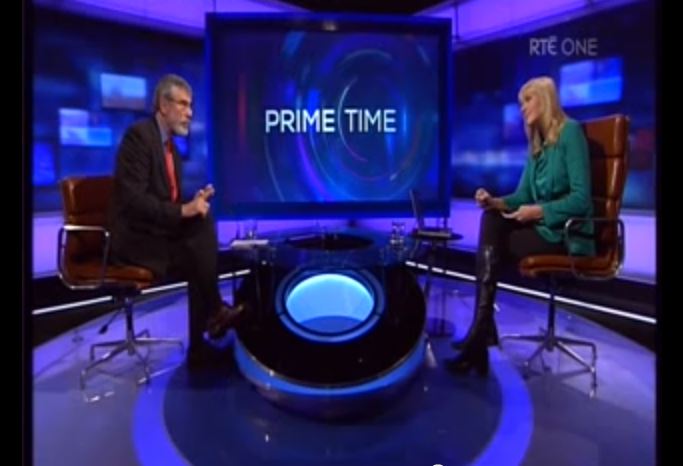
Gerry Adams quizzed by Miriam O'Callaghan
Gerry Adams quizzed by Miriam O’Callaghan

Monday night’s Primetime interview with Gerry Adams was a reminder that RTE is well capable of doing thorough, professional and researched public service broadcasting.

It did much to dispel the doubts cast about the station’s reputation by both the Frontline presidential debate and “Mission to Prey” debacles.

It also showed that Sinn Féin is not as clever, strategic and skilled in the political dark art of spin as many in other political parties and the media presume.

Watching the programme last night, and again today on Youtube, raises the obvious question: why did Gerry Adams agree to do this 24 minute interview in which he essentially spent his time talking about murder?

In part the interview was the consequence of the remarks he made in the Dáil on January 29th last during the expressions of sympathy on the killing of Garda Adrian Donohue.

He used that occasion to offer his condolences and solidarity with the family of Garda Donohue, but also to broaden that expression of sympathy to include others murdered in the line of duty; saying: “I apologise to Mrs. McCabe and the McCabe family, Garda Ben O’Sullivan and the families of other members of the State forces who were killed by republicans in the course of the conflict.”

But, having offered that apology in the Dáil, why did he seem so incapable last night to expand on that and adequately apologise, sympathise and console those who had lost relatives to so called republican paramilitaries over the years?

Why go on to the programme and give such an interview, when you know you are either unable or unprepared to answer the questions and offer the information that is going to be asked of you?

Could it be that the reason for his appearance was less to do with expanding upon his comments of January 29th and more to do with trying to pre-empt what he fears may be revealed when the Boston Tapes are released?

Could it also be an attempt to deflect attention away from the recent Belfast court case involving Adam’s brother Liam?

Deflecting attention away from one difficult story by opening up about another one is not a tactic unfamiliar to Mr Adams and Sinn Féin. Recall how Gerry Adams revealed how his own was father was both a paedophile and a thug while he was being criticised for his handling of the allegations of abuse made to him by his niece Aine Tyrell about her father, Liam Adams.

The revelation about his father came around the time that he acknowledged that he not dealt well with the allegations and that his actions when he discovered that Liam Adams was working with children were wrong – he had approached his brother rather than his employers.

While Adams’ performance last night will do little to diminish his standing with the bulk of Sinn Féin activists, it may cause some of the newer and younger intake people who considered Sinn Féin as an idealistic alternative to mainstream politics to think again.

Adams’ supporters will justify their continuing support with claims that this is all a smear against their leader – echoes of what we have heard in recent days from UKIP, but the defence used by some that this is all a very long time ago does not hold water.

Another defence offered online by defenders of Adams is that this is all RTÉ bias against their party. Why, they asked, wasn’t RTE asking Labour party leaders if they were in Official IRA?

Frankly, I have no problem with RTÉ asking them that, at least it suggests that some in Sinn Féin may unconsciously realise that Miriam O’Callaghan’s questioning of their leader last night was both fair and legitimate

@FiannaFailparty Back from the Brink?

My analysis piece entitled “Back from tcuislehe Brink” from the April 2013 (Árd Fheis) edition of Fianna Fáil’s Cuisle magazine 


Back in April 2011 the possibility of Fianna Fáil seeing its poll ratings even just break through the 20% barrier seemed like a pipe dream. But more than that, it was one that you dared not talk about in public in case people might question 1: Your political judgement or 2: Your grip on reality.

Yet, barely two years on, our party’s support heading into the mid 20s and we have confounded the pundits with two better than anticipated by-election performances in Dublin West and Meath East.

Back in 2011 things looked a lot darker. There had been a number of occasions between late 2008 and early 2011, as support plummeted, where we thought: it cannot fall any further. Yet it did.

Two years on from what I described in my Herald column as our electoral “punishment beating” our main achievement is not the increase in the polls, but rather the halt in the party’s decline achieved in the months following the February 2011 defeat.

That was the critical point. It was when the party’s future was most at risk. Remember those political pundits who advised that the only future lay in lurching to the right or trying to outflank the Shinners on euro-scepticism?

That was when we faced the key test for a venerable and established political party: its ability to adapt and respond effectively to change. The alternative was stark: descend into factionalism and fade slowly into oblivion.

By the time of last year’s Árd Fheis the party had determined that its future lay in change: real change. The decision to invite Prof Tim Bale to address the Árd Fheis was both timely and inspired. His presentation, based on his research into the Tories 13 years in the wilderness, listed the 12 key lessons points a party in our position needs to learn. The first two are:

1: Fully understand the scale of the defeat and
2: Not to underestimate your opponents.

Yet they are two lessons large established parties find it hardest to grasp. Having represented the political centre of gravity for so long it is hard to grasp that it has moved away and that you need to regain its trust.

This was not just true of the Tories, but of other big political parties who have lost and recovered: from the British Labour Party to the Japanese Liberal Democratic Party (LDP).

The temptation is to believe that your rejection is just a temporary phenomenon: that your former voters have just been misled by siren voices from the opposition and will return to the fold when the weaknesses and failings of the other crowd are exposed.

This was the mistake the Tories made about New Labour under Tony Blair and, conversely the mistake that Old Labour made about Thatcher. Both seriously underestimated their opposition and considerably overestimated their apparent entitlement to govern.

But there is another point on Prof Bale’s list. It is number 12: Political parties with respected traditions rarely disappear

While the SPD still languishes behind its rival CDU some nine years after Gerhard Schröder lost the Chancellorship to Merkel, it is still a major force in German politics. While Schröder’s resignation and the formation of the left wing Die Linke hurt Germany’s oldest political party, it focussed on the future; reformed and changed.

The same can be said for the Swedish Social Democrats – once Fianna Fáil’s main challenger for the title of Europe’s more successful political party. While its support has been falling steadily since the early 1990s, it still remains a major force in Swedish politics, though in opposition since 2006.

Japan's LDP
Japan’s LDP

While these parties suffered successive defeats, they were not on the scale of Feb 2011. To find an example of a party that came back from an electoral mauling of similar magnitude you need to look to Japan’s LDP. Sometimes hailed as the world’s most successful democratic party, the LDP held power in Japan almost continuously from 1955 to September 2009.

The seeds of its 2009 defeat (where it went from 296 seats to 119) were sown in the mid 90s where there were a number of major political reforms.

While the LDP continued to win elections, other parties were adapting better. It could still boast a popular leader in Junichiro Koizumi but, behind the scenes, the LDP was losing its advantage. It went from winning the 2005 election with one of the largest majorities ever to losing 60% of its seats in 2009.

The loss provided an initial shock to the system with some MPs jumping ship, but the LDP is a big and long established beast. It soon adapted to the 1994 reforms and worked at providing a very effective opposition. After just three years it completely reversed the 2009 defeat winning 294 seats at the December 2012 election.

Clearly there were other factors at play, but it does show what a political party that is deeply rooted in its communities and has a wide and diverse membership can achieve when it faces up to realities.


Why the Good Friday Agreement is a good metaphor for @FiannaFailparty

Fianna Fáil Ard Fheis this weekend

My column on this weekend’s Fianna Fáil Árd Fheis from today’s Herald

If you are planning to head to Ballsbridge for a quiet pint or a cup of coffee this Friday or Saturday – think again. From about 5pm this Friday until well past mid-night on Saturday the area around the RDS will be saturated with about five thousand exuberant and excitable Fianna Fáil-ers gathered for the party’s Árd Fheis – including yours truly.

If you decide to follow the Árd Fheis proceedings online or on air you can expect to hear the Good Friday Agreement (GFA), whose fifteenth anniversary passed two weeks ago with little acknowledgement from the Government, mentioned several times.

Many in Fianna Fáil fear that its greatest recent political achievement is being slowly air brushed out of official history.

The impression is being given that the GFA was merely the logical and inevitable consequence of the 1985 Anglo Irish Agreement, about which we have heard a lot following the deaths of both Garret Fitzgerald and Margaret Thatcher.

As one of many people who spent countless hours travelling up and down to Belfast on pre M1 roads that stopped for lollipop ladies in Balbriggan and Julianstown, I can assure you there was nothing inevitable about it.

But the Good Friday Agreement is also something of a metaphor for Fianna Fáil itself.

We now see that that getting agreement was the easier piece of work when compared with the effort and energy required to get it implemented and working – well, almost working.

The same is true of Fianna Fáil. The work required to get the party to this point has been huge, but it as nothing to the work ahead.

While last year’s Árd Fheis focused mainly on important internal reforms, such as One Member One Vote, the truly difficult work starts now.

This Árd Fheis is more about facing outwards and talking to an electorate who now shows signs of being ready to listen to what the party has to say. But the party’s improving opinion poll figures should not delude pundits, or even party members, to thinking its resurgence is assured.

To be brutally frank, what has Fianna Fail said or done in recent months to justify such increases? While it has produced some very fine policy proposals such as the Family Home Bill and Regulation of Debt Management Advisors Bill, they hardly account for bounce.

Nor does the performance of the party’s spokespeople.

Without doubt the party has scored significant hits on the government in recent months, particularly via its Health Spokesman Billy Kelliher, its Finance Spokesman Michael McGrath and its Justice Spokesman Niall Collins and, of course, the party leader Michéal Martin, but it is finding it difficult to mark all bases with such few Oireachtas personnel.

While he has several new people inside the Oireachtas who he can use effectively: such as Senators Averil Power and Marc McSharry, perhaps the leader also needs to look outside the ranks of the parliamentary party for other new faces and voices to put on Radio and TV in senior roles – Dublin Bay South’s Cllr Jim O’Callaghan for instance.

The hard truth is that the increases are as much down to Fine Gael and Labour’s travails as they are to any softening of attitude to Fianna Fáil. Besides, as the poll analysts would tell you, it is dangerous to read too much into opinion polls where over 30% of the respondents are answering: don’t know.

This is not to underestimate the size of what the party has achieved. At this time last year it was a tough job convincing others that while the party may be down, it was not finished. The big achievement has not been the increases in the polls, but rather the halt in the party’s decline.

At last year’s Árd Fheis the party helped reverse that decline by re-introducing itself to its own members, this weekend it starts the even great task of re-introducing itself to its former supporters. Let’s hope it has more success in doing that than the GFA has had in getting its institutions working.


Why waste time speculating about possible @FiannaFailparty and @FineGaeltoday link-ups?

This piece is also on www.TNT24.ie 

Surely I cannot be alone in realising that there is less chance of Fianna Fáil and Fine Gael linking up than there is of Luis Suarez having all his teeth pulled and turning vegetarian.

Yet, within hours of each new opinion poll you will see lots of speculation in print, on air, online and/or on all three that the next government will consist of Fianna Fáil and Fine Gael in some combination or other.

Such speculation seems to be based just on adding together the numbers that bring you to 50% and ignores the glaring Catch 22 that renders the chances of any such FG/FF or FF/FG alliance impossible: neither party would ever agree to go into a partnership government where it was not the biggest partner.

Kenny Martin
Photo via http://www.dailyedge.ie/

And as, by definition, a partnership government of just two groups cannot have two biggest partners, neither party would agree to be the junior partner in such a relationship. To do so would fly in the face of the fundamental rule of Irish governmental politics: junior coalition partners come off worst.

The strategists in both Fine Gael and Fianna Fáil know this. Whatever their weaknesses and deficiencies in policy formulation, these are still wily and experienced political operatives, they understand political realities. More critically they understand the laws of self preservation. They know that going into government as the junior partner while leaving Labour and Sinn Féin as the official opposition would be tantamount to writing their own party’s obituary.

Those who argue, on the basis of current opinion polls, that the Fine Gael / Fianna Fáil option may be the only viable one after the next election, do it on the basis that politics is a “numbers game”.

Well, to some degree it is, but numbers do not dictate everything. True, without the numbers you have no role and no say, but the converse is not true. Having the numbers does not mean that you must necessarily do A or B. Having the numbers does not restrict your options, quiet the opposite. Rather than being compelled to pursue some particular course, you have the opportunity to exercise judgement and think strategically.

This is not to discount the temptation and lure of ministerial office, especially to those who may not plan to face the electorate again. Saying no to power is no easy task, but the decision is made somewhat less troublesome if you know that saying yes to office today as a junior partner means that you are almost certainly ensuring that that option will be denied to you and your colleagues for many years thereafter.

Though majorly damaged after electoral pounding it took in the February 2011 General Election, Fianna Fáil is still hard wired for power – perhaps even more so that Fine Gael – so saying no to office would be difficult for some within the upper echelons of the organisation. Perhaps this is why the party leadership has recruited the membership of the party to ensure that any post election decision would be made by the broader party.

The situation is just as true for Fine Gael, though for other reasons. Having spent so long as the second party of Irish politics, it is now relishing its time in the top spot. It will be loathe to surrender that place – least of all to Fianna Fáil.

If the next election were to put Fianna Fáil ahead of Fine Gael, no matter by how small a margin, Fine Gael would do nothing to help Fianna Fáil back into power. Fine Gael would seek alliances with Labour, Sinn Féin, Independents, Socialists, Wallacites; McGrath-ites (of the Mattie or Fintan variety) Greens, People Before Profit, Profit Before People, Cart Before the Horse or whoever to keep Fianna Fáil out.

I know I risk appearing more than a little cynical in not mentioning policies and principles and just discussing the possible make up of a future government in terms of survival strategies but, I believe the chances of a Fine Gael/Fianna Fáil government are so remote and unrealistic that it is cynical not to dismiss it and to allow any more time and energy be wasted on discussing an option (and the associated policies) that does not exist.

#Merkel & #EU need to learn the lessons of Germany’s own economic renewal

adenauer
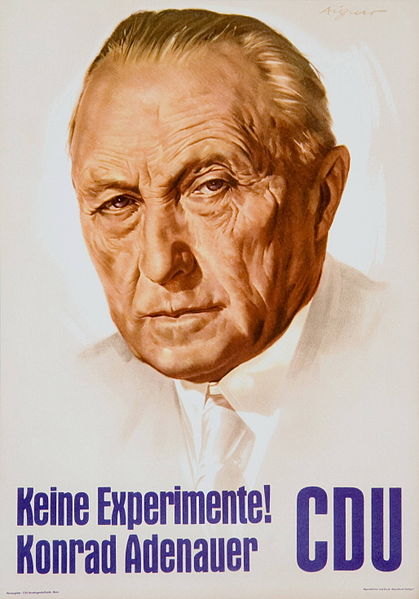
1957 Adenauer Election Poster: No Experiments

Yesterday (Thurs April 11th) the Irish Times ran a story saying that the German chancellor Angela Merkel is facing mounting political pressure at home to demand fiscal concessions from Ireland in exchange for granting extra time to repay crisis loans.

It seems that once again Germany is insisting that it not merely have an input into EU talks and discussion, but that it have a veto on the outcome. It is the ‘he who pays the piper calls the tune’ school of political thought.  While the approach is not unfamiliar in politics, it flies totally in the face of democratic process and accountability. But even more than that, in this instance, it contradicts the history of Germany’s own economic revival and the important role played by one of Ms Merkel’s most illustrious predecessors: Konrad Adenauer.

Germany’s Wirtschaftswunder – the economic miracle of the 1950s – was based in large measure on a generous programme of debt forgiveness given to Germany by its 33 debtor countries (including Ireland). The 1953 London Agreement on German External Debts, effectively wrote off half of Germany’s total mountain of debt and gave it additional time to repay the monies it owed. These debts included war reparations from both first and second world wars, plus the massive German 1930’s debt default, which was just as significant as the 2008 European financial crisis.

The West German CDU Chancellor, Konrad Adenauer realised that there would be no growth or revival of the West German economy for as long as it had to make huge annual payment to the Allied and other powers. These hefty payments, many of which Germany was even failing to make, were draining the West German economy of the ability to rebuild itself.  He recognised that the only way to achieve growth was to get some relief from this debt burden, hence the London conference on German external debts.

Adenauer managed to convince the others sitting around the table that the only way that Germany could recover and rebuild was for them to ease the burden on it – he managed to convince them to stop doing to Germany what Germany is now doing to Ireland, Spain, Portugal, Greece and Cyprus.

Easing the burden of West Germany’s debt did not make the country lazy and profligate, quite the opposite. The Agreement, along with the Marshall Plan very quickly enabled the West German government and industry to use the resources freed up by the easing of the debt burden to generate domestic economic activity and growth.

Not only did the London Agreement write off 50% of Germany’s debt it removed the requirement that interest be paid, though did say that this proviso would be revisited in the event of German reunification. The collapse of the Wall in late 1989 triggered that proviso but it was never implemented due to Chancellor’s Kohl’s protestations that demanding such interest payments would make it almost impossible for Germany to meet the considerable costs of re-unification. So, once again, Germany’s partners allowed it to walk away from its financial commitments in the greater good.

Kenny MerkelAs we know, both Enda Kenny and the Fine Gael party is deeply proud of its strong association with the CDU and Ms Merkel via their shared membership of the centre right European grouping: The European People’s Party EPP. Indeed, they regard the linkage as so important and significant that Mr Kenny manged to include a quick visit to Berlin and photocall with the Chancellor in the first week of the February 2011 general election campaign.

Perhaps the next time An Taoiseach meets up with the Chancellor in either Dublin, Brussels or Berlin he might gently remind her that her countries economic resurgence and dominance is due, in no small part, to the fact that 33 other countries, including Ireland, had allowede Germany to ease its burdens when it mattered and that it may now be time for Germany to allow others the facility they once extended to it.


@vodafoneIreland on twitter succeeds where online & phone support fails

Just a quick update on my recent experiences with Vodafone Ireland.

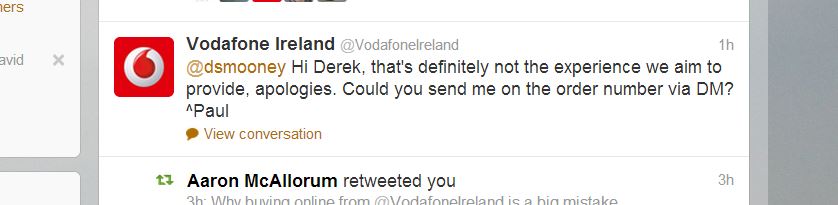
Within an hour or so or posting yesterday’s blog I was contacted by @VodafoneIreland on Twitter. They accepted that the customer service had been poor and promised to resolve the issue today.

To be fair to them – they did. Everything was resolved to my satisfaction by lunchtimed

My Vodafone Red account is now set up and I have my new iPhone complete with credit supplied by Vodafone to make up for the chaos and confusion their online and phone support had caused over the preceding days.

My verdict:

@vodafoneIreland on Twitter 10/10

Vodafone Customer Support on phone & online 3/10 – really needs do better

Why buying online from @VodafoneIreland is a big mistake

Vodafone-Red-logoFor the past few years I have had a pay as you go mobile phone account with Vodafone.ie – plus a separate Vodafone mobile broadband toggle I use with my iPad. In total this cost about €60 a month,

Last week I spotted Vodafone’s new Vodafone Red bill pay account and decided to for the €55 a month level and also buy a new iPhone – costing €99 (I had a basic model Nokia up to now). I decided to do the switch and order the lot online, this I did last week-end – so far so good.

I got an email confirming the switch and saying that my phone would arrive at my door within 24 hours. On Monday the money was taken from my credit card. Though I was not anticipating delivery of the phone until Tuesday I stayed around the house and worked from home.

I did the same on Tuesday – I worked from home all day – never left even once, but no phone arrived.

This morning (Wednesday) I went online to see what was happening – using Vodafone’s online chat service. While the guy in customer service was polite he basically suggested that there was nothing he could do – there had been a hitch at Vodafone’s end and my order had not been submitted – the money had been taken out of my account alright, but as far as Vodafone was concerned the order had “failed to be sent automatically, so the system will be processing the order again..”

He advised me that I had two options:

1. Go buy another phone from any Vodafone shop, and “the moment you receive the one we are going to send, you can send it back to us and you will be refunded back” or,

2. Wait at home for another 3 days for my existing order to be resubmitted. processed and maybe delivered.

I made it clear that neither option was acceptable and so chose to go to the Vodafone shop on Grafton Street to see if I could sort it out there and leave with a phone that I had paid for last Monday.

At the shop they told me that this was not an issue for them, but they put me through to the customer service desk via a phone on the shop counter.

I went through all the above with them and was again offered the two options above, though without any of the politeness or courtesy shown in the online chat encounter.

She told me that she was going to cancel my order, arrange a refund of my €99, but that this would take up to 5 working days. She said I could then decide what I want to do, but to do this she needed me to give her my Credit Card number over the phone… ie she wanted me to call out my credit credit number over the phone, standing at the shop counter in a busy shop in front of strangers! When I expressed reservations at doing this she became very indignant.

So – as a result of taking what I thought was the safer, more convenient option and shopping online with Vodafone I have:

1. No change of service

2. No new phone

3. Wasted a day and a half waiting at home for a delivery that was never coming

4. Had €99 deducted by Vodafone from my credit card account for two days so far – and in all likelihood for the best part of a week.

Whatever this is – it is not customer service!

POST SCRIPT

Since posting this I have been contacted by @VodafoneIreland who accept that this situation is unacceptable.

Voda

They have promised to sort this problem out in the morning. I will update then

Have today’s eurosceptics actually read #Thatcher’s Bruges speech?

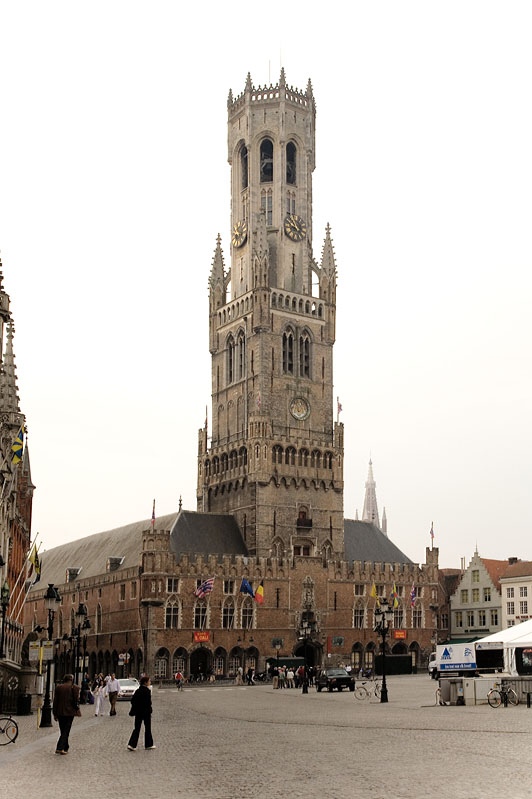
Bruges Belfry
Bruges Belfry

According to some sources; when British PM David Cameron was preparing his recent speech on Europe his researchers looked at Mrs Thatcher’s famous 1988 Bruges speech for inspiration. After reading it they concluded that they could not use it as the tone, language and phrases would not sit well with today’s eurosceptics be they Tory, UKIP or Sinn Féin.

It would appear that many of today’s eurosceptics/anti-europeans who claim Thatcher as a heroine have not read the speech or, if they have, they have failed to grasp its contents. They certainly have conveniently forgot that she signed the Single European Act. While her Bruges Speech is hardly a call for a federal Europe, neither is it a manifesto for euroscepticism.

Doubtless her views changed in her later years, but in this keynote speech, she sets out her vision of the European Community as practical way which Europe can ensure the future prosperity and security of its people – an EC with Britain at its heart.

Not all the contents of this speech sit easy with me – its Defence section for example, but read for yourself and see how you feel about its contents in the current situation.

Margaret Thatcher Speech to the College of Europe (“The Bruges Speech”) 1988 Sept 20

Mr. Chairman, you have invited me to speak on the subject of Britain and Europe. Perhaps I should congratulate you on your courage. If you believe some of the things said and written about my views on Europe, it must seem rather like inviting Genghis Khan to speak on the virtues of peaceful coexistence! I want to start by disposing of some myths about my country, Britain, and its relationship with Europe and to do that, I must say something about the identity of Europe itself.

Europe is not the creation of the Treaty of Rome. Nor is the European idea the property of any group or institution. We British are as much heirs to the legacy of European culture as any other nation. Our links to the rest of Europe, the continent of Europe, have been the dominant factor in our history.

For three hundred years, we were part of the Roman Empire and our maps still trace the straight lines of the roads the Romans built. Our ancestors—Celts, Saxons, Danes—came from the Continent. Our nation was—in that favourite Community word—”restructured” under the Norman and Angevin rule in the eleventh and twelfth centuries. This year, we celebrate the three hundredth anniversary of the glorious revolution in which the British crown passed to Prince William of Orange and Queen Mary. Visit the great churches and cathedrals of Britain, read our literature and listen to our language: all bear witness to the cultural riches which we have drawn from Europe and other Europeans from us.

We in Britain are rightly proud of the way in which, since Magna Carta in the year 1215, we have pioneered and developed representative institutions to stand as bastions of freedom. And proud too of the way in which for centuries Britain was a home for people from the rest of Europe who sought sanctuary from tyranny. But we know too that without the European legacy of political ideas we could not have achieved as much as we did. From classical and mediaeval thought we have borrowed that concept of the rule of law which marks out a civilised society from barbarism.

And on that idea of Christendom, to which the Rector referred—Christendom for long synonymous with Europe—with its recognition of the unique and spiritual nature of the individual, on that idea, we still base our belief in personal liberty and other human rights.
Too often, the history of Europe is described as a series of interminable wars and quarrels. Yet from our perspective today surely what strikes us most is our common experience. For instance, the story of how Europeans explored and colonised—and yes, without apology—civilised much of the world is an extraordinary tale of talent, skill and courage. But we British have in a very special way contributed to Europe. Over the centuries we have fought to prevent Europe from falling under the dominance of a single power.

We have fought and we have died for her freedom. Only miles from here, in Belgium, lie the bodies of 120,000 British soldiers who died in the First World War. Had it not been for that willingness to fight and to die, Europe would have been united long before now—but not in liberty, not in justice. It was British support to resistance movements throughout the last War that helped to keep alive the flame of liberty in so many countries until the day of liberation.

Tomorrow, King Baudouin will attend a service in Brussels to commemorate the many brave Belgians who gave their lives in service with the Royal Air Force—a sacrifice which we shall never forget. And it was from our island fortress that the liberation of Europe itself was mounted. And still, today, we stand together. Nearly 70,000 British servicemen are stationed on the mainland of Europe.

All these things alone are proof of our commitment to Europe’s future. The European Community is one manifestation of that European identity, but it is not the only one. We must never forget that east of the Iron Curtain, people who once enjoyed a full share of European culture, freedom and identity have been cut off from their roots.We shall always look on Warsaw, Prague and Budapest as great European cities. Nor should we forget that European values have helped to make the United States of America into the valiant defender of freedom which she has become.

EUROPE’S FUTURE 

This is no arid chronicle of obscure facts from the dust-filled libraries of history. It is the record of nearly two thousand years of British involvement in Europe, cooperation with Europe and contribution to Europe, contribution which today is as valid and as strong as ever [sic].

Yes, we have looked also to wider horizons—as have others—and thank goodness for that, because Europe never would have prospered and never will prosper as a narrow-minded, inward-looking club. The European Community belongs to all its members. It must reflect the traditions and aspirations of all its members. And let me be quite clear. Britain does not dream of some cosy, isolated existence on the fringes of the European Community. Our destiny is in Europe, as part of the Community.

That is not to say that our future lies only in Europe, but nor does that of France or Spain or, indeed, of any other member. The Community is not an end in itself. Nor is it an institutional device to be constantly modified according to the dictates of some abstract intellectual concept. Nor must it be ossified by endless regulation.

The European Community is a practical means by which Europe can ensure the future prosperity and security of its people in a world in which there are many other powerful nations and groups of nations. We Europeans cannot afford to waste our energies on internal disputes or arcane institutional debates. They are no substitute for effective action. Europe has to be ready both to contribute in full measure to its own security and to compete commercially and industrially in a world in which success goes to the countries which encourage individual initiative and enterprise, rather than those which attempt to diminish them.

This evening I want to set out some guiding principles for the future which I believe will ensure that Europe does succeed, not just in economic and defence terms but also in the quality of life and the influence of its peoples.

WILLING COOPERATION BETWEEN SOVEREIGN STATES 

My first guiding principle is this: willing and active cooperation between independent sovereign states is the best way to build a successful European Community. To try to suppress nationhood and concentrate power at the centre of a European conglomerate would be highly damaging and would jeopardise the objectives we seek to achieve. Europe will be stronger precisely because it has France as France, Spain as Spain, Britain as Britain, each with its own customs, traditions and identity. It would be folly to try to fit them into some sort of identikit European personality. Some of the founding fathers of the Community thought that the United States of America might be its model. But the whole history of America is quite different from Europe.

People went there to get away from the intolerance and constraints of life in Europe. They sought liberty and opportunity; and their strong sense of purpose has, over two centuries, helped to create a new unity and pride in being American, just as our pride lies in being British or Belgian or Dutch or German. I am the first to say that on many great issues the countries of Europe should try to speak with a single voice. I want to see us work more closely on the things we can do better together than alone.

Europe is stronger when we do so, whether it be in trade, in defence or in our relations with the rest of the world.
But working more closely together does not require power to be centralised in Brussels or decisions to be taken by an appointed bureaucracy. Indeed, it is ironic that just when those countries such as the Soviet Union, which have tried to run everything from the centre, are learning that success depends on dispersing power and decisions away from the centre, there are some in the Community who seem to want to move in the opposite direction.

We have not successfully rolled back the frontiers of the state in Britain, only to see them re-imposed at a European level with a European super-state exercising a new dominance from Brussels. Certainly we want to see Europe more united and with a greater sense of common purpose. But it must be in a way which preserves the different traditions, parliamentary powers and sense of national pride in one’s own country; for these have been the source of Europe’s vitality through the centuries.

ENCOURAGING CHANGE

My second guiding principle is this: Community policies must tackle present problems in a practical way, however difficult that may be. If we cannot reform those Community policies which are patently wrong or ineffective and which are rightly causing public disquiet, then we shall not get the public support for the Community’s future development. And that is why the achievements of the European Council in Brussels last February are so important. It was not right that half the total Community budget was being spent on storing and disposing of surplus food. Now those stocks are being sharply reduced. It was absolutely right to decide that agriculture’s share of the budget should be cut in order to free resources for other policies, such as helping the less well-off regions and helping training for jobs. It was right too to introduce tighter budgetary discipline to enforce these decisions and to bring the Community spending under better control.

And those who complained that the Community was spending so much time on financial detail missed the point. You cannot build on unsound foundations, financial or otherwise, and it was the fundamental reforms agreed last winter which paved the way for the remarkable progress which we have made since on the Single Market.

But we cannot rest on what we have achieved to date. For example, the task of reforming the Common Agricultural Policy is far from complete. Certainly, Europe needs a stable and efficient farming industry. But the CAP has become unwieldy, inefficient and grossly expensive. Production of unwanted surpluses safeguards neither the income nor the future of farmers themselves. We must continue to pursue policies which relate supply more closely to market requirements, and which will reduce over-production and limit costs.

Of course, we must protect the villages and rural areas which are such an important part of our national life, but not by the instrument of agricultural prices. Tackling these problems requires political courage. The Community will only damage itself in the eyes of its own people and the outside world if that courage is lacking.

EUROPE OPEN TO ENTERPRISE

My third guiding principle is the need for Community policies which encourage enterprise. If Europe is to flourish and create the jobs of the future, enterprise is the key. The basic framework is there: the Treaty of Rome itself was intended as a Charter for Economic Liberty. But that it is not how it has always been read, still less applied.

The lesson of the economic history of Europe in the 70’s and 80’s is that central planning and detailed control do not work and that personal endeavour and initiative do. That a State-controlled economy is a recipe for low growth and that free enterprise within a framework of law brings better results. The aim of a Europe open to enterprise is the moving force behind the creation of the Single European Market in 1992. By getting rid of barriers, by making it possible for companies to operate on a European scale, we can best compete with the United States, Japan and other new economic powers emerging in Asia and elsewhere.

And that means action to free markets, action to widen choice, action to reduce government intervention. Our aim should not be more and more detailed regulation from the centre: it should be to deregulate and to remove the constraints on trade. Britain has been in the lead in opening its markets to others. The City of London has long welcomed financial institutions from all over the world, which is why it is the biggest and most successful financial centre in Europe.

We have opened our market for telecommunications equipment, introduced competition into the market services and even into the network itself—steps which others in Europe are only now beginning to face. In air transport, we have taken the lead in liberalisation and seen the benefits in cheaper fares and wider choice. Our coastal shipping trade is open to the merchant navies of Europe. We wish we could say the same of many other Community members. Regarding monetary matters, let me say this. The key issue is not whether there should be a European Central Bank.

The immediate and practical requirements are:

  • to implement the Community’s commitment to free movement of capital—in Britain, we have it;
  • and to the abolition through the Community of exchange controls—in Britain, we abolished them in 1979;
  • to establish a genuinely free market in financial services in banking, insurance, investment;
  • and to make greater use of the ECU.

This autumn, Britain is issuing ECU-denominated Treasury bills and hopes to see other Community governments increasingly do the same. These are the real requirements because they are what the Community business and industry need if they are to compete effectively in the wider world.

And they are what the European consumer wants, for they will widen his choice and lower his costs.It is to such basic practical steps that the Community’s attention should be devoted. When those have been achieved and sustained over a period of time, we shall be in a better position to judge the next move. It is the same with frontiers between our countries. Of course, we want to make it easier for goods to pass through frontiers. Of course, we must make it easier for people to travel throughout the Community.

But it is a matter of plain common sense that we cannot totally abolish frontier controls if we are also to protect our citizens from crime and stop the movement of drugs, of terrorists and of illegal immigrants. That was underlined graphically only three weeks ago when one brave German customs officer, doing his duty on the frontier between Holland and Germany, struck a major blow against the terrorists of the IRA. And before I leave the subject of a single market, may I say that we certainly do not need new regulations which raise the cost of employment and make Europe’s labour market less flexible and less competitive with overseas suppliers.

If we are to have a European Company Statute, it should contain the minimum regulations. And certainly we in Britain would fight attempts to introduce collectivism and corporatism at the European level—although what people wish to do in their own countries is a matter for them.

EUROPE OPEN TO THE WORLD

My fourth guiding principle is that Europe should not be protectionist. The expansion of the world economy requires us to continue the process of removing barriers to trade, and to do so in the multilateral negotiations in the GATT. It would be a betrayal if, while breaking down constraints on trade within Europe, the Community were to erect greater external protection. We must ensure that our approach to world trade is consistent with the liberalisation we preach at home. We have a responsibility to give a lead on this, a responsibility which is particularly directed towards the less developed countries. They need not only aid; more than anything, they need improved trading opportunities if they are to gain the dignity of growing economic strength and independence.

EUROPE AND DEFENCE 

My last guiding principle concerns the most fundamental issue—the European countries’ role in defence. Europe must continue to maintain a sure defence through NATO. There can be no question of relaxing our efforts, even though it means taking difficult decisions and meeting heavy costs. It is to NATO that we owe the peace that has been maintained over 40 years. The fact is things are going our way: the democratic model of a free enterprise society has proved itself superior; freedom is on the offensive, a peaceful offensive the world over, for the first time in my life-time.

We must strive to maintain the United States’ commitment to Europe’s defence. And that means recognising the burden on their resources of the world role they undertake and their point that their allies should bear the full part of the defence of freedom, particularly as Europe grows wealthier. Increasingly, they will look to Europe to play a part in out-of-area defence, as we have recently done in the Gulf. NATO and the Western European Union have long recognised where the problems of Europe’s defence lie, and have pointed out the solutions. And the time has come when we must give substance to our declarations about a strong defence effort with better value for money.

It is not an institutional problem. It is not a problem of drafting. It is something at once simpler and more profound: it is a question of political will and political courage, of convincing people in all our countries that we cannot rely for ever on others for our defence, but that each member of the Alliance must shoulder a fair share of the burden. We must keep up public support for nuclear deterrence, remembering that obsolete weapons do not deter, hence the need for modernisation.

We must meet the requirements for effective conventional defence in Europe against Soviet forces which are constantly being modernised. We should develop the WEU, not as an alternative to NATO, but as a means of strengthening Europe’s contribution to the common defence of the West. Above all, at a time of change and uncertainly in the Soviet Union and Eastern Europe, we must preserve Europe’s unity and resolve so that whatever may happen, our defence is sure.

At the same time, we must negotiate on arms control and keep the door wide open to cooperation on all the other issues covered by the Helsinki Accords. But let us never forget that our way of life, our vision and all we hope to achieve, is secured not by the rightness of our cause but by the strength of our defence. On this, we must never falter, never fail.

THE BRITISH APPROACH 

Mr. Chairman, I believe it is not enough just to talk in general terms about a European vision or ideal. If we believe in it, we must chart the way ahead and identify the next steps. And that is what I have tried to do this evening. This approach does not require new documents: they are all there, the North Atlantic Treaty, the Revised Brussels Treaty and the Treaty of Rome, texts written by far-sighted men, a remarkable Belgian— Paul Henri Spaak —among them. However far we may want to go, the truth is that we can only get there one step at a time. And what we need now is to take decisions on the next steps forward, rather than let ourselves be distracted by Utopian goals. Utopia never comes, because we know we should not like it if it did.

Let Europe be a family of nations, understanding each other better, appreciating each other more, doing more together but relishing our national identity no less than our common European endeavour. Let us have a Europe which plays its full part in the wider world, which looks outward not inward, and which preserves that Atlantic community—that Europe on both sides of the Atlantic—which is our noblest inheritance and our greatest strength. May I thank you for the privilege of delivering this lecture in this great hall to this great college (applause).

You can watch a video of the speech:  http://www.margaretthatcher.org/document/113688

ENDS

POLL: Compare and Contrast Statements on #Thatcher

Thatcher FitzGeraldInteresting to note the different tones adopted by An Taoiseach and the Leader of the Opposition in their respective statements on the death of Margaret Thatcher.  While both probably reflect the broad view of public opinion, which best reflects that view?

Statement by Taoiseach Enda Kenny on the death of former British Prime Minister Margaret Thatcher

I was saddened to learn of the death this morning of former British Prime Minister Margaret Thatcher.

Mrs Thatcher was a formidable political leader who had a significant impact on British, European and world politics. During her eleven years as Prime Minister, she defined an era in British public life.

While her period of office came at a challenging time for British-Irish relations, when the violent conflict in Northern Ireland was at its peak, Mrs Thatcher signed the Anglo-Irish Agreement which laid the foundation for improved North-South cooperation and ultimately the Good Friday Agreement.

I extend my deepest sympathies to her family and the Prime Minister David Cameron.

Statement by FF Leader Micheál Martin on the death of former British Prime Minister Margaret Thatcher

“Today, on hearing of the death of Margaret Thatcher, our first thoughts are thoughts of condolence for her family. Our personal sympathy is also with her friends and colleagues within the Conservative Party and the British Government.

“In the coming days and weeks, there will inevitably be much discussion of Mrs Thatcher’s political legacy.

“It is important that such discussion take a balanced account of her approach to Irish affairs. While I or the Fianna Fáil party would have had little in common with the politics of Mrs Thatcher, it would be wrong not to acknowledge that the long journey towards the peace and respect that we enjoy between Britain and Ireland today, took its first faltering steps in the bilateral discussions between Mrs Thatcher and former Taoiseach Charles Haughey.

“However the British Prime Minister’s hard-line approach to an increasingly violent situation in the North was one of a number of factors which limited the potential of those early initiatives. Unfortunately her uncompromising approach to the escalating crisis in the early 1980s may actually have acted as a major boost for the recruitment efforts of the Provisional IRA at that time.

“There can be no doubt that the career of Margaret Thatcher had a significance and impact that is seen very rarely in modern European politics. The debate about the consequence of her impact will go on for many years to come.

“But today, our thoughts are with her family and close friends.”

Which statement more closely reflects your view?

You are playing senior hurling now lads: why renegotiating the PfG won’t work for @Labour

seamusbrennan
The late Séamus Brennan: “You are playing senior hurling now lads…”

“You are playing senior hurling now lads – but you are playing with lads with All Ireland medals”.

This, according to Eamon Ryan, is how the late Séamus Brennan greeted the Green Party team as it arrived in Government buildings for the 2007 talks on forming a government with Fianna Fáil.

It is a phrase that every Labour Party TD calling for a renegotiation of the Programme for Government (PfG) should print out and place at the top of their PC screen.

God be with the days when Labour recruited its Dáil candidates from the old ITGWU or FWUI. Those guys knew the first principles of negotiating; they particularly knew that you did not go into negotiations unless you had 1. A strong hand and 2. A fair idea of the outcome. Yet some in Labour are advocating that they enter talks with neither.

They want to enter a renegotiation of the government’s fundamental policy programme at precisely the moment when their party has hardly ever been weaker. Do they seriously expect that their senior partners in Fine Gael will take pity on them and offer them major policy concessions just because they are having a bad hair day?

Do they really underestimate their government partners that much?

Politics is a tough world guys. Wake up.

You do not get your way in politics just because you mean well, you get your way and get policies implemented by getting a mandate and pursuing your goals assiduously.

You certainly do not enter talks with partners from whom you wish to extract concessions with the message: we are in a weakened state and desperately need to give the impression that we can beat you into submission, so please, please, please let us.

It is the equivalent in nature of a lone deer asking a lion to not to devour them as they have a leg injury and cannot run properly today. Indeed it goes further and suggests that the lion should agree to allow the injured deer to bitch slap them around for a while so that any other deer who may be watching from a distance will think more highly of them.

There is no compulsion on Fine Gael to enter meaning renegotiation talks with Labour. They know Labour cannot cut and run now and risk facing the electorate, so they know it is strapped into this arrangement until the bitter end. The very most Labour could hope to get is a sham negotiation where we see TV clips of the pairs of Ministers from each side entering Government buildings for late night talks and the last minute “leak” from a source “close to the Labour leadership” saying the talks are at a crucial point right now and may go well into the night. The optics will look good, they may even fool a few activists, but most others (including the public) will see it as just a gesture. If the guys want to go down this road there is doubtless a battered old playbook for such an exercise laying around Government building somewhere.

The current cohort of Fine Gael TDs is possibly the most right of centre since the late 1950s. They are already getting flack from supporters and voters for the appearance that Labour is dictating too much of the government’s agenda, particularly on social issues, so they are neither motivated nor minded to give any more policy ground to them on the back of what was a bad day for Labour and, conversely, a good day for Fine Gael.

The idea of renegotiating the PfG is at best: naïve, and at worst: dumb.

That so many TDs would advocate it after only two years in office suggests that we are probably beyond the mid point of the life of this government and that the chances of there being a general election in early 2015 just got stronger.