No long summer break from political debate

This week’s Broadsheet column was a defence of the oft criticisied Summer School season and an argument for more policy Irish think tanks, for for a Fianna Fáil aligned one in particular. Original column online here: Broadsheet.ie 


KSS-WEBSLIDER-BANNER17-FA-1024x299

At around 4.20pm on Friday last Dáil Éireann adjourned for the Summer recess. It is due to return at 2pm on Wednesday September 20th.

Cue the usual hollow complaints from the commentariat over TDs holidays and short Dáil sessions, with a few harrumphs from the Brussels side-line courtesy of Fine Gael MEP, Sean Kelly who tweeted that the EU parliament’s holiday will be 4 weeks shorter.

If this Dáil was actually processing legislation, especially the range of halfway decent Private Members Bills coming from backbenchers across the House, then there may be a basis for complaint. But, it isn’t.

To be fair, it is not as if TDs and Senators are about to head off to the Maldives or Marrakech. The Seanad is sitting this week, as are several Oireachtas committees, and they will take a shorter break than the Dáil and return earlier – and before you sigh that the committees don’t count, bear in mind that Sean Fleming’s Public Accounts Committee will be launching its report into the financial procedures at Garda College, Templemore at 2.00pm tomorrow.

Continue reading “No long summer break from political debate”

The honeymoon for Leo was over… even before it started? @campaignforleo @FineGael

This column is from last month, June 19th 2017. In it, I looked at Taoiseach Varadkar’s first few faltering days in office and conclude that things have not been going according to his masterplan.

Even the more ardent blueshirt cannot call a cabinet that contains FG ministers who entered the Oireachtas in 1981 (Bruton), 1987 (Flanagan) and 1989 (Creed), 1992 (Fitzgerald) and 1994 (Ring) new or fresh.

Meanwhile, the Marie Whelan saga, which was not of Varadkar’s making, but his ownership of a move that looked suspiciously like a vintage political stroke, is now 100%

Original article here: www.broadsheet.ie/the-honeymoon-is-over/

____________________________________________________
Silage

“Silage and Ice-cream”.   This is how Audrey Carville defined the classic Irish Summer on RTÉ Radio One’s Morning Ireland earlier today.

And though silage was not exactly plentiful in the Liberties, Rathmines or even Yellowbatter in Drogheda during my childhood years, I think I know what she means.

Indeed, up to this morning I hadn’t realised that silage is spelled with just one “l”. Though I cannot recall using the word in many speeches, reports or articles I am virtually certain that I used two “l”s anytime I have written it.

I know for sure that I used two “l”s when I went searching for the phrase just before writing this piece, only to discover that the two “l”-ed version of silage, i.e. sillage (pronounced as if there were no “l”s at all in the word) is the word used to describe the lingering fragrance that someone’s perfume leaves in the air.

Silage and ice-cream may also be an apt phrase to describe Leo Varadkar’s first few days as Taoiseach.

The ice-cream has come in the form of the positive coverage his elevation to high office has generated, both at home and abroad, though that may be starting to melt a bit after two solid weeks of learning what a wonderfully precocious child he was and how he wrote his first letter to the Irish Times aged three, or whatever.

His first TV interview with Tommy Gorman was good. He was clear, concise and on top of his brief. The fact that he opted to do his first one-to-one TV encounter as Taoiseach with RTÉ’s northern editor was clearly intended to signal that the North would be a priority with this Taoiseach in a way that it had not been for his predecessor.

It was also interesting that he opted to set out his government’s policy approach to the North and re-unification himself having just appointed his rival, Simon Coveney, as the line minister dealing with the brief, a signal perhaps of things to come.

But, and not for the first time, a gap emerged between what he says and what he does. His decision to just meet with the leaders of two of the North’s five major political parties was not a good first move. In using his first actions on the North to meet with just Arlene Foster of the DUP and Sinn Féin’s Michelle O’Neill, and not to meet with the leaders of the other three centre ground parties: the SDLP, UUP and Alliance, the new Taoiseach was perpetuating the mistake made by recent Irish governments.

Yes, a deal on the return of Stormont and the Executive is not possible without the two big beasts of the DUP and Sinn Féin agreeing to again work together, but the smaller parties should not be taken for granted. Even the British government realised that when it invited all the parties to Downing Street last Thursday, not just the big two.

Taoiseach Varadkar made a silly unforced error in appearing to relegate the smaller parties to the second division of negotiation. Their participation in the institutions is as important and crucial as that of the DUP and SF. If anything, the events of the second half of last year suggest that it is even more important, as the two main parties seem unable to reach accommodations in office without the smaller parties there to give them cover.

Varadkar should know this. He sits at a Cabinet which could not continue in office if it were not for the involvement of smaller parties and Independents though, as we see from today’s latest development in the Marie Whelan appointment saga, he may know it, but he doesn’t show it.

Perhaps this is the point. Perhaps his near disdainful attitude to the smaller parties in the North just echoes his disdainful attitude to its own partners in government?

The incredible, some would say grubby, rush to get Marie Whelan quickly sworn in as a judge of the appeal court this morning so that the sorry saga is all over and down before tomorrow’s Cabinet meeting is a brazen throw down to Ministers Ross and Naughten and – by extension to Fianna Fáil.

Is this just Varadkar bravado, showing early on that he is now the boss and what he says goes? Or, is the nomination a difficult, but essential, element of the succession’s realpolitik that he must see through to the end, no matter how the stench adheres to him? I suspect this is more the latter.

Those who say that Leo has wiped Fianna Fáil’s eye by pushing this through seem to miss the point that this appointment, coupled with the fiasco of the cabinet reshuffle that wasn’t, has just shortened what could have been an extensive Varadkar honeymoon.

As every job interviewee had been told: you only get one chance to make a first impression and Leo has wasted his. Meanwhile, Fianna Fáil will wait for its moment to exact some political revenge and that will be a moment of its choosing, not Leo’s. If Fianna Fáil is to bring down this government let be on an issue of policy that affects people’s lives, not “beltway” process.

The Marie Whelan saga was not of Varadkar’s making, but his ownership of a move that looks suspiciously like a vintage political stroke, is now 100%. The appointment was brought to Cabinet as the last act of the outgoing Taoiseach and outgoing Justice Minister, but by defending it so fiercely the new Taoiseach has made it his own… alone… and, unless I am missing something, I have not seen the new, sorry… the incoming… Minister for Justice, Charlie Flanagan, (it hardly seems right calling someone who has been in the Dáil since 1987 “new”) rushing to the barricades to help.

If Varadkar has been preparing all his political life for this moment, then it is hard to believe that this is what he had planned. You cannot call a cabinet that contains FG ministers who entered the Oireachtas in 1981 (Bruton), 1987 (Flanagan) and 1989 (Creed), 1992 (Fitzgerald) and 1994 (Ring) new or fresh.

We shall see tomorrow how he handles the even trickier issue of appointing Junior Ministers. Will he be bold and courageous in these hardly earth-shattering selections, or will he just do what he did with the cabinet?

Are these first faltering steps a case of the promises made to secure election restricting the ability to operate, or is the problem more fundamental? Can Varadkar be the thrusting and dynamic Taoiseach his Fine Gael parliamentary colleagues longed for, or will he just become the commentator-in-chief?

Is that the sillage of silage or of raspberry ripple ice-cream. Excuse me, I must be off to Teddys in Sandycove!

 

The perks of abstinence…?

This Broadsheet column first appeared online on June 12th 2017. In it, I explore the ramifications of the 2017 Westminster election result on politics in Northern Ireland, and suggest – borrowing heavily from an Irish Times article by Denis Bradley – that politics on the nationalist/republican side may be set for a major change over the coming year… www.broadsheet.ie/the-perks-of-abstinence/

_____________________________________________

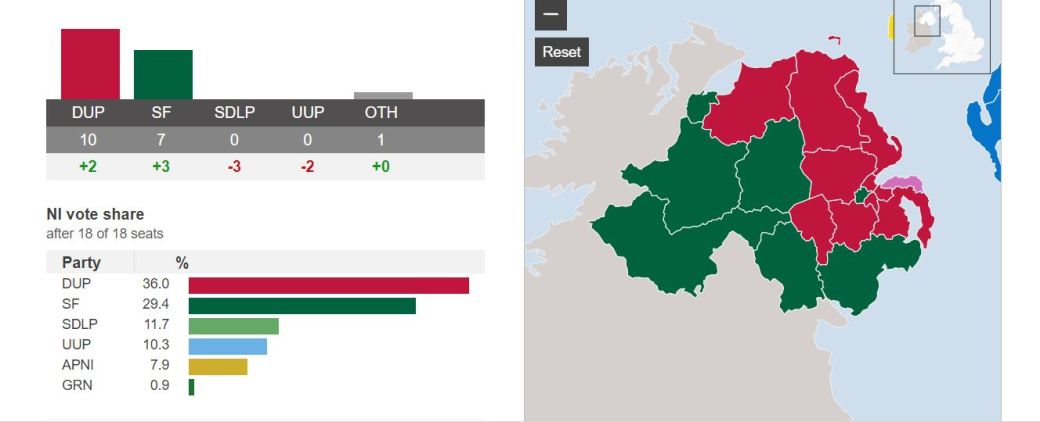
BBC NI

The results page from the BBC NI website – www.bbc.com/results/northern_ireland

While the outcome of the Westminster election was far from conclusive in England and Wales, the same cannot be said for Scotland and Northern Ireland.

Only for the resurgence of the Scottish Tories under Ruth Davidson, Theresa May would be moving furniture rather than clinging to office by her fingertips. While the same Scottish result has, sadly, delayed the prospect of an Indy2 referendum, as the SNP Westminster representation collapsed from 56 seats to just 35 thanks to a 13% drop in support.

Continue reading “The perks of abstinence…?”

#Macron – Le Pen and Now

This column appeared on Broadsheet.ie on April 24th, 2017 – just after the first round of voting in the French Presidential election when Macron and Le Pen emerged as the two front runners in Round Two: www.broadsheet.ie/le-pen-and-now

________________________

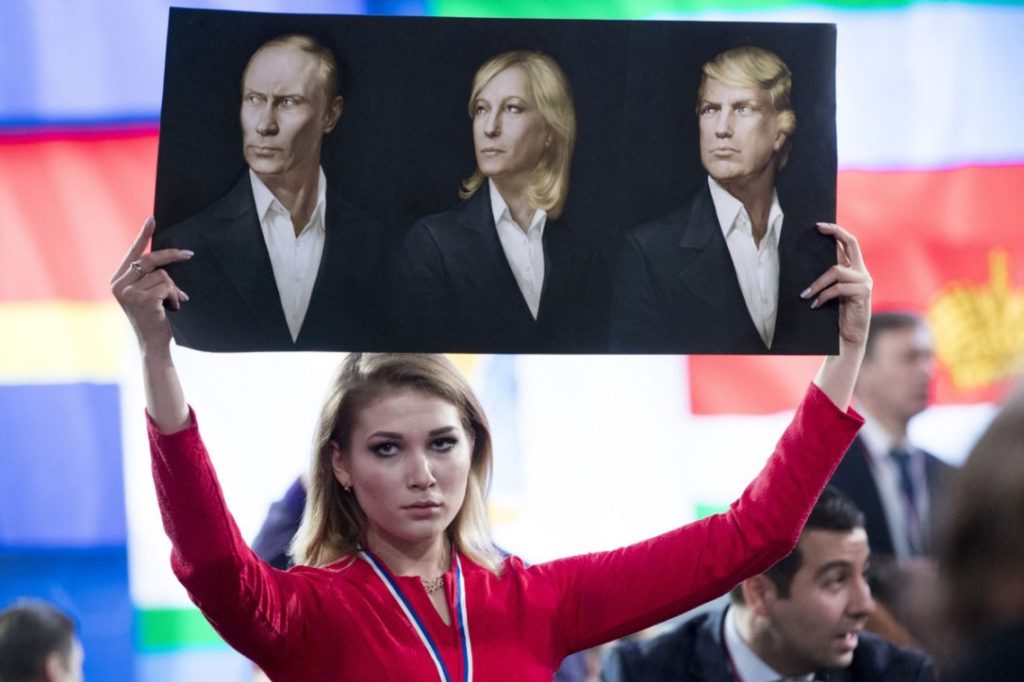
protester.jpg.size.custom.crop.1086x724
The new would-be divine trinity: Putin, Le Pen, Trump?

You could almost hear the collective sigh of relief last night as the first exit poll results from the French presidential election emerged showing Emmanuel Macron as the front runner. Macron, the former Economy Minister under Socialist President Francois Hollande and now independent centrist candidate now faces off against the second placed right-winger, Marine Le Pen in round two of the election in two weeks’ time.

It wasn’t just EU officials and other EU heads of government who were relieved, but also the heads of the polling companies whose predictions turned out to be extraordinary accurate, in many cases within just 1% of the result.

That sense of relief continued into this morning with European stock markets rallying and the Euro rising to a five-month peak with the news that France is likely to have a more centrist pro-EU President Emmanuel Macron.

Only a month ago the polls suggested that Le Pen might emerge as the lead candidate in the first round followed by Macron, with some showing Le Pen as high as 27% and Macron around 25%.  However; the collapse in recent weeks of the socialist party candidate Hamon saw the far left’s Melechon rally and join the leading pack, consisting of Le Pen, Macron and the conservative candidate Fillon, all within 3-4% of each other.

Continue reading “#Macron – Le Pen and Now”

I hate to admit it, but @JuliaHB1 and other #brexiteers may have a point, just not the one they think

Here is my Broadsheet article from Sept 28th regarding the calls for a second #Brexit referendum vote. I would love to be able to support the call, but I cannot. Experience of re-runs of Irish EU referendums tells me that this is not an option in the UK given the high voter turnout.

————– 

questiontimeI have to confess that my heart sinks a little whenever I hear English Tories or English nationalists, like Nigel Farage, mention Ireland during their rants about the EU. The reference is usually patronising or condescending or – even worse – is given in the form of advice that would have us join them in their march back to a glorious era that never existed.
This is why my heart sank when Julia Hartley Brewer, a British Talk Radio host, Leave campaigner and former political editor, stated on last Thursday’s BBC Question Time that the EU had forced Ireland, and other countries, to vote again on EU referendums.

Her comments came during the course of a discussion on whether Britain might have another referendum on Brexit – a proposal put forward by the failed Corbyn challenger, Owen Smith MP or that the UK might have a separate vote on the final deal hammered out on the conclusion of the Art 50 negotiations, an idea put forward by Tim Farron’s Liberal Democrats.

Though hearing Hartley-Brewer getting it badly wrong on the notion of the EU ‘forcing’ us to vote again made my heart sink a little, it sank even further when I realised that she and her fellow panellist that night Jacob Rees-Mogg MP (who looks like he is being portrayed by Joyce Grenfell) may actually have a point, just not the one they think.

Though I and other Remainers may wish it to be otherwise, the hard fact is that Ireland’s voting again on the Nice and Lisbon treaties is not relevant to the UK’s situation for one simple reason: turnout.

In the first referendum on the Nice Treaty (Nice I) in 2001 the turnout was just under 35% – the result then was 54% No: 46% Yes. At second referendum on the Nice Treaty (Nice II) in Oct 2002 the turnout shot up to just under 50% with Yes getting 63% and No dropping to 37%.

It was a broadly similar situation in the case of the two Lisbon Treaty referendums. In Lisbon I in June 2008 the turnout was 53%. No won by 53%:47%. At Lisbon II the turnout had again increased, this time to 59% with Yes now winning by 63%:37%

In both cases the turnout in the first referendum was low to start with, in the case of Nice I it was exceptionally low, just in the mid-30s, so there was a convincing argument to be made for a second vote, particularly when you felt that a second referendum would have a higher turnout.

This was not the case in the UK’s Brexit referendum. The turnout there was a whopping 72%. This is a substantial turnout. It is much higher that recent UK General Election turnouts, indeed you have to go back to Tony Blair’s 1997 election victory to find a UK general election turnout of over 70%.

The huge political risk you take by having a re-run second Brexit referendum in these circumstances is that you get a lower turnout. It is politically saleable to try to reverse one mandate with a smaller one?

To be clear, turnout alone was not the reason why there were re-runs of the Nice and Lisbon referendums. In both cases post referendum polling and analysis found that the main reason for voting “No” or abstaining was a lack of knowledge of either treaty. Both “Yes” and “No” voters were highly critical of what they viewed as a dearth of clear, accessible information on the treaty’s merits.

While the Remainers can clearly point to a lot of misinformation from the Leave side, not least the claims that leaving would mean £350 million extra per week for the NHS, they cannot yet point to any substantive research or analysis suggesting any changes in opinion.

Noted UK pollster, Prof John Curtice, reckons that there is little evidence of a “significant rethink” three months on from the result with those who voted Remain still convinced that they were right and likewise for the Leavers. Very few minds have been changed, though let us see if that remains the case as the details of the Brexit deal on offer emerge during the course of the next year or so.

The problem with all this abstract discussion on a second referendum is that it takes the focus away from the very real and tangible issues with the first result: most crucially that the Hartley Brewer, Farage and others do not want to honour the clear Remain majorities in Northern Ireland and Scotland. Instead they want to use the votes of English and Welsh people to forcibly drag Northern Ireland and Scotland out of the EU against their declared will.

This is no small issue, yet it is receiving scant attention in the UK and, sadly, here.

Voters in both Northern Ireland and Scotland voted convincingly to stay in the EU, by much bigger margins that the people across the UK voted to leave. Many of those voters in Northern Ireland hold Irish passports and are thus also EU citizens, even if the UK leaves. Can that citizenship – and the guarantees and privileges it offers – simply be snatched away from them on the say so of 50%+ of voters in the south of England?

As people like Michéal Martin and Colum Eastwood have repeatedly said over the past few weeks and months; trying to drag the North out of the EU against its will ignores the layered complexities of the Irish political process.

It is a refutation of the basic principles of the accommodation achieved in the Good Friday Agreement and that is something that concerns all of us on this island.

We should be debating and discussing this now. We should be looking at the significant consequences of Brexit for our economy, for our trade – both North/South and East/West, our education system, out health service.

We should not allow the foot dragging by the British Government on outlining its terms of exit to stop us from forcefully setting out our concerns and our alternatives. We need the speedy establishment of the all-island political/civic forum I called for here at the end of June. I know the Taoiseach and his team messed up their first attempt to get the idea up and running, but they need to go again and get it right this time.

A simple primer on Irish #Defence Policy

Here is another of my weekly Broadsheet columns. I am slowly catching up on reposting these columns here, I hope to have my site up to date over the coming week.

This one is from August 29th and offers a quick primer on understanding Irish Defence policy: www.broadsheet.ie/mission-creep-2/ 

————————————

army

Though you may not have noticed it – there was, over the last few weeks, an attempt to start a public debate on Irish Defence policy. While the Irish Examiner, in particular, did its level best to get it going, the discussion soon fizzled out.

The reason why the debate never really got going may be due to the fact that we tend to only discuss defence policy in public in response to some significant event or, more frequently, to some outlandish and unfounded claim.

On the rare occasions that we have any debate on defence in Ireland, they tend to be either end of the extreme ranging from claims that we are abandoning neutrality, a claim made continuously since the 1970s, to questions as to why we even have a Defence Force.

Though there is a real and clear public pride in our Defence Forces, both at home and abroad, there is also a surprising paucity of knowledge about Defence policy.

With this in mind, I want to use this week’s Broadsheet.ie offering to put some basic facts about Irish Defence policy out there, in the vain hope that the next public debate on Defence may be based on fact and reality, not myth and assertion.

Let’s start with a few basics.

The Irish Defence Forces comprise the Army, Air Corps and Naval Service and should total 9,500 men and women. The current manpower figure as set out in a parliamentary reply to Fianna Fáil’s Lisa Chambers, is just under 9100.

There are approximately 460 Irish troops currently serving overseas on a range of UN led and mandated peace-keeping and humanitarian missions. These include: 60 naval service personnel on the humanitarian search and rescue operations in the Mediterranean; about 210 troops on the UNIFIL mission in Lebanon and approx 140 troops serving in the UNDOF mission on the Golan Heights in Syria.

Though these numbers are way down from the average of 800 plus personnel serving overseas less than a decade ago, it still represents a sizeable Irish contribution to international peace and security, which in turn contributes to our own national security.

We spend about €900 million per year on Defence, though the vast bulk (over 70%) is accounted for by wages and pensions. When it comes to value for money the Defence Forces lead the way. The reform and modernisation programme undertaken between 2001 and 2010 make it a model of how public sector reform can be done right. Productivity was increased, numbers were reduced and the savings were invested in vastly improved equipment and training.

Now let’s turn to the policy side. First and foremost, Ireland is militarily neutral. While this is usually defined as not being a member of a military alliance, it also means that we decide for ourselves how much we spend on defence and – most importantly – how, where and when we deploy our troops overseas on humanitarian and peace-keeping/peace enforcement operations.

This is done via the “Triple-Lock” mechanism of UN mandate, Cabinet and Dáil approval. Triggering this triple lock is required before 12 or more Defence Force personnel are deployed overseas under arms. This enshrines not only our military neutrality but our commitment to multilateralism and the UN.

We use the phrase UN mandated, which means that a UN resolution is required. Nowadays many UN mandated missions are not UN led, i.e. “blue helmet”, but rather led by regional organisations – such as the EU, The African Union, NATO etc – on behalf of the UN. This was the case in the 2008 EUFor Chad  mission, which was commanded by an Irishman, Gen. Pat Nash.

I was in the Dept. of Defence during the Chad/Central African Republic mission, which was established to deal with the crisis created in the region on foot of the Darfur famine. I saw how the Triple Lock was implemented smoothly and speedily. UN resolution 1778 was passed at the end of Sept 2007, Cabinet Approval was given in October, unanimous Dáil approval by the end of November and by December an initial deployment of Army Rangers and support elements were on the ground in Eastern Chad establishing the Irish Camp.

Any difficulties in deployment were not due to the Irish or the Triple Lock but rather to the frustrating slowness of other EU countries, particularly the non-neutral ones, to respond especially when it came to offering air and medical support to the mission.

Nothing I saw at those defence meetings in Brussels led me to think that an EU Army was a realistic possibility, leaving aside the fact that we have a veto (EU requires unanimity on common defence) on it and that the Irish Constitution (Art 29.4.9) precludes Irish membership of a common defence.

Speaking of air support brings me back to the Irish Examiner article mentioned at the outset. From my perspective this appears to be based on the inaccurate, if not sensationalised misreading, of an already inaccurate report.

I say inaccurate as the original material suggests that is not Ireland which has asked the RAF to protect our airspace from terrorist threats, but rather that it is the British who have asked for Irish permission to fly into our air space in the event of terrorist air attacks heading for Britain.

When viewed this way the story is not quite as sensational, nor is it the slam dunk argument for Ireland rushing out and purchasing a fleet of F-16s.

I am not absolutely opposed to our buying a few F-16s – though if we are going to go into the fighter aircraft market why not opt for some newer F-35s?

I am sure the Air Corps would be overjoyed to have them, though I suspect the Departments of Finance and Public Expenditure might baulk at the tripling or quadrupling of annual defence expenditure necessary to keep these fighters in the air 24/7, especially when we consider the real and actual threat assessments.

So, let us have a full debate on defence (and foreign) policy by all means, but let us ground it in fact and reality.

ENDS

Pro-EU sentiment across #Ireland should be fostered via all island Forum #brexitresult

puckoonThis is my Broadsheet “Mooney on Monday” from Monday piece from June 27th on how the Irish Government (and politicians) must act in response to the UK’s Brexit vote.  

There is a new (though not uncritical) pro-EU majority across the island that should be encouraged and fostered via a re-establishment of the Forum on Europe. There must not any a return of form of border across the island.

The original online version appears here: www.broadsheet.ie/return-of-the-hard-border/

———————————

For as long as I can recall it has been a central tenet of Unionism that the status of Northern Ireland should not change without the political consent of the majority of the people living there.

Yet, that it precisely what is set to happen over the coming years, with senior members of the DUP cheering it on

Despite the fact that a clear majority – some 56% – of the people of Northern Ireland who voted, including large numbers from both traditions, stated that they wanted to remain in the EU, their wishes are about to be ignored. It seems that a majority in the North is only a majority when the DUP is a part of it.

Continue reading “Pro-EU sentiment across #Ireland should be fostered via all island Forum #brexitresult”

The problem with #EUref campaign, is the problem with British politics #Brexit #VoteRemain

BrexitThis piece first appeared on the Slugger O’Toole website on June 14th. Note that I wrote this piece a few days before the horrific murder of Jo Cox, M.P.

____________________

Shortly before polling day in last year’s Marriage Equality referendum one of the Irish national daily newspapers ran an opinion piece by a marketing/messaging expert evaluating the Yes and No campaigns to that point.

Though he had several criticisms of those of us on Yes side and even suggested that the Yes campaign was putting the outcome in unnecessary doubt, the subtext to his article seemed to be: this would have been a whole lot better if he had been running things.

I mention this now just in case anyone thinks that the observations I am about to make here about the poor state of the UK’s In/Out debate are intended in the same – if only they had asked me – vein.

They are not. Having worked on the winning side in several referenda from Lisbon II to Marriage Equality and from the Good Friday Agreement to Seanad Abolition, I know how difficult they can be and how each referendum is different from the other.

Continue reading “The problem with #EUref campaign, is the problem with British politics #Brexit #VoteRemain”

The Legend of #Enda of the wild Wesht…

The Legend of Enda of the Wild Whest…

Enda’s #armygate saga has had pundits of all hues falling over themselves to explain, or even excuse, how and why An Taoiseach went to a recent EPP gathering in Madrid and told a story about the Irish Defences Forces being on standby to protect ATMs back in 2012.

Some have seen this as just another example of the perils of letting Enda go off script. Others suggest it shows that his grip on the actualité is slipping, a bit like his story of the woman thanking him after the Budget.

In order to retain my punditry badge, let me weigh in with another possible explanation. I think Enda is suffering from Ransom Stoddard Syndrome.

Who is Ransom Stoddard, I hear you ask. He was the main character in the 1962 western: The Man Who Shot Liberty Valance. Stoddard, played by Jimmy Stewart, is the eponymous hero who shot the outlaw Liberty Valance – except, well…. he didn’t. (I hope this doesn’t spoil the plot for anyone hasn’t seen it.)

“No, sir. This is the West, sir. When the legend becomes fact, print the legend.”

Following a long political career, built in part on his reputation as the man who shot the criminal, Stoddard attempts to clarify events in an interview with a local newspaper. As the interview ends Stoddard asks the editor if the newspaper is going to use the real story, the editor replies: “No, sir. This is the West, sir. When the legend becomes fact, print the legend.”

For Enda the legend of Enda has become confused with fact. The Enda legend or, to use the political communications parlance, the Enda narrative, is that he and Fine Gael manfully pulled Ireland back from the brink. In Fine Gael’s mind they inherited a bankrupt and dysfunctional country and, with careful planning and skilful leadership, turned it around to become the fastest growing economy in Europe. Not only that, they also tell themselves (and others) that the recession would never have hit Ireland if only Fine Gael had been in office for the preceding decade.

It is this narrative Enda was sharing with his colleagues in the EPP. The problem is that the facts don’t back it up, so Fine Gael and Enda must construct its own facts, facts based on its legends.

As Noel Whelan points out in his column in the Irish Times: Kenny gaffe over army and ATMs part of pattern of deception this is not the first, second or third time Enda has uttered this story of Army, ATMs and the Central Bank. This story has been constructed not only to fit into a narrative of the past, it is structured so as to advance it.

Yes, as others have pointed out, it does highlight Enda’s recurring issues with going off script and ad-libbing, but it is about more than a Taoiseach who can’t be trusted out on his own and who can’t remember his lines. It is about a party in government that is all narrative and no facts.

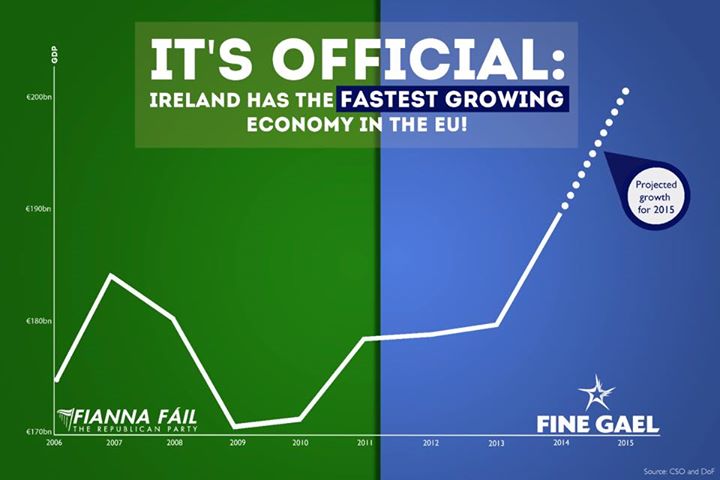
11225395_10153631887578211_4150166261132217846_nLast week the Fine Gael placed a graphic on its Facebook page which purported to show that it alone had secured Ireland’s recovery and made Ireland the fastest growing economy in the EU. To even the most casual of viewers the graphic, especially ones who ignore the dodgy Y axis increments, shows that the bulk of the recovery had been secured before the 2011 election and that the economy had effectively flat lined for the first two years of Fine Gael and Labour’s time in office.

Try searching for the 2002 and 2007 Fine Gael manifestos on the party’s website – you won’t find them. Neither will you find the many statements from Fine Gael spokespeople urging more spending after every Budget. The reality that both campaign platforms, plus the party statements promised to spend more and tax less than the Fianna Fáil alternatives does not sit well with the new Fine Gael legend.

Where Fine Gael is all narrative and no facts – Fianna Fáil has the opposite problem, it is all facts and precious little narrative. Up to the appearance of Brian Cowen and Bertie Ahern before the Banking Inquiry Fianna Fáil spokespeople seemed singularly unwilling to talk about the years leading up to the 2011 election. It seemed that they, like Fine Gael, thought that talking about the period 2002 – 2011 could only damage the party – but as Cowen and Ahern showed, setting the record straight and speaking candidly about what actually happened does not undermine Fianna Fáil.

Cowen and Ahern’s able and informed testimony at the Banking Inquiry showed that the Governments they led were neither reckless nor directionless. Yes, they made mistakes, but as they proved by their command of the facts and the details they did have a plan and were, in the teeth of a global financial crisis, making the best decisions they could on the basis of the facts and information before them. Their assured solo appearances contrasted with Enda’s assisted one, where he did the general patter and handed over to Richard Bruton when the questions become difficult.

The big fallout from the Banking Inquiry is not damaging Fianna Fáil the way Fine Gael’s strategists planned it would. They were full sure that parading the old familiar Fianna Fáil faces before the committee to be questioned and pilloried would re-ignite the public anger and ire of the 2011 election. Why else delay the hearings until the final run up to the election.

But they were wrong. While Fianna Fáil is hardly soaring in the polls, its support has been creeping up painfully slowly, just while the support levels for Fine Gael’s preferred enemy: Sinn Féin, have been slipping steadily downwards.

Hence the need for Fine Gael and for Enda is up the ante on the faux narrative and hype up the legend of Enda of the West complete, to return to the western movie motif, with the good guy white hats they have fabricated for themselves.

The problem is that life and politics today is much more questioning and techni-coloured now than it was in the days of the black and white western – no matter how exciting the story sounds.

I wrote this piece for the Slugger O’Toole website

@sluggerotoole: Derek Mooney on @FiannaFáilparty’s long road to recovery #ep14ie #le14 #ee14 ##ep2014

This is an analysis piece I penned for the Slugger O’Toole website

———————————————————————————————–

Fianna Fáil

While there are worse jobs in the world: the worst job in politics is certainly leader of the opposition.

If he didn’t already know this, it is certain that Fianna Fáil’s leader Micheal Martin will know this in just over a week.

The 2014 European and Local Election campaigns for which he and his HQ team have prepared and planned for over 18 months are proving themselves to be a source of unalloyed joy. It is hard to believe that these are the campaigns they wanted.

The latest round of opinion poll findings only confirm this. They suggest that

  • His Dublin Euro candidate will fail to take the seat
  • His Midlands North West duo may struggle to win a seat
  • While his Ireland South candidates have the best part of two quotas between but are so imbalanced as to render a second seat impossible.

If the ballots cast on Friday confirm these poll findings, then it will be hard to make any of this sound like an achievement.

Continue reading “@sluggerotoole: Derek Mooney on @FiannaFáilparty’s long road to recovery #ep14ie #le14 #ee14 ##ep2014”