Will the “Don’t knows” and “Won’t Votes” be the real victors in #ep2014?

Here is a piece I wrote for the BEERG weekly newsletter just over two weeks ago. Sorry for the delay in posting this on here.  

BEERG Newsletter Issue #15, May 2nd 2014

BEERG’s Derek Mooney writes: With just three weeks to go to voting for the European Parliament elections across Europe it seems that the “don’t knows” may be the winners.

While campaigning is stepping up across Europe and despite a major push from the EU to drive up voter turnout, most polling forecasts suggest that turnout in the 2014 EU parliament elections will drop below the 46% turnout achieved in 2009, with young voters particularly disinterested in electing MEPs.

Open Europe has produced a detailed briefing paper http://goo.gl/7LndzP in which it suggests that a surge in support across the EU for populist anti-EU, anti-austerity, anti-immigrant and anti-establishment parties, could see them win up to 31% of the vote in May.

Couple this strong showing from these parties with another low turnout and, Open Europe estimates, that 74.4% of all voters across Europe will have voted against the EU, for radical change, or not bothered to vote at all. This means that only 25.6% of all eligible voters will have actually come out and voted in favour of parties that broadly support the status quo or favour or more integration.

While these status quo/centrist parties, mainly the EPP, S&D and ALDE will see their aggregate share of the vote decrease, it does not necessarily mean that they will lose their grip on Parliament. While these “fringe” parties will do well in what is widely considered a “second order” election – i.e. not that important to voters’ day to day concerns and a means of registering a protest – these parties are not a coherent group. They span the political spectrum from far left to far right and differ as much from each other as they do from the parties of the centre. The latest forecast suggests that the far right’s Le Pen and Wilders will have enough MEPs from enough member states to form a group: with approximately 38 MEPs from 7 member states.

The net impact of these divergent political trends, Open Europe suggests, is that we paradoxically end up with a more integrationist EU Parliament. It argues that moderate parties (i.e. ones that believe the EU is in need of fundamental reform) will lose out to anti EU parties and this dynamic will reinforce what it terms “the corporatist tendency” of the two main groups (the centre Right EPP and centre left S&D) to freeze out the anti-EU MEPs by binding the Parliament and Commission closer together in pushing an integrationist, Brussels-focused agenda.

The most recent PollWatch2014 prediction of the outcome of the 2014 European Parliament elections suggests that centre-right EPP group and the centre-left S&D group are neck and neck. While previous polls (such as the one I posted here recently) had indicated a slight S&D majority in the new parliament PollWatch now predicts the EPP to pull ahead – with the EPP now forecast to win 222 seats, and the S&D Group 209. Past PollWatch predictions were in the region of 98% correct

It also estimates, based on recent polling data across the EU, that the number of MEPs who could be identified as supporting free market policies is also expected to fall from 242 to 206. Amongst other this this would be bad news for David Cameron, as the incoming Parliament will effectively have a veto over some of many of the EU reforms he seeks.

Cameron’s best hope for his reforms, lies, it seems in the EU Council, but only if he can get other leaders on board and secure agreement in nominating a pro-competitiveness Commission in the autumn.

Meanwhile the candidates for the Commission Presidency had the first of their two live TV debates on EuroNews last Monday. On the podium were (pictured from left to right) the ex-Belgian Prime Minister Guy Verhofstadt (for the Liberals/ALDE): the outgoing European Parliament chief Martin Schulz (from the centre-left S&D), the Greens Ska Keller MEP and the former Luxembourg Prime Minister Jean-Claude Juncker (of the centre-right EPP),

A snap online poll conducted by Europe Decides judged Verhofstadt the debate winner with 55% and placed Juncker, the current front runner for the post, last with a paltry 9%. Most commentators felt the debate was short of any firm or details proposals.

Juncker said that he wanted “a serious Europe. A Europe that doesn’t dream, but gets things done”. During the course of the debate, the former chairman of the Eurogroup that oversaw the tough bailout programmes for Greece, Ireland and Portugal, called for a legal minimum wage across the EU.

Schulz’s promised “to give back justice and fairness” and to create “a Europe of citizens not of banks and speculators” pledging to publish the Commission’s negotiating mandate on the ongoing trade talks with United States.

Verhofstadt said that the EU needed “less internal market regulation, but more common policies” arguing that “the crisis and unemployment” had turned young people against the EU.

At one point Verhofstadt said his model for Commission president was Jacques Delors, causing Martin Schulz to point out that Delors was a Socialist.

The issue of how the next Commission President would be selected also came up. As the nominees of the two largest groups, Juncker and Schulz are keen to avoid any last minute negotiations that might lead to another name entering at the last minute as a compromise.

Schulz said that stitching-up the Commission presidency via a back-room deal would reduce the elections to “a little game” while Verhofstadt said that not choosing one of the formal candidates (i.e. ones already nominated) would be “unthinkable”.

On 27 May, after the election results are known, the EU Parliament President and the group leaders in the parliament will meet together to discuss the results. Their discussions will feed into deliberations by EU government leaders who will meet later that day to decide who to nominate for Commission President.

My @beerg article on recent #eudatap developments and important comments by @seankellymep


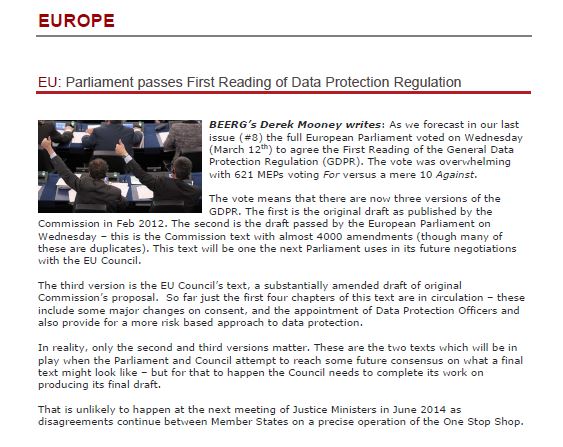
This is a piece I wrote for the March 14th issue of the BEERG global labour newsletter. It examines the consequences of the EU Parliament’s overwhelming vote on the General Data Protection Regulation and acknowledges the hard work and valid concerns raised by the Irish MEP Sean Kelly (EPP & Fine Gael)

BEERG Newsletter March 14th 2014

Though it is now accepted across the EU that the Data Protection Regulation is not likely to be approved until 2015 at the earliest, the European Parliament has scheduled a debate on the legislation on Tuesday (11 March) with a full First Reading vote on it on Wednesday.

The vote comes just 10 weeks before voters across Europe go to the polls to elect the next European Parliament.

The plenary vote on Wednesday is no mere gesture, however. It is the outgoing Parliament setting out its position so that the incoming one can start negotiations with the Council of Ministers, as soon as they have adopted their position, though the timetable for the Council’s part of the process remains uncertain

It is not the European Parliament’s only debate on Data Protection this week as it is also set to approve the final report of its own inquiry into alleged mass surveillance by the US National Security Agency.

That report not only demands that the US/EU trade talks not lead to a softening of data protection standards, it also calls for the suspension of a programme to share bank transfer data with the US, and calls on member states to strengthen oversight of their intelligence services.

As mentioned earlier, the ball now lies with the member states governments via the EU’s Council of Ministers. The Justice Ministers met last week and held a policy debate on outstanding issues relating to the data protection regulation framework.

ASs the communique issued after the meeting said: “Ministers broadly supported the draft provisions as regards the territorial scope of the regulation and confirmed the understanding that international transfers of personal data to third countries should take place on the basis of key principles contained in chapter V of the draft regulation.”

It then went on to diplomatically express the ongoing delays and problems saying:

“Ministers agreed that more technical work will need to be done on important aspects of this chapter and that the question of alternative models for international data transfer will need to be studied in depth.”

“The Council confirmed that the work will continue at a technical level on the basis of the progress achieved so far on: pseudonymisation as an element of the risk-based approach, portability of personal data for the private sector and obligations of controllers and processors.”

“Whilst a majority of delegations appeared to be of the opinion that the scope of the profiling provision in the future regulation should, like the current Directive 95/46/EC, limit itself to regulating automated decision-making that has legal effects or significantly affects individuals, some other delegations pleaded in favour of specific provisions on profiling. Work at a technical level should therefore continue on that basis.”

Others involved in the process expressed their frustrations with the Council’s difficulties in reaching a consensus less delicately. Ralf Bendrath, the Green Party’s data protection expert and an adviser to the German Green MEP who is the Rapporteur who has steered the Regulation through Parliament thus far said on Twitter: “Germany again – embarrassingly – less supportive than all other member states on progress”. He went on to dismiss Germany’s observations that the issue will “need more debate” and chided them for not specifically stating their objections.

While Ministers are still a long way off reaching agreement on their draft of the Regulation, that is not to say that a great deal of technical work and progress is going on behind the scenes.

The Greek EU Presidency has been working away very assiduously in recent months with a series of DAPIX and other Data Protection officials meerting. The Greeks have also been engaging with the Italian government (it is the the next country to hold the 6 month rotating Presidency of the EU) to work out a road map for agreeing on the data protection reform swiftly.

While their original objective of agreeing on a mandate for negotiation with the European Parliament before the end of the Greek Presidency looks unlikely to be achieved, they are busily dotting all the “i”s and crossing all the “t”s they reasonably can awaiting some direction from the member states.

Meanwhile in the UK, the Liberal Democrat Junior Minister at the Justice Ministry, Simon Hughes MP, has announced a review of the criminal sanctions available for breaches of the UK’s Data Protection Act. He said the review would help the UK government “decide whether to increase the penalties as the law permits”.

Feeding into this process Pinsent Masons’ specialist in data protection law Kathryn Wynn has suggested that the government should go further than reviewing the criminal sanctions and should also consider strengthening the civil monetary penalty regime too, arguing that a previous increase in the maximum level of fine in 2010 had prompted organisations to take the issue of data protection seriously.

Using the draft EU’s General Data Protection Regulation as an example she suggests that the review take the approach envisaged there, where the level of penalty for a data breach is calculated on the basis of a percentage of their annual turnover.

So, even before it is passed, we could see the draft EU’s General Data Protection Regulation is influencing domestic legislation across Europe.

High Stakes and possible troubles Irn-Bru-ing as #ep2014 approach

Here is my article from this week’s BEERG Newsletter looking at mounting tensions in the race to take the EU Commission Presidency

ib_cansYou call tell that there’s an election approaching by how targeted, populist and political the press releases from MEPs become. Take the Scottish Nationalist (SNP) MEP Alyn Smith, who has suggested that Scotland consider banning Canadian-born singers Justin Bieber and Celine Dion in retaliation for Canadian authorities prohibiting several Canadian stores from selling the popular Scottish soft drink Irn-Bru. Smith justified his call, albeit tongue in cheek, by saying that between them, Bieber and Dion have produced “more sugary schmaltz” than Irn-Bru ever has.

While Smith’s demand has the virtue of humour and creativity, the same cannot be said for the political attack made by the centre-right European Peoples’ Party (EPP) on German Socialist MEP, Martin Schulz (photo) on Wednesday as reported by the EurActiv website http://www.euractiv.com.

Schulz is the outgoing President European Parliament and the likely Socialist candidate to be President of the next EU Commission

The attack centres on allegations made by the EPP that a €60,000 European Parliament contract was awarded to the wife of Sergei Stanishev, the president of the PES: Party of European Socialists. The €60,000 contract was for an information project promoting the European elections in Bulgaria.

Leading the attack for the EPP, German MEP Ingeborg Grässle claims the situation has alarm bells ringing over an “obvious” conflict of interest involving some of the most prominent figures in the European socialist family, saying “European Parliament staff under the direction of Socialist President Martin Schulz handing out a contract worth €60,000 to the wife of the European Socialist Party President – this smacks of political favours… Is Mr. Schulz using parliament funds to help his political friends?”

EurActiv reports that its sources say that Schulz is concentrating on his campaign to succeed to José Manuel Barroso as Commission President and shudders at any piece of news which could upset his plan.

The fact that the attack was led by a German MEP is significant as Grässle and Schulz’s own parties the CDU and SPD are now in a grand coalition partnership government in Germany. Expect to see and hear more political skulduggery as the May parliamentary elections approach. The stakes are high with more than just the political balance in the European Parliament to consider. As the BEERG Newsletter has reported reforms made under the EU’s Lisbon Treaty means that heads of government must take the results of the European elections “into account” when selecting the next EU Commission President.

With polls suggesting a swing to the Socialists in the May election, possible sufficient to make it the largest single group in Parliament, Schulz is well placed to become the next Commission President, however the centre right EPP group is not likely to allow this prized post slip from its grasp.

12 of the 28 heads of Government are members of the EPP, including Germany’s Angela Merkel, Spain’s Mariano Rajoy and Poland’s Donald Tusk. British Prime Minister David Cameron’s Tory Party quit the EPP in 2009.

The EPP is planning to select its candidate for the EU Commission Presidency at its Congress in Dublin on March 6th & 7th. There are four possible contenders: the Finnish Prime Minister Jyrki Katainen, the Latvian Prime Minister Valdis Dombrovskis, the current commissioner for the internal market Michel Barnier and the former Luxembourg Prime Minister and EU veteran Jean-Claude Juncker.

The PES, whose European Parliamentary group is called the Progressive Alliance of Socialists and Democrats (S&D) will hold it pre-election congress in Rome on 1 March.

ENDS

#ep2014 will bring new @Europarl_EN and new @EU_Commission

This is a piece on the 2014 EU Parliament elections and the appointment of a new EU Commission I wrote for the Jan 10th issue of BEERG‘s Global Labor Relations Newsletter

——————————————————————————–

BEERGEuropean Union: 2014 to bring a new Parliament and new Commission

Derek Mooney writes: Next May citizens across the 28 EU states will go to the polls to elect the 751 members of the next European Parliament.

Voters across the EU have tended to treat these contests as what political scientists call: “second order” elections. This usually means that voter turnout is lower than in national elections and the campaigns are often fought more on national issues rather than pan European ones. In many cases the results in each country reflect the current standing of the national government more than they do the manifestos of the European groupings.

While voting will take place during a 3 to 4 day period across the 28 member states, we can get a sense of the possible outcomes by looking at opinion polls in the eight largest EU countries (France, Germany, Italy, the Netherlands, Poland, Romania, Spain and the United Kingdom) as these account for around 77% of all the EU citizens entitled to vote and will elect around 64% of the Members of the European Parliament (MEPs).

A policy paper presented to the Notre Europe: Jacques Delors’s Institute focussing on what the political balance of power in the next European Parliament might be suggests the possibility of some major changes.

The paper features an analysis of recent opinion polls in these eight countries. It suggests a swing to the Left and Centre Left as well as major gains for protest and fringe parties on both the far left and far right.

In the outgoing parliament the EPP (Centre Right group) holds 265 seats against 184 for the Social & Democrats (Centre Left). The analysis of the polls suggests a swing to the centre left that not just closes this gap, but even reverses it. Some analysts predict that the EPP group might win 209 seats in May, four less than the S&D’s predicted 213.

The predicted changes on the margins are no less dramatic. The domestic opinion polls in France suggest that the far right Front National, led by Marine Le Pen, could become the largest French party in the elections, possibly taking 21% of the vote and increasing its number of MEPs from 3 to 17. While on the other end of the spectrum far left parties such as the Spanish Izquierda Unida (United Left) may increase its number of MEPs from 1 to 8.

Political commentators are suggesting that these advances by parties on the far left and far right, plus gains by populist protest parties like Italy’s Five Star Movement led by comedian Beppe Grillo could see them holding up to 40% of the seats in the incoming parliament.

The political zero sum gain dictates that the increased influence of these groups comes at the expense of the traditional dominance of big blocs: the EPP, the S&D and the Liberal ALDE group, leading to greater political uncertainty in the next Parliament.

This uncertainty comes at a time when the Lisbon Treaty has given an increased role and say to the European Parliament, not least in the appointment of the next European Commission especially the Commission President, which will follow the European Elections.

The Lisbon Treaty has changed the rules on the appointment of Commission President and these come into effect for the first time in 2014. Article 17 of the Treaty and the Declaration 11 annexed to it set out that the choice of the candidate for the Commission presidency will be made “taking into account the elections to the European Parliament”.

This was supposed to mean that the various pan-European EU groupings declare who their candidates for the Commission presidency will be in advance of the May parliamentary elections and set out their commission presidency manifestos. In each country candidates looking to become an MEP would indicate to which European political grouping they would affiliate indicate the Commission presidency candidate that grouping will back.

Names are being bandied about as to who might nominated by each of the main groups. The current EU Parliament President, Martin Shultz looks like being the likely nominee of the centre left S&D grouping, having already secured the backing of 20 or so centre left parties across Europe, most importantly his own German SPD and Francoise Hollande’s Socialist Party.

The EPP may opt to propose Jean Claude-Juncker, the recently defeated long serving Luxembourg Premier. Juncker’s gain maybe at the expense of his party colleague, Viviane Reding, who had previously harboured ambitions to become Commission President having served as a Vice President. Realising that that path is now closed there is some suggestion that she may step down as a Commissioner before her term expires to seek re-election as an MEP (she was previously an MEP) and seek the post of President of the Parliament. The same suggestion is being made about her French Commission colleague Michel Barnier.

But, being Europe, the practice looks like it will be very different. While MEPs want to see the power reside with them and the Commission Presidency go to the largest group (or coalition of groups) in the incoming European Parliament, national governments and leaders, most notably Angela Merkel and David Cameron, are deeply reluctant to surrender the final say to the parliament and are taking a very broad view of the phrase “taking into account the elections to the European Parliament”

While no one should be heading to the bookies to put bets on the results just yet, it is reasonable to assume that the incoming European Parliament and Commission with have a more leftish and presumably interventionist hue than the outgoing one. Given the difficulties posed to business by the outgoing centrist parliament, this cannot come as good news to business and employers across the EU.

The prospect of a more leftist Commission and parliament, coupled with the political uncertainty heralded by a phalanx of extremist parties of both left and right, could lead to some interesting and difficult times ahead.

ENDS


Bold Santa Claus: Can he be investigated over illegal data collection? #eudatap

A light hearted piece, penned by a couple of us in BEERGon the employment data aspects of data protection from the festive/end of year edition of the BEERG Newsletter 

—————————————————

reding (2)The BEERG Team write:According to usually unreliable sources in Brussels, Commissioner Reding is to ask the European Parliament to investigate allegations that the head of a global enterprise operating from an unspecified Artic territory just within EU borders has been holding and using data files on a range of individuals world-wide. There are also suspicions that the enterprise may have links to the US’s National Security Agency (NSA). The company concerned has been identified as Claws Enterprises, headed by the mysterious Sanity Claws.

Commission Reding is said to have been alerted to the operations of Claws after hearing a rhyming couplet broadcast on several EU and US radio stations in recent weeks.   According to the aforementioned sources the recording said that Claws has been

       “…making a list and checking it twice / he’s going to find out who’s naughty and nice…”

Leading data protection sources informed BEERG that no information commission or data protection authority anywhere in the EU can trace any records of any non-judicial or non-policing enterprise or individual registering with them for the purpose of checking who is “naughty or nice”.

The recording is causing understandable concern in the EU capital coming so soon as it does on the heels of the Snowden revelations. The suggestion that both this enterprise and Mr Snowden are based in neighbouring Polar Regions is also causing concern and raising questions of some collusion.

Commission Reding is said to be considering immediately raising this issue as part of the EU-US Trade talks given this enterprise’s seasonal global operations, particularly the suggestion that Claws (spelling of the name to be checked) is expected to be “coming to town” soon.  Tea Party sources in the US refused to confirm or deny rumours that they are hosting a reception for Mr Claws when he gets to DC. A Tea Party spokesperson said: “We will be having an end-of-year get together. Come all ye faithful”.

Questions are now being asked if this Mr Sanity Claws will be visiting the NSA offices near Washington DC during his impending visit and what is the nature of his relationship with the NSA given the rumours that he has a team of elves and minions strategically placed across the planet. French officials have questioned as to whether Claws Enterprises are operating in conformity with the Posting of Elves Directive.

One official commented: “We suspect that some of the elves posted by Claws to France may be below the minimum height requirement for elves in France. Further, we have suspicions that they may also be working on Sundays”.

The CGT union has called an emergency meeting of its Elves and Safety Committee and says it will oppose any moves to downsize French elves.  Meanwhile, a spokesperson for UNI Global said that while they had never heard of Claws Enterprises and had no idea what they did. Nevertheless, the spokesperson called on the company to open negotiations for an International Framework Agreement. The spokesperson added that they had commissioned a leading NGO to produce a report on “poverty pay” in Elf Land. We believe that the report is provisionally entitled: “Hi-Ho, Hi-Ho our wages are too low”.

German media sources quoted Chancellor Angela Merkel saying: “Thankfully, as part of the program for government with our SPD colleagues we have just agreed a national minimum height for elves in Germany”.

Sources totally disconnected with Commissioner Reding’s office have been expressing concerns that this Sanity Claws enterprise has been gathering personal data with neither implicit or explicit written consent – either on file or online.

“Where does this leave the right to be forgotten?” said one of the sources. “We believe that the right to be completely forgotten must be applied and that these lists being held by Mr Sanity Claws and the personal information held on them must be destroyed within the next 10 days. We know that the people of the EU and the US, especially younger people, will thank us for this before the end of the month if we have our way”, they continued.

When asked if the Commission position meant that Claws should destroy his lists and not deliver presents to children on December 25th our source responded that “austerity was for life and not just for Christmas” and the sooner that children realised this the better.

Another anonymous legal source, specialising in the area of contract law and service level agreements, has told BEERG over the phone that they do not believe the specified enterprise could legally or credibly offer a reward-based service determined solely on a subjective assessment of an individual’s niceness or naughtiness. “It sounds like madness to us lawyers” they said. “We have examined the text, the content and provisions of hundreds of contracts over the years and, based on this experience, we can state with near certainty that there is no sanity clause.”

PS… since writing this piece we are hearing reports that the Commission have also learned of another enterprise holding and using unapproved personal oral hygiene data trading under the name: The Tooth Fairy.

#Merkel & #EU need to learn the lessons of Germany’s own economic renewal

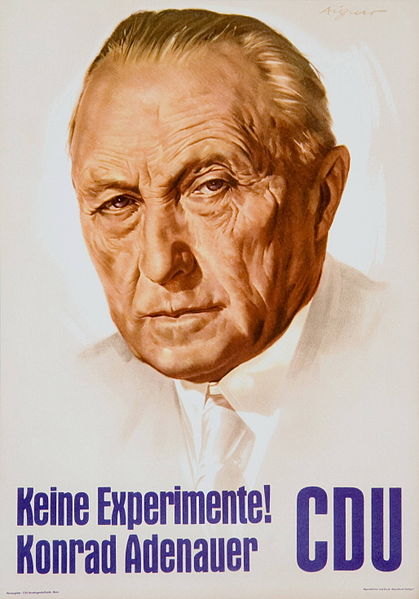
adenauer
1957 Adenauer Election Poster: No Experiments

Yesterday (Thurs April 11th) the Irish Times ran a story saying that the German chancellor Angela Merkel is facing mounting political pressure at home to demand fiscal concessions from Ireland in exchange for granting extra time to repay crisis loans.

It seems that once again Germany is insisting that it not merely have an input into EU talks and discussion, but that it have a veto on the outcome. It is the ‘he who pays the piper calls the tune’ school of political thought.  While the approach is not unfamiliar in politics, it flies totally in the face of democratic process and accountability. But even more than that, in this instance, it contradicts the history of Germany’s own economic revival and the important role played by one of Ms Merkel’s most illustrious predecessors: Konrad Adenauer.

Germany’s Wirtschaftswunder – the economic miracle of the 1950s – was based in large measure on a generous programme of debt forgiveness given to Germany by its 33 debtor countries (including Ireland). The 1953 London Agreement on German External Debts, effectively wrote off half of Germany’s total mountain of debt and gave it additional time to repay the monies it owed. These debts included war reparations from both first and second world wars, plus the massive German 1930’s debt default, which was just as significant as the 2008 European financial crisis.

The West German CDU Chancellor, Konrad Adenauer realised that there would be no growth or revival of the West German economy for as long as it had to make huge annual payment to the Allied and other powers. These hefty payments, many of which Germany was even failing to make, were draining the West German economy of the ability to rebuild itself.  He recognised that the only way to achieve growth was to get some relief from this debt burden, hence the London conference on German external debts.

Adenauer managed to convince the others sitting around the table that the only way that Germany could recover and rebuild was for them to ease the burden on it – he managed to convince them to stop doing to Germany what Germany is now doing to Ireland, Spain, Portugal, Greece and Cyprus.

Easing the burden of West Germany’s debt did not make the country lazy and profligate, quite the opposite. The Agreement, along with the Marshall Plan very quickly enabled the West German government and industry to use the resources freed up by the easing of the debt burden to generate domestic economic activity and growth.

Not only did the London Agreement write off 50% of Germany’s debt it removed the requirement that interest be paid, though did say that this proviso would be revisited in the event of German reunification. The collapse of the Wall in late 1989 triggered that proviso but it was never implemented due to Chancellor’s Kohl’s protestations that demanding such interest payments would make it almost impossible for Germany to meet the considerable costs of re-unification. So, once again, Germany’s partners allowed it to walk away from its financial commitments in the greater good.

Kenny MerkelAs we know, both Enda Kenny and the Fine Gael party is deeply proud of its strong association with the CDU and Ms Merkel via their shared membership of the centre right European grouping: The European People’s Party EPP. Indeed, they regard the linkage as so important and significant that Mr Kenny manged to include a quick visit to Berlin and photocall with the Chancellor in the first week of the February 2011 general election campaign.

Perhaps the next time An Taoiseach meets up with the Chancellor in either Dublin, Brussels or Berlin he might gently remind her that her countries economic resurgence and dominance is due, in no small part, to the fact that 33 other countries, including Ireland, had allowede Germany to ease its burdens when it mattered and that it may now be time for Germany to allow others the facility they once extended to it.


Have today’s eurosceptics actually read #Thatcher’s Bruges speech?

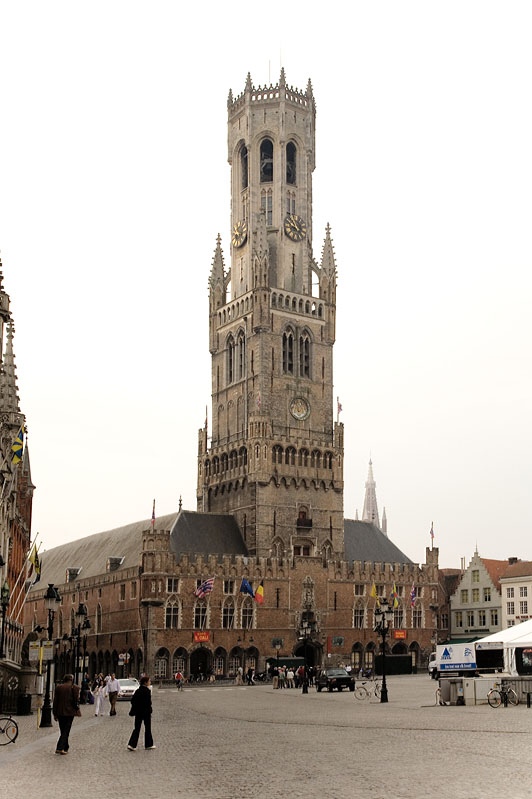
Bruges Belfry
Bruges Belfry

According to some sources; when British PM David Cameron was preparing his recent speech on Europe his researchers looked at Mrs Thatcher’s famous 1988 Bruges speech for inspiration. After reading it they concluded that they could not use it as the tone, language and phrases would not sit well with today’s eurosceptics be they Tory, UKIP or Sinn Féin.

It would appear that many of today’s eurosceptics/anti-europeans who claim Thatcher as a heroine have not read the speech or, if they have, they have failed to grasp its contents. They certainly have conveniently forgot that she signed the Single European Act. While her Bruges Speech is hardly a call for a federal Europe, neither is it a manifesto for euroscepticism.

Doubtless her views changed in her later years, but in this keynote speech, she sets out her vision of the European Community as practical way which Europe can ensure the future prosperity and security of its people – an EC with Britain at its heart.

Not all the contents of this speech sit easy with me – its Defence section for example, but read for yourself and see how you feel about its contents in the current situation.

Margaret Thatcher Speech to the College of Europe (“The Bruges Speech”) 1988 Sept 20

Mr. Chairman, you have invited me to speak on the subject of Britain and Europe. Perhaps I should congratulate you on your courage. If you believe some of the things said and written about my views on Europe, it must seem rather like inviting Genghis Khan to speak on the virtues of peaceful coexistence! I want to start by disposing of some myths about my country, Britain, and its relationship with Europe and to do that, I must say something about the identity of Europe itself.

Europe is not the creation of the Treaty of Rome. Nor is the European idea the property of any group or institution. We British are as much heirs to the legacy of European culture as any other nation. Our links to the rest of Europe, the continent of Europe, have been the dominant factor in our history.

For three hundred years, we were part of the Roman Empire and our maps still trace the straight lines of the roads the Romans built. Our ancestors—Celts, Saxons, Danes—came from the Continent. Our nation was—in that favourite Community word—”restructured” under the Norman and Angevin rule in the eleventh and twelfth centuries. This year, we celebrate the three hundredth anniversary of the glorious revolution in which the British crown passed to Prince William of Orange and Queen Mary. Visit the great churches and cathedrals of Britain, read our literature and listen to our language: all bear witness to the cultural riches which we have drawn from Europe and other Europeans from us.

We in Britain are rightly proud of the way in which, since Magna Carta in the year 1215, we have pioneered and developed representative institutions to stand as bastions of freedom. And proud too of the way in which for centuries Britain was a home for people from the rest of Europe who sought sanctuary from tyranny. But we know too that without the European legacy of political ideas we could not have achieved as much as we did. From classical and mediaeval thought we have borrowed that concept of the rule of law which marks out a civilised society from barbarism.

And on that idea of Christendom, to which the Rector referred—Christendom for long synonymous with Europe—with its recognition of the unique and spiritual nature of the individual, on that idea, we still base our belief in personal liberty and other human rights.
Too often, the history of Europe is described as a series of interminable wars and quarrels. Yet from our perspective today surely what strikes us most is our common experience. For instance, the story of how Europeans explored and colonised—and yes, without apology—civilised much of the world is an extraordinary tale of talent, skill and courage. But we British have in a very special way contributed to Europe. Over the centuries we have fought to prevent Europe from falling under the dominance of a single power.

We have fought and we have died for her freedom. Only miles from here, in Belgium, lie the bodies of 120,000 British soldiers who died in the First World War. Had it not been for that willingness to fight and to die, Europe would have been united long before now—but not in liberty, not in justice. It was British support to resistance movements throughout the last War that helped to keep alive the flame of liberty in so many countries until the day of liberation.

Tomorrow, King Baudouin will attend a service in Brussels to commemorate the many brave Belgians who gave their lives in service with the Royal Air Force—a sacrifice which we shall never forget. And it was from our island fortress that the liberation of Europe itself was mounted. And still, today, we stand together. Nearly 70,000 British servicemen are stationed on the mainland of Europe.

All these things alone are proof of our commitment to Europe’s future. The European Community is one manifestation of that European identity, but it is not the only one. We must never forget that east of the Iron Curtain, people who once enjoyed a full share of European culture, freedom and identity have been cut off from their roots.We shall always look on Warsaw, Prague and Budapest as great European cities. Nor should we forget that European values have helped to make the United States of America into the valiant defender of freedom which she has become.

EUROPE’S FUTURE 

This is no arid chronicle of obscure facts from the dust-filled libraries of history. It is the record of nearly two thousand years of British involvement in Europe, cooperation with Europe and contribution to Europe, contribution which today is as valid and as strong as ever [sic].

Yes, we have looked also to wider horizons—as have others—and thank goodness for that, because Europe never would have prospered and never will prosper as a narrow-minded, inward-looking club. The European Community belongs to all its members. It must reflect the traditions and aspirations of all its members. And let me be quite clear. Britain does not dream of some cosy, isolated existence on the fringes of the European Community. Our destiny is in Europe, as part of the Community.

That is not to say that our future lies only in Europe, but nor does that of France or Spain or, indeed, of any other member. The Community is not an end in itself. Nor is it an institutional device to be constantly modified according to the dictates of some abstract intellectual concept. Nor must it be ossified by endless regulation.

The European Community is a practical means by which Europe can ensure the future prosperity and security of its people in a world in which there are many other powerful nations and groups of nations. We Europeans cannot afford to waste our energies on internal disputes or arcane institutional debates. They are no substitute for effective action. Europe has to be ready both to contribute in full measure to its own security and to compete commercially and industrially in a world in which success goes to the countries which encourage individual initiative and enterprise, rather than those which attempt to diminish them.

This evening I want to set out some guiding principles for the future which I believe will ensure that Europe does succeed, not just in economic and defence terms but also in the quality of life and the influence of its peoples.

WILLING COOPERATION BETWEEN SOVEREIGN STATES 

My first guiding principle is this: willing and active cooperation between independent sovereign states is the best way to build a successful European Community. To try to suppress nationhood and concentrate power at the centre of a European conglomerate would be highly damaging and would jeopardise the objectives we seek to achieve. Europe will be stronger precisely because it has France as France, Spain as Spain, Britain as Britain, each with its own customs, traditions and identity. It would be folly to try to fit them into some sort of identikit European personality. Some of the founding fathers of the Community thought that the United States of America might be its model. But the whole history of America is quite different from Europe.

People went there to get away from the intolerance and constraints of life in Europe. They sought liberty and opportunity; and their strong sense of purpose has, over two centuries, helped to create a new unity and pride in being American, just as our pride lies in being British or Belgian or Dutch or German. I am the first to say that on many great issues the countries of Europe should try to speak with a single voice. I want to see us work more closely on the things we can do better together than alone.

Europe is stronger when we do so, whether it be in trade, in defence or in our relations with the rest of the world.
But working more closely together does not require power to be centralised in Brussels or decisions to be taken by an appointed bureaucracy. Indeed, it is ironic that just when those countries such as the Soviet Union, which have tried to run everything from the centre, are learning that success depends on dispersing power and decisions away from the centre, there are some in the Community who seem to want to move in the opposite direction.

We have not successfully rolled back the frontiers of the state in Britain, only to see them re-imposed at a European level with a European super-state exercising a new dominance from Brussels. Certainly we want to see Europe more united and with a greater sense of common purpose. But it must be in a way which preserves the different traditions, parliamentary powers and sense of national pride in one’s own country; for these have been the source of Europe’s vitality through the centuries.

ENCOURAGING CHANGE

My second guiding principle is this: Community policies must tackle present problems in a practical way, however difficult that may be. If we cannot reform those Community policies which are patently wrong or ineffective and which are rightly causing public disquiet, then we shall not get the public support for the Community’s future development. And that is why the achievements of the European Council in Brussels last February are so important. It was not right that half the total Community budget was being spent on storing and disposing of surplus food. Now those stocks are being sharply reduced. It was absolutely right to decide that agriculture’s share of the budget should be cut in order to free resources for other policies, such as helping the less well-off regions and helping training for jobs. It was right too to introduce tighter budgetary discipline to enforce these decisions and to bring the Community spending under better control.

And those who complained that the Community was spending so much time on financial detail missed the point. You cannot build on unsound foundations, financial or otherwise, and it was the fundamental reforms agreed last winter which paved the way for the remarkable progress which we have made since on the Single Market.

But we cannot rest on what we have achieved to date. For example, the task of reforming the Common Agricultural Policy is far from complete. Certainly, Europe needs a stable and efficient farming industry. But the CAP has become unwieldy, inefficient and grossly expensive. Production of unwanted surpluses safeguards neither the income nor the future of farmers themselves. We must continue to pursue policies which relate supply more closely to market requirements, and which will reduce over-production and limit costs.

Of course, we must protect the villages and rural areas which are such an important part of our national life, but not by the instrument of agricultural prices. Tackling these problems requires political courage. The Community will only damage itself in the eyes of its own people and the outside world if that courage is lacking.

EUROPE OPEN TO ENTERPRISE

My third guiding principle is the need for Community policies which encourage enterprise. If Europe is to flourish and create the jobs of the future, enterprise is the key. The basic framework is there: the Treaty of Rome itself was intended as a Charter for Economic Liberty. But that it is not how it has always been read, still less applied.

The lesson of the economic history of Europe in the 70’s and 80’s is that central planning and detailed control do not work and that personal endeavour and initiative do. That a State-controlled economy is a recipe for low growth and that free enterprise within a framework of law brings better results. The aim of a Europe open to enterprise is the moving force behind the creation of the Single European Market in 1992. By getting rid of barriers, by making it possible for companies to operate on a European scale, we can best compete with the United States, Japan and other new economic powers emerging in Asia and elsewhere.

And that means action to free markets, action to widen choice, action to reduce government intervention. Our aim should not be more and more detailed regulation from the centre: it should be to deregulate and to remove the constraints on trade. Britain has been in the lead in opening its markets to others. The City of London has long welcomed financial institutions from all over the world, which is why it is the biggest and most successful financial centre in Europe.

We have opened our market for telecommunications equipment, introduced competition into the market services and even into the network itself—steps which others in Europe are only now beginning to face. In air transport, we have taken the lead in liberalisation and seen the benefits in cheaper fares and wider choice. Our coastal shipping trade is open to the merchant navies of Europe. We wish we could say the same of many other Community members. Regarding monetary matters, let me say this. The key issue is not whether there should be a European Central Bank.

The immediate and practical requirements are:

  • to implement the Community’s commitment to free movement of capital—in Britain, we have it;
  • and to the abolition through the Community of exchange controls—in Britain, we abolished them in 1979;
  • to establish a genuinely free market in financial services in banking, insurance, investment;
  • and to make greater use of the ECU.

This autumn, Britain is issuing ECU-denominated Treasury bills and hopes to see other Community governments increasingly do the same. These are the real requirements because they are what the Community business and industry need if they are to compete effectively in the wider world.

And they are what the European consumer wants, for they will widen his choice and lower his costs.It is to such basic practical steps that the Community’s attention should be devoted. When those have been achieved and sustained over a period of time, we shall be in a better position to judge the next move. It is the same with frontiers between our countries. Of course, we want to make it easier for goods to pass through frontiers. Of course, we must make it easier for people to travel throughout the Community.

But it is a matter of plain common sense that we cannot totally abolish frontier controls if we are also to protect our citizens from crime and stop the movement of drugs, of terrorists and of illegal immigrants. That was underlined graphically only three weeks ago when one brave German customs officer, doing his duty on the frontier between Holland and Germany, struck a major blow against the terrorists of the IRA. And before I leave the subject of a single market, may I say that we certainly do not need new regulations which raise the cost of employment and make Europe’s labour market less flexible and less competitive with overseas suppliers.

If we are to have a European Company Statute, it should contain the minimum regulations. And certainly we in Britain would fight attempts to introduce collectivism and corporatism at the European level—although what people wish to do in their own countries is a matter for them.

EUROPE OPEN TO THE WORLD

My fourth guiding principle is that Europe should not be protectionist. The expansion of the world economy requires us to continue the process of removing barriers to trade, and to do so in the multilateral negotiations in the GATT. It would be a betrayal if, while breaking down constraints on trade within Europe, the Community were to erect greater external protection. We must ensure that our approach to world trade is consistent with the liberalisation we preach at home. We have a responsibility to give a lead on this, a responsibility which is particularly directed towards the less developed countries. They need not only aid; more than anything, they need improved trading opportunities if they are to gain the dignity of growing economic strength and independence.

EUROPE AND DEFENCE 

My last guiding principle concerns the most fundamental issue—the European countries’ role in defence. Europe must continue to maintain a sure defence through NATO. There can be no question of relaxing our efforts, even though it means taking difficult decisions and meeting heavy costs. It is to NATO that we owe the peace that has been maintained over 40 years. The fact is things are going our way: the democratic model of a free enterprise society has proved itself superior; freedom is on the offensive, a peaceful offensive the world over, for the first time in my life-time.

We must strive to maintain the United States’ commitment to Europe’s defence. And that means recognising the burden on their resources of the world role they undertake and their point that their allies should bear the full part of the defence of freedom, particularly as Europe grows wealthier. Increasingly, they will look to Europe to play a part in out-of-area defence, as we have recently done in the Gulf. NATO and the Western European Union have long recognised where the problems of Europe’s defence lie, and have pointed out the solutions. And the time has come when we must give substance to our declarations about a strong defence effort with better value for money.

It is not an institutional problem. It is not a problem of drafting. It is something at once simpler and more profound: it is a question of political will and political courage, of convincing people in all our countries that we cannot rely for ever on others for our defence, but that each member of the Alliance must shoulder a fair share of the burden. We must keep up public support for nuclear deterrence, remembering that obsolete weapons do not deter, hence the need for modernisation.

We must meet the requirements for effective conventional defence in Europe against Soviet forces which are constantly being modernised. We should develop the WEU, not as an alternative to NATO, but as a means of strengthening Europe’s contribution to the common defence of the West. Above all, at a time of change and uncertainly in the Soviet Union and Eastern Europe, we must preserve Europe’s unity and resolve so that whatever may happen, our defence is sure.

At the same time, we must negotiate on arms control and keep the door wide open to cooperation on all the other issues covered by the Helsinki Accords. But let us never forget that our way of life, our vision and all we hope to achieve, is secured not by the rightness of our cause but by the strength of our defence. On this, we must never falter, never fail.

THE BRITISH APPROACH 

Mr. Chairman, I believe it is not enough just to talk in general terms about a European vision or ideal. If we believe in it, we must chart the way ahead and identify the next steps. And that is what I have tried to do this evening. This approach does not require new documents: they are all there, the North Atlantic Treaty, the Revised Brussels Treaty and the Treaty of Rome, texts written by far-sighted men, a remarkable Belgian— Paul Henri Spaak —among them. However far we may want to go, the truth is that we can only get there one step at a time. And what we need now is to take decisions on the next steps forward, rather than let ourselves be distracted by Utopian goals. Utopia never comes, because we know we should not like it if it did.

Let Europe be a family of nations, understanding each other better, appreciating each other more, doing more together but relishing our national identity no less than our common European endeavour. Let us have a Europe which plays its full part in the wider world, which looks outward not inward, and which preserves that Atlantic community—that Europe on both sides of the Atlantic—which is our noblest inheritance and our greatest strength. May I thank you for the privilege of delivering this lecture in this great hall to this great college (applause).

You can watch a video of the speech:  http://www.margaretthatcher.org/document/113688

ENDS

Can you read and digest this Bill in 30 mins? #promnight

I defy anyone to read this and be ready to argue for or against in 30mins or less…..

IRBC Bill

Results of my online poll

Here are the results of my online poll. Over 360 visitors to the webpage in last two days – thanks for the 247 votes cast and for the comments posted.

I am not claiming this as scientific, just indicative…. maybe most indicative of just who follows me on Twitter and Facebook

You can print out the results in a PDF document fromhere: Impressed Most Poll

The question posed: Leaving aside whether you voted Yes or No who impressed you most during the Fiscal Treaty Campaign (Pick 3)


Total Votes 247

%


1

Micheál Martin

21.86%

2

Declan Ganley

14.17%

3

Michael McGrath

14.17%

4

Simon Coveney

13.77%

5

Mary Lou McDonald

13.77%

6

Joan Burton

5.67%

7

Gerry Adams

5.26%

8

Enda Kenny

4.45%

9

Shane Ross

2.83%

10

Eamon Gilmore

1.62%

11

Joe Higgins

1.21%

12

Richard Boyd Barrett

1.21%


Who impressed you most during referendum campaign?