You are playing senior hurling now lads: why renegotiating the PfG won’t work for @Labour

seamusbrennan
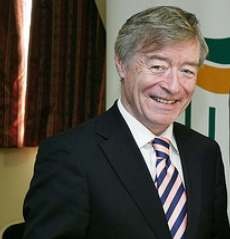
The late Séamus Brennan: “You are playing senior hurling now lads…”

“You are playing senior hurling now lads – but you are playing with lads with All Ireland medals”.

This, according to Eamon Ryan, is how the late Séamus Brennan greeted the Green Party team as it arrived in Government buildings for the 2007 talks on forming a government with Fianna Fáil.

It is a phrase that every Labour Party TD calling for a renegotiation of the Programme for Government (PfG) should print out and place at the top of their PC screen.

God be with the days when Labour recruited its Dáil candidates from the old ITGWU or FWUI. Those guys knew the first principles of negotiating; they particularly knew that you did not go into negotiations unless you had 1. A strong hand and 2. A fair idea of the outcome. Yet some in Labour are advocating that they enter talks with neither.

They want to enter a renegotiation of the government’s fundamental policy programme at precisely the moment when their party has hardly ever been weaker. Do they seriously expect that their senior partners in Fine Gael will take pity on them and offer them major policy concessions just because they are having a bad hair day?

Do they really underestimate their government partners that much?

Politics is a tough world guys. Wake up.

You do not get your way in politics just because you mean well, you get your way and get policies implemented by getting a mandate and pursuing your goals assiduously.

You certainly do not enter talks with partners from whom you wish to extract concessions with the message: we are in a weakened state and desperately need to give the impression that we can beat you into submission, so please, please, please let us.

It is the equivalent in nature of a lone deer asking a lion to not to devour them as they have a leg injury and cannot run properly today. Indeed it goes further and suggests that the lion should agree to allow the injured deer to bitch slap them around for a while so that any other deer who may be watching from a distance will think more highly of them.

There is no compulsion on Fine Gael to enter meaning renegotiation talks with Labour. They know Labour cannot cut and run now and risk facing the electorate, so they know it is strapped into this arrangement until the bitter end. The very most Labour could hope to get is a sham negotiation where we see TV clips of the pairs of Ministers from each side entering Government buildings for late night talks and the last minute “leak” from a source “close to the Labour leadership” saying the talks are at a crucial point right now and may go well into the night. The optics will look good, they may even fool a few activists, but most others (including the public) will see it as just a gesture. If the guys want to go down this road there is doubtless a battered old playbook for such an exercise laying around Government building somewhere.

The current cohort of Fine Gael TDs is possibly the most right of centre since the late 1950s. They are already getting flack from supporters and voters for the appearance that Labour is dictating too much of the government’s agenda, particularly on social issues, so they are neither motivated nor minded to give any more policy ground to them on the back of what was a bad day for Labour and, conversely, a good day for Fine Gael.

The idea of renegotiating the PfG is at best: naïve, and at worst: dumb.

That so many TDs would advocate it after only two years in office suggests that we are probably beyond the mid point of the life of this government and that the chances of there being a general election in early 2015 just got stronger.

Have we in Fianna Fáil survived our election punishment beating?

My column from yesterday’s Evening Herald (21/Feb/13) taking a very personal look at where Fianna Fáil is today; almost exactly two years on from the political meltdown of Election 2011 

Sums up the the response in many places in 2011

——————————————————————————————————————

Though I don’t share his politics I like John O’Farrell. O’Farrell, whose father hailed from Galway, is a comedy writer and British Labour Party supporter who is now their candidate in the Eastleigh by-election.

My reasons for liking him stem not just from his days as a script writer on Spitting Image but from his hilarious 1998 memoir: Things Can Only Get Better: Eighteen Miserable Years in the Life of a Labour Supporter.

In it he details the disappointments, frustrations and the heartache he endured at all levels of the Labour Party until he came to realise that “Michael Foot would never be Prime Minister… and that the nuclear arms race was never going to be stopped by face painting alone.”

A few months after the punishment beating that was Fianna Fáil’s 2011 General Election result I started to wonder if I should start work on my own homespun version.

I toyed around with several possible titles, including: I Thought That Things Could Only Get Better: Boy, Was I Wrong or Fianna Fáil: the view from the edge.

The idea never got beyond a few lines on the PC screen, however. This was partly due to my not seeing anything even vaguely humorous in my situation, but also to me not knowing any publisher sufficiently cracked to commission it. Back in 2011 it was hard to imagine a market for such a work.

I also had a slight suspicion that the party was not yet ready for the scrapheap, nor for 18 years in the wilderness.

Yes, it was in bad shape – very bad shape. Not just the organisation, but the people too. Friends and colleagues who had worked in politics were shell shocked by the result. Not just elected reps, but people on more modest salaries working behind the scenes. Researchers, press officers, organisers and administrators. Losing 51 seats meant HQ shedding staff over half its staff.

But along with this loss, a loss that many hundreds of thousands of other people have had to face, was the realisation that people of my vintage were the ones who had allowed the decline to happen: we could be the generation that not only wrecked Fianna Fáil, but damaged the values on which it was founded.

This is not to underestimate or disregard the mistakes we made and the anger we caused to those people whose support we had sought and won over the decades. Nor is it a plea for pity. It is just to acknowledge that the 2011 defeat had real consequences for many of us.

While there were reports of some particularly heated and fraught exchanges during the campaign, what I experienced at the doors was a harsh coldness. The voters had long since made up their minds on Fianna Fáil – we had let them down badly and we would pay the price.

I suspect many voters even surprised themselves with the scale and magnitude of the Tsunami that engulfed Fianna Fáil two years ago.

Two years is not a long time in the life of an established political party. While the coldness and mistrust may have thawed somewhat, there is still a lot of real anger out there that will take a long time to address.

This should not be confused, however, with the contrived disdain that characterises some people’s attitudes to Fianna Fáil. As Sean Gallagher discovered during his presidential bid, it is now almost McCarthey-esque. You can talk about us in a way that you could not about almost any other group.

It ranges from the scorn that perceives FF as unprincipled, gauche, maybe even a bit NOCD (not our class dahling) to the more visceral anti Fianna Fail-ism that sees us all as chancers and strokers.

But for as long as I know that I am in a party that works to give people the means and opportunities to succeed, I reckon I can live with that.

ENDS

Soldiers could lead the battle to reform public service

Irish troops serving the cause of peace internationally

My column from tonight’s Evening Herald on how the reform and modernisation of the Defence Forces over the past year could prove a model for public sector reform

—————————————————————————————————–

The first tentative step on the path to a possible Croke Park II deal was taken last week when Public Sector unions and management sat down together for preliminary talks.

While reaching any form of deal will pose difficulties for negotiators on both sides, the management side has a particularly difficult delicate balance to strike. Though their political masters in Cabinet may be signalling their support for a deal they also know that most Fine Gael back benchers would be just as happy if no deal was reached.

The public service is just one more issue that divides back-benchers from both parties, with many of FG’s newer intake of TD’s echoing the “small government” rhetoric heard from US Republicans and Tea-Partyers.

It is not an uncommon view in these difficult times. There are many siren voices around attacking the public service and portraying it as riding on the back of a shrinking private sector.

Sadly, the public service often leaves itself open to these onslaughts with daft examples of wasteful spending and bad work practises. But the danger lies when occasionally justified criticisms are distilled into a dogma.

Yes, the public service is in need of reform and modernisation, but the one dimensional demonizing of the entire public service we hear from some quarters will not help reform anything. Nor will the “everything is just fine as it is” defence we hear from various public sector unions.

Public service reform is possible without hyperbole or blood on the carpets. With the right management and leadership the public service is capable of reforming and modernising itself. I know, because I was there when it happened.

The reform and modernisation of the Defence Forces over the past decade and a half is a model of how it can be done right.

The 2009 Bórd Snip Nua report found that the Defence Forces were the only sector in the Public Service to reduce numbers during the Celtic Tiger.

While the numbers working in the Public Service had increased by 17% between 2001 and 2009, the numbers working in the defence organisation actually fell by 8%, going from 11,808 down to 10,895 a drop of 913.

The reduction in numbers in uniform was reflected in a reduction of numbers of civil servants in the Department. These payroll savings were invested in better equipment and improved training meaning that the Irish Defence Forces could do more with less.

The negotiations were tough, but both sides recognised that it was in their mutual interest. While soldiers and officers do not have Trade Unions, they do have strong representative organisations: PDFORRA and RACO and a parallel conciliation and arbitration process that conducts it business quietly and effectively,

Perhaps the absence of outside influences, speculation and running commentaries, helped create the conditions for agreement – but not nearly as strong leadership, both political and military.

We should now be finding ways of replicating this progressive model. Before coming into office the Taoiseach’s last big idea on the Defence Forces was that it should be running boot camps for young offenders.

Doubtless he has abandoned this nonsense having spent two years seeing them close up, but their handling of the last round of barrack closures suggests that he may not yet have realised just how the Defence Forces be a model for public service reform.

ENDS

Our Constitution gives people the power, thankfully

Today, December 29th 2012, marks the 75th anniversary of the Irish Constitution, Búnreacht na hÉireann coming into effect. This is my Evening Herald column on it continuing importance and relevance to Irish life.

eamon de valera
Dev – Architect of our Constitution

On this day seventy five years ago the Irish Constitution came into operation. As we have seen in recent and current controversies, almost four decades on, the Constitution is still central to much of our political debate.

Within the past year we have seen it successfully amend it three times: Judges Pay, Fiscal Compact and Children’s Rights. But, we have also seen the public resoundingly reject the governments request that they amend it on the issue of  Oireachtas enquiries.

It is not the first time the public has done this. Not only did they defeat the Nice I and Lisbon I votes, as early as 1959 they rejected the then attempt to change the voting system. Indeed in 1968 the voters rejected the next two amendments put to them, both related to elections.

It was not until the 1972 vote on joining the then EEC that the people passed the first amendment to the Constitution. (Technically this is the Third Amendment as the first two were made in 1939 and 1941 without referendums as part of transitional arrangements.)

Over the past 75 years the public have approved some twenty five changes to the Constitution. While some were technical in nature, others – such as the five votes relating to abortion – were highly controversial and emotionally charged.

What this shows is that the Constitution makes the people sovereign. They alone decide what changes may be made to the fundamental law of the land.

This important aspect of De Valera’s 1937 Constitution has been much praised over the years. While it is easy to look at the language and some of the secondary provisions as being a product of their time and maybe a little outdated now, most legal experts view the principles set out in the Constitution of 1937 as being ahead of their time.

Five of the fifty articles are devoted to Fundamental Rights. Decades before international instruments, such as the United Nations Charter and the Universal Declaration of Human Rights proclaimed fundamental rights and fair procedures, the Irish Constitution had done so.

Indeed, while the Constitution does not declare Ireland as militarily neutral, it does contain in Article 29.2 a commitment to “the pacific settlement of international disputes” and the adherence to International law. This is just something else that marks the document out as being ahead of its time.

But while it may have been well ahead of its time 75 years ago, it is still so?

I would argue that, essentially, it is. The fundamental principles it espouses are just that – fundamental. The commitment to democracy, rule of law, fair procedures etc do not change with the seasons of the prevailing political fashion.

But it is also a living document, particularly in the provisions relating to how government and the judiciary should work. Back in 1937 it seemed natural that only those over 21 should be entitled to vote, by 1972 that was changed to 18 by a margin of over 5 to 1 of those voting.

Events of recent years have thrown up some more significant issues. Are our governmental structures sufficiently responsive – or even fit for purpose – in the context of the IMF/EU bailout and an evolving European Union/Eurozone? Is the 1930’s post independence concept of property ownership appropriate in 21st century Ireland?

But where is reform on these issues being discussed? Not at the Government’s Constitutional Convention, it seems. Its initial priorities, as set out by the Government, are to discuss the President’s term of office and the voting age. This is the equivalent of setting up a dance committee after the Titanic has hit the ice. The one substantive constitutional issue on which the government, particularly the Taoiseach, is committed is abolition of the Seanad.

Just when we require more meaningful scrutiny of government policy, it proposes less and sells it under the guise of “reform”. Fortunately, it is the people who will be sovereign on this.

ENDS

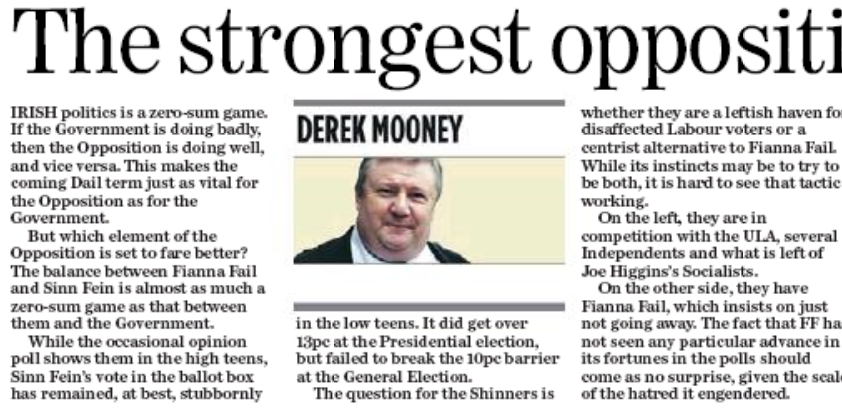
The Strongest Opposition may be within the coalition itself

The text of my column from tonight’s Evening Herald (Mon Sept 17th)

—————————————-

Irish politics is a zero sum game. If the government is doing badly; then the opposition is doing well, and vice versa.

Derek Mooney’s Column in tonight’s Evening Herald

This makes the coming Dáil term just as vital for the opposition as for the government.

But which element of the opposition is set to fare better? The balance between Fianna Fáil and Sinn Féin is almost as much a zero sum game as that between them and the government.

While the occasional opinion poll shows them in the high teens, Sinn Féin’s vote in the ballot box has remained, at best, stubbornly in the low teens. It did get over 13% at the Presidential election, but failed to break the 10% barrier at the General Election.

The question for the Shinners is whether they are a leftish haven for disaffected Labour voters or a centrist alternative to Fianna Fáil. While its instincts may be to try to do both, it is hard to see that tactic working.

On the left they are in competition with the ULA, several Independents and what is left of Joe Higgin’s Socialists.

On the other side they have Fianna Fáil, which insists on just not going away. The fact that FF has not seen any particular advance in its fortunes in the polls should come as no surprise given the scale of the hatred it engendered.

The past 18 months has been about Fianna Fáil stabilising its position. It has put a floor under its decline, which was no small task. The issue now is if it can recover former ground.

While FF may skirmish with SF over ex FF voters who went to Labour, the main battle will be fought elsewhere and with another enemy. Surveys suggest that up to 40% of those who said they voted FF in 2007 switched to FG in 2011.

This sizeable group are still angry and hurt. They have not been ready to listen to Fianna Fáil so far. Will they become disenchanted over the coming months with Enda Kenny and Fine Gael as it struggles to deliver on its election promises?

Will this be sufficient? Will the disenchantment be enough to allow them to listen to anything the party has to say, never mind be convinced by it? These are questions taxing Fianna Fail reps at their think in today and tomorrow.

The opposition parties and independents will also need to consider the competition they face from the emerging, and varied, opposition within government.

It ranges from Brian Hayes and Joan Burton’s fighting over pensioners to FG backbenchers bemoaning its failure to take on the public sector.

The greatest challenge, though, may come from within the Labour Party. There seems to be something about becoming chairman of the smaller party in government that makes the holder think they are the deputy leader of the opposition. I call it “Dan Boyle Syndrome”.

As a first time Deputy; sitting on the government backbenches; the new Labour Chairman may gaze longingly at the other side of the Dáil wishing he were there opposing and criticising the current Government, but he isn’t.

The public gets the difference between government and opposition. They understand the fundamental truth of Mario Cuomo’s famous maxim: “you campaign in poetry but you govern in prose”.

If he thinks doing solo runs will firewall him from the approaching barrage of criticism and unpopularity, then he is in for a nasty surprise. All he needs to do is Google “Dan Boyle” and “election results” to see how these tactics failed.

FG and Lab TDs would do well to heed the words of Mary Harney: “Even the worst day in government is better than the best day in opposition”. This may seem unlikely, but it is the case, especially if you believe politics is about improving things.

If they doubt it, then they only need call the Marine Hotel and ask any Fianna Fáil TD.

ENDS

It’s petty settling these old scores incognito Chris

My column on the Chris Andrews Twittergate fiasco from today’s (Mon August 13th 2012) Evening Herald

Anonymous Tweets

I am not exactly sure how I feel about Chris Andrews today. I have known him personally for over 25 years. We are near contemporaries. I have campaigned alongside him and, on a couple of occasions, for him. He managed to so something I repeatedly failed to do: to get elected.

In his case that meant serving as a Dublin City Councillor and a TD for the Dublin South East constituency. His defeat in the great Fianna Fáil wipeout of February 2011 was not a reflection on his work as a local representative.

He came closer than many to hanging on in a constituency that has not be traditional FF territory. His work rate meant that the tide which engulfed him was not nearly as severe as that which washed away so many others.

For these reasons I feel sorry to see him exit politics.

But there is another side too. Like many of his friends and supporters I am deeply angered by the report in yesterday’s Sunday Independent of his antics in setting up a fake twitter account to attack Fianna Fáil.

This anger is twofold. It is an anger at his actions and his attempts to glorify them by presenting himself now as some victim, but it is also an anger at his betrayal of the trust of supporters and colleagues, like me.

No matter how much he may seek to convince himself otherwise, Chris is no victim.

He is no principled dissenter or critic being silenced out by an intolerant leadership. His actions were petty and self serving. He hid behind a fake account (@brianfornerFF) and sniped at perceived political rivals in the hope of bringing them down and advancing himself.

I engaged with his fake persona on Twitter a few times, mistakenly believing it what that of a disillusioned young member. After a few exchanges I quickly realised that it was nothing of the sort, though I never suspected it was Chris.

There was nothing noble or admirable in his comments, Most were just bitchy and sneering rants at colleagues. The only “political” thread in his exchanges with me was his expressed disdain for political dynasties, a little ironic now given the source.

The comical point in all of this is that the real Chris Andrews and I were exchanging messages on twitter at the same time as the fake tweets.

I, like others, had become an audiences for Chris’s one man performance of his own “Philadelphia Here I Come”. Unlike Friel’s “Gar Public” and “Gar Private” his were not the inner and outer voices of the same person, one expanding upon and setting the context for the utterances of the other.

Quite the opposite. While “official Chris” publicly expressed support and praise for the party “Continuity Chris” was lashing out at those seeking to reform and rebuild. He did occasionally take pot shots at the leadership and senior figures, but his targets were mainly local.

It was all a game, and a pointless one at that.

There was no great point of principle at stake here. His attacks and indeed his departure was not about the party’s stand on the Fiscal Treaty Referendum, no more than it was about its support of Gay marriage or a reformed Seanad.

This was about high politics or the future, it was about low politics and the past. It was about settling old scores and doing it out of sight, hidden behind a screen.

It was about the worst of the old politics, which makes his parting shot, his suggestion that dissent and criticism is not tolerated in FF, all the more galling.

Because of his age, his location and indeed his background Chris was uniquely placed to play a part in crafting and determining whatever future Fianna Fáil may have. The pity is that he rejected that opportunity – it did not reject him. This is what makes me both sad and angry.

Results of my online poll

Here are the results of my online poll. Over 360 visitors to the webpage in last two days – thanks for the 247 votes cast and for the comments posted.

I am not claiming this as scientific, just indicative…. maybe most indicative of just who follows me on Twitter and Facebook

You can print out the results in a PDF document fromhere: Impressed Most Poll

The question posed: Leaving aside whether you voted Yes or No who impressed you most during the Fiscal Treaty Campaign (Pick 3)


Total Votes 247

%


1

Micheál Martin

21.86%

2

Declan Ganley

14.17%

3

Michael McGrath

14.17%

4

Simon Coveney

13.77%

5

Mary Lou McDonald

13.77%

6

Joan Burton

5.67%

7

Gerry Adams

5.26%

8

Enda Kenny

4.45%

9

Shane Ross

2.83%

10

Eamon Gilmore

1.62%

11

Joe Higgins

1.21%

12

Richard Boyd Barrett

1.21%


Who impressed you most during referendum campaign?

Labour could be casualty in Treaty Yes vote

My Evening Herald column from today’s (Thurs May 24th) edition:

voting
Many different reasons to vote yes or no

With less than a week to go the referendum campaign seems more and more to be about less and less.

On the face of it, if you believe the posters, the choice is to Vote Yes to achieve stability or to Vote No to end austerity.

But do any of us really believe these claims? Regrettably, like previous EU referendums the debate has been conducted at the extremes, not the centre. It was the case in the Nice and Lisbon referendums, remember those “€1.84 Minimum Wage after Lisbon” posters?

Mercifully, we have been spared the malign input of Cóir and Youth Defence this time. The are no loss, especially as most of them wouldn’t know a treaty from a tea-bag (to rob a line I recently overheard)

But this absence of any significant ultra right involvement on the no side does highlight a curious undercurrent to the campaign, one, which I suspect, may be a factor in how some people decide how to vote next week.

While the slogans maybe about the EU and the Euro the referendum has morphed into a proxy battle on the future of left / right politics in Ireland.

From the start the battle front was drawn up along left versus right lines.

On the Yes side you had the right and centre right parties: FG, FF and Lab (more about them later), the employers’ and business organisations, the farmer’s groups and the more established/mainstream trade unions.

On the No side you had the socialist and hard left parties, People Before Profit, Joe Higgin’s Socialists, Sinn Féin, the more radical trade unions.

While the entrance of The Declan Ganley somewhat clouded the the Left/Right delineation, it hasn’t ruptured it.

The sight of him sharing No platforms with irredentist left firebrands is a joy to behold, especially when you consider that they agree on virtually nothing, including Europe. Most on the hard left are euro-sceptic while The Ganley is avowedly Euro-federalist.

While passing the Fiscal Treaty will herald no major day to day changes – mainly because it just restates the centre/centre right economic orthodoxy in place since 2008 – it will cement it into domestic law for the foreseeable future.

It is this that the left fears and opposes most.

Passing the Treaty would recalibrate the centre of the Irish political spectrum a few points to the right. It won’t be a seismic or noticeable shift, but it torpedoes the Left’s ambitions of shifting it the other way.

It doesn’t vanquish them, nor does it make them to tone the rhetoric down. If anything, it will do the opposite, but in their hearts they will know that their ambition to shift Ireland economically to the left has been reversed.

This explains why the campaign from Joe Higgins, Boyd Barrett and Sinn Féin has been so fierce. But not as fierce as when its over and they start to target each other.

I am not predicting that their poll rating drops are set to drop. They won’t. They will probably rise as voters use them to express their disapproval of government parties going pack on pre election pledges.

But the Irish electorate is sophisticated. It is overwhelmingly aspirational. This applies across all social classes and communities. They want their kids to do better than they did. That decides voting intentions more than anything.

In the meantime Sinn Féin will continue to do well at Labour’s expense, after all Gerry and Mary Lou are saying now what Éamon and Joan were saying two years ago.

It is Labour who will be the biggest casualty. Polls showing 40% of Labour supporters voting No could have longer term ramifications for the leadership. But whatever they may be, they can be so where near as damaging as Gilmore’s infamous “Frankfurt’s Way or Labour’s Way” slogan.

It may turn out to be the most devastating political slogan of recent times – devastating to its authors, that is.

Referendum is as much about Left vs Right as it is about the €

What will we be voting about on May 31st? It is one of the toughest Treaty referendum questions to answer.

European Central Bank
The ECB on Frankfurt’s Way?

If you are to believe the thousands of posters that adorn our street lamps we are either voting yes to stability and jobs or voting no to austerity. A simple enough choice… or so you’d think? Unfortunately, as the campaign progresses, it is becoming clear that neither the Yes nor the No poster claims stands up to much scrutiny.

Do we really think we will suddenly achieve stability and more jobs if we vote yes? I suspect that even the most ardent of yes voters believes that to be case.

On the other hand does the most convinced no voter think that the austerity measures, including household and septic tank charges will disappear if 50% plus one of us votes no? I doubt it.

So what are we voting about?

The best answer I have heard so far has not come from a member of government, the ULA or Sinn Féin. It came, peculiarly enough, from a Euro bureaucrat, a former member of the board of the European Central Bank member. Not the type of person you would expect to speak with simplicity and clarity, yet he did.

Speaking on RTE Radio One’s This Week programme, Lorenzo Bini Smaghi described the decision before us with a cheque book analogy. After years of having separate current accounts, he explained, the Eurozone countries have decided to have one current account and one single chequebook between them for certain purposes.

The risk with this is that any individual country could abuse their access and stick others with the bill, so it is important to agree a set of strict and enforceable rules beforehand. These rules are set out in the Fiscal Treaty. If you want to be able to use the joint account, you need to agree the rules. Refuse to agree the rules and you won’t be allowed near the chequebook.

It is a simple and effective explanation.

What we are voting about is our relationship with the Eurozone countries. Do we want to continue and strengthen that relationship or do we want to weaken it. This does not mean that voting No is the same as being against the Europe, but the choice we are facing has become starker than we would like it to be.

Ok. So now that I have attempted to make the issue a little clearer and get behind the hype and hysteria printed on the posters let me now reverse the process and confuse it again.

While much of the debate has been about the EU and the Euro let me point to another level in the debate. Though it does not get mentioned so much, this referendum has become a proxy battle on the future of left versus right politics in Ireland.

Before The Declan Ganley entered the fray the battle lines had been drawn up along clear Left/Right lines.

On the Yes side you had the right/centre right parties (FG, FF and even Lab), the employers’ and business organisations, the farmer’s groups and the more conservative trade unions.

On the No side you had the radical and left parties, People Before Profit, Joe Higgins Socialists, Sinn Féin, the more radical trade unions.

A Yes result would recalibrate the centre of the Irish political spectrum several degrees to the right. While this would not vanquish the left, it would limit their scope and hem them in.

This could help explain why Sinn Féin has been so fierce in urging a No. A Yes vote would place a definite ceiling on their ambitions and make the centre/centre right economic approach the norm for at least the next decade.

This would leave the hard left /socialist factions with no influence, just sitting on the sideline spouting rhetoric – so, no change there.

The main casualty could be Irish Labour Party, no matter what the result. “Frankfurt’s Way or Labour’s Way” may turn out to be the most devastating political slogan of recent times – devastating to its authors, that is.