LBJ pulling yet another beagle’s ears. His own dog was named Little Beagle Johnson (LBJ)
While surfing the internet I came across this little nugget: Lyndon Baines Johnson’s “Rules of Life”.
The ebullient LBJ was a larger than life character who contemporaries described as highly driven, ambitious and devoid of any interests or past-times outside politics.
Though mainly remembered now as the President who even further embroiled the US in the Viet-Nam war (a policy he inherited from JFK) too many forget his personal campaign for massive social reform, entitled: The Great Society. You can find the text of LBJ’s first Great Society speech here
In asking a High Court Judge to re-examine and review the documentation and material already available the Cabinet, and in particular the Taoiseach, Enda Kenny and the Minister for Justice and Defence, Alan Shatter are attempting to out-Nixon Nixon.
Back in early 1973, as the scandal of the Watergate Break In and Cover Up began to break, the then US President Richard M Nixon, in conjunction with his advisers John Ehrlichman and Bob Haldeman, devised a plan to get Nixon’s White House Counsel John Dean to write a report for the President on Watergate that “basically clears the President and White House staff of involvement”. Their plan was that they could cite Dean’s Report as what they had relied upon and that they could blame Dean for deceiving them.
While Dean did initially agree to go to Camp David at the President’s request to write such a report, but he soon came to realise that he was being lined up as the scapegoat and decided not to complete the report. Nixon sacked him shortly afterwards, on the same day as he announced the resignations of Ehrlichman and Haldeman.
While the Government is not asking a retired High Court Judge to become is scapegoat, it does seem to be looking to get a supposedly independent review that it determines will verify its own jaundiced version of events.
How else can we interpret the fact that while the Justice Minister was indicating how the review would operate he announced that he had decided on the review as he had received a review of the Verrimus report from RITS, a Dublin based IT security firm, that concluded that there was “no evidence at all”.
So, even as the Minister announces the review he sets out his view on what it should, if not must, conclude.
This, as with Nixon’s Dean Report, is all about attempting to draw a line under a growing political scandal rather than getting to the core of what caused it: allegations of bugging at GSOC’s premises?
Why opt for such a limited review, reporting to the Justice Minister and with Terms of Reference set by the Minister instead of an inquiry under the Commissions of Inquiry legislation?
Today’s Cabinet decision, albeit deeply flawed, runs counter to last week’s comments by both An Taoiseach and the Justice Minister and suggests either 1). A realization that the government’s spinning on the subject is not having the same impact now as it had at the start, and/or 2). Pressure from Labour members of the Cabinet growing tired of defending the Justice Minister.
—————
Background material on the Nixon/Dean Watergate Report
The timeline for Dean’s Watergate Report
March 20, 1973: In his conversation with chief of staff H. R. Haldeman about White House counsel John Dean’s phony “Dean Report,” which will say that no one in the White House was involved in the Watergate conspiracy, President Nixon says: “[The report] should lay a few things to rest. I didn’t do this, I didn’t do that, da-da, da-da, da-da, da-da, da-da, da-da, da-da. Haldeman didn’t do this. Ehrlichman didn’t do that. Colson didn’t do that. See?”
March 22, 1973: President Nixon tells his aides to ensure that the nation never learns of the political and financial machinations that surround the Watergate burglary from his aides under investigation: “And, uh, for that reason, I am perfectly willing to—I don’t give a sh_t what happens, I want you all to stonewall it, let them plead the Fifth Amendment, cover-up or anything else.” But he wants something on paper that he can point to and say he knew nothing about the Watergate conspiracy, and that he had ordered an internal investigation of the matter. He sends counsel John Dean to Camp David for the weekend to write the document
March 27, 1973: President Nixon orders senior aide John Ehrlichman to conduct his own “independent investigation” of the conspiracy, since White House counsel John Dean has not yet produced the results of his own “investigation”
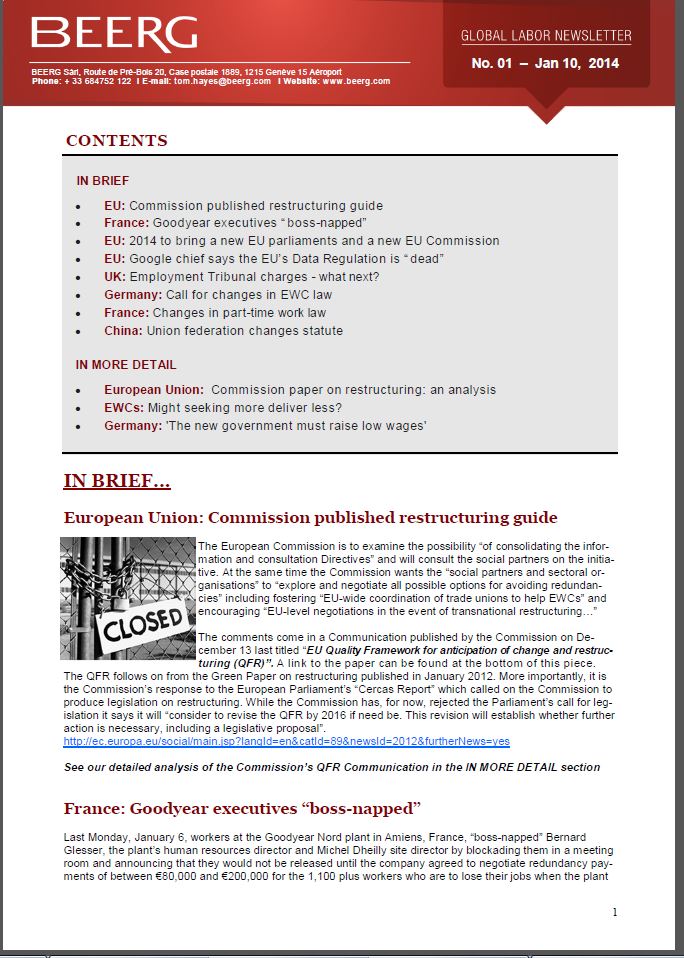
Here is my article from this week’s BEERG Newsletter looking at mounting tensions in the race to take the EU Commission Presidency
You call tell that there’s an election approaching by how targeted, populist and political the press releases from MEPs become. Take the Scottish Nationalist (SNP) MEP Alyn Smith, who has suggested that Scotland consider banning Canadian-born singers Justin Bieber and Celine Dion in retaliation for Canadian authorities prohibiting several Canadian stores from selling the popular Scottish soft drink Irn-Bru. Smith justified his call, albeit tongue in cheek, by saying that between them, Bieber and Dion have produced “more sugary schmaltz” than Irn-Bru ever has.
While Smith’s demand has the virtue of humour and creativity, the same cannot be said for the political attack made by the centre-right European Peoples’ Party (EPP) on German Socialist MEP, Martin Schulz (photo) on Wednesday as reported by the EurActiv website http://www.euractiv.com.
Schulz is the outgoing President European Parliament and the likely Socialist candidate to be President of the next EU Commission
The attack centres on allegations made by the EPP that a €60,000 European Parliament contract was awarded to the wife of Sergei Stanishev, the president of the PES: Party of European Socialists. The €60,000 contract was for an information project promoting the European elections in Bulgaria.
Leading the attack for the EPP, German MEP Ingeborg Grässle claims the situation has alarm bells ringing over an “obvious” conflict of interest involving some of the most prominent figures in the European socialist family, saying “European Parliament staff under the direction of Socialist President Martin Schulz handing out a contract worth €60,000 to the wife of the European Socialist Party President – this smacks of political favours… Is Mr. Schulz using parliament funds to help his political friends?”
EurActiv reports that its sources say that Schulz is concentrating on his campaign to succeed to José Manuel Barroso as Commission President and shudders at any piece of news which could upset his plan.
The fact that the attack was led by a German MEP is significant as Grässle and Schulz’s own parties the CDU and SPD are now in a grand coalition partnership government in Germany. Expect to see and hear more political skulduggery as the May parliamentary elections approach. The stakes are high with more than just the political balance in the European Parliament to consider. As the BEERG Newsletter has reported reforms made under the EU’s Lisbon Treaty means that heads of government must take the results of the European elections “into account” when selecting the next EU Commission President.
With polls suggesting a swing to the Socialists in the May election, possible sufficient to make it the largest single group in Parliament, Schulz is well placed to become the next Commission President, however the centre right EPP group is not likely to allow this prized post slip from its grasp.
12 of the 28 heads of Government are members of the EPP, including Germany’s Angela Merkel, Spain’s Mariano Rajoy and Poland’s Donald Tusk. British Prime Minister David Cameron’s Tory Party quit the EPP in 2009.
The EPP is planning to select its candidate for the EU Commission Presidency at its Congress in Dublin on March 6th & 7th. There are four possible contenders: the Finnish Prime Minister Jyrki Katainen, the Latvian Prime Minister Valdis Dombrovskis, the current commissioner for the internal market Michel Barnier and the former Luxembourg Prime Minister and EU veteran Jean-Claude Juncker.
The PES, whose European Parliamentary group is called the Progressive Alliance of Socialists and Democrats (S&D) will hold it pre-election congress in Rome on 1 March.
This is a piece on the 2014 EU Parliament elections and the appointment of a new EU Commission I wrote for the Jan 10th issue of BEERG‘s Global Labor Relations Newsletter
——————————————————————————–
European Union: 2014 to bring a new Parliament and new Commission
Derek Mooney writes:Next May citizens across the 28 EU states will go to the polls to elect the 751 members of the next European Parliament.
Voters across the EU have tended to treat these contests as what political scientists call: “second order” elections. This usually means that voter turnout is lower than in national elections and the campaigns are often fought more on national issues rather than pan European ones. In many cases the results in each country reflect the current standing of the national government more than they do the manifestos of the European groupings.
While voting will take place during a 3 to 4 day period across the 28 member states, we can get a sense of the possible outcomes by looking at opinion polls in the eight largest EU countries (France, Germany, Italy, the Netherlands, Poland, Romania, Spain and the United Kingdom) as these account for around 77% of all the EU citizens entitled to vote and will elect around 64% of the Members of the European Parliament (MEPs).
A policy paper presented to the Notre Europe: Jacques Delors’s Institute focussing on what the political balance of power in the next European Parliament might be suggests the possibility of some major changes.
The paper features an analysis of recent opinion polls in these eight countries. It suggests a swing to the Left and Centre Left as well as major gains for protest and fringe parties on both the far left and far right.
In the outgoing parliament the EPP (Centre Right group) holds 265 seats against 184 for the Social & Democrats (Centre Left). The analysis of the polls suggests a swing to the centre left that not just closes this gap, but even reverses it. Some analysts predict that the EPP group might win 209 seats in May, four less than the S&D’s predicted 213.
The predicted changes on the margins are no less dramatic. The domestic opinion polls in France suggest that the far right Front National, led by Marine Le Pen, could become the largest French party in the elections, possibly taking 21% of the vote and increasing its number of MEPs from 3 to 17. While on the other end of the spectrum far left parties such as the Spanish Izquierda Unida (United Left) may increase its number of MEPs from 1 to 8.
Political commentators are suggesting that these advances by parties on the far left and far right, plus gains by populist protest parties like Italy’s Five Star Movement led by comedian Beppe Grillo could see them holding up to 40% of the seats in the incoming parliament.
The political zero sum gain dictates that the increased influence of these groups comes at the expense of the traditional dominance of big blocs: the EPP, the S&D and the Liberal ALDE group, leading to greater political uncertainty in the next Parliament.
This uncertainty comes at a time when the Lisbon Treaty has given an increased role and say to the European Parliament, not least in the appointment of the next European Commission especially the Commission President, which will follow the European Elections.
The Lisbon Treaty has changed the rules on the appointment of Commission President and these come into effect for the first time in 2014. Article 17 of the Treaty and the Declaration 11 annexed to it set out that the choice of the candidate for the Commission presidency will be made “taking into account the elections to the European Parliament”.
This was supposed to mean that the various pan-European EU groupings declare who their candidates for the Commission presidency will be in advance of the May parliamentary elections and set out their commission presidency manifestos. In each country candidates looking to become an MEP would indicate to which European political grouping they would affiliate indicate the Commission presidency candidate that grouping will back.
Names are being bandied about as to who might nominated by each of the main groups. The current EU Parliament President, Martin Shultz looks like being the likely nominee of the centre left S&D grouping, having already secured the backing of 20 or so centre left parties across Europe, most importantly his own German SPD and Francoise Hollande’s Socialist Party.
The EPP may opt to propose Jean Claude-Juncker, the recently defeated long serving Luxembourg Premier. Juncker’s gain maybe at the expense of his party colleague, Viviane Reding, who had previously harboured ambitions to become Commission President having served as a Vice President. Realising that that path is now closed there is some suggestion that she may step down as a Commissioner before her term expires to seek re-election as an MEP (she was previously an MEP) and seek the post of President of the Parliament. The same suggestion is being made about her French Commission colleague Michel Barnier.
But, being Europe, the practice looks like it will be very different. While MEPs want to see the power reside with them and the Commission Presidency go to the largest group (or coalition of groups) in the incoming European Parliament, national governments and leaders, most notably Angela Merkel and David Cameron, are deeply reluctant to surrender the final say to the parliament and are taking a very broad view of the phrase “taking into account the elections to the European Parliament”
While no one should be heading to the bookies to put bets on the results just yet, it is reasonable to assume that the incoming European Parliament and Commission with have a more leftish and presumably interventionist hue than the outgoing one. Given the difficulties posed to business by the outgoing centrist parliament, this cannot come as good news to business and employers across the EU.
The prospect of a more leftist Commission and parliament, coupled with the political uncertainty heralded by a phalanx of extremist parties of both left and right, could lead to some interesting and difficult times ahead.
My column for The Herald from Washington DC on my “coffee shop” poll one year on from President Barack Obama’s second term win.
My “in Washington” Herald column
“The worse I do, the more popular I become”. So said the late President Kennedy trying to understand his higher poll ratings after the Cuban Missile Crisis.
Almost exactly 50 years after Kennedy’s assasssination the words could just as easily sum up Barack Obama’s past year. Sitting here, looking out from my Washington DC hotel bedroom towards the Dome of the Capitol building; it is hard to believe it is over a year since I was writing about the 2012 Presidential debates. Though his lack lustre performancein the first debate hurt his poll ratings in the opening weeks, I had no doubt he would be re-elected.
The real question one year ago was if Obama’s second term could deliver the hope and promise which his 2008 campaign promised and his first term failed to match. One year on, it seems that his record in his second term will not be any more impressive than his record in the first.
Over the past 12 months he has presided over a budgetary crisis that effectively shut down large parts of the federal bureaucracy; the Snowden leaks and allegations of spying on friendly governments; continuing problems with his health care reforms, indecision over how to respond to the Syrian crisis and worsening relations with Russia and Putin. Add the sluggishness of the American recovery and you have a catalogue of woes that should have his political foes beside themselves with glee – but they’re not.
Just as in the 2012 election: Obama is blessed with his opponents. Over the past week the President has, as leader of the Democratic Party, witnessed three significant victories: in the Mayoral elections in Boston and New York and the Gubernatorial election in nearby Virginia where the former DNC Chairman Terry McAuliffe, a man with several relations in Dublin, won in a traditionally Republican State.
Though techically a victory for the Republic Party, the President can also add moderate Governor Chris Christie’s landslide re-election in New Jersey to the Democrat column. The more conservative “tea party” republicans seem very reluctant to rejoice in Christie’s win, with the darling of the American right Newt Gingrich saying that he was more of a “personality” leader rather than the leader of a movement.
Maybe he is right. Perhaps Gov Christie is just media savvy creation and not the real deal, but his capacity to win over moderates, women and Latinos is something the Republican Party needs if it is to convince voters, post Obama, that they are worth a second look.
For decades before George W Bush presidential elections were fought on the basis of the Democrat lurching to the left to win the nomination but steering back to the centre to win the election itself and the Republican doing likewise, only to the right first,then back to the centre. Bush and his campaign stratagust Karl Rove changed that – they went right towin the nomination and then stayed there working on bring out new right of centre voters. The model worked in 2000 and 2004, but is now bust. The voters know it. The people at the top of the Republican Party know it. Only their grassroots don’t get it. Very few of the people I spoke with over the past few days here in Washington DC and in neighbouring Virginia, regret voting for Obama. They may feel let down by the President, but almost none believe that Romney was the way to go. Though hardly an exhaustive or scientic survey. To be frank it was conducted mainly in bars, coffee shops and stores. I did try to correct any imbalance in the sample due to my social habits by also talking to people attending the same business conference as me. Those interviews yielded the far from astounding conclusion that those who complain most loudly about Obama, never voted for him. Just like it is back in Dublin.
My column from today’s Herald on Chris Andrew’s joining Sinn Féin
My column in today’s Herald
————————————————————————
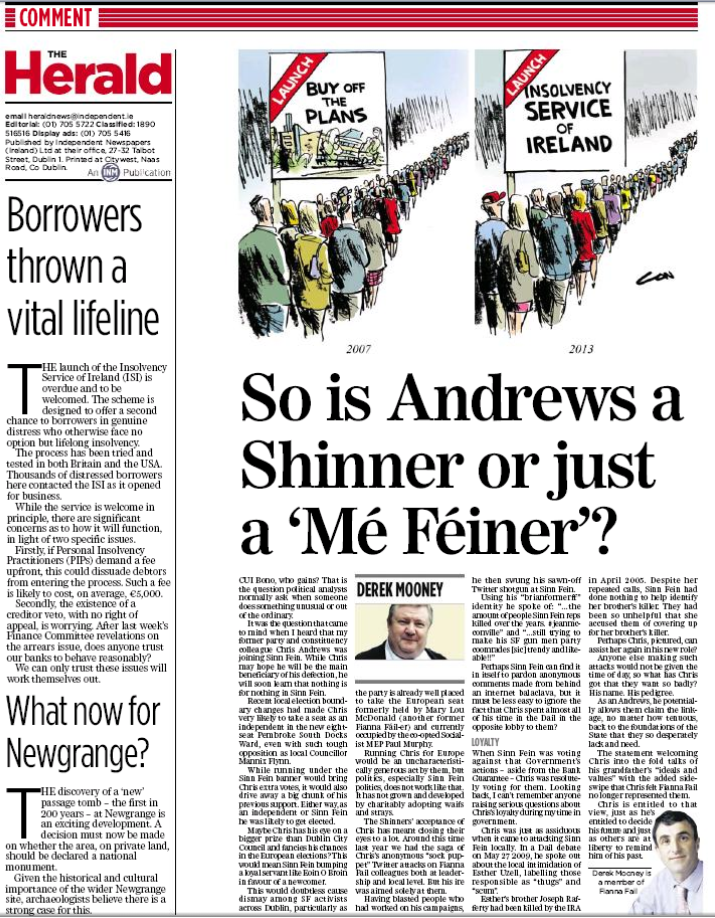
Cui Bono, who gains? That is the question political analysts normally ask when someone does something unusual or out of the ordinary.
It was the question that came to mind when I heard that my former party and constituency colleague Chris Andrews was joining Sinn Féin.
While Chris may hope he will be the main beneficiary of his defection, he will soon learn that nothing is for nothing in Sinn Féin.
Recent local election boundary changes had made Chris very likely to take a seat as an independent in the new eight seat Pembroke South Docks Ward, even with such tough opposition as local Councillor Mannix Flynn.
While running under the Sinn Féin banner would bring Chris extra votes, it would also drive away a big chunk of his previous support. Either way, as an independent or Sinn Féin he was likely to get elected.
Maybe Chris has his eye on a bigger prize than Dublin City Council and fancies his chances in the European elections? This would mean Sinn Féin bumping a loyal servant like Éoin Ó Broin in favour of a newcomer.
This would doubtless cause dismay among SF activists across Dublin, particularly as the party is already well placed to take the European seat formerly held by Mary Lou McDonald (another former Fianna Fáil-er) and currently occupied by the co-opted Socialist MEP Paul Murphy.
Running Chris for Europe would be an uncharacteristically generous act by them, but politics, especially Sinn Féin politics, does not work like that. It has not grown and developed by charitably adopting waifs and strays.
The Shinner’s acceptance of Chris has meant them closing their eyes to a lot.
Around this time last year we had the saga of Chris’s anonymous “sock puppet” Twitter attacks on Fianna Fáil colleagues both at leadership and local level. But his ire was not aimed solely at them.
Having blasted people who had worked on his campaigns, he then swung his sawn off twitter shotgun at Sinn Féin. Using his “brianformerff” identity he spoke of: “…the amount of people Sinn Féin reps killed over the years. #jeanmcconville” and “…still trying to make his SF gun men party coomrades [sic] trendy and likeable!!”
Perhaps Sinn Féin can find it in itself to pardon anonymous comments made from behind an internet balaclava, but it must be less easy to ignore the fact that Chris spent almost all of his time in the Dáil in the opposite lobby to them?
When Sinn Féin was voting against that Government’s actions – aside from the Bank Guarantee – Chris was resolutely voting for them. Looking back, I can’t remember anyone raising serious questions about Chris’s loyalty during my time in government.
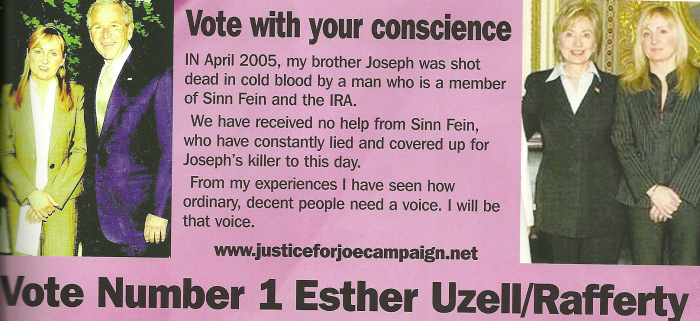
Chris was just as assiduous when it came to attacking Sinn Féin locally. In a Dáil debate on May 27 2009 he spoke out about the local intimidation of Esther Uzell, labelling those responsible as “thugs” and “scum”. Esther’s brother Joseph Rafferty had been killed by the IRA in April 2005. Despite her repeated calls, Sinn Féin had done nothing to help identify her brother’s killer. They had been so unhelpful that she accused them of covering up for her brother’s killer.
Perhaps Chris can assist her again in his new role?
Anyone else making such attacks would not be given the time of day, so what has Chris got that they want so badly? His name. His pedigree.
As an Andrews he potentially allows them claim the linkage, no matter how tenuous, back to the foundations of the State that they so desperately lack and need. The statement welcoming Chris into the fold talks of his grandfather’s “ideals and values” with the added sideswipe that Chris felt Fianna Fáil no longer represented them.
Chris is entitled to that view, just as he’s entitled to decide his future and just as others are at liberty to remind him of his past.
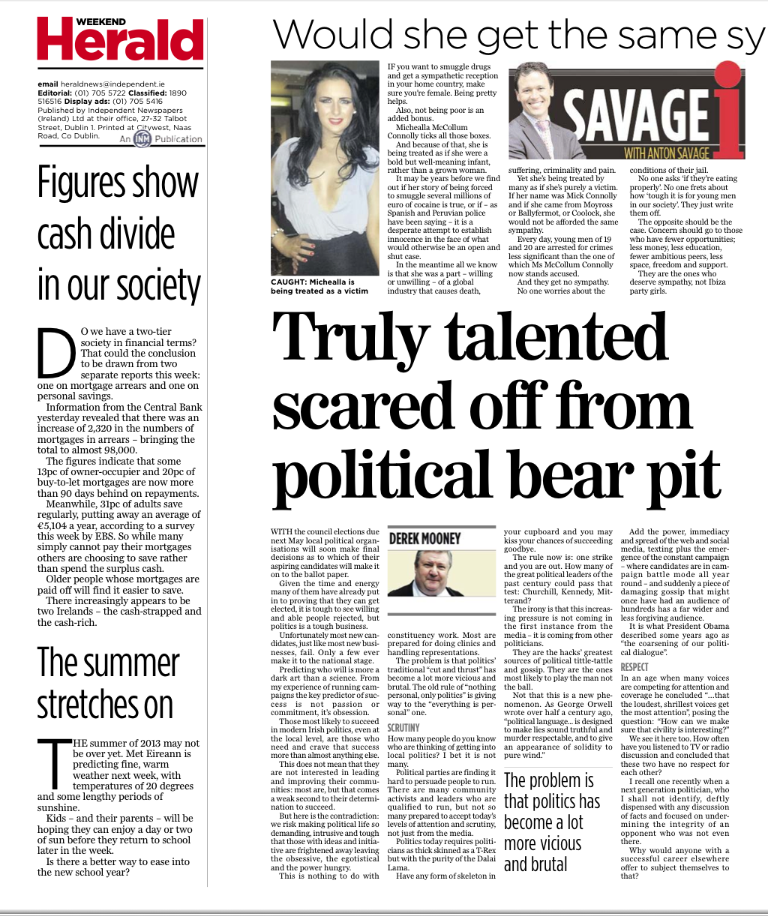
This is my latest column on how “playing the man, not the ball” is hurting Irish politics. It appeared in today’sHerald (August 24th 2013):
Evening Herald Aug 24, 2013
With the council elections due next May local political organisations will soon make final decisions as to which of their aspiring candidates will make it on to the ballot paper.
Given the time and energy many of them have already put in to proving that they can get elected, it is tough to see willing and able people rejected, but politics is a tough business.
Unfortunately most new candidates, just like most new businesses, fail. Only a few ever make it to the national stage.
Predicting who will is more a dark art than a science. From my experience of running campaigns the key predictor of success is not passion or commitment, its obsession… and I don’t mean the fragrance.
Those most likely to succeed in modern Irish politics, even at the local level, are those who need and crave that success more than almost anything else.
This does not mean that they are not interested in leading and improving their communities: most are, but that comes a weak second to their determination to succeed.
But here is the contradiction: we risk making political life so demanding, intrusive and tough that those with ideas and initiative are frightened away leaving the obsessive, the egotistical and the power hungry.
This is nothing to do with constituency work. Most are prepared for doing clinics and handling representations. The problem is that politics’ traditional “cut and thrust” has become a lot more vicious and brutal. The old rule of “nothing personal, only politics” is giving way to the “everything is personal” one.
How many people do you know who are thinking of getting into local politics? I bet it is not many.
Political parties are finding it hard to persuade people to run. There are many community activists and leaders who are qualified to run, but not so many prepared to accept today’s levels of attention and scrutiny, not just from the media.
Politics today requires politicians as thick skinned as a T-Rex but with the purity of the Dalai Lama. Have any form of skeleton in your cupboard and you may kiss your chances of succeeding goodbye. The rule now is: one strike and you are out. How many of the great political leaders of the past century could pass that test: Churchill, Kennedy, Mitterand?
The irony is that this increasing pressure is not coming in the first instance from the media – it is coming from other politicians.
They are the hacks greatest sources of political tittle-tattle and gossip. They are the ones most likely to play the man not the ball.
Not that this is a new phenomenon. As George Orwell wrote over half a century ago, “political language… is designed to make lies sound truthful and murder respectable, and to give an appearance of solidity to pure wind.”
Add the power, immediacy and spread of the web and social media, texting plus the emergence of the constant campaign – where candidates are in campaign battle mode all year round – and suddenly a piece of damaging gossip that might once have had an audience of hundreds has a far wider and less forgiving audience.
It is what President Obama described some years ago as “the coarsening of our political dialogue” In an age when many voices are competing for attention and coverage he concluded “…that the loudest, shrillest voices get the most attention”, posing the question: “How can we make sure that civility is interesting?”
We see it here too. How often have you listened to TV or radio discussion and concluded that these two have no respect for each other? I recall one recently when a next generation politician, who I shall not identify, deftly dispensed with any discussion of facts or and focused on undermining the integrity of an opponent who was not even there.
Why would anyone who either with a successful career elsewhere offer to subject themselves to that?
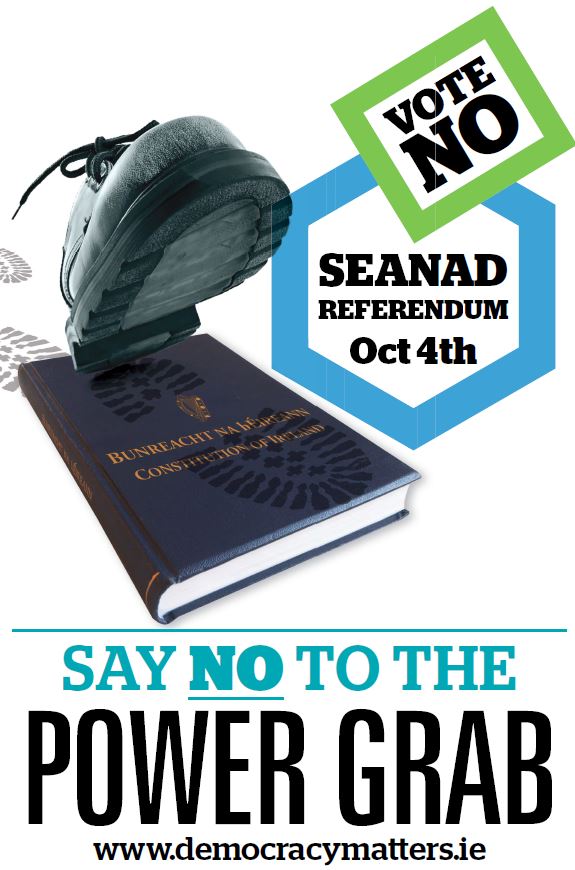
As a firm believer in Seanad reform – and consequently a trenchant opponent of Seanad abolition – the Sunday Independent’s Millward Brown poll showing the No to Abolition side gaining further momentum is gratifying.
The past few weeks have hardly been great for the No side. Fine Gael has been pretty active on the airwaves over the Summer break, while Sinn Féin’s opportunistic decision to campaign for a Yes, having vehemently opposed the Government’s proposal in both the Dáil and Seanad, hasn’t helped the No cause either.
All this makes the increase in the pro Seanad reform level of support all the more re-assuring. Not that the poll suggests that the campaign is done and dusted. Far from it.
More than almost any other, this Seanad abolition policy, is the lone brain child of Enda Kenny. Though there seem to be no research papers, discussion documents or policy positions he can produce to justify the origins of this initiative, he is the man behind it and he has more to lose by its defeat than anyone else.
While Labour nominally favours abolition, its TDs and Ministers can reasonably see their policy obligations as fulfilled by the holding of a referendum. Don’t expect to see many of them working too hard for a Yes to abolition vote. Indeed, as the Labour Chief Whip has indicated, at least half the Labour parliamentary party may actually work for a No vote seeing it as the best way to secure a popular mandate for Seanad reform.
One of the two authors of Labour’s 2009 position paper on Seanad reform, Junior Minister, Alex White has not commented on the issue much, while the other author, Joanna Tuffy TD has indicated that she will be campaigning for a No vote.
The worrying shift in the poll numbers make it necessary for Fine Gael to up the ante over the weeks ahead.
Given that the main shift has been in the group who describe themselves as favouring reform expect to see Fine Gael focus its attentions there and try to convince them that a Yes vote is a vote for reform.
We already had a glimpse of this approach last week via its neophyte Wicklow TD, Simon Harris’s speech at the Parnell Summer School.
Harris advanced the argument that abolishing the Seanad counts as reform and gives power back to the people as it means the single remaining chamber of the Oireachtas: the Dáil will be 100% elected by the public.
Harris’s reasoning seems to hinges on the statistic that the number of people registered to vote in Seanad elections, under current legislation, is around 156,000; about 5% of the approx 3.1 million entitled to vote at the February 2011 Dáil election.
What Harris misses, however, is that this 156,000 (Councillors, Oireachtas members and NUI and TCD graduates) is defined in legislation – not the Constitution. Everyone in the North and South could be given the right to vote with the passing of an Act by the Dáil and Seanad. Indeed the Seanad has already voted for such a piece of reform with the Second Stage vote on the Quinn/Zappone Seanad Reform Bill.
The extension of the Seanad franchise to all is now completely within the gift of Deputy Harris’s colleagues on the government benches.
The only real obstacle to such a real reform is the Taoiseach’s obduracy in insisting on Seanad abolition instead of reform.
Though not central to the argument it is worth noting that the 156,000 figure is probably an understatement as it just counts the NUI and Trinity graduates who have registered to vote. Many 100s of 1000s more are entitled to vote by virtue of their graduation.
The other problem with Harris’s reasoning is the idea that the answer to existing disenfranchisement is more disenfranchisement. It defies all democratic principles to propose removing someone’s voting rights when you have it in your power to extend them.
If you were to apply Deputy Harris’s quirky logic to the campaign for women’s suffrage a century back you would determine that the way to ensure equal voting rights for all was to remove the vote from men so that the two genders were equally disadvantaged.
The very legitimate criticism that not enough people are entitled to vote in Seanad elections is properly addressed by giving everyone the right, not by removing it.
I would hope that Deputy Harris’s espousal of a position that is the absolute antithesis of reform is informed by loyalty to his party leader and desire for advancement rather than by belief in the argument itself.
If it is the former then the case for reform is all the greater, if it is latter then it is time to worry.
Today’s RedC poll for Paddy Power brings very little good news unless you are an independent or a don’t know. The unadjusted core figures rank the parties in descending order as:
Fine Gael 23%
Fianna Fáil 18%
Don’t Knows 18%
Independents 17%
Sinn Féin 13%
Labour 9%
After adjusting the figures by excluding 50% of the don’t know and adjusting the other 50% back to how they voted in 2011 the ranking positions stay the same. Only the relative gaps between Fine Gael and Fianna Fáil and between Fianna Fáil and the Independents widen.
Fine Gael 29%
Fianna Fáil 22%
Independents 21%
Sinn Féin 15%
Labour 11%
Sinn Fein’s lead over Labour remains at a steady 4%. While this may, at first glance, suggest some good news for Sinn Féin, the party has been in this territory before only for its good polling numbers to fail to translate into votes.
Back in December 2010, on the eve of a general election, three polls showed the party in the mid teens. A Red C Poll for The Sun on 03/12/2010 gave the party 16%. The MRBI/Irish Times poll on Dec 16th put it on 15% while a third, the Red C/Sunday Business Post poll of December 18th put its support at 14%. On polling day, two months later, the voters gave it 9.9%.
This is not to discount its advance since. Sinn Féin has been consistently polling in the mid teens since September 2011. That said, though an Irish Times poll in early October 2011 put party support at a hefty 18% its Presidential candidate and possibly most charismatic figure, Martin McGuinness still could not get the party’s actual vote past the 13.7% mark in the ballot boxes a few weeks later.
Despite its considerable and well resourcing organisation it seems to still have a problem translating favourable poll numbers into actual votes.
Though of cold comfort to Fianna Fáil it does not, at least, have this particular problem. The MRBI/Irish Times and Red C/Sunday Business Post polls conducted on the eve of the 2009 Local elections put Fianna Fáil’s support at 20% and 21% respectively. On polling day, the party managed to scrape its way up to 25.4%.
Fianna Fáil problems are more significant. While it has won back some of its lost “soft” support and pulled itself up from the 2011 hammering it has yet to say or do anything substantive to win back many of those who had voted for it in 2002 and 2007 but rejected it in 2011. There is nothing to suggest it is doing any better with potential first time voters either.
Despite the speculation of last weekend, Fianna Fáil’s problem is not its leader. The notion that Fianna Fáil picking a new leader whose only virtue is that they were not a member of the previous government is almost laughable. Surely no one in the party or the commentariat is delusional enough to think that the electorate is so naïve that it will flock to Fianna Fáil’s cause just because it has a leadership team devoid of anyone who served under Ahern or Cowen?
Despite its apology and acknowledgement of past mistakes, Fianna Fáil has yet to present a researched and substantive alternative policy programme. It has come up with some good micro-policies, not least its family home protection and debt resolution Bills, but many have been light on substance and appear to have been produced as well intentioned responses to specific representative groups, e.g. the Mobile Phone Radiation Warning Bill
Try finding the party’s April 2013 Policy Guide on its website. It is there, but you have to know what you are looking for to find it. Click on the “issues” button on the homepage and you get the Spring 2012 version, to locate the latest version you need to do a search for it by name.
The April 19th 2013 document shows the party has been doing some serious work on policy, but you would be hard pushed to know it from the statements coming from its spokespeople. These still read as knee jerk responses to government statements rather than as co-ordinated parts of a coherent alternative. Fine Gael may have gotten away with tactic this during its time in opposition, but Fianna Fáil does not have the luxury they had: a Government unwilling and unable to communicate with its own supporters.
Perhaps the criticisms of a small and possibly over stretched clique around the leadership have some basis in reality, but as someone who has spent a long time around the party, on both the inside and outside tracks, I think the problem lies elsewhere.
Michéal Martin has shown a remarkable capacity for getting out and about and engaging with members and voters alike, it is curious, therefore, to read of him being less engaged and accessible to members of his own very diminished parliamentary party.
Might I suggest that the fault lies on both sides. Yes, he should be having regular one to one meetings with his 33 parliamentary colleagues – God knows there are not that many of them to make such regular meetings impractical – but they too should be engaging with him.
The traditional deference to the leader needs to change. Gone are the days when you had to wait ages to have an audience with the great leader as he busied himself with the great affairs of state in the Taoiseach’s office. Parliamentary party members have the opportunity for unique access, let them use it. A minority can only exercise sole access when allowed by the majority indifference or reticence.
Despite the job losses and the massive reduction in resources, there still appears to be a sense that the party structures are operating and running as if the party is still as big as it once was. Worse still many of those working those structures have no sense memory of how the party should operate in opposition.
A small number of paid officials are being expected to do the party’s policy research and formulation with minimal input from a vast array of experts across the volunteer membership. Too much power and control is being retained around the centre and around Leinster House: not by the leadership and his supposed clique, but also by members of the parliamentary party who are criticising him for just that.
I am old enough to remember what was put in place between 1982 and 1987, the last time the party was truly in opposition. Back then a series of policy committees were established by the leadership and mandated, working with the various spokespeople, to produce credible and researched policies for submission to the party for adoption.
These committees worked with the TDs and Senators but were not run by them. Outside experts were brought in to assist and work with them.
To borrow a phrase from Fianna Fáil’s past – the phase of its recovery will be dependent on policies and substance – not personality. The party already has the potential to bring itself back into the upper 20s in terms of actual voter support – the question now for the leadership and the party as a whole is if it has the energy, expertise and inclination to innovate the policy approaches that could bring support up into the 30% plus range.





 derekmooney.ie