Over the past few days, I’ve seen several political pundits offering their Irish election forecasts – offering a range of possible seat totals.
God bless their courage.
Until the campaign gets underway, I think it is wiser to avoid seat predictions, especially ones informed by polling. My main reason for this is that I think that the outcome of election will be heavily influenced by the campaign itself.
Campaigns matter… and this time around I believe the truth of this sound political adage will be very evident.
This is part due to the fact that this is will be a winter election. Though voters do like to be canvassed and the old motto that a vote worth getting is worth asking for still holds true voters might not be as inclined to engage with canvassers at their doors, especially during a cold Thursday evening. Continue reading “My thoughts… with about one week until the start of #GE2024 campaign”→
In this column I look at the changes since the 2024 Local and European elections and consider their ramifications and the possibility of even further changes. Though Fianna Fáil and Fine Gael are understandably exuberant after each securing 23% of the votes of those who showed up… anyone imagining this as a sign of greater things to come, should think twice. This column forms the basis of my latest Mooney on Politics podcast.
I have lost count of how many times I have started this week’s script and then had to rethink or rewrite it. These drafts have not been overtaken by events, as such, but rather by my taking a little more time to stand back and (attempt) to take a bigger overview of:
what has happened, and
what may be about to happen next
The first draft started with this pithy and succinct summary of the local and European election results, sent to me by a colleague soon after the first count results were announced in a number of councils:
Voters think the government is crap… but they think the opposition is crappier
In this week’s column I return to a topic I have discussed many times over the years – Irish Defence. Though there are some signs that things may be about to improve, the pace is no where near fast enough. The Minister responsible is more pre-occupied with positioning and messaging, than on tackling the real problems. We see this in his hands off approach to the current Defence Bill. You can also listen to the accompanying Podcast, it also includes a short review of Eamon Ryan’s leader’s address at last weekend’s Green Party conference.
It’s deeply frustrating to tune in to TV or Radio debate on Ireland’s traditional policy of military neutrality and the Triple Lock and then hear the case for both being argued by people who seem far more interested in criticising the U.S. or the E.U. or the very concept of military defence.
Take last Wednesday’s Tonight Show on Virgin Media TV. On the panel were Deputies Dr Cathal Berry and Mick Barry and Dr Karen Devine. While the producers may have anticipated that Dr Devine and Deputy Barry would be making the case for military neutrality and the retention of the Triple Lock (and I accept the risk of using these two phrases as if they were interchangeable) I heard precious little from either one on the actual case for both.
In this week’s column I perform my regular analysis of the party leader addresses given over the past two weeks by An Tánaiste Micheál Martin and Taoiseach Simon Harris. I consider the two scripts as pieces of political communications. I examine the numbers and wonder if parties no longer see these set piece speeches as worthwhile in themselves, but simply the price of getting their leader on the Sunday TV and Radio interview slots and getting some soundbites into print and Social Media? This article can also be heard as a Podcast
Though Mark Twain may not be the first name to spring to mind when considering Micheál Martin and Simon Harris’s Árd Fheis speeches of, it is the one that pops into mine.
The reason is the line usually associated with Twain: “I didn’t have time to write a short letter, so I wrote a long one instead” (the quote is sometimes attributed to Blaise Pascal).
In both speeches, Harris and Martin delivered scripts that were, to my mind, far too dense and over packed with unnecessary detail. As a consequence, both speeches were delivered at a speed and pace that left any viewers at home struggling to catch up.
Both delivered speeches that were more designed be informative and demonstrative, than persuasive or motivational. Put bluntly, they were of the “one for everyone in the audience” with long lists of achievements or of future promises.
While this should not come as a shock to those who have sat through any of Martin’s 9 previous Árd Fheis speeches (This one was his 10th speech in his near 14 years as Fianna Fáil leader) it is decidedly odd that Harris, who we are all assured is the great communicator chose to do the same?
Though the sobriquet great communicator can often be a euphemism for something else… wasn’t Boris Johnson once hailed as such?
However, back to those two Saturday night speeches. Neither one scrimped on either facts or stats, but is that really the right diet to serve to a less than interested viewing public on a Saturday evening? I think not.
It increasingly seems that the Saturday night Árd Fheis speech is now the price a party leader must pay to get a solid one-to-one interview on the following day’s The Week in Politics on RTÉ TV and This Week on RTÉ Radio One.
Having waded through both speeches, three or four times each to check timings, see what parts were omitted and gauge the reaction of folks in the hall, I can assure you that you will get a far better understanding of what the two leaders are about from those interviews than you will from the speeches. This may help explain why Sinn Féin is not planning to have its Árd Fheis until the autumn and is not use its airtime on the Locals and Europeans?
The two speeches, in numbers:
Martin
Harris
Time slot
22m 34s
24m 48s
Applause breaks
23
43
Applause time
2m 18s
5m 40s
Actual speaking time
20m 16s
19m 08s
Words spoken
3,350
3004
Sentences
412
218
Word per minute
165
157
By the way, while both the Harris and Martin speeches are filled with statistics, not all of them stand up to scrutiny. Take these contrasting lines on housing.
While Martin framed the government’s record on housing since 2020 in the following terms:
In the last four years more houses have been built than in the previous nine years combined. There is more to be done, but that is real momentum.
Martin on housing
Harris described that same achievement, this way:
Under Fine Gael, the number of homes being built has increased six-fold. The number of social homes has increased more than ten-fold. But we need more homes and more home ownership.
Harris on housing
While I would strongly argue that Martin’s depiction is the more accurate, An Tánaiste was in such a rush to get to his next line and to deliver his script within the allotted time that he, once again, undersold a key line.
Fianna Fáil argues that it put country above politics and went into government with Fine Gael, a party that had twice been rejected by the voters, to impose a major public policy shift on housing… and yet its leader blurts out this key achievement without punctuating the point.
This single line should have had the crowd in the hall on their feet to congratulate their leader, and their ministers, on pushing through a major policy shift.
But it didn’t.
There was no applause break. No cheers.
Instead, the Fianna Fáil ploughed on with his busy text to talk at speed about the Help to Buy, First Home and Vacant Property Refurbishment schemes. Each one a most worthwhile policy, but none as important as this political point.
But this is not the only problem with going for this shopping list approach.
When you opt to have one for everyone in the audience then you better deliver one for everyone. Though both took the same approach, I would venture than perhaps Harris did it more effectively, in rhetorical terms.
This was most evident on the two occasions where Harris directed his comments to the audience at home. The first was his assurance to people with disabilities that their voice would be heard. The second was his call to action, directly asked those watching for their trust, support and especially their votes.
Harris call to action…
Maybe both men should have heeded the advice of Bertie Ahern, when he advised Harris to only take on a ‘small number of issues’ as Taoiseach.
Bertie Ahern advice
Well, the same applies to speeches.
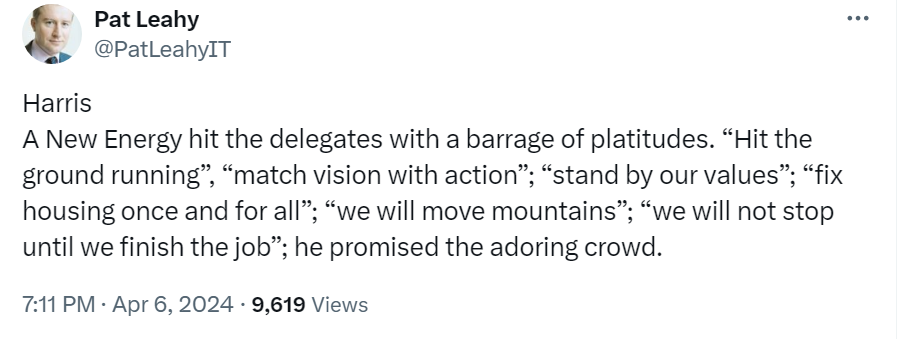
This is not to say that Harris was more convincing than Martin. Frankly, while Harris’s writers may have served their man better, the script they gave him was loaded with far too many clichés. A point succinctly made by Pat Leahy in this tweet.
To his credit, Martin’s gravitas and more assured and polished delivery made up for the dense paucity of the script.
When you look at the list of themes Martin highlighted in his script you can see that this was largely dictated by the cabinet portfolios held by Fianna Fáil ministers.
There were sections on Housing, Education, Health, Agriculture, Finance and Foreign Affairs and even Gaeltacht, all portfolios now held by members of Fianna Fáil in government.
But while all these portfolios are held by Fianna Fáil, these are not all the portfolios held by Fianna Fáil. There was one that merited no mention by the Tánaiste whatsoever… Defence.
It is the responsibility held by the Tánaiste himself, yet he could not be bothered to make even a passing reference to it. There was no mention of the recruitment and retention crisis, no mention of his plans to shred Fianna Fáil’s long standing commitment to the triple-lock.
Not that the singular defence reference in Simon Harris’s script was all that important, comprising one short non-specific promise to do more to support and resource our Defence Forces. No mention of the decade plus of neglect by his party of defence.
Ironically, Harris’s speech focused almost as much on Fianna Fáil policy areas as Martin’s. Harris was forthright in parking his policy tanks on the lawns of Fianna Fáil departments with big ticket pronouncements on housing, agriculture, and health.
The one non-Fianna Fáil held department to get a major mention in Harris’s speech was Justice, with Harris pivoting to reposition Fine Gael as the party of Law and Order. It was a pitch that led many in the commentariat to see Helen McEntee’s time in Justice as coming to a close a few days later.
The fact that McEntee has continued on Justice Minister is rightly seen as evidence that Harris’s Árd Fheis speech was less about substance and all about messaging, but messaging that has a lower shelf life than a Tik Tok video.
The fact that An Tánaiste did not mention crime or the Gardaí and had nothing to say about what had happened in Dublin a few months earlier, despite the presence in the hall of one of the highest profile and effective Fianna Fáil Lord Mayors of Dublin in decades, truly puzzles me.
As does the lack of any direct reference to a distinct Fianna Fáil position on migration, despite his party producing a policy document on migration – one largely framed by comments and analysis from Jim O’Callaghan T.D. only a day earlier. Indeed, proposals from that document were front page news on Saturday’s Irish Independent.
Before I conclude my analysis let me quickly turn my analysis to the other key actor in any Árd Fheis, the party audience in the hall. Their reaction, their loyal approval of key lines and key phrases can subliminally point the increasingly disinterested viewer at home to a point that they may have other wise missed.
Just as the dreaded laughter track in a sit com can point you were the writers put their jokes. The whoops and hollers of the party faithful help tell the viewing public that these are the important political takeaways.
Viewed in this context, Harris’s speech, was the hands down winner, with his Fine Gael crowd cheering and clapping twice as much and for twice as long as Martin’s more jaded and borderline apathetic cohort.
Let me demonstrate by comparing the audience reaction to their comments on what is happening in Gaza. For both leaders, this was a key moment in their speech. Their message was almost similar. But listen to the audience response.
Harris on PalestineMartin on Palestine
This does not make Harris’s speech better, however.
Frankly both speeches were wasted opportunities with both parties opting to churn out formulaic scripts containing disjointed soundbites, but 100% free of any over arching narrative. These speeches could have been serious attempts to communicate directly with the audience at home. They weren’t. So, in that context, both failed.
They were not spectacular fails… but they were still fails nonetheless.
Poker players among you will know about “tells.” These are the little involuntary actions, sometimes physical, sometimes verbal, that “tell” about the strength of another player’s hand.
According to those who know and understand the game far better than I, one common “tell” is to watch how other players handle their chips. Players with strong hands tend to grab their chips well before the action reaches them, indicating a desire to bet. While players with weak hands will leave their stacks untouched.
Not being much of a poker player I will have to take their word for it. But, as a keen watcher of the game of politics I can talk about this government’s more significant “tells.”
We saw a big one at the recent Fine Gael think-in. It involved Taoiseach, Leo Varadkar wading into the EU nitrates derogation controversy by promising the Irish Farmers Association he would invite EU environment commissioner to Ireland to discuss the issue. Continue reading “Feck the tiger… says Varadkar to Martin”→
In my first post of 2023 (apologies for the delay) I look back at the first few weeks of the Donohoe #Postergate saga and explore how Fine Gael has taken the old political dictum: when you are explaining, you are losing, and turned it on its head. Though they may feel it is working in the short-term… I believe that in the longer term, it will not. I do not see Minister Donohoe resigning – even post SIPO investigation – but I think his value (commercial or otherwise) to Fine Gael is now considerably diminished.
If you are explaining, you are losing.
So ubiquitous is this political truism that its authorship is variously ascribed to such election campaigning greats as Ronald Reagan or Karl Rove.
The idea underpinning the phrase is appropriately straight forward. If you want to win voters over to your cause you must sound confident and convinced. You do this best by having a message that is clear and concise. Spend too much time explaining your position and you come off looking desperate to convince. Continue reading “Fine Gael reckons when they are explaining, you are snoozing”→
In this blog I discuss the principal factors a party leader should consider when contemplating a mid-term reshuffle. Though I draw many of these from British political research, I also consider recent Irish expamples and refrain – largely – from engaging in too much speculation about who may be in or out next Saturday… or next week when the junior ministries are announced.
Will it be “as you were” with some folks just moving steps rather than entering/exiting?
Aware of Paddy Ashdown’s background as both a Royal Marine and a Special Boat Service officer, Charles Kennedy observed wryly to the House of Commons in Oct 1998 that Ashdown was: “the only party leader who’s a trained killer. Although, to be fair, Mrs Thatcher was self-taught.”
Not that the Iron Lady saw it that way. Speaking about her post-election reshuffle options in a BBC interview on the day after her 1983 election win, she resisted Sir Robin Day’s invitation to call herself a good (political) butcher. Instead, she disagreed with Herbert Asquith’s claim that a good Prime Minister must be a good butcher, before adding that they did need to know how to carve the joint. A distinction without a difference?
I discussed the implications of the latest political scandal for An Taoiseach Micheál Martin’s leadership of Fianna Fáil on RTÉ Radio One’s This Week show on Sunday August 28th, 2022.
My view is that An Taoiseach was hoping to avoid losing Deputy Troy as a Junior Minister as he did not wish to face into the prospect of nominating a replacement at this time. There are five or six very capable and willing candidates for appointment, each feeling that they have an “understanding” with the party leader that they will be promoted when the reshuffle comes in late December. Continue reading “Implications of the latest political scandal for Fianna Fáil leadership”→
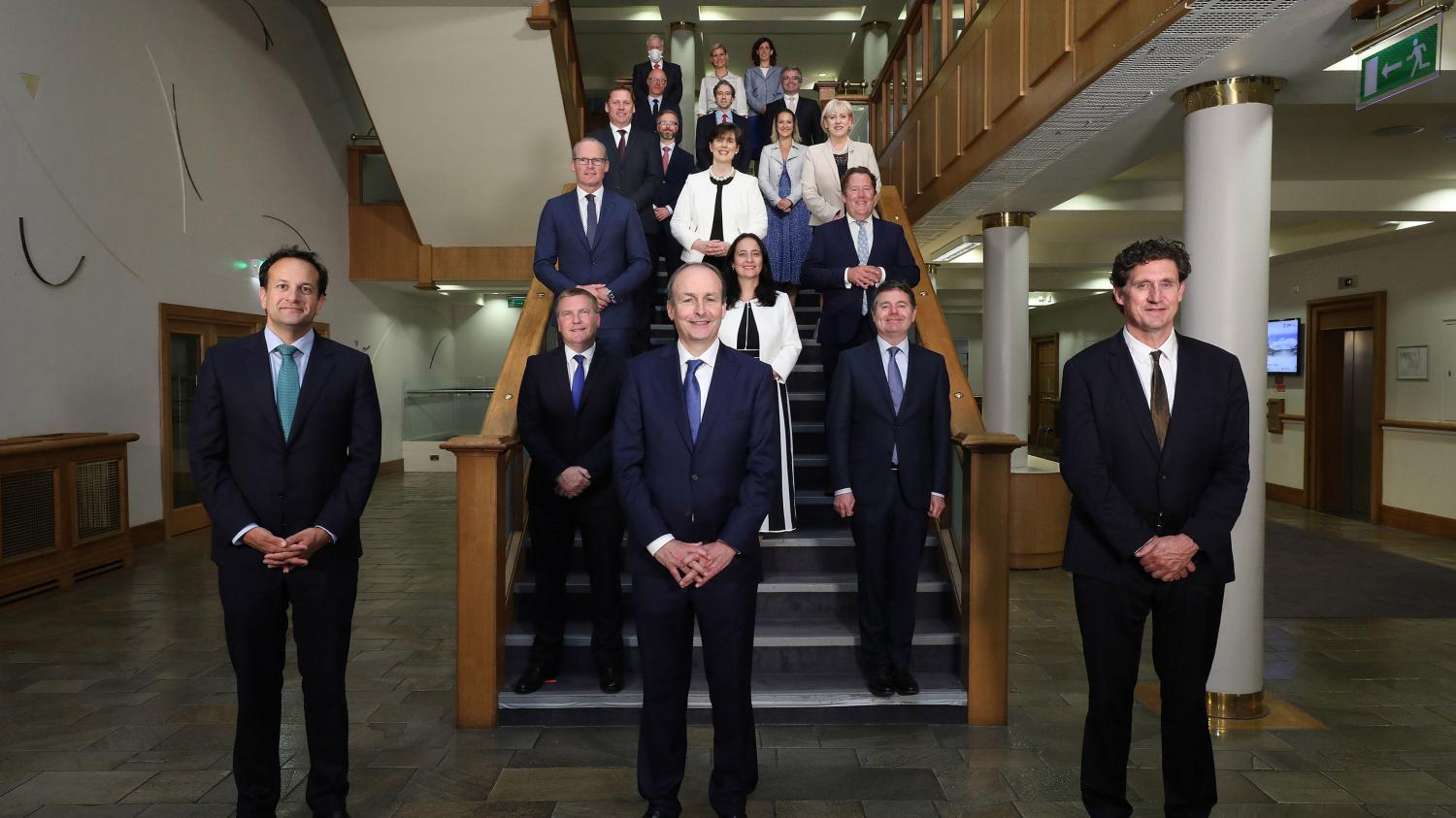
You do really have to wonder if the Taoiseach and Tánaiste understand politics at all?
Their immediate and absolute refusal to accede to calls for a mid-point review of the Programme for Government, coming from senior representatives in their two parties, is an example of this.
What is so wrong with agreeing to a mid-point review, a political stock-take, of the programme so painstaking negotiated back in June 2020?
Why shouldn’t the moment at which the two leaders switch roles also involve an appraisal of how effective this government has been at implementing the lengthy programme announced just over two years ago?
Earlier this week, An Taoiseach Micheál Martin, accompanied by ministers Simon Coveney and Eamon Ryan headed to McKee barracks, beside the Phoenix Park, to launch the overdue and long anticipated government’s action plan response to the Report of the Commission on the Defence Forces, entitled: “Building for the future – change from within.”
It is a good document. It commits the government to moving the State’s level of defence capability to Level of Ambition 2 (LOA) over a period of six years between now and 2028. In terms of cash and people, this means growing the annual Defence budget to €1.5 billion by 2028 (in 2022 prices) plus expanding the defence establishment by 2,000 personnel (civil and military).






 derekmooney.ie