Last weekend I ran a poll under PR STV on the excellent www.opavote.org website to select/elect the worst Minister in Government. I closed polling a few minutes ago.
Many thanks to all those who took the time to vote. I ran this poll to see how well the site performed.
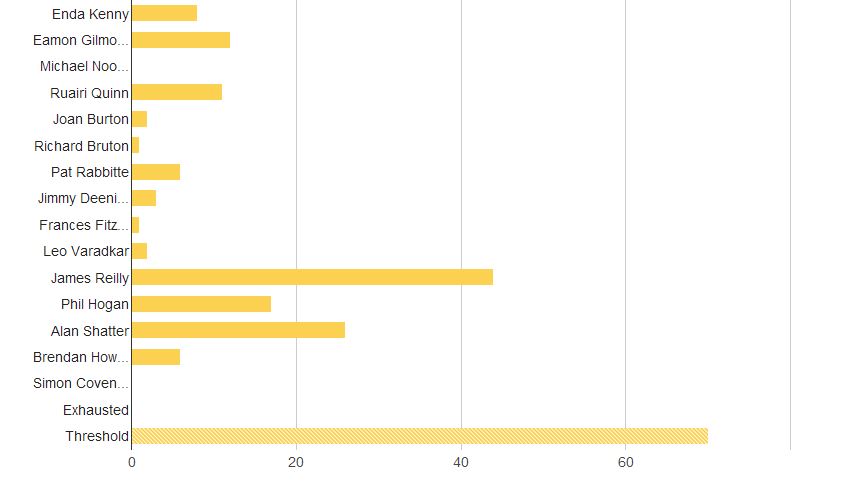
Results in Tabular formatFirst count as a bar chart
Where votes were tied (for an elimination) the one to be eliminated was picked by reference to their first count vote, where they were tied on first count is was by random selection
Interestingly both Michael Noonan and Simon Coveney received zero votes on the first count – which prompts me to shortly run a poll: Who is the best Minister in Cabinet (I may run that poll on a slightly different basis and seek the top three rather than just the one best)
I recently discovered the opavote.org website and wanted to try it out, so I decided to create an online poll to see how the site works.
The poll is determine the worst member of Government – the poll is being run under PR STV – ie you vote for the worst minister in the order of your choice 1 being worst, 2 being second worst and so on… you can stop after 1, or continue on down until 15 (for least worst… or even best!)
There will just be one winner – i.e. one person who exceeds the 50% + 1 quota. You can view the results as the voting proceeds – ie it will run the election as if yours was the final vote to be cast.
Surely I cannot be alone in realising that there is less chance of Fianna Fáil and Fine Gael linking up than there is of Luis Suarez having all his teeth pulled and turning vegetarian.
Yet, within hours of each new opinion poll you will see lots of speculation in print, on air, online and/or on all three that the next government will consist of Fianna Fáil and Fine Gael in some combination or other.
Such speculation seems to be based just on adding together the numbers that bring you to 50% and ignores the glaring Catch 22 that renders the chances of any such FG/FF or FF/FG alliance impossible: neither party would ever agree to go into a partnership government where it was not the biggest partner.
And as, by definition, a partnership government of just two groups cannot have two biggest partners, neither party would agree to be the junior partner in such a relationship. To do so would fly in the face of the fundamental rule of Irish governmental politics: junior coalition partners come off worst.
The strategists in both Fine Gael and Fianna Fáil know this. Whatever their weaknesses and deficiencies in policy formulation, these are still wily and experienced political operatives, they understand political realities. More critically they understand the laws of self preservation. They know that going into government as the junior partner while leaving Labour and Sinn Féin as the official opposition would be tantamount to writing their own party’s obituary.
Those who argue, on the basis of current opinion polls, that the Fine Gael / Fianna Fáil option may be the only viable one after the next election, do it on the basis that politics is a “numbers game”.
Well, to some degree it is, but numbers do not dictate everything. True, without the numbers you have no role and no say, but the converse is not true. Having the numbers does not mean that you must necessarily do A or B. Having the numbers does not restrict your options, quiet the opposite. Rather than being compelled to pursue some particular course, you have the opportunity to exercise judgement and think strategically.
This is not to discount the temptation and lure of ministerial office, especially to those who may not plan to face the electorate again. Saying no to power is no easy task, but the decision is made somewhat less troublesome if you know that saying yes to office today as a junior partner means that you are almost certainly ensuring that that option will be denied to you and your colleagues for many years thereafter.
Though majorly damaged after electoral pounding it took in the February 2011 General Election, Fianna Fáil is still hard wired for power – perhaps even more so that Fine Gael – so saying no to office would be difficult for some within the upper echelons of the organisation. Perhaps this is why the party leadership has recruited the membership of the party to ensure that any post election decision would be made by the broader party.
The situation is just as true for Fine Gael, though for other reasons. Having spent so long as the second party of Irish politics, it is now relishing its time in the top spot. It will be loathe to surrender that place – least of all to Fianna Fáil.
If the next election were to put Fianna Fáil ahead of Fine Gael, no matter by how small a margin, Fine Gael would do nothing to help Fianna Fáil back into power. Fine Gael would seek alliances with Labour, Sinn Féin, Independents, Socialists, Wallacites; McGrath-ites (of the Mattie or Fintan variety) Greens, People Before Profit, Profit Before People, Cart Before the Horse or whoever to keep Fianna Fáil out.
I know I risk appearing more than a little cynical in not mentioning policies and principles and just discussing the possible make up of a future government in terms of survival strategies but, I believe the chances of a Fine Gael/Fianna Fáil government are so remote and unrealistic that it is cynical not to dismiss it and to allow any more time and energy be wasted on discussing an option (and the associated policies) that does not exist.
Yesterday (Thurs April 11th) the Irish Times ran a storysaying that the German chancellor Angela Merkel is facing mounting political pressure at home to demand fiscal concessions from Ireland in exchange for granting extra time to repay crisis loans.
It seems that once again Germany is insisting that it not merely have an input into EU talks and discussion, but that it have a veto on the outcome. It is the ‘he who pays the piper calls the tune’ school of political thought. While the approach is not unfamiliar in politics, it flies totally in the face of democratic process and accountability. But even more than that, in this instance, it contradicts the history of Germany’s own economic revival and the important role played by one of Ms Merkel’s most illustrious predecessors: Konrad Adenauer.
Germany’s Wirtschaftswunder – the economic miracle of the 1950s – was based in large measure on a generous programme of debt forgiveness given to Germany by its 33 debtor countries (including Ireland). The 1953 London Agreement on German External Debts, effectively wrote off half of Germany’s total mountain of debt and gave it additional time to repay the monies it owed. These debts included war reparations from both first and second world wars, plus the massive German 1930’s debt default, which was just as significant as the 2008 European financial crisis.
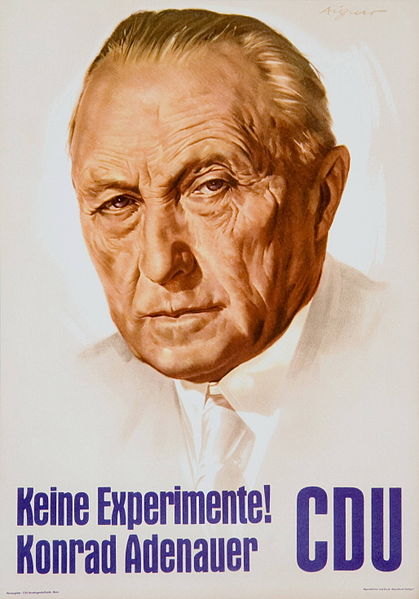
The West German CDU Chancellor, Konrad Adenauer realised that there would be no growth or revival of the West German economy for as long as it had to make huge annual payment to the Allied and other powers. These hefty payments, many of which Germany was even failing to make, were draining the West German economy of the ability to rebuild itself. He recognised that the only way to achieve growth was to get some relief from this debt burden, hence the London conference on German external debts.
Adenauer managed to convince the others sitting around the table that the only way that Germany could recover and rebuild was for them to ease the burden on it – he managed to convince them to stop doing to Germany what Germany is now doing to Ireland, Spain, Portugal, Greece and Cyprus.
Easing the burden of West Germany’s debt did not make the country lazy and profligate, quite the opposite. The Agreement, along with the Marshall Plan very quickly enabled the West German government and industry to use the resources freed up by the easing of the debt burden to generate domestic economic activity and growth.
Not only did the London Agreement write off 50% of Germany’s debt it removed the requirement that interest be paid, though did say that this proviso would be revisited in the event of German reunification. The collapse of the Wall in late 1989 triggered that proviso but it was never implemented due to Chancellor’s Kohl’s protestations that demanding such interest payments would make it almost impossible for Germany to meet the considerable costs of re-unification. So, once again, Germany’s partners allowed it to walk away from its financial commitments in the greater good.
As we know, both Enda Kenny and the Fine Gael party is deeply proud of its strong association with the CDU and Ms Merkel via their shared membership of the centre right European grouping: The European People’s Party EPP. Indeed, they regard the linkage as so important and significant that Mr Kenny manged to include a quick visit to Berlin and photocall with the Chancellor in the first week of the February 2011 general election campaign.
Perhaps the next time An Taoiseach meets up with the Chancellor in either Dublin, Brussels or Berlin he might gently remind her that her countries economic resurgence and dominance is due, in no small part, to the fact that 33 other countries, including Ireland, had allowede Germany to ease its burdens when it mattered and that it may now be time for Germany to allow others the facility they once extended to it.
The late Séamus Brennan: “You are playing senior hurling now lads…”
“You are playing senior hurling now lads – but you are playing with lads with All Ireland medals”.
This, according to Eamon Ryan, is how the late Séamus Brennan greeted the Green Party team as it arrived in Government buildings for the 2007 talks on forming a government with Fianna Fáil.
It is a phrase that every Labour Party TD calling for a renegotiation of the Programme for Government (PfG) should print out and place at the top of their PC screen.
God be with the days when Labour recruited its Dáil candidates from the old ITGWU or FWUI. Those guys knew the first principles of negotiating; they particularly knew that you did not go into negotiations unless you had 1. A strong hand and 2. A fair idea of the outcome. Yet some in Labour are advocating that they enter talks with neither.
They want to enter a renegotiation of the government’s fundamental policy programme at precisely the moment when their party has hardly ever been weaker. Do they seriously expect that their senior partners in Fine Gael will take pity on them and offer them major policy concessions just because they are having a bad hair day?
Do they really underestimate their government partners that much?
Politics is a tough world guys. Wake up.
You do not get your way in politics just because you mean well, you get your way and get policies implemented by getting a mandate and pursuing your goals assiduously.
You certainly do not enter talks with partners from whom you wish to extract concessions with the message: we are in a weakened state and desperately need to give the impression that we can beat you into submission, so please, please, please let us.
It is the equivalent in nature of a lone deer asking a lion to not to devour them as they have a leg injury and cannot run properly today. Indeed it goes further and suggests that the lion should agree to allow the injured deer to bitch slap them around for a while so that any other deer who may be watching from a distance will think more highly of them.
There is no compulsion on Fine Gael to enter meaning renegotiation talks with Labour. They know Labour cannot cut and run now and risk facing the electorate, so they know it is strapped into this arrangement until the bitter end. The very most Labour could hope to get is a sham negotiation where we see TV clips of the pairs of Ministers from each side entering Government buildings for late night talks and the last minute “leak” from a source “close to the Labour leadership” saying the talks are at a crucial point right now and may go well into the night. The optics will look good, they may even fool a few activists, but most others (including the public) will see it as just a gesture. If the guys want to go down this road there is doubtless a battered old playbook for such an exercise laying around Government building somewhere.
The current cohort of Fine Gael TDs is possibly the most right of centre since the late 1950s. They are already getting flack from supporters and voters for the appearance that Labour is dictating too much of the government’s agenda, particularly on social issues, so they are neither motivated nor minded to give any more policy ground to them on the back of what was a bad day for Labour and, conversely, a good day for Fine Gael.
The idea of renegotiating the PfG is at best: naïve, and at worst: dumb.
That so many TDs would advocate it after only two years in office suggests that we are probably beyond the mid point of the life of this government and that the chances of there being a general election in early 2015 just got stronger.
Irish troops serving the cause of peace internationally
My column from tonight’s Evening Herald on how the reform and modernisation of the Defence Forces over the past year could prove a model for public sector reform
—————————————————————————————————–
The first tentative step on the path to a possible Croke Park II deal was taken last week when Public Sector unions and management sat down together for preliminary talks.
While reaching any form of deal will pose difficulties for negotiators on both sides, the management side has a particularly difficult delicate balance to strike. Though their political masters in Cabinet may be signalling their support for a deal they also know that most Fine Gael back benchers would be just as happy if no deal was reached.
The public service is just one more issue that divides back-benchers from both parties, with many of FG’s newer intake of TD’s echoing the “small government” rhetoric heard from US Republicans and Tea-Partyers.
It is not an uncommon view in these difficult times. There are many siren voices around attacking the public service and portraying it as riding on the back of a shrinking private sector.
Sadly, the public service often leaves itself open to these onslaughts with daft examples of wasteful spending and bad work practises. But the danger lies when occasionally justified criticisms are distilled into a dogma.
Yes, the public service is in need of reform and modernisation, but the one dimensional demonizing of the entire public service we hear from some quarters will not help reform anything. Nor will the “everything is just fine as it is” defence we hear from various public sector unions.
Public service reform is possible without hyperbole or blood on the carpets. With the right management and leadership the public service is capable of reforming and modernising itself. I know, because I was there when it happened.
The reform and modernisation of the Defence Forces over the past decade and a half is a model of how it can be done right.
The 2009 Bórd Snip Nua report found that the Defence Forces were the only sector in the Public Service to reduce numbers during the Celtic Tiger.
While the numbers working in the Public Service had increased by 17% between 2001 and 2009, the numbers working in the defence organisation actually fell by 8%, going from 11,808 down to 10,895 a drop of 913.
The reduction in numbers in uniform was reflected in a reduction of numbers of civil servants in the Department. These payroll savings were invested in better equipment and improved training meaning that the Irish Defence Forces could do more with less.
The negotiations were tough, but both sides recognised that it was in their mutual interest. While soldiers and officers do not have Trade Unions, they do have strong representative organisations: PDFORRA and RACO and a parallel conciliation and arbitration process that conducts it business quietly and effectively,
Perhaps the absence of outside influences, speculation and running commentaries, helped create the conditions for agreement – but not nearly as strong leadership, both political and military.
We should now be finding ways of replicating this progressive model. Before coming into office the Taoiseach’s last big idea on the Defence Forces was that it should be running boot camps for young offenders.
Doubtless he has abandoned this nonsense having spent two years seeing them close up, but their handling of the last round of barrack closures suggests that he may not yet have realised just how the Defence Forces be a model for public service reform.
Today, December 29th 2012, marks the 75th anniversary of the Irish Constitution, Búnreacht na hÉireann coming into effect. This is my Evening Herald column on it continuing importance and relevance to Irish life.
Dev – Architect of our Constitution
On this day seventy five years ago the Irish Constitution came into operation. As we have seen in recent and current controversies, almost four decades on, the Constitution is still central to much of our political debate.
Within the past year we have seen it successfully amend it three times: Judges Pay, Fiscal Compact and Children’s Rights. But, we have also seen the public resoundingly reject the governments request that they amend it on the issue of Oireachtas enquiries.
It is not the first time the public has done this. Not only did they defeat the Nice I and Lisbon I votes, as early as 1959 they rejected the then attempt to change the voting system. Indeed in 1968 the voters rejected the next two amendments put to them, both related to elections.
It was not until the 1972 vote on joining the then EEC that the people passed the first amendment to the Constitution. (Technically this is the Third Amendment as the first two were made in 1939 and 1941 without referendums as part of transitional arrangements.)
Over the past 75 years the public have approved some twenty five changes to the Constitution. While some were technical in nature, others – such as the five votes relating to abortion – were highly controversial and emotionally charged.
What this shows is that the Constitution makes the people sovereign. They alone decide what changes may be made to the fundamental law of the land.
This important aspect of De Valera’s 1937 Constitution has been much praised over the years. While it is easy to look at the language and some of the secondary provisions as being a product of their time and maybe a little outdated now, most legal experts view the principles set out in the Constitution of 1937 as being ahead of their time.
Five of the fifty articles are devoted to Fundamental Rights. Decades before international instruments, such as the United Nations Charter and the Universal Declaration of Human Rights proclaimed fundamental rights and fair procedures, the Irish Constitution had done so.
Indeed, while the Constitution does not declare Ireland as militarily neutral, it does contain in Article 29.2 a commitment to “the pacific settlement of international disputes” and the adherence to International law. This is just something else that marks the document out as being ahead of its time.
But while it may have been well ahead of its time 75 years ago, it is still so?
I would argue that, essentially, it is. The fundamental principles it espouses are just that – fundamental. The commitment to democracy, rule of law, fair procedures etc do not change with the seasons of the prevailing political fashion.
But it is also a living document, particularly in the provisions relating to how government and the judiciary should work. Back in 1937 it seemed natural that only those over 21 should be entitled to vote, by 1972 that was changed to 18 by a margin of over 5 to 1 of those voting.
Events of recent years have thrown up some more significant issues. Are our governmental structures sufficiently responsive – or even fit for purpose – in the context of the IMF/EU bailout and an evolving European Union/Eurozone? Is the 1930’s post independence concept of property ownership appropriate in 21st century Ireland?
But where is reform on these issues being discussed? Not at the Government’s Constitutional Convention, it seems. Its initial priorities, as set out by the Government, are to discuss the President’s term of office and the voting age. This is the equivalent of setting up a dance committee after the Titanic has hit the ice. The one substantive constitutional issue on which the government, particularly the Taoiseach, is committed is abolition of the Seanad.
Just when we require more meaningful scrutiny of government policy, it proposes less and sells it under the guise of “reform”. Fortunately, it is the people who will be sovereign on this.
In American politics they refer to a policy issue that is so controversial or highly charged that it is dangerous for any politician to dare touch it as a”third rail” issue. Third rail being a reference to the electrified third rail of a metro or train system.
Leaders’ questions….. or, questions for a leader?
As we have recently seen both here and in the US, abortion is just such a classic third rail issue.
The last thing the Taoiseach and his Ministers want right now is a divisive argument within the Fine Gael parliamentary party. The party leadership is determined to quell the growing unrest.
Over the past few days we have seen and heard a series of backbench Fine Gael TDs coming out to state their own views on what should be in and what should not be in the legislation the government must produce to comply with the European Court of Human Rights judgment.
But will Enda Kenny’s tough words from Cardiff yesterday, telling these TDs that they must back whatever legislation the government produces be enough to keep them in line?
Is this the Taoiseach being a strong and determined leader or it is him doing an impression of what he thinks a strong leader should look like?
At a parliamentary party meeting Last July it was reported that anywhere up to 15 TDs had put the Taoiseach on notice that they would oppose legislation that would pave the way for abortion.
More importantly, in the context of the current situation they sought assurances from Kenny that the findings of the expert group on abortion would be discussed with them before they were brought to Cabinet.
While they did not get that assurance, they will not be happy to see the Government adopt a position without proper consultation with them.
In fairness, the Taoiseach can argue that the tragic events of recent weeks have hurried matters along and robbed him and them of the time and space in which to consider the expert group’s findings.
But will this sizeable group of back benchers be calmed and silenced so easily.
The timing could not be worse with one of the toughest budgets this government is going to have to introduce barely a week away.
Yes, the government has a big majority, but it cannot afford to lose too many overboard. So far Fine Gael has lost one TD, over Roscommon hospital. Those this pales in comparison to the four TDs that Labour has lost, included two former Junior Ministers.
Is this really the best of times for a Taoiseach to be publicly warning TDs that they will be expected to vote the right way or lose the whip? It is hard to argue that your back benchers should be using the parliamentary party room to air their views in private when you deliver that rebuke yourself very publicly.
This is the second time, in just over a week, that we have seen the Taoiseach resort to such megaphone diplomacy. Last week it was his ill judged and, frankly, insensitive public call on Praveen Halappanavar to meet with the Chairman of the inquiry into his wife’s death delivered on the floor of the Dáil.
As we saw that call was particularly ineffective as Mr Halappanavar graciously, but firmly, resisted Enda Kenny’s entreaties to back down.
Will his call this week to his back benchers be any more effective? Only if it is backed up with direct contacts and clear communications from the Whip’s office.
Backbenchers do not like being taken for granted, especially when they feel the governments plans and ideas run contrary to those of their own grassroots. Enda Kenny needs to remember that real leadership is about more than just being seen to be in charge, it is about convincing people they are doing the right, not just telling them to do it.







 derekmooney.ie