This is my latest article for Broadsheet.ie – available online here: New Politics Explained
What exactly is this “New Politics” we have been reading and hearing about so much lately?
It was the question that should have occurred to me as soon as the Public Relations Institute asked me to participate in a panel discussion they held last Thursday as part of a half day seminar entitled: Public Affairs in the era of ‘New Politics’.
But it didn’t. Like many others, I have been throwing about the phrase “new politics” in the two and a half weeks since the Dáil elected a Taoiseach as if everyone understands what it means.
This is the handbook prepared by US Republican pollster Frank Luntz in 2009. It sets out the language and arguments that Israeli Government spokespeople should use on the media to explain and defend Israel’s then occupation of Gaza.
You can hear lines from this 2009 being used again today to defend the latest onslaught on Gaza.
I have now updated my initial thoughts, musings, observations and mild rantings on the implications of the local election results, particularly Fianna Fáil’s stronger than expected showing.
This was first posted on Sunday morning – updated on Monday morning to reflect the revised party national totals in the Local Elections.
Local Election Results national overview
“If history repeats itself, and the unexpected always happens, how incapable must Man be of learning from experience.” – George Bernard Shaw.
Quite a lot, it seems.
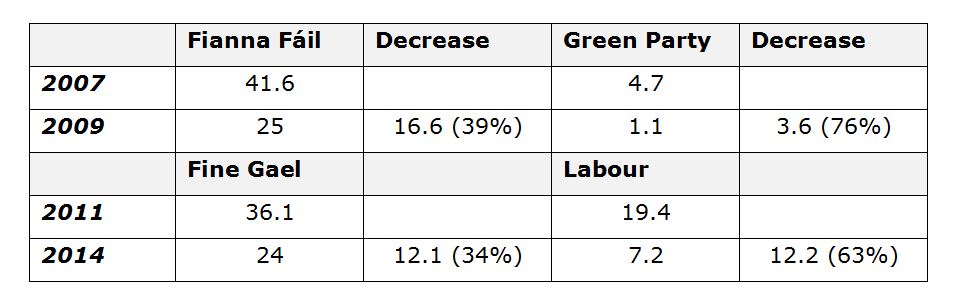
Yesterday we saw history repeating itself, with the electorate visiting upon Fine Gael and Labour almost exactly the same devastating blow it had served up to Fianna Fáil and Labour five years earlier.
In 2009 Fianna Fáil lost around 39% of its support (when compared with 2007) while the Greens endured a massive reduction in its vote of 76%.
Yesterday, based on the Local Election results to hand, Fine Gael lost 34% of its support and Labour lost 63%.
While the story of the Local Elections is the rise in support for Sinn Féin and the Independents and the scale of the loss for Labour, the Fine Gael haemorrhaging of support should not be ignored.
Indeed, the case can be made that the real story of the election is this massive Fine Gael loss – a loss that should not be glossed over by what might appear to be its reasonable performance in the European Elections.
Losing 100 plus Councillors, on a day when you have increased the number of available council seats, is a political meltdown of Fianna Fáil in 2009 proportions. It will send a shiver around the Fine Gael backbenches that will match that currently coursing along the spines of their Labour colleagues.
Leo Varadkar’s line that the next election will be a battle between Fine Gael and Sinn Féin was a clever attempt to calm the troops with the notion that their lost support will come back when the Irish voters realise that Fine Gael is all that stands between them and the Shinners.
It’s clever line, but a flawed one.
For it to offer any comfort it would need to be underpinned by Fine Gael still remaining the largest party – but it hasn’t. By the time the dust settles it will become clear that the other big story of the locals is the return to frontline politics of Fianna Fáil, even if its European results are a bit rocky.
If the battle of the next election is, as Varadkar suggests, to be fought on the question of where you stand with regard to Sinn Féin then Fianna Fáil, with a few more weapons in its armoury, is standing on better – and now even firmer – ground than the depleted followers of Enda.
While Fine Gael may see itself as the antithesis of Sinn Féin, Fianna Fáil can challenge SF’s voodoo economics every bit as credibly as FG, but with the added bonus that that can better undermine and dismantle the Shinner’s fallacious claim to Republicanism, especially in its back yard.
The other story of the Fianna Fáil result is its incredible variety. Its national level of support at just over 25% belies some very good and incredibly bad local results, especially in urban centres.
They range from the sublime such as its 49% in Bailieborough-Coothall 39% in Castlecomer and 38.4% in Ballymote-Tobercurry to the ridiculous: such as its 4.9% in Dublin North Inner City, 6.8% in Tallaght South and 8.7% in Lucan.
While there are several other disappointing low teen results in urban centres across the country e.g 9.6% in Waterford City South, 10.5% in Bray and 13% in Limerick City North, it is no coincidence that the single digit performances are in Dublin.
That is not to say that the Capital is a wasteland for Fianna Fail. Contrast the single performance mentioned above with the parties stunning 27.3% in Castleknock, its 24.2% in Clontarf and its 22.3% in Stillorgan.
While the overall Dublin result of 16% points to a major problem for the party, the variety in results, highlighted above, shows Fianna Fáil’s further potential for growth and renewal in large swathes of Dublin.
It is the very patchiness of its result that points up where the party needs to work harder and better. Far too many candidates in Dublin were left to struggle on by themselves with no structured national campaign to underpin their efforts.
Having “Fianna Fáil” on your poster does not guarantee a good new candidate a certain base level of support in Dublin and other urban centres in the same way as having “Sinn Féin” on your poster did for their new first time candidates. Indeed it does not offer the prospect of that base level of support as it does in non-urban Ireland.
The candidates in Dublin raised the Fianna Fáil vote to their level, not the other way around. The vote in Dublin and other urban centres, is not the party vote plus the candidate’s unique personal support – it is just the latter. In certain parts of the city is it the unique personal support minus the residual antagonism to Fianna Fáil.
The “Fianna Fáil” identity is Dublin is not a coherent identity based on a core defining message from the party as a national political party: it is the collective identities of its various candidates.
This is not to underestimate the particular nature of Dublin voters, especially their looser party allegiances; it is just to point out that Dublin voters are just as likely to be receptive to a national message, just less continuously loyal to it.
Despite some clearly very good results in Dublin, most Fianna Fáil supporters still struggle to answer the questions: why should I vote Fianna Fáil and what does Fianna Fáil stand for. Most of the successful candidates I have encountered in Dublin answer it with the words: here is what I stand for…
It is not that there are not answers to these questions, but rather that the party has not sufficiently defined and substantiated them.
It is work that can and must be done. That work is not aided or encouraged by intemperate outbursts or Quixotic threatened heaves. The issues are policy and organisation – not personality.
The 24.3% of voters who abandoned Fine Gael and Labour saw their political alternatives this week. Some said independents, some said Sinn Féin – though not by a large margin as the swing to Sinn Féin since the 2011 election is in the 5.3%, but even more said Fianna Fáil with a swing of just over 8%, but the point should not be lost that the biggest single section of them said: none of the above.
The ones who stayed at home are the ones who were badly let down by Fianna Fáil and are now just as angry with Fine Gael and Labour for promising them a new politics and then delivering the old failed politics as usual.
Perhaps they concluded that they could afford to sit out these second order elections, as they do not see how the results will change their lives, they will not be as sanguine at the next election.
While there are worse jobs in the world: the worst job in politics is certainly leader of the opposition.
If he didn’t already know this, it is certain that Fianna Fáil’s leader Micheal Martin will know this in just over a week.
The 2014 European and Local Election campaigns for which he and his HQ team have prepared and planned for over 18 months are proving themselves to be a source of unalloyed joy. It is hard to believe that these are the campaigns they wanted.
The latest round of opinion poll findings only confirm this. They suggest that
His Dublin Euro candidate will fail to take the seat
His Midlands North West duo may struggle to win a seat
While his Ireland South candidates have the best part of two quotas between but are so imbalanced as to render a second seat impossible.
If the ballots cast on Friday confirm these poll findings, then it will be hard to make any of this sound like an achievement.
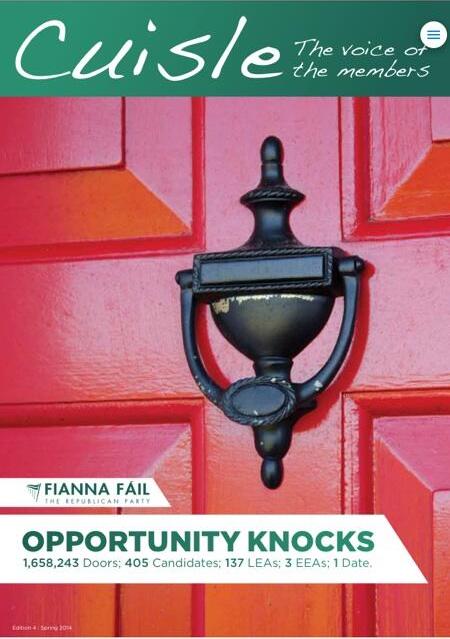
This is an article I have written for the March 2014 Árd Fheis issue of Fianna Fáil’s members’ magazine Cuisle.
————————————————————————————————–
A few months before the 2011 election, Michael Gallagher (the TCD Professor of Politics, not the Donegal postman and amateur weather forecaster) posted a blog where he asking how long Fianna Fáil could expect to spend in opposition. In it he wrote:
“Fianna Fáil is not a party accustomed to spending time there. Its longest spell on the opposition benches is still the nearly six years between its foundation in May 1926 and its entry into government in March 1932. Since then, the party has never spent more than one consecutive Dáil term in opposition and the longest spell it has been out of power remains the 4 years and 4 months of the Cosgrave coalition in the mid-1970s.”
Underpinning Gallagher’s 2010 comments is the idea that Fianna Fáil has never been that good at opposition. It is a fair point.
Not only have we not spent much time in opposition, as Gallagher points out, it is almost 30 years since we last spent a full Dáil term there.
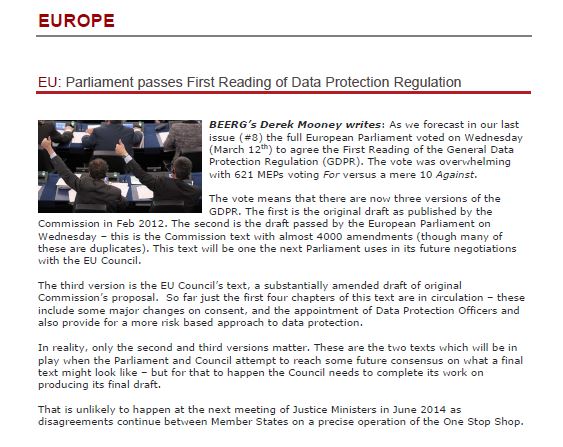
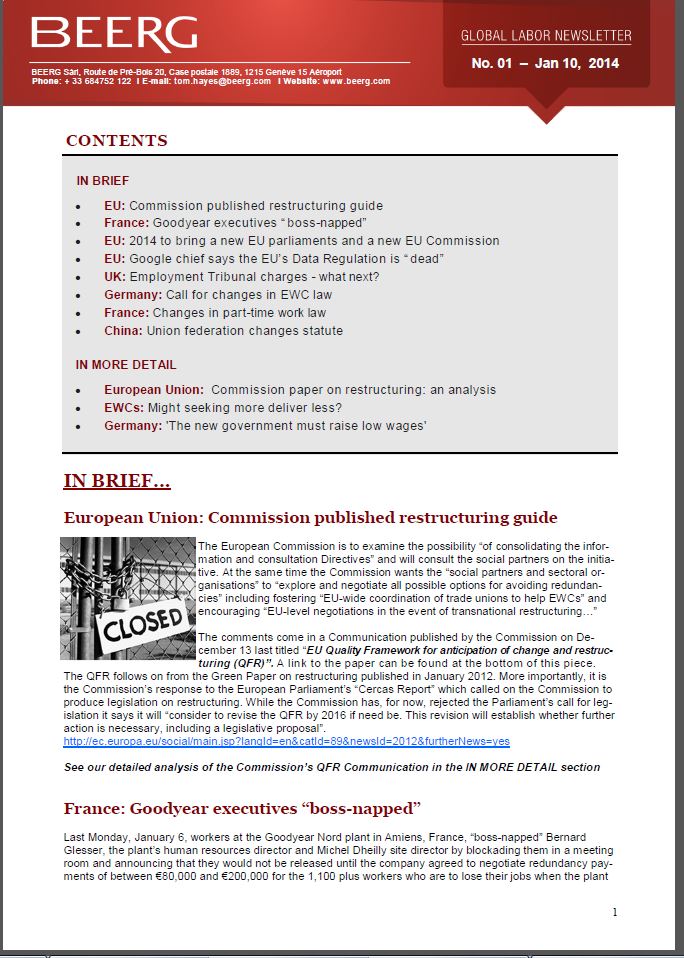
This is a piece I wrote for the March 14th issue of the BEERG global labour newsletter. It examines the consequences of the EU Parliament’s overwhelming vote on the General Data Protection Regulation and acknowledges the hard work and valid concerns raised by the Irish MEP Sean Kelly (EPP & Fine Gael)
BEERG Newsletter March 14th 2014
Though it is now accepted across the EU that the Data Protection Regulation is not likely to be approved until 2015 at the earliest, the European Parliament has scheduled a debate on the legislation on Tuesday (11 March) with a full First Reading vote on it on Wednesday.
The vote comes just 10 weeks before voters across Europe go to the polls to elect the next European Parliament.
The plenary vote on Wednesday is no mere gesture, however. It is the outgoing Parliament setting out its position so that the incoming one can start negotiations with the Council of Ministers, as soon as they have adopted their position, though the timetable for the Council’s part of the process remains uncertain
It is not the European Parliament’s only debate on Data Protection this week as it is also set to approve the final report of its own inquiry into alleged mass surveillance by the US National Security Agency.
That report not only demands that the US/EU trade talks not lead to a softening of data protection standards, it also calls for the suspension of a programme to share bank transfer data with the US, and calls on member states to strengthen oversight of their intelligence services.
As mentioned earlier, the ball now lies with the member states governments via the EU’s Council of Ministers. The Justice Ministers met last week and held a policy debate on outstanding issues relating to the data protection regulation framework.
ASs the communique issued after the meeting said: “Ministers broadly supported the draft provisions as regards the territorial scope of the regulation and confirmed the understanding that international transfers of personal data to third countries should take place on the basis of key principles contained in chapter V of the draft regulation.”
It then went on to diplomatically express the ongoing delays and problems saying:
“Ministers agreed that more technical work will need to be done on important aspects of this chapter and that the question of alternative models for international data transfer will need to be studied in depth.”
“The Council confirmed that the work will continue at a technical level on the basis of the progress achieved so far on: pseudonymisation as an element of the risk-based approach, portability of personal data for the private sector and obligations of controllers and processors.”
“Whilst a majority of delegations appeared to be of the opinion that the scope of the profiling provision in the future regulation should, like the current Directive 95/46/EC, limit itself to regulating automated decision-making that has legal effects or significantly affects individuals, some other delegations pleaded in favour of specific provisions on profiling. Work at a technical level should therefore continue on that basis.”
Others involved in the process expressed their frustrations with the Council’s difficulties in reaching a consensus less delicately. Ralf Bendrath, the Green Party’s data protection expert and an adviser to the German Green MEP who is the Rapporteur who has steered the Regulation through Parliament thus far said on Twitter: “Germany again – embarrassingly – less supportive than all other member states on progress”. He went on to dismiss Germany’s observations that the issue will “need more debate” and chided them for not specifically stating their objections.
While Ministers are still a long way off reaching agreement on their draft of the Regulation, that is not to say that a great deal of technical work and progress is going on behind the scenes.
The Greek EU Presidency has been working away very assiduously in recent months with a series of DAPIX and other Data Protection officials meerting. The Greeks have also been engaging with the Italian government (it is the the next country to hold the 6 month rotating Presidency of the EU) to work out a road map for agreeing on the data protection reform swiftly.
While their original objective of agreeing on a mandate for negotiation with the European Parliament before the end of the Greek Presidency looks unlikely to be achieved, they are busily dotting all the “i”s and crossing all the “t”s they reasonably can awaiting some direction from the member states.
Meanwhile in the UK, the Liberal Democrat Junior Minister at the Justice Ministry, Simon Hughes MP, has announced a review of the criminal sanctions available for breaches of the UK’s Data Protection Act. He said the review would help the UK government “decide whether to increase the penalties as the law permits”.
Feeding into this process Pinsent Masons’ specialist in data protection law Kathryn Wynn has suggested that the government should go further than reviewing the criminal sanctions and should also consider strengthening the civil monetary penalty regime too, arguing that a previous increase in the maximum level of fine in 2010 had prompted organisations to take the issue of data protection seriously.
Using the draft EU’s General Data Protection Regulation as an example she suggests that the review take the approach envisaged there, where the level of penalty for a data breach is calculated on the basis of a percentage of their annual turnover.
So, even before it is passed, we could see the draft EU’s General Data Protection Regulation is influencing domestic legislation across Europe.
Here is my article from this week’s BEERG Newsletter looking at mounting tensions in the race to take the EU Commission Presidency
You call tell that there’s an election approaching by how targeted, populist and political the press releases from MEPs become. Take the Scottish Nationalist (SNP) MEP Alyn Smith, who has suggested that Scotland consider banning Canadian-born singers Justin Bieber and Celine Dion in retaliation for Canadian authorities prohibiting several Canadian stores from selling the popular Scottish soft drink Irn-Bru. Smith justified his call, albeit tongue in cheek, by saying that between them, Bieber and Dion have produced “more sugary schmaltz” than Irn-Bru ever has.
While Smith’s demand has the virtue of humour and creativity, the same cannot be said for the political attack made by the centre-right European Peoples’ Party (EPP) on German Socialist MEP, Martin Schulz (photo) on Wednesday as reported by the EurActiv website http://www.euractiv.com.
Schulz is the outgoing President European Parliament and the likely Socialist candidate to be President of the next EU Commission
The attack centres on allegations made by the EPP that a €60,000 European Parliament contract was awarded to the wife of Sergei Stanishev, the president of the PES: Party of European Socialists. The €60,000 contract was for an information project promoting the European elections in Bulgaria.
Leading the attack for the EPP, German MEP Ingeborg Grässle claims the situation has alarm bells ringing over an “obvious” conflict of interest involving some of the most prominent figures in the European socialist family, saying “European Parliament staff under the direction of Socialist President Martin Schulz handing out a contract worth €60,000 to the wife of the European Socialist Party President – this smacks of political favours… Is Mr. Schulz using parliament funds to help his political friends?”
EurActiv reports that its sources say that Schulz is concentrating on his campaign to succeed to José Manuel Barroso as Commission President and shudders at any piece of news which could upset his plan.
The fact that the attack was led by a German MEP is significant as Grässle and Schulz’s own parties the CDU and SPD are now in a grand coalition partnership government in Germany. Expect to see and hear more political skulduggery as the May parliamentary elections approach. The stakes are high with more than just the political balance in the European Parliament to consider. As the BEERG Newsletter has reported reforms made under the EU’s Lisbon Treaty means that heads of government must take the results of the European elections “into account” when selecting the next EU Commission President.
With polls suggesting a swing to the Socialists in the May election, possible sufficient to make it the largest single group in Parliament, Schulz is well placed to become the next Commission President, however the centre right EPP group is not likely to allow this prized post slip from its grasp.
12 of the 28 heads of Government are members of the EPP, including Germany’s Angela Merkel, Spain’s Mariano Rajoy and Poland’s Donald Tusk. British Prime Minister David Cameron’s Tory Party quit the EPP in 2009.
The EPP is planning to select its candidate for the EU Commission Presidency at its Congress in Dublin on March 6th & 7th. There are four possible contenders: the Finnish Prime Minister Jyrki Katainen, the Latvian Prime Minister Valdis Dombrovskis, the current commissioner for the internal market Michel Barnier and the former Luxembourg Prime Minister and EU veteran Jean-Claude Juncker.
The PES, whose European Parliamentary group is called the Progressive Alliance of Socialists and Democrats (S&D) will hold it pre-election congress in Rome on 1 March.
This is a piece on the 2014 EU Parliament elections and the appointment of a new EU Commission I wrote for the Jan 10th issue of BEERG‘s Global Labor Relations Newsletter
——————————————————————————–
European Union: 2014 to bring a new Parliament and new Commission
Derek Mooney writes:Next May citizens across the 28 EU states will go to the polls to elect the 751 members of the next European Parliament.
Voters across the EU have tended to treat these contests as what political scientists call: “second order” elections. This usually means that voter turnout is lower than in national elections and the campaigns are often fought more on national issues rather than pan European ones. In many cases the results in each country reflect the current standing of the national government more than they do the manifestos of the European groupings.
While voting will take place during a 3 to 4 day period across the 28 member states, we can get a sense of the possible outcomes by looking at opinion polls in the eight largest EU countries (France, Germany, Italy, the Netherlands, Poland, Romania, Spain and the United Kingdom) as these account for around 77% of all the EU citizens entitled to vote and will elect around 64% of the Members of the European Parliament (MEPs).
A policy paper presented to the Notre Europe: Jacques Delors’s Institute focussing on what the political balance of power in the next European Parliament might be suggests the possibility of some major changes.
The paper features an analysis of recent opinion polls in these eight countries. It suggests a swing to the Left and Centre Left as well as major gains for protest and fringe parties on both the far left and far right.
In the outgoing parliament the EPP (Centre Right group) holds 265 seats against 184 for the Social & Democrats (Centre Left). The analysis of the polls suggests a swing to the centre left that not just closes this gap, but even reverses it. Some analysts predict that the EPP group might win 209 seats in May, four less than the S&D’s predicted 213.
The predicted changes on the margins are no less dramatic. The domestic opinion polls in France suggest that the far right Front National, led by Marine Le Pen, could become the largest French party in the elections, possibly taking 21% of the vote and increasing its number of MEPs from 3 to 17. While on the other end of the spectrum far left parties such as the Spanish Izquierda Unida (United Left) may increase its number of MEPs from 1 to 8.
Political commentators are suggesting that these advances by parties on the far left and far right, plus gains by populist protest parties like Italy’s Five Star Movement led by comedian Beppe Grillo could see them holding up to 40% of the seats in the incoming parliament.
The political zero sum gain dictates that the increased influence of these groups comes at the expense of the traditional dominance of big blocs: the EPP, the S&D and the Liberal ALDE group, leading to greater political uncertainty in the next Parliament.
This uncertainty comes at a time when the Lisbon Treaty has given an increased role and say to the European Parliament, not least in the appointment of the next European Commission especially the Commission President, which will follow the European Elections.
The Lisbon Treaty has changed the rules on the appointment of Commission President and these come into effect for the first time in 2014. Article 17 of the Treaty and the Declaration 11 annexed to it set out that the choice of the candidate for the Commission presidency will be made “taking into account the elections to the European Parliament”.
This was supposed to mean that the various pan-European EU groupings declare who their candidates for the Commission presidency will be in advance of the May parliamentary elections and set out their commission presidency manifestos. In each country candidates looking to become an MEP would indicate to which European political grouping they would affiliate indicate the Commission presidency candidate that grouping will back.
Names are being bandied about as to who might nominated by each of the main groups. The current EU Parliament President, Martin Shultz looks like being the likely nominee of the centre left S&D grouping, having already secured the backing of 20 or so centre left parties across Europe, most importantly his own German SPD and Francoise Hollande’s Socialist Party.
The EPP may opt to propose Jean Claude-Juncker, the recently defeated long serving Luxembourg Premier. Juncker’s gain maybe at the expense of his party colleague, Viviane Reding, who had previously harboured ambitions to become Commission President having served as a Vice President. Realising that that path is now closed there is some suggestion that she may step down as a Commissioner before her term expires to seek re-election as an MEP (she was previously an MEP) and seek the post of President of the Parliament. The same suggestion is being made about her French Commission colleague Michel Barnier.
But, being Europe, the practice looks like it will be very different. While MEPs want to see the power reside with them and the Commission Presidency go to the largest group (or coalition of groups) in the incoming European Parliament, national governments and leaders, most notably Angela Merkel and David Cameron, are deeply reluctant to surrender the final say to the parliament and are taking a very broad view of the phrase “taking into account the elections to the European Parliament”
While no one should be heading to the bookies to put bets on the results just yet, it is reasonable to assume that the incoming European Parliament and Commission with have a more leftish and presumably interventionist hue than the outgoing one. Given the difficulties posed to business by the outgoing centrist parliament, this cannot come as good news to business and employers across the EU.
The prospect of a more leftist Commission and parliament, coupled with the political uncertainty heralded by a phalanx of extremist parties of both left and right, could lead to some interesting and difficult times ahead.
Let’s get one thing clear at the outset: I have no in depth or insider knowledge of what has been going on with the Limerick City of Culture – or City of Vultures as some have christened it.
All I know is what I have read in the papers and on Twitter. In that regard, I suppose, I am very like the Minister for Arts, Heritage and the Gaeltacht, Jimmy Deenihan TD, who admitted on Radio last Sunday that he only knew what he had read in the papers. Doesn’t it make you feel good inside to know that the State’s money is being guarded so keenly?
Looking at the whole debacle from the safe distance of South Dublin, it does appear to me to be an example of how resignation is not always the answer to a problem. An already bad situation has now been made considerably worse by not just one, but a whole series of resignations.
Contrary to the perceived wisdom of the past few years, if not decades, calling for someone’s head and demanding their resignation is not the solution to every problem.
As we are seeing in Limerick, instead of addressing a problem of governance, the whole debate surrounding who should and should not resign has moved the focus to a clash of personalities, even if the outworking of that clash has been entertaining to those of us outside Limerick.
While a resignation may offer a win to one side in a dispute, that victory is just Pyrrhic where the core issue is not addressed.
In the case of Limerick the sequence of resignations, starting with the Artistic Director’s and culminating with the Chief Executive’s (who I should declare is a highly regarded former colleague of mine) has only succeeded in having both sides in the dispute poking each other in the eye and undermining public confidence in what should have been an exciting time in Limerick.
Problems such as the lack of proper advanced planning and budgeting and transparency in the appointments have not been addressed. These issues persist, though not to such a degree that they are stopping the Limerick Year of Culture from proceeding, as it does have a publicised calendar of events for the coming months.
The net result of the resignations is a slew of bad publicity and a hiatus in administration while new personnel are properly appointed – what did that achieve?
Without doubt the individuals resigning did so for what they felt were genuine reasons – whether those resignations where “elective” or “unavoidable”.
“Elective” is the “I just cannot tolerate this any longer” approach where the person believes that resignation is their only remaining response to a problem, having exhausted all other options. Such resignations are often gauged to focus public attention on a major issue of governance, or as a protest against some major malfeasance.
The other, is where the resignation is “unavoidable” because public comment or media attention on some major issue or dispute has made it impossible for the person to reasonably remain in a position, it usually features the line: “it is now in the best interests of the organisation that I move on”.
While noble, do the Limerick resignations fall under these headings? Was there an initial “active” resignation precipitated by frustration at how things were being run – or did someone just peg their toys out of the pram at not getting their way?
Similarly was unavoidable resignation really unavoidable, or was their position untenable from the outset by virtue of the particular nature of the appointment process?
From this distance and with such piecemeal information to go on, I have no idea.
What I do know is that none of the resignations have achieved anything and that there are now four people out of work, each of whom could have contributed further to making the year a success.
Meanwhile the people in government who should be answering questions and acting speedily to undo the damage caused by their delays in 2012 and 2013 continue to act as if they were mere bystanders.

 This is my latest article for Broadsheet.ie – available online here: New Politics Explained




 MooneyComms