
Irish Defence Policy – the sleeping dog that’s no longer content to stay asleep

This column first appeared on Broadsheet on Monday, January 31st with the much snappier title: Indefensible. In it, I explain how a decade of political neglect of both defence policy and the Defence Forces is coming back to haunt the government. Sadly, the comments of An Taoiseach and of Ministers Coveney and Ryan point to them having beither the ideas or the political will to undo the damage of thar decade of neglect. 

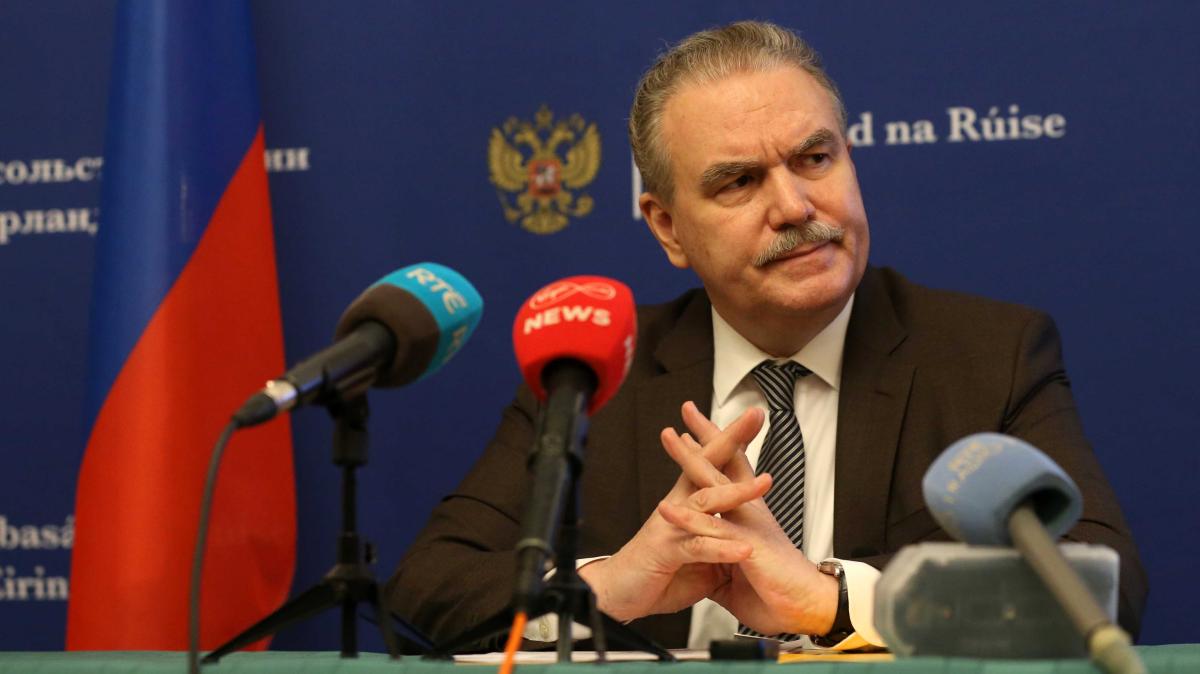
Active Measures – Russia’s Ambassador to Ireland, Yury Filatov. Pic via SASKO LAZAROV/ROLLINGNEWS.IE

After a decade of defence issues being pushed so far down the political agenda that you’d need a bathysphere and a decompression chamber to even spot them, they came roaring back up that agenda this week. With a vengeance.

Each day brought a new story. It started with the concern over the build up of Russian forces on the Ukrainian border and the not unconnected tumult over Russia’s plans to mount naval exercises in Ireland’s exclusive economic zone.

It then continued with the policy-making-on-the-hoof announcement by Taoiseach Micheál Martin and the Communications Minister Eamon Ryan that they plan to come up a plan to close Cathal Brugha barracks and use it for housing.

Continue reading “Irish Defence Policy – the sleeping dog that’s no longer content to stay asleep”

For Both Taoiseach and Tánaiste The Question is: To reshuffle, or not…?

This column first appeared on Broadsheet on January 4th and looks at the contrasting approaches that both Taoiseach and Tánaiste appear (from their public comments, at least) to the possibility of a reshuffle of their ministesr when the government mid-point/turnabout comes next December.

Justice Minister Helen McEntee – Picture: Sam Boal Via Irish Examiner

Political commentators hailing a minister who was on maternity leave for half of 2022 as their politician of the year tells you a lot about the state of Irish politics.

Not that I particularly object to their choice of Minister Helen McEntee. Her absence from the cabinet table at a challenging time did nothing to diminish her public profile, while the positive media treatment of her return, did much to enhance it.

Minister McEntee is one of the few recognisable names and faces around the Cabinet table. She has become a political figure in her own right, albeit one who is still untested – a point I made here last February.

This is not something you can say about all her colleagues. While some do stand out as individuals with thoughts and ideas of their own, most come across as either politically shapeless or just innocuous. Mercifully the Taoiseach and Tánaiste have not required certain ministers wear nametags at meetings, if What’s My Line ever returns to our TV screens, the panel would have some trouble discerning precisely what the Minister for Children or the Minister for Agriculture do for a living. Continue reading “For Both Taoiseach and Tánaiste The Question is: To reshuffle, or not…?”

Martin and Johnson… a lot more alike than you’d think

This column first appeared on Broadsheet on Monday December 13th. It looks at a comparison I would never have thought possible just two years ago – but I explain why the two leaders – who do not share many traits or characteristics – regrettably share one very large negative one

The famous blackboard from Derry Girls – now (a copy) in the Ulster Museum

If you haven’t seen it already, then do yourself an enormous favour and check out the glorious blackboard scene from the second series of Derry Girls. Actually, just go and watch all of Lisa McGee’s deeply affectionate and wildly funny account of life in 1990’s Derry.

In the blockboard scene, Fr Peter invites teenagers from a catholic girls’ school and a protestant boys’ school, brought together for a cross community weekend, to suggest examples of things they have in common. These are then written down on a blackboard.

While they struggle to come up with things they have in common, they have no such problem listing their differences: Catholics watch RTÉ; Protestants love soup. Catholics love statues; Protestants hate Abba. The ‘differences’ blackboard is soon overflowing. The similarities one remains bare.

While I’ve no doubt it wouldn’t be anywhere near as funny, ask a group of Irish people what Boris Johnson and Micheál Martin have in common, and they’d struggle to propose much for the similarities one. Continue reading “Martin and Johnson… a lot more alike than you’d think”

Yes, filter NPHET but filter the air in classrooms first

This week’s column first appeared on Broadsheet on December 6th and looks at two strained sets of relationships. The first is that between ministers and NPHET and the second is the one between the government and the hospitality industry.

When it comes to the relationship between the Cabinet and NPHET, a mutual preparedness to blur the delineation between roles of decision-maker and decision implementer, is coming back to bite… both . 

Meanwhile, the government’s willingness to propose additional restrictions for the hospitality sector can be seen as an attempt to distract from the same government’s lethargy on ICU beds, ventilation and antigen testing.  

Professor of health systems at Dublin City University, Anthony Staines on BBC’s Newsnight (Dec 3 2021)

Many years ago I was asked to help in the re-structuring and re-invigoration of a voluntary organisation. I was one of a group of outsiders. Each tasked with reviewing key aspects of the organisation’s work, operations, and structures.

Each of us brought a different skillset to the mission, HR, communications, fund raising and organisation. Towards the end of the assignment they brought us together to compare notes.

Governance had been a major issue in the organisation with the odd board member accused of crossing the line and getting involved in the day-to-day operations. So, we were all interested to see and hear what the person looking at organisation and governance would recommend.

Continue reading “Yes, filter NPHET but filter the air in classrooms first”

Does MM stand for: Micheál Martin or Managerial Minimalism?

This week’s column first appeared on Broadsheet.ie on Monday Novembe 15th and returns to a familiar theme; the flawed political leadership style of Micheál Martin.  

You can tell that it wasn’t a great week for the current government, when one of the least worst headlines it garnered was: Taoiseach defends Eamon Ryan’s appointment of cronies to climate council roles.

It’s like Zapponegate never happened… or maybe it’s that this administration spends so much time lurching from problem to problem that it hasn’t yet had a chance to learn the lessons of the last one?

Let’s look back over the stories that dominated the headlines during just the first few days of last week.

On Tuesday, we discovered that it would be 2042 before we would see a Dart underground line. We also found that that there won’t be new metro lines south or west of Dublin with the next two decades either. All this courtesy of a National Transport Authority review of its strategy for the capital.

This was the same day that we learned that the Department of Finance was considering going after the home purchase deposits coming via the ‘Bank of Mum and Dad’. (It took Pascal Donohoe several days to walk this story back.)

Continue reading “Does MM stand for: Micheál Martin or Managerial Minimalism?”

The Shinners ready themselves for government… but are we ready for them?

This week’s column first appeared on Broadsheet on Monday November 1st 2022, two days after the Sinn Féin Árd Fheis in Dublin. I explain why I think speculation about Sinn Féin being in government North and South within the next year, or two, is far too premature. I do not say it is impossible, just that it requires the leaderships in the two traditional big parties, Fianna Fáil and Fine Gael, to continue to mishandle events and misread the public mood. I firmly believe that one of these two former big beasts (at least) will soon come to its political senses and see that it is not offering the change demanded by a sizable cohort of what is still a moderate electorate.   

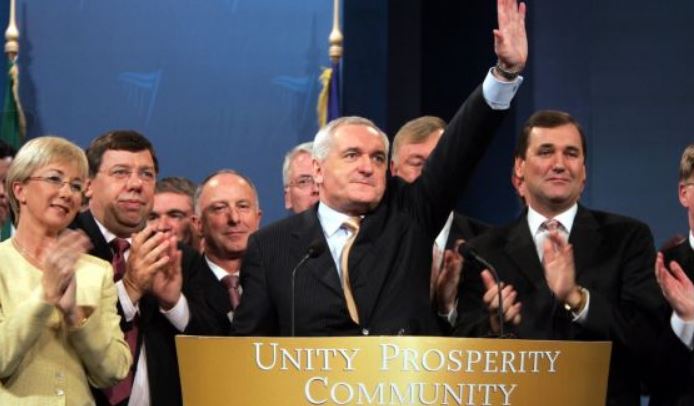
Former Taoiseach Bertie Ahern, at the 2005 Fianna Fáil Árd Fheis in Killarney

For about twenty years I lived within a ten-minute walk of the RDS and Simmonscourt. This was particularly useful for the Fianna Fáil Árd Fheiseanna.

It meant I could soak up the atmosphere and anticipation in the hall during the build up to the party leader’s speech, but quickly nip home to see the full speech live on TV and catch the RTÉ news review.

This gave me a better sense of how the speech played in the world outside, as I was seeing what the people at home saw… well, those few who bother to watch these things.

Continue reading “The Shinners ready themselves for government… but are we ready for them?”

My interim by-election review for Fianna Fáil

This column first appeared on Broadsheet.ie on July 12th, a few days after the Dublin Bay South by-Election result. That result shows that Fianna Fáil is facing a crisis of relevance and viability, one that its leader of over 10 years is unwilling to address or acknowledge. This column was offered as an independent review of what I think went wrong in the by-election. 

A few weeks after the February 2020 election I said that Fianna Fáil’s Micheál Martin needed to stop and “take a hard look at why his party lost support and seats”. I said it again, several times, over the weeks and months that followed. I even offered the independent review the Australian Labour Party had commissioned into its electoral failure as a template.

I thought it was essential that the party examine why it had done so badly before doing anything precipitative, such as going into government with the party it had promised to put out of office.

The leadership thought otherwise. It felt Fianna Fáil’s best course of action was to get into office and that its political revival would come from the government program for recovery. It seemed to miss the inconvenient truth that this meant giving Fine Gael a veto on Fianna Fáil’s fortunes.

This was one of the main reasons I ended my 40 plus year membership of Fianna Fáil. Why would I knock myself out trying to rebuild a party, when the top Fine Gael brass would have a bigger say in it than grassroot members?

Continue reading “My interim by-election review for Fianna Fáil”

Why does Martin’s Fianna Fáil have such a stubborn problem with young people?

This week’s column first appeared on Broadsheet last Monday (July 5th). In it, I look at the argument on Fianna Fáil’s real and demonstrable problems with young voters that mysteriously leaked out from the parliamentary party. Indeed, it is long past time for folks to wonder why (and how) there are so many leaks from what is supposed a confidential meeting of elected colleagues, particularly when most of that leaked material is often detrimental to those not on the leader’s side. I also take a final look at the Dublin Bay South By-Election. 

According to the many detailed leaks from last week’s Fianna Fáil parliamentary party meeting (an issue itself worthy of an article) the suggestion that young people perceive the party as toxic and inimical to their needs, angered and upset several TD’s and junior ministers.

And not in a good way. Rather than being angered that young people feel this way – and sadly they do, as almost every poll published over the past 18 months has shown – some ministers were outraged that colleagues would dare point this out.

Even the recent Irish Times Ipsos/Mori, which optimistically showed Fianna Fáil’s support increasing nationally by 6pts to 20%, still found that the party is only on 8% among Dublin voters aged under 35. This puts it in a very weakened 5th place in Dublin, well behind Sinn Féin, Fine Gael, The Greens and Independents.

Continue reading “Why does Martin’s Fianna Fáil have such a stubborn problem with young people?”

Why does an unpopular party have a popular leader?

Last week I rekindled my love affair with the word “paradox”, so expect to see it pop up here a lot, including in this week’s Broadsheet column where I look at the paradox of Fianna Fáil’s poll ratings remaining stubbornly low, while the approval ratings of its leader move up. Has An Taoiseach, Micheál Martin learned how to disassociate himself from his party… and doesn’t this mean that what is in his interest, is not in his party’s.. and vice-versa?   

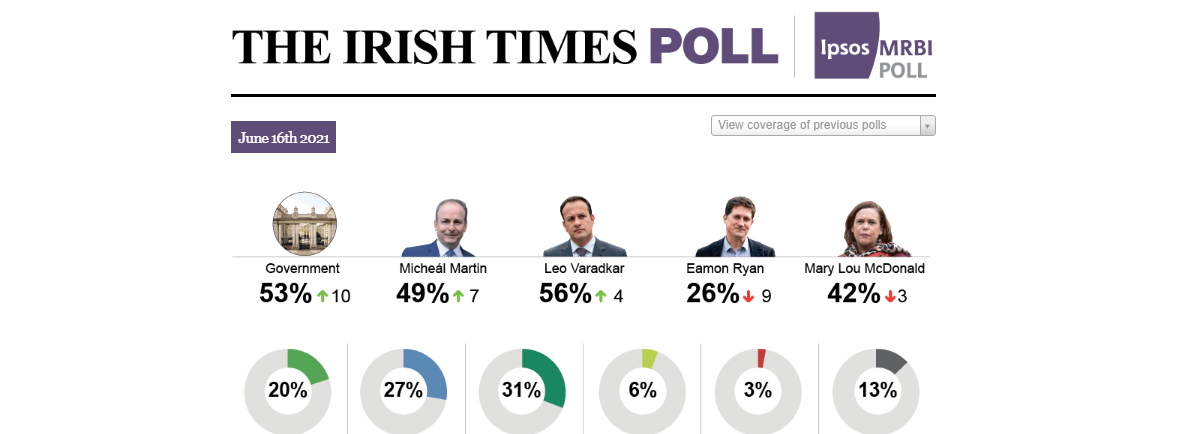
Ipsos/MRBI Irish Times Poll – June 16th 2021

Though I probably keep this fact well hidden from readers, I really try to not write about polling too often. I say this through clenched fingers as I know it must seem that I have written about little else over the past few weeks and months.

It is a fair criticism to say that political pundits talk and write excessively about polling in the guise of political analysis. While the soap opera aspects of politics, who’s in, who’s out, who’s politically in bed with whom, does help liven up what can often be a dull area, the focus should be on the policies and the decisions rather than who makes them.

The old Heisenberg uncertainty/indeterminacy principle applies to politics as much as it does to physics. If you cannot accurately measure both the position and the velocity of an object simultaneously, then you should focus more on the  trajectory of an object or an idea than analysing snapshots of where it was a few days or weeks ago.   

All of which is a long-winded way of me explaining/excusing – why I am once again talking about polling. In my defence, I do this as there is something that is worth discussing in the two most recent opinion polls: yesterday’s Ireland Thinks/Irish Mail on Sunday one and last week’s Irish Times/IPSOS/MRBI, as they offer some contradictory results.

Continue reading “Why does an unpopular party have a popular leader?”

No defence of defence relationships

This article first appeared on Broadsheet dot i e on February 22nd and considers the political dimension to the reported breakdown in relationships between senior management in the Department of Defence and the Irish Defence Forces. I establish that the problem has nothing to do with personalities, but rather the structural relations between the two leaderships and the perception that the Department of Defence is not championing the cause of the Defence Forces within government, most particularly with the Department of Finance. But that is impossible to do without a committed minister at cabinet with political clout. A minister who puts Defence first, not second.

A few months after I started working as the special adviser in the Department of Defence, Gerry Hickey, the late and much missed programme manager to Taoiseach Bertie Ahern, phoned me to check on some departmental facts and figures for the annual Programme for Government review.

“…and roughly how many civil servants work in the Department of Defence”, he enquired.

“From what I can tell… about half of them”, I acerbically responded.

There was an exasperated silence at the other end of the line.  Not for the first time my knack for being smart-assed at the wrong moment was backfiring.  

“What was that?” he asked.

Luckily, I had the number to hand as there had been a parliamentary question on that topic a week or two before. From memory there were about 380 individual civil servants, but as some were on job sharing schemes this was roughly equal to 360 whole-time equivalents.  

My wise-guy answer was unnecessarily facetious. Almost all the department officials I encountered during in my time in defence were hard-working and professional. This is across the department, not just those on the policy side, who I encountered most frequently, but also the junior and mid-ranking officials who made the defence establishment work efficiently, such as those in the pay and pensions branches.

Continue reading “No defence of defence relationships”